



惯性聚合 高效追踪和阅读你感兴趣的博客、新闻、科技资讯
阅读原文 在惯性聚合中打开

推荐订阅源

Know Your Adversary
Know Your Adversary
小众软件
小众软件
L
LangChain Blog
月光博客
月光博客
博客园 - Franky
Microsoft Azure Blog
Y
Y Combinator Blog
有赞技术团队
有赞技术团队
奇客Solidot–传递最新科技情报
奇客Solidot–传递最新科技情报
MongoDB | Blog
MongoDB | Blog
Recorded Future
Recorded Future
V
Visual Studio Blog
TaoSecurity Blog
TaoSecurity Blog
S
Schneier on Security
C
Cybersecurity and Infrastructure Security Agency CISA
P
Privacy & Cybersecurity Law Blog
T
Threat Research - Cisco Blogs
D
DataBreaches.Net
L
LINUX DO - 热门话题
C
Check Point Blog
F
Fortinet All Blogs
Hugging Face - Blog
Hugging Face - Blog
The Hacker News
The Hacker News
钛媒体:引领未来商业与生活新知
钛媒体:引领未来商业与生活新知
Microsoft Security Blog
酷 壳 – CoolShell
酷 壳 – CoolShell
V
V2EX
让小产品的独立变现更简单 - ezindie.com
The GitHub Blog
The GitHub Blog
P
Proofpoint News Feed
L
Lohrmann on Cybersecurity
博客园 - 司徒正美
T
Threatpost
P
Palo Alto Networks Blog
A
About on SuperTechFans
Spread Privacy
Spread Privacy
Engineering at Meta
Engineering at Meta
N
News | PayPal Newsroom
T
Tailwind CSS Blog
The Last Watchdog
The Last Watchdog
Blog — PlanetScale
Blog — PlanetScale
A
Arctic Wolf
量子位
Exploit-DB.com RSS Feed
博客园 - 聂微东
Google Online Security Blog
Google DeepMind News
www.infosecurity-magazine.com
V
Vulnerabilities – Threatpost
H
Hacker News: Front Page

TechPowerUp

Zhitai TiPlus 9100 1 TB Review AMD Ryzen 7 7700X3D Review Endorfy Solum 2 Series Review - One Sound, Three Price Points Montech E28 PWM 120 mm Fan Review Assassin's Creed Black Flag Resynced Handheld Performance Review Assassin's Creed Black Flag Resynced Performance Benchmark Review - 35 GPUs Tested ASUS ROG Strix Z890-E Gaming Wi-Fi Review Cooler Master V8 ACE 3DHP Black Review XPG Lancer Blade RGB DDR5-5600 16 GB CL46 Review - Low Profile Lenovo Yoga Pro 7i Gen 11 Aura Edition (15IPH11) Review - Light Workhorse Loaded with Features GEEKOM A9 Max (2026 Update) Review Pwnage Ultra Custom Pro Symm 3 Review ASUS ROG Strix X870E-E Gaming Wi-Fi7 Neo Review MSI MPG Ai1600TS Review Lenovo Yoga Slim 7i Gen 11 Aura Edition (14IPH11) Review - Panther Lake & OLED on the Go MSI Claw 8 EX AI+ CG3EM Review - Panther Lake FTW MSI MPG CORELIQUID P22 360 W Review Lian Li B4-mATX Review Gigabyte X870E Aorus Master X3D Ice Review TerraMaster F4-425 Pro Review GMKtec NucBox K16 Review Best of Computex 2026 Akko Dash Ultra Review ASUS TUF Gaming B850-Pro Wi-Fi7 W Neo Review Noctua NL-LC1-36 AIO Review - Very Impressive OXS Thunder Duo X Review - Surround Sound Around Your Neck Gigabyte Z890 Aorus Elite Wi-Fi7 Plus Review ACEMAGIC Retro X5 Review GIGABYTE AERO X16 (EG61H) Review - AMD Strix Point on Steroids Meets Low Weight and NVIDIA Blackwell AMD Ryzen 9 9950X3D2 Dual Edition Review - Maximum Cache Patriot Viper Elite 5 Ultra RGB DDR5-8000 48 GB CL36 Review ASRock Phantom Gaming X870 Riptide Wi-Fi Review ASUS ROG RYUO IV 360 ARGB Review HP ZBook Ultra G1a 14 Review - The Mighty Mini with Strix Halo Sapphire Radeon RX 9070 GRE Pulse Review ASRock Radeon RX 9070 GRE Steel Legend Review Acer Radeon RX 9070 GRE Nitro Review Cougar Terminator Air Review - High Expectations, Harsh Reality? ASUS ProArt B850-Creator Wi-Fi Neo Review Memblaze PBlaze7 7A46 6.4 TB Review - Random Write King Arctic Freezer 36-S A-RGB Review 007 First Light Handheld Performance Review 007 First Light Performance Benchmark Review - 30+ GPUs Tested be quiet! Dark Perk Ergo Review Lian Li HydroShift II OLED Curved 360P28 Review Gigabyte X870E Aero X3D Wood Review MINISFORUM AtomMan G7 Pro Review Upcoming Hardware Launches 2026 (Updated May 2026) MSI Crosshair 16 HX AI (D2XW) Review - The Mid-range Choice for a Vivid Display G-Wolves Fenrir Pro Review Colorful iGame X870E Vulcan OC V14 Review Gigabyte MO27Q2A Review - Feature-Complete, Room-Dependent Forza Horizon 6 Performance Benchmark Review - 30+ GPUs Tested Forza Horizon 6 Handheld Performance Review Endorfy Scrim Review - Decent Gaming Chair Under €250 GEEKOM A7 Max Review ASUS ROG Strix X870E-A Gaming Wi-Fi 7 Neo Review Sharkoon SKILLER SGM70W Review Gigabyte GO27Q24G Review - Borderless by Design, Gaming by Nature ASRock Phantom Gaming Z890 Lightning Wi-Fi Review CPS PCCOOLER RT720 TC Review Ninkear YBOOK 15 Review - Budget 2-in-1 with Caveats ASUS ProArt Z890-Creator Wi-Fi Review Seagate Ultra Compact SSD 2 TB Review G-Wolves HTX Ultra Review Fractal Design Pop 2 Vision RGB Review ASUS GeForce RTX 5090 Matrix Platinum Review - 800 W Powerhouse MSI MPG 271QR QD-OLED X50 Review - 500 Hz for the Elite Few DFRobot LattePanda Iota Review NZXT N7 Z890 Review ASRock Phantom Gaming 360 LCD Review ASUS ProArt GoPro Edition (PX13, HN7306) Review - Small but Deadly Endorfy Meta Review - Budget-friendly Gaming Chair ScaleFlux CSD5320 7.68 TB Review - Compression Magic Kingston Fury Beast DDR5-6000 32 GB CL40 Review MSI MPG X870E Carbon Max Wi-Fi Review TerraMaster D1 SSD Pro Enclosure Review - Feature Packed and Silent Pragmata Handheld Performance Review Pragmata Performance Benchmark Review - 30+ GPUs Tested PNY RTX 5080 Slim OC Review RAWM Leviathan V4 Review XMG Neo 16 (E25) + Oasis Water Cooler Review ASRock SL-1200P 1200 W Review ID-Cooling FROZN A620 SLK Review MSI MPG 322UR QD-OLED X24 Review - Less Expensive and Even Better Creative Pebble Nova Review darkFlash DY460 Review MSI MEG X870E Ace Max Review
ACEMAGIC Tank M1A Pro+ Review
14:52 by Oldschool297 · 2026-04-21 · via TechPowerUp

Introduction

Acemagician Logo

ACEMAGIC is typically known for affordable to mid-range Mini-PCs, but the Tank M1A Pro+ steps into an entirely different performance tier. This is not a typical office system or a light workstation substitute. It is a high-performance compact system built around AMD's Ryzen AI Max+ 395, with the Radeon 8060S, this Strix Halo hardware shifts it into a very different class from most machines in this category. This is all running at high power limits as well and wrapped in a very unconventional design.
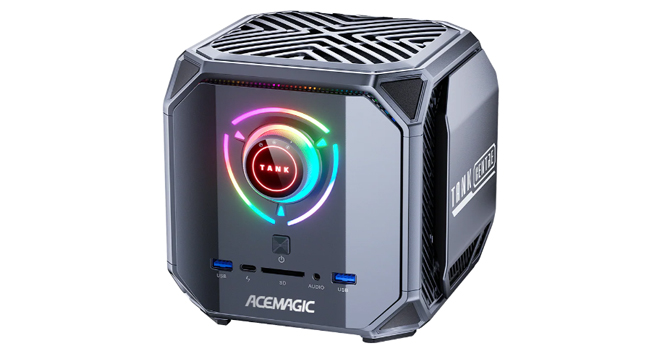
ACEMAGIC also offers a non-Plus version that's geared more toward traditional gaming and GPU-driven workloads, using Intel's Core i9-13900HK and Intel Arc A770 MXM discrete graphics with 16 GB of dedicated GDDR6 memory. That gives it a more conventional performance profile for modern gaming, rendering, and other tasks that benefit from a true dedicated GPU with its own high-bandwidth memory. By comparison, the M1A Pro+ takes a more modern hybrid approach with AMD's Radeon 8060S iGPU and XDNA 2 NPU, giving it stronger AI-focused platform capabilities. Even so, as the benchmarks will show, it performs remarkably well on integrated graphics alone with excellent gaming results, surpassing our current chart leaders and showing just how far high-end iGPU performance has come.

One of the biggest highlights of the M1A Pro+ is the Radeon 8060S, as it is currently AMD's top integrated GPU for x86 Windows systems, built on RDNA 3.5 and paired with Ryzen AI Max series processors. With 40 graphics cores and boost clocks up to 2.9 GHz, it represents a major jump over the Radeon 780M and 890M solutions found in most premium Mini-PCs, pushing integrated graphics much closer to the lower end of discrete GPU territory. It also brings support for modern graphics features such as DirectX 12, making it a much better option for current AAA games and GPU-accelerated workloads than previous AMD iGPUs.

It still works within the limits of an integrated design, relying on shared system memory and a mobile-class power envelope, so it is not a direct substitute for a proper mid-range desktop graphics card. Even so, this is one of the most powerful iGPU solutions we have tested, and it makes the GPU and gaming sections especially interesting, because integrated graphics in this review pool have mostly been advancing in smaller steps until now.

The M1A Pro+ features AMD's Ryzen AI Max+ 395, a 16-core, 32-thread Zen 5 processor with boost clocks up to 5.1 GHz and a quoted AI throughput of up to 126 TOPS. Unlike most Mini-PCs that rely on efficiency-focused power targets, ACEMAGIC allows this system to run at up to 140 W in Performance mode, giving both the CPU and GPU room to stretch in sustained workloads. Users can switch between Performance, Standard, and Eco power profiles using a front-facing dial, making it easy to adjust behavior on the fly depending on workload or noise and power preferences. In our testing, we kept the front dial set to Performance mode for the main benchmark runs, and re-ran some of them (Cinebench, y-cruncher, blender and SPECviewperf) in Balanced mode to see if it yielded any difference in results.

The memory configuration is also well beyond what most compact systems offer, shipping with 128 GB of onboard LPDDR5X-8000 in a four-channel configuration. A large portion of this can be allocated as shared video memory, making the system more viable for GPU-heavy tasks like rendering, AI workloads, and large datasets. The trade-off is that memory is not upgradeable, but that's a small caveat when you have such a massive memory pool that comes standard.

Storage support is very flexible for its size, as ACEMAGIC includes three PCIe 4.0 x4 M.2 2280 slots. That opens the door for multi-drive setups focused on speed, project space, or local data-heavy workflows, something that is often limited or entirely missing in smaller enclosures. For connectivity, the Tank M1A Pro+ includes dual 2.5 GbE Ethernet ports, Wi-Fi 7, and Bluetooth 5.4, while supporting up to four 8K displays via a combination of HDMI 2.1, DisplayPort 2.0, and USB4. Front and rear I/O are dense, with a mix of USB 3.2 Gen 2, USB 3.2 Gen 1, USB4, SD card support, and dual 3.5 mm audio jacks.

One of the more unique features of the M1A Pro+ is the large front-mounted power dial, which lets the system switch between Silent, Balanced, and Performance profiles rated at 70 W, 100 W, and 140 W respectively. To see how much of an effect it actually has, I reran several parts of the benchmark suite across all three settings, including Cinebench 2024, Blender, y-cruncher, SPECviewperf 13, and our noise stress test. It will be interesting to see how much these different power profiles affect both performance and acoustics across the review.

Specifications
CPUAMD Ryzen AI Max+ 395
16 cores/32 threads
Zen 5 architecture
Up to 5.1 GHz boost
GPUAMD Radeon 8060S
RDNA 3.5 architecture
40 compute units
Up to 2.9 GHz
Memory128 GB LPDDR5X-8000
Four-channel
Onboard, non-upgradeable
Storage3× M.2 2280 PCIe 4.0 x4
Display Outputs2× HDMI 2.1 (8K @ 60 Hz)
1× DisplayPort 2.0 (8K @ 60 Hz)
1× USB4 Type-C (8K @ 60 Hz)
Connectivity

2× HDMI 2.1 (8K@60 Hz)
2× USB 3.2 Gen 2 Type-A
4× USB 3.2 Gen 1 Type-A
1× USB4 Type-C (8K@60 Hz)
1× DP 2.0 (8K@60 Hz)
2× 3.5 mm audio jack
1× DC input jack
2× 2.5G RJ45 Gigabit Ethernet
1× SD card slot

NetworkingWi-Fi 7
Bluetooth 5.4
2× 2.5 GbE Ethernet
Power ModesSilent: 70 W
Balanced: 100 W
Performance: 140 W
Operating SystemWindows 11 Pro
Dimensions166.7 × 166.9 × 160.9 mm
Product pageACEMAGIC Tank M1A Pro+
Price$2,899.00 USD (on sale, as of this review)