




惯性聚合 高效追踪和阅读你感兴趣的博客、新闻、科技资讯
阅读原文 在惯性聚合中打开

推荐订阅源

S
Securelist
腾讯CDC
L
LangChain Blog
aimingoo的专栏
aimingoo的专栏
Cyber Security Advisories - MS-ISAC
博客园_首页
CTFtime.org: upcoming CTF events
云风的 BLOG
云风的 BLOG
P
Proofpoint News Feed
罗磊的独立博客
爱范儿
爱范儿
freeCodeCamp Programming Tutorials: Python, JavaScript, Git & More
H
Help Net Security
Vercel News
Vercel News
MyScale Blog
MyScale Blog
博客园 - 叶小钗
The Register - Security
钛媒体:引领未来商业与生活新知
钛媒体:引领未来商业与生活新知
量子位
Y
Y Combinator Blog
C
Cyber Attacks, Cyber Crime and Cyber Security
NISL@THU
NISL@THU
GbyAI
GbyAI
SecWiki News
SecWiki News
M
MIT News - Artificial intelligence
Engineering at Meta
Engineering at Meta
P
Privacy International News Feed
月光博客
月光博客
奇客Solidot–传递最新科技情报
奇客Solidot–传递最新科技情报
C
Check Point Blog
博客园 - 聂微东
Project Zero
Project Zero
让小产品的独立变现更简单 - ezindie.com
Latest news
Latest news
V
Vulnerabilities – Threatpost
T
The Blog of Author Tim Ferriss
cs.CL updates on arXiv.org
D
Darknet – Hacking Tools, Hacker News & Cyber Security
T
Tor Project blog
F
Fortinet All Blogs
Recorded Future
Recorded Future
IT之家
IT之家
D
Docker
The GitHub Blog
The GitHub Blog
V
Visual Studio Blog
MongoDB | Blog
MongoDB | Blog
T
Threat Research - Cisco Blogs
Hugging Face - Blog
Hugging Face - Blog
C
CXSECURITY Database RSS Feed - CXSecurity.com
V
V2EX

TrueNAS – Open Enterprise Storage

What We Heard at NAB 2026 | TrueNAS - Open Enterprise Storage TrueNAS V160 Launched: High Performance, No All-Flash Tax TrueNAS 26 Is Here: What's New in This Major Release TrueNAS Connect: Enterprise Features on Your Own Hardware TrueNAS Immutability: Multi-Layered Data Protection & Ransomware Defense TrueNAS CEO Note to Community: We Are All TrueNAS TrueNAS 25.10.2 Goldeye: 100+ Fixes & What's New TrueNAS Names Brett Davis CEO for Enterprise Growth TrueNAS Plans for 2026: TrueNAS 26 & OpenZFS 2.4 Roadmap TrueNAS Connect Plus Now Available for All Community Users TrueNAS R60: High-Speed NVMe Storage for AI Workloads Introducing TrueNAS WebShare: Secure Web-Based File Sharing TrueNAS 25.10.1: Goldeye Matures, Performs, and Connects TrueNAS & Veeam v13: Turnkey Cyber‑Resilient Backups Customer Advantages of the TrueNAS Open Core Model TrueNAS Named Data Storage Company of the Year 2025 TrueNAS 25.10: Smarter, Streamlined Updates & Tools TrueNAS F-Series Shines at IBC with Two “Best of Show” Awards TrueNAS 25.10 “Goldeye”: NVMe‑oF, Unified, Simplified Storage Introducing TrueNAS Connect: Secure Monitoring & Alerts The ESG Advantage of Open Enterprise Architecture: Why TrueNAS Is the Sustainable Choice | TrueNAS - Open TrueNAS 25.10-RC1: New Features, Fixes & OpenZFS 2.3.4 Seamless Setup: Exploring TrueNAS Web-Driven Installation | TrueNAS - Open Enterprise Storage TrueNAS 25.10 “Goldeye” BETA is Available TrueNAS 25.10 “Goldeye” Highlights TrueNAS 25.04.2: Fangtooth restores Virtualization iXsystems Rebrands as TrueNAS to Reflect Market Momentum in Enterprise Storage | TrueNAS - Open Enterprise June 1 - Apps Migration Deadline for TrueNAS 24.04 and 23.10 TrueNAS 25.04.1: Fangtooth Unification Gains Momentum TrueNAS 24.10.2.2 Prepares for IP Addressing of Apps TrueNAS H30 and F100 add Fast Dedup with TrueNAS 25.04 Meet TrueNAS Community Edition – The Future of Open Storage TrueNAS Apps Made Easy with Electric Eel & Fangtooth TrueNAS H30 Secures Two ‘Best of Show’ Honors at NAB 2025 | TrueNAS - Open Enterprise Storage TrueNAS H30 Wins Best of Show Awards at NAB 2025 TrueNAS 25.04: Fangtooth is RELEASED Slash Your Virtualization Costs with TrueNAS Storage TrueCommand 3.1 Enhances Management and Monitoring TrueNAS 25.04: Fangtooth Unification Begins with New Features Fangtooth Unification Begins | TrueNAS iXsystems Experiences Record Growth in TrueNAS Enterprise Storage, Spins Off Server Business to Amaara TrueNAS Delivers Record Growth in 2024, Plans Strategic Expansions in 2025 | TrueNAS - Open Enterprise Storage The TrueNAS H30 is the Swiss Army Knife of Storage TrueNAS 24.10.2: Electric Eel Shines Brightly The new TrueNAS H30 brings NVMe Performance to the Edge | TrueNAS - Open Enterprise Storage Ransomware Protection & Immutable Backup with TrueNAS TrueNAS Fangtooth includes OpenZFS 2.3.0 Fangtooth Unifies the TrueNAS Community TrueNAS Electric Eel Performance Sizzles | TrueNAS - Open Enterprise Storage TrueNAS 24.10.1: RAIDZ, Docker & NVMe Storage Upgrades TrueNAS Wins TrustRadius 2025 Buyer's Choice Award for Exceptional Value and Customer Experience | TrueNAS 24.10 “Electric Eel” Powers Up Your Storage TrueNAS Electric Eel: First to Integrate OpenZFS 2.3 Features Electric Eel RC1 Feature Complete | TrueNAS Enhanced Data Migration in Electric Eel | TrueNAS Immutable Backup & Enterprise Storage Security Features | TrueNAS 2024 TrueNAS Electric Eel Emerges TrueNAS Launches “Powered by TrueNAS” with First Partner HexOS The Benefits of Expanding from One to Multiple TrueNAS Systems TrueNAS SCALE Dragonfish Reaches its Second Major Milestone TrueNAS Dragonfish Performance Breathes Fire TrueNAS CORE 13.3 BETA is now Available iXsystems Brings Flagship Data Platform to Market with Production Release of TrueNAS SCALE 24.04 | TrueNAS - Open Enterprise Storage TrueNAS Enterprise H-Series Adds Versatility to Storage TrueNAS SCALE Dragonfish Major Release TrueNAS Delivers Dramatic Quality Improvements The Future of the TrueNAS Community How to Set Up and Install TrueNAS CORE TrueNAS CORE 13.3 Plans TrueNAS SCALE Dragonfish SMB Services and Performance TrueNAS Named a Customers Choice in the North American Region TrueNAS SCALE 23.10.2 Delivers Enterprise Quality Gartner Peer Insights Primary Storage Customers’ Choice New Survey Ranks Top Hypervisor Options as Users Seek VMware Alternatives Beyond VMware: Exploring Virtualization Alternatives Donation of Fast Dedup to OpenZFS and TrueNAS Fast Dedup is a Valentines Gift to the OpenZFS and TrueNAS Communities | TrueNAS - Open Enterprise Storage TrueNAS SCALE Dragonfish Reaches BETA Why Traditional Storage is So Expensive How TrueNAS Delivers Unbeatable Value | TrueNAS - Open Enterprise Storage TrueNAS Year in Review: Top Stories of 2023 TrueCommand 3.0 Manages ZFS Replication | TrueNAS - Open Enterprise Storage TrueNAS SCALE 23.10 has the Fastest Growth Ever TrueNAS 13.0-U6.1 is the Final Update Release Black Friday Special Offer for US Only! 5% Off on TrueNAS Mini R! The New Performance Flagship: TrueNAS F-Series iXsystems Introduces TrueNAS Enterprise F-Series All-NVMe Appliances and TrueNAS SCALE 23.10 TrueNAS SCALE 23.10 is RELEASED with SMB Features iXsystems Invests in Leadership as TrueNAS GrowsiXsystems Invests in Leadership as Enterprise Adoption of OpenZFS Summit highlights Fast Dedup and RAIDZ Expansion TrueNAS SCALE Cobia Has a New WebUI TrueNAS SCALE 23.10-RC.1 introduces dRAID Coffee and Open Source with Kris Moore and Isaac Levin Improves Data Mobility and Furthers Data Freedom TrueNAS SCALE Cobia Has Reached BETA Enterprise Data Protection Solutions & NVMe Secure Storage TrueNAS SCALE “Bluefin” adds SMB Multichannel and Quality iXsystems Named Gartner Peer Insights™ Customers’ Choice Newsletter: Huge iX-Storj giveaway TrueNAS Core-13.0-u5-release and more | TrueNAS - Open Enterprise Storage iXsystems Named a North America Customers Choice in Gartner Peer Insights™
FreeNAS Hardware Guide III: Pools, Performance & Cache
iX Team · 2015-02-11 · via TrueNAS – Open Enterprise Storage
 

ZFS Pool Configuration

ZFS storage pools are comprised of vdevs which are striped together. vdevs can be single disks, N-way mirrors, RAIDZ (Similar to RAID5), RAIDZ2 (Similar to RAID6), or RAIDZ3 (there is no hardware RAID analog to this, but it’s a triple parity stripe essentially). A key thing to know here is a ZFS vdev gives the IOPs performance of one device in the vdev. That means that if you create a RAIDZ2 of ten drives, it will have the capacity of 8 drives but it will have the IOPs performance of a single drive. The need for IOPs becomes important when providing storage to things like database servers or virtualization platforms. These use cases rarely utilize sequential transfers. In these scenarios, you’ll find larger numbers of mirrors or very small RAIDZ groups are appropriate choices. At the other end of the scale, a single user trying to do a sequential read or write will benefit from a larger RAIDZ[1|2|3] vdev. Many home media server applications do quite well with a pool comprising a single 3-8 drive RAIDZ[1|2|3] vdev.
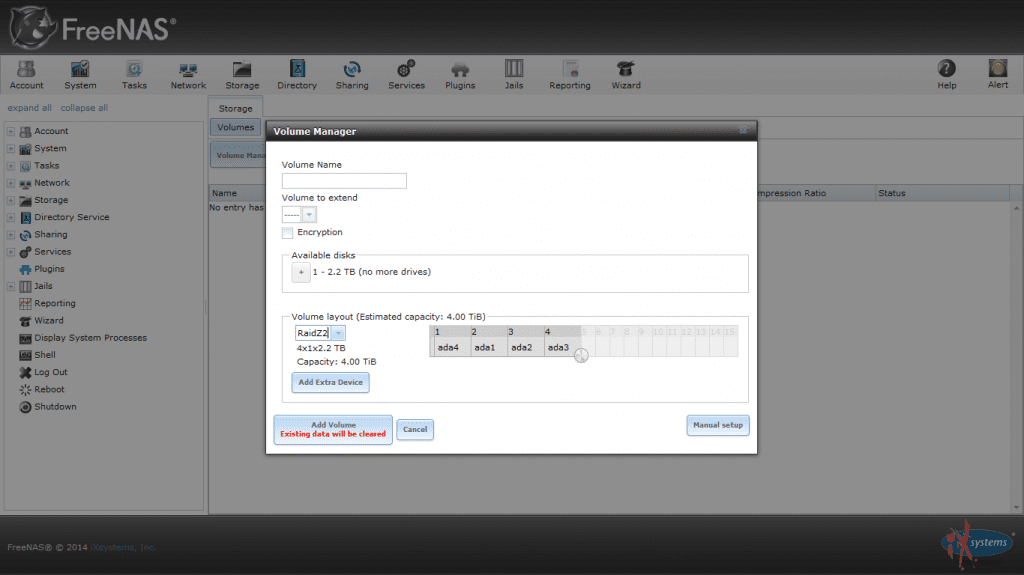
FreeNAS Volumes

RAIDZ1 gets a special note here. When a RAIDZ1 loses a drive, all the other drives in the vdev become single points of failure. A ZFS storage pool will not operate if a vdev fails. This means if you have a pool made up of a single 10 drive RAIDZ vdev and one drive fails, pool operation depends on none of the remaining 9 drives failing. In addition, with modern drives being as large as they are, rebuild times are not trivial. During the rebuild period, all of the drives are doing increased I/O as the array rebuilds. This additional stress can cause additional drives in the array to fail. Since a degraded RAIDZ1 can withstand no additional failures, you are very close to “game over” there. Powers of 2 pool configuration: there is much wisdom out there on the internet about the value of configuring ZFS vdevs in a power of two. This made some sense when building ZFS pools that did not utilize compression. Since FreeNAS utilizes compression by default (and there are 0 cases where it makes sense to change the default!), any attempts to optimize ZFS with the vdev configuration are foiled by the compressor. Pick your vdev configuration based on the IOPs needed, space required, and desired resilience. In most cases, your performance will be limited by your networking anyway.

ZIL Devices

ZFS can use dedicated devices for its ZIL (ZFS intent log). This is essentially the write cache for synchronous writes. Some workflows generate very little traffic that would benefit from a dedicated ZIL, others use synchronous writes exclusively and, for all practical purposes, require a dedicated ZIL device. The key thing to remember here is the ZIL always exists in memory. If you have a dedicated device, the memory ZIL is mirrored to the dedicated device, otherwise it is mirrored to your pool. By using an SSD, you reduce latency and contention by not utilizing your data pool (which is presumably comprised of spinning disks) for mirroring the in-memory ZIL. There’s a lot of confusion surrounding ZFS and ZIL device failure. When ZFS was first released, dedicated ZIL devices were essential to data pool integrity. A missing ZIL vdev would render the entire pool unusable. With these older versions of ZFS, mirroring the ZIL devices was essential to prevent a failed ZIL device from destroying the entire pool. This is no longer the case with ZFS. Missing ZIL vdevs will impact performance but will not cause the entire pool to become unavailable. However, the conventional wisdom that the ZIL must be mirrored to prevent data loss in the case of ZIL failure lives on. Keep in mind that the dedicated ZIL device is merely mirroring the real in-memory ZIL. Data loss can only occur if your dedicated ZIL device fails and the system crashes with writes in transit in the unmirrored memory ZIL. As soon as the dedicated ZIL device fails, the mirror of the in-memory ZIL moves to the pool (in practice, this means you have a window of a few seconds where a system is vulnerable to data loss following a ZIL device failure). After a crash, ZFS will attempt to replay the ZIL contents. SSDs themselves have a volatile write cache, so they may lose data during a bad shutdown. To ensure the ZFS write cache replay has all of your inflight writes, the SSD devices used for dedicated ZIL devices should have power protection. HGST makes a number of devices that are specifically targeted as dedicated ZFS ZIL devices. Other manufacturers such as Intel offer appropriate devices as well. In practice, only the designer of the system can determine if the use case warrants a professional enterprise SSD with power protection or if a consumer-level device will suffice. The primary characteristics here are low latency, high random write performance, high write endurance, and, depending on the situation, power protection.

L2ARC Devices

ZFS allows you to equip your system with dedicated read cache devices. Typically, you’ll want these devices to be lower latency than your main storage pool. Remember that the primary read cache used by the system is system RAM, which is orders of magnitude faster than any SSD. If you can satisfy your read cache requirements with RAM, you’ll enjoy better performance than if you use SSD read cache. In addition, there is a scenario where an L2ARC read cache can actually drop performance. Consider a system with 6GB of memory cache (ARC) and a working set that is 5.9 GB. This system might enjoy a read cache hit ratio of nearly 100%. If SSD L2ARC is added to the system, the L2ARC requires space in RAM to map its address space. This space will come at the cost of evicting data from memory and placing it in the L2ARC. The ARC hit rate will drop, and misses will be satisfied from the (far slower) SSD L2ARC. In short, not every system can benefit from an L2ARC. FreeNAS includes tools in the GUI and at the command line that can determine ARC sizing and hit rates. If the ARC size is hitting the maximum allowed by RAM, and if the hit rate is below 90%, the system can benefit from L2ARC. If the ARC is smaller than RAM or if the hit rate is 99.X%, adding L2ARC to the system will not improve performance. As far as selecting appropriate devices for L2ARC, they should be biased towards random read performance. The data on them is not persistent, and ZFS behaves quite well when faced with L2ARC device failure. There is no need or provision to mirror or otherwise make L2ARC devices redundant, nor is there a need for power protection on these devices.
Joshua Paetzel
iXsystems Senior Engineer
<< Part 2/4 of A Complete Guide to FreeNAS Hardware Design: Hardware Specifics
Part 4/4 of A Complete Guide to FreeNAS Hardware Design: Network Notes & Conclusion >>