




There is a growing demand among individuals, businesses, and organizations for alternative virtualization solutions, especially given the drastic shift in strategy and resulting price increases for VMware following its acquisition by Broadcom. We surveyed the VMware users among our community about which non-VMware hypervisor options they are considering. The aim of the survey was to capture insights on user preferences for non-VMware hypervisors while highlighting the versatility and freedom of our very own TrueNAS Open Storage in any virtualized environment.
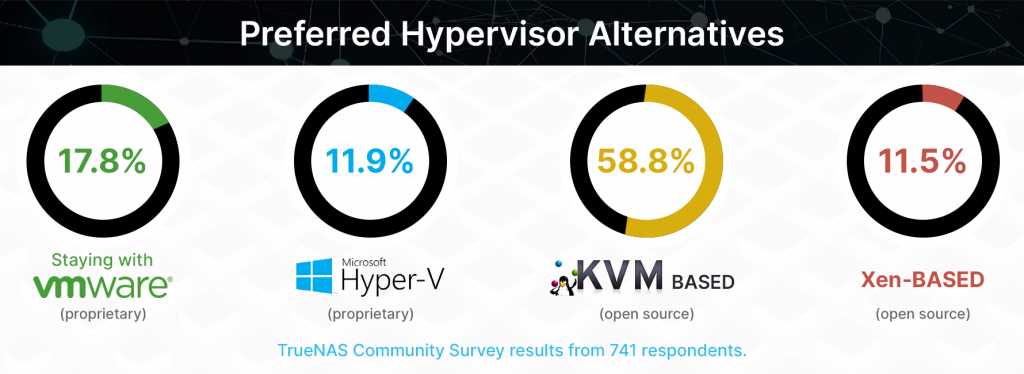
The results from 741 respondents, across the TrueNAS forums, subreddit, and various social media revealed that 58.8% of participants were considering KVM-based hypervisors as their top choice. Following behind were Microsoft’s Hyper-V with 11.9% and Xen-based hypervisors with 11.5%. Additionally, 17.8% of respondents were considering staying with VMware at its higher cost. Notably, these responses show a gravitation towards open-source alternatives driven by a desire to safeguard against potential future lock-outs.
Microsoft Hyper-V is a native commercial hypervisor most commonly used for creating virtual machines on x86-64 systems running Windows. As Microsoft’s hypervisor-based virtualization platform, Hyper-V offers a solution tailored to the unique demands of Windows environments. This integration facilitates management and interoperability with various Microsoft technologies, including native support for Windows Server features such as Active Directory, PowerShell, and System Center.
In addition to its strong ties with Windows Server, Hyper-V also extends its support to Linux virtual machines, making it a choice for heterogeneous environments.
Learn more about using Hyper-V with TrueNAS
KVM, or “Kernel-based Virtual Machine”, is a free and open-source module for the Linux kernel that allows the Linux kernel to act as a hypervisor. Initially released in 2007, KVM has been leveraged by multiple virtualization products, including as the integrated hypervisor within TrueNAS SCALE. Open hypervisor choices include OpenShift, oVirt, and Proxmox. KVM is also used as the basis for some commercial hypervisors, such as the Nutanix Acropolis HyperVisor (AHV). In the community survey, Proxmox was the most common KVM-based choice.
KVM can be deployed as part of an integrated hypervisor such as Proxmox, or used as an underlying component of a more customized solution. While KVM itself is free and open source, some solutions that integrate it may offer professional paid support plans, and different suites of tools for creating, configuring, and managing virtual machines.
Learn more about using KVM-based hypervisors with TrueNAS
Like KVM, Xen is a free and open-source hypervisor, originally developed by the University of Cambridge Computer Laboratory. Xen is used as the basis for both fully open source products such as XCP-ng, as well as in commercial products like Oracle’s VM Server and Citrix’s XenServer. In the survey, XCP-ng was the most common Xen-based choice.
Similarly to KVM, some Xen-based hypervisors are available as purely free open source software, with the option of paid support plans such as XCP-ng. Xen also has additional management planes beyond the built-in web UI, including Xen Orchestra, to aid in the administration of clustered systems.
Learn more about using Xen-based hypervisors with TrueNAS
With features such as ZFS, replication, and snapshotting, TrueNAS ensures data integrity, availability, and protection for virtualized environments. Supporting block and file, TrueNAS is flexible enough to fit seamlessly into your existing virtualization infrastructure and can be tuned to meet even your most demanding performance needs.
This means whether you’re using VMware, Hyper-V, KVM, or any other hypervisor, TrueNAS offers compatibility and freedom of choice, so you can have the flexibility you need without the barriers commonly associated with proprietary locked-in solutions.
To find a virtualization solution that is perfect for your environment, start by checking out the Community’s recommendations on our newly-created community section “TrueNAS as VM Storage”, complete with use case and licensing information for each solution.
New to TrueNAS? The TrueNAS SCALE Evaluation Guide offers a step-by-step breakdown, from the initial boot to replication, enabling you to navigate TrueNAS with confidence. Once up and running, you can explore deeper with virtualization tutorials available in TrueNAS documentation. With TrueNAS Community insights and practical guidance at your fingertips, you’ll be better equipped to make informed decisions for virtualization and your data.
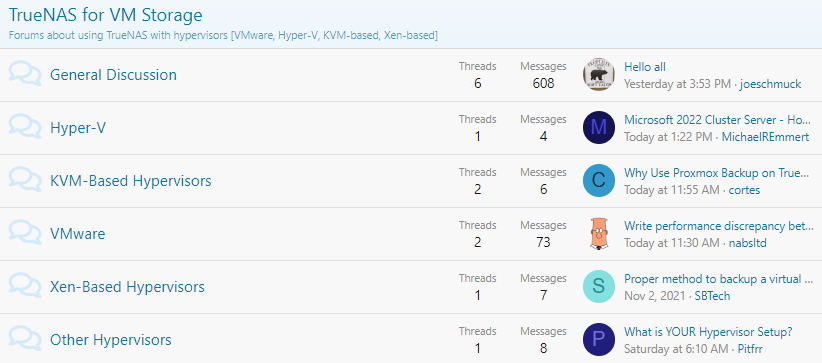
Let us know what you think! Hypervisor discussions are currently unfolding on the TrueNAS forums. Participate in the general discussion or jump into the thread to discuss the hypervisor you are considering. There is a thriving community rallying around Open-Source platforms powered by TrueNAS, sharing invaluable support and insights. Join the conversation today to offer your perspectives, experiences, or questions about VMware alternatives.
此内容由惯性聚合(RSS阅读器)自动聚合整理,仅供阅读参考。 原文来自 — 版权归原作者所有。