


September 24, 2025
— Jason Rasmussen
Learn how Immich developed a better way to synchronize data with the mobile app.
For some time now it has been painfully obvious to the team (and its users 😂), that the mobile app needs a new synchronization implementation. This is also one of the last roadblocks for a stable release. This post is a deep dive into the core issues of syncing large volumes of data with a mobile client, the technical details of the new implementation, as well as our thought process behind the decisions that led to the current design.
To give a little bit of background on how the old implementation came to be, it's worth noting that the mobile app has changed a lot since it was originally built in 2022. Over time, a lot has changed, and, prior to recent discussions around v2, the team had never formally discussed a solution to the problem. Thus the current state, as you would expect, was problematic in a few crucial ways:
In short, the previous implementation has a lot of limitations which continue to plague users, especially those with large libraries (100,000+ assets). From the user's perspective, the app takes a long time to open, a long time to load the main timeline, results in a significant drop in FPS while the synchronization process is running, increases battery drain, and all while potentially not even being able to complete the sync at all.
The high level goal was simple: fix all the issues with the previous implementation 😂. In all seriousness, we wanted the new implementation to have the following characteristics:
Off the bat we realized that having end-to-end streaming would be a huge win in terms of memory, stability, and throughput. To support end-to-end streaming to the mobile app, we would need to:
Reading from PostgreSQL in chunks was easy enough. Having just migrated to Kysely from TypeORM, we were already seeing massive improvements with regard to speed and memory usage in other parts of the application as we migrated queries to use the streaming interface (see #16600, #16666, #16700, #16706, etc.).
Here is an example of what streaming looks like when querying albums:
This enabled streaming from the database to the Node.js process, but the server still needed to send the data across the network in chunks. This was initially problematic as JSON is not a streamable format. We discussed a variety of protocols, but eventually decided to use the JSON Lines format for simplicity.
JSON Lines is a convenient format for streaming JSON data over a network connection. Each line is a separate JSON object, making it easy to process the data incrementally. Here is what the serialization logic looks like:
The Content-Type header just needs to be changed from application/json to application/jsonlines+json.
On the other side, the mobile app essentially does the opposite. It reads the data in chunks, concatenating the JSON objects as they arrive, making sure to only process complete lines.
Now that we had figured out how to end-to-end stream data to the mobile app, the next step was figuring out how to make the whole process resumable. If there was a network interruption, or the client disconnected part way through the sync, we wanted to be able to pick up where we left off, instead of having to start over from square one. This led us to the idea of checkpoints and acknowledgements. The basic idea was to keep track of the last, successfully received row, per table. The server would send an acknowledgement token with each row, and the mobile app would periodically send this token back, as a confirmation. If the connection was lost, the mobile app would initialize a new connection and the server would automatically pick up where it left off.
There were some details that were important to get right as we were implementing this, such as:
Initially we started using a simple updatedAt timestamp column, but that ended up being problematic if you had multiple records updated in the same millisecond. Eventually, we transitioned to UUIDv7 IDs, which are inherently unique while also being time-based.
Per the specification, the first 48 bits of the ID are a timestamp, with millisecond precision. This means that we can use the UUIDv7 as a reliable, unique, and fast index for our queries. We can easily query for all records with an ID greater than the last acknowledged ID, and be guaranteed that we will get all records that were created or updated after that point in time.
Here is what the final query looks like, using the UUIDv7 ID as the checkpoint:
It is worth talking, briefly, about the response format. Each JSON line uses the following format, with a type, acknowledgement token, and a data object:
The ack token can be POST-ed back to the server, after the data has been persisted to
SQLite, client-side. The type and data fields are versioned domain-transfer-objects, which
enable the mobile app to safely deserialize the data.
Acknowledgements are heavily connected to the idea of checkpoints, which are essentially an acknowledgement that is connected to a specific table. More specifically, a specific query. It turns out that, because of sharing, there are a few situations where we actually need to track the sync progress in two or more different ways for the same table, such as the asset table.
As you can see a checkpoint is tied to a specific session and SyncEntityType. The SyncEntityType represents a specific database query. Examples include:
AuthUserV1UserV1UserDeleteV1AssetV1AssetDeleteV1AssetExifV1AlbumV1AlbumDeleteV1One thing that was a bit more annoying to manage was tracking deletes. Since the mobile app needs to know when to delete a record from its database, the server would need to hold on to deleted data for some period of time, in order to be able to send it to the client. We decided to implement this via database triggers.
A trigger can run before or after a row or transaction updates or deletes a set of data. Previously, we had tried to stay away from using triggers, mostly because they can be hard to reason about, and are a real pain to track and test. However, internally, we developed some tooling around schema tracking that we extended to include triggers and functions, and this has made it much more manageable.
Here are some common building blocks that we made:
With those blocks, here is what it took to track deletes on the asset table.
With this tooling, which automatically generates migrations, tracks drift, and provides reusable building blocks for common database operations, we were able to streamline our development process regarding audit tables. Also, we were able to design a robust system to test these triggers and functions.
From the first discussion, we knew that testing would be crucial to the success of the new implementation. We especially wanted to validate that the same data would not be sent multiple times, that the sync was resumable, and that, with all the sharing rules, the right data was being sent to the right user.
If you have never heard of medium tests, you have probably heard of integration tests. Medium tests are essentially integration tests, except that they aren't restricted to specific layers of the application. They are bigger than unit tests, but not as big as end-to-end tests. In our case, they spin up a real database, and execute real queries against it, and they run super fast.
With a framework for executing real queries against a real database, we are able to describe expected sync situations and validate that they are working properly. Since the test uses a real database and queries, we have high confidence that the code is working as expected.
Here is a sample test that checks that a deleted asset is detected and sent
Currently, we have 185 medium tests, that run in about 10 seconds.
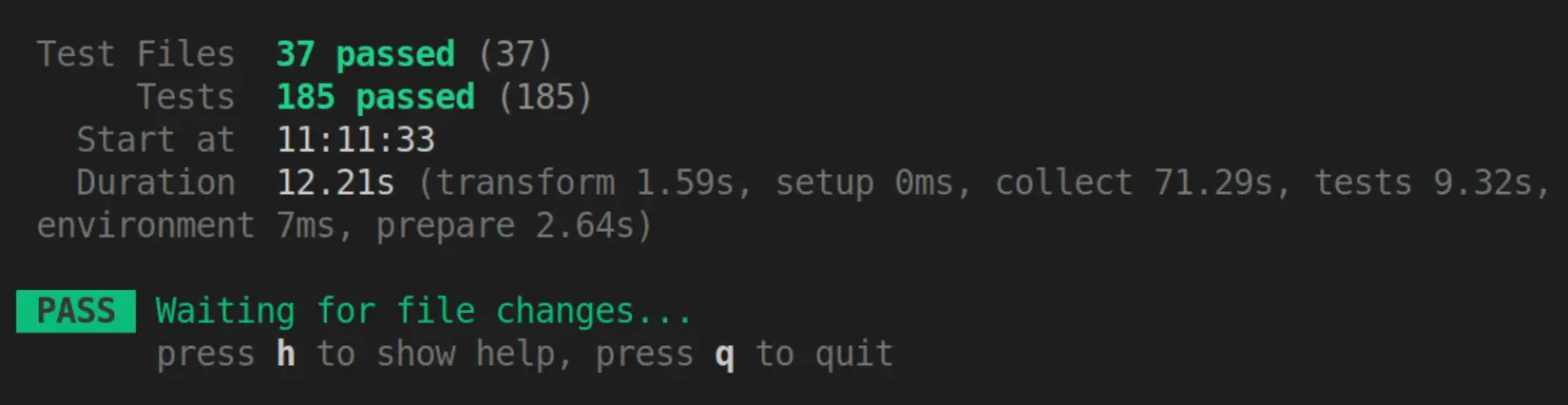
We have tests for various scenarios, including asset creates, updates, and deletes, assets being added and removed from albums, albums being created, updated, and deleted, albums being shared and unshared with users, users being created, updated, and deleted, exif being updated, partner sharing being enabled and disabled, and many, many more.
We also have mechanisms built into the process to allow the server to communicate to the client that it needs to do a full sync, instead of an incremental sync. Similarly, the client can tell the server when it wants reset all checkpoints and start from scratch. This has been super useful for the mobile developers as they have been testing and troubleshooting.
In short, the team has been working hard for most of this year, in order to improve the sync process and make it more efficient. We believe the new process has achieved all of our goals. It is resumable, incremental, and performant. The new process takes less time and uses less memory. It has involved a lot of work, but we believe the results have been worth it. Moving forward, we plan to continue to expand the process to more tables and objects, and add tests for any issues or bugs that we discover along the way.
Cheers,
The Immich Team
此内容由惯性聚合(RSS阅读器)自动聚合整理,仅供阅读参考。 原文来自 — 版权归原作者所有。