
惯性聚合 高效追踪和阅读你感兴趣的博客、新闻、科技资讯
阅读原文 在惯性聚合中打开

推荐订阅源

F
Fortinet All Blogs
S
Secure Thoughts
月光博客
月光博客
美团技术团队
雷峰网
雷峰网
Exploit-DB.com RSS Feed
奇客Solidot–传递最新科技情报
奇客Solidot–传递最新科技情报
N
News and Events Feed by Topic
freeCodeCamp Programming Tutorials: Python, JavaScript, Git & More
Forbes - Security
Forbes - Security
W
WeLiveSecurity
P
Proofpoint News Feed
阮一峰的网络日志
阮一峰的网络日志
爱范儿
爱范儿
G
GRAHAM CLULEY
cs.AI updates on arXiv.org
AI
AI
Last Week in AI
Last Week in AI
Google Online Security Blog
Schneier on Security
云风的 BLOG
云风的 BLOG
Threat Intelligence Blog | Flashpoint
Recent Announcements
Webroot Blog
Webroot Blog
T
Tor Project blog
Cisco Talos Blog
Cisco Talos Blog
N
News and Events Feed by Topic
罗磊的独立博客
The Register - Security
Blog — PlanetScale
Blog — PlanetScale
T
Threat Research - Cisco Blogs
博客园 - 【当耐特】
Apple Machine Learning Research
人人都是产品经理
人人都是产品经理
T
The Exploit Database - CXSecurity.com
www.infosecurity-magazine.com
B
Blog
腾讯CDC
Microsoft Azure Blog
酷 壳 – CoolShell
酷 壳 – CoolShell
H
Hacker News: Front Page
Application and Cybersecurity Blog
Engineering at Meta
Engineering at Meta
Latest news
Latest news
IT之家
IT之家
D
DataBreaches.Net
博客园 - 司徒正美
N
Netflix TechBlog - Medium
V
V2EX
钛媒体:引领未来商业与生活新知
钛媒体:引领未来商业与生活新知

Articles on Smashing Magazine — For Web Designers And Developers

From Kickoff To First Concept: How To Turn Brand Strategy Into Visual Direction — Smashing Magazine Designing For Distressed Users: Why Mental Health Apps Shouldn’t Follow Every UI Fashion Meet Kirki: WordPress’s First Visual Builder With An Infinite Canvas — Smashing Magazine Users Don’t Need More Tools: They Need Seamless Integrations — Smashing Magazine Matching AI Modality To User Intent: Designing The Right Interface — Smashing Magazine Why Accessibility Is An Operational Capability, Not A Feature — Smashing Magazine Snapshots Of Summer (July 2026 Wallpapers Edition) — Smashing Magazine Designing With Uncertainty: How AI Supercharges Probabilistic Thinking — Smashing Magazine The Impact Of Humanoid Robots On Humanity — Smashing Magazine The Benefits Of Cognitive Inclusion In UX Research — Smashing Magazine How To Make Your Design System AI-Ready — Smashing Magazine June Is For Exploring (2026 Wallpapers Edition) — Smashing Magazine Algorithmic Theming Engines: Building Self-Correcting Color Systems With contrast-color() — Smashing Magazine Your Prototype Is Not Being Honest With Your Users (And Here’s How To Fix It) — Smashing Magazine Four Levels Of Customer Understanding — Smashing Magazine Advanced Tree Counting: Mathematical Layouts With sibling-index() And sibling-count() — Smashing Magazine Ten Data-Backed Truths Of User Experience ROI — Smashing Magazine Practical Interface Patterns For AI Transparency (Part 2) — Smashing Magazine The Architecture Of Local-First Web Development — Smashing Magazine Rethinking The Experience Of System Tools — Smashing Magazine Designing Stable Interfaces For Streaming Content — Smashing Magazine A Fresh View In May (2026 Wallpapers Edition) — Smashing Magazine The “Bug-Free” Workforce: How AI Efficiency Is Subtly Disrupting The Interactions That Build Strong Teams — Smashing Magazine The UX Designer’s Nightmare: When “Production-Ready” Becomes A Design Deliverable — Smashing Magazine Session Timeouts: The Overlooked Accessibility Barrier In Authentication Design — Smashing Magazine How To Improve UX In Legacy Systems — Smashing Magazine Identifying Necessary Transparency Moments In Agentic AI (Part 1) — Smashing Magazine A Practical Guide To Design Principles — Smashing Magazine The Joy Of A Fresh Beginning (April 2026 Wallpapers Edition) — Smashing Magazine The Site-Search Paradox: Why The Big Box Always Wins — Smashing Magazine Testing Font Scaling For Accessibility With Figma Variables — Smashing Magazine Modal vs. Separate Page: UX Decision Tree — Smashing Magazine Anime vs. Marvel/DC: Designing Digital Products With Emotion In Flow — Smashing Magazine Moving From Moment.js To The JS Temporal API — Smashing Magazine Beyond border-radius: What The CSS corner-shape Property Unlocks For Everyday UI — Smashing Magazine Building Dynamic Forms In React And Next.js — Smashing Magazine Persuasive Design: Ten Years Later — Smashing Magazine Human Strategy In An AI-Accelerated Workflow — Smashing Magazine Now Shipping: Accessible UX Research, A New Smashing Book By Michele Williams — Smashing Magazine Getting Started With The Popover API — Smashing Magazine Fresh Energy In March (2026 Wallpapers Edition) — Smashing Magazine Say Cheese! Meet SmashingConf Amsterdam 🇳🇱 — Smashing Magazine A Designer’s Guide To Eco-Friendly Interfaces — Smashing Magazine Designing A Streak System: The UX And Psychology Of Streaks — Smashing Magazine Building Digital Trust: An Empathy-Centred UX Framework For Mental Health Apps — Smashing Magazine Designing For Agentic AI: Practical UX Patterns For Control, Consent, And Accountability — Smashing Magazine CSS @scope: An Alternative To Naming Conventions And Heavy Abstractions — Smashing Magazine Combobox vs. Multiselect vs. Listbox: How To Choose The Right One — Smashing Magazine Short Month, Big Ideas (February 2026 Wallpapers Edition) — Smashing Magazine Practical Use Of AI Coding Tools For The Responsible Developer — Smashing Magazine Unstacking CSS Stacking Contexts — Smashing Magazine Beyond Generative: The Rise Of Agentic AI And User-Centric Design — Smashing Magazine Rethinking “Pixel Perfect” Web Design — Smashing Magazine Smashing Animations Part 8: Theming Animations Using CSS Relative Colour — Smashing Magazine UX And Product Designer’s Career Paths In 2026 — Smashing Magazine Penpot Is Experimenting With MCP Servers For AI-Powered Design Workflows — Smashing Magazine Pivoting Your Career Without Starting From Scratch — Smashing Magazine Countdown To New Adventures (January 2026 Wallpapers Edition) — Smashing Magazine How To Design For (And With) Deaf People — Smashing Magazine Giving Users A Voice Through Virtual Personas — Smashing Magazine How To Measure The Impact Of Features — Smashing Magazine Smashing Animations Part 7: Recreating Toon Text With CSS And SVG — Smashing Magazine Accessible UX Research, eBook Now Available For Download — Smashing Magazine State, Logic, And Native Power: CSS Wrapped 2025 — Smashing Magazine How UX Professionals Can Lead AI Strategy — Smashing Magazine
No, People Don’t Want More AI In Their Life — Smashing Magazine
https://www.smashingmagazine.com/author/vitaly-friedman/ · 2026-07-15 · via Articles on Smashing Magazine — For Web Designers And Developers

Many companies assume everyone craves new AI features. But the reality is that most people don’t want more AI — at least not in the way most AI leaders envision it. Brought to you by Design Patterns For AI Interfaces, friendly video courses on UX and design patterns by Vitaly.

Many companies silently assume that everybody wants more AI in their lives. That people are craving new AI features, new AI products, new AI workflows — that would all magically replace all existing outdated practices and broken ways of working.

But in reality, it seems like people don’t want more AI at all — at least not in the way most AI leaders envision it. Unsurprisingly, many AI features have low adoption and retention — at a very high cost of delivery, and a high risk of reputation damage.

The AI People Don’t Need

It’s remarkably difficult to make a strong argument with senior leadership, but AI is not a value proposition. New AI features don’t magically make for happy or excited customers. Because AI features are often bolt-ons and separate tools for employees to use, they typically take people out of their regular way of working.

AI is pretty good at amplifying shortcuts and shortcomings in organizations — from data quality to decision making. It can’t magically fix years of accumulated quick patches, technical debt, broken culture and internal politics. If anything, they become more visible with AI as inconsistencies or conflicting priorities and get handed directly to users, who are then left to make sense of the mess themselves.

Because in most organizations, work typically requires hopping on and off between plenty of disconnected and fragmented systems, with a new AI tool, they now have yet another system that they also need to hop on and off. Often it produces more work, and typically it’s not particularly rewarding work either.

On top of that, people are very much aware of the cost of finding and fixing AI hallucinations. Asking AI to generate a response might feel easier than writing from scratch, but it has a cost:

  • Skim through the entire AI output,
  • Spot key points to focus attention on,
  • Review/verify key points, one-by-one,
  • Check rationale for what follows next,
  • Articulate corrections + regenerate,
  • Review the response (a number of times).
A Business Model Canvas annotated in green and red marker: ‘AI goes here’ points to Key Activities and Key Resources, while ‘not here’ crossed out in red points to Value Propositions.
AI goes in Key Activities and Key Resources — not in Value Propositions. Image by David Bland. (Large preview)

For many people, AI isn’t something they can proactively choose and explore on their own — it arrives uninvited, at someone else’s pace. On top of that, plenty of messages amplify fears and worries about AI replacing work — so it’s hardly surprising that the perception of AI isn’t excitement. It’s resistance to change and deep anxiety about one’s place in a world that seems to be changing without them.
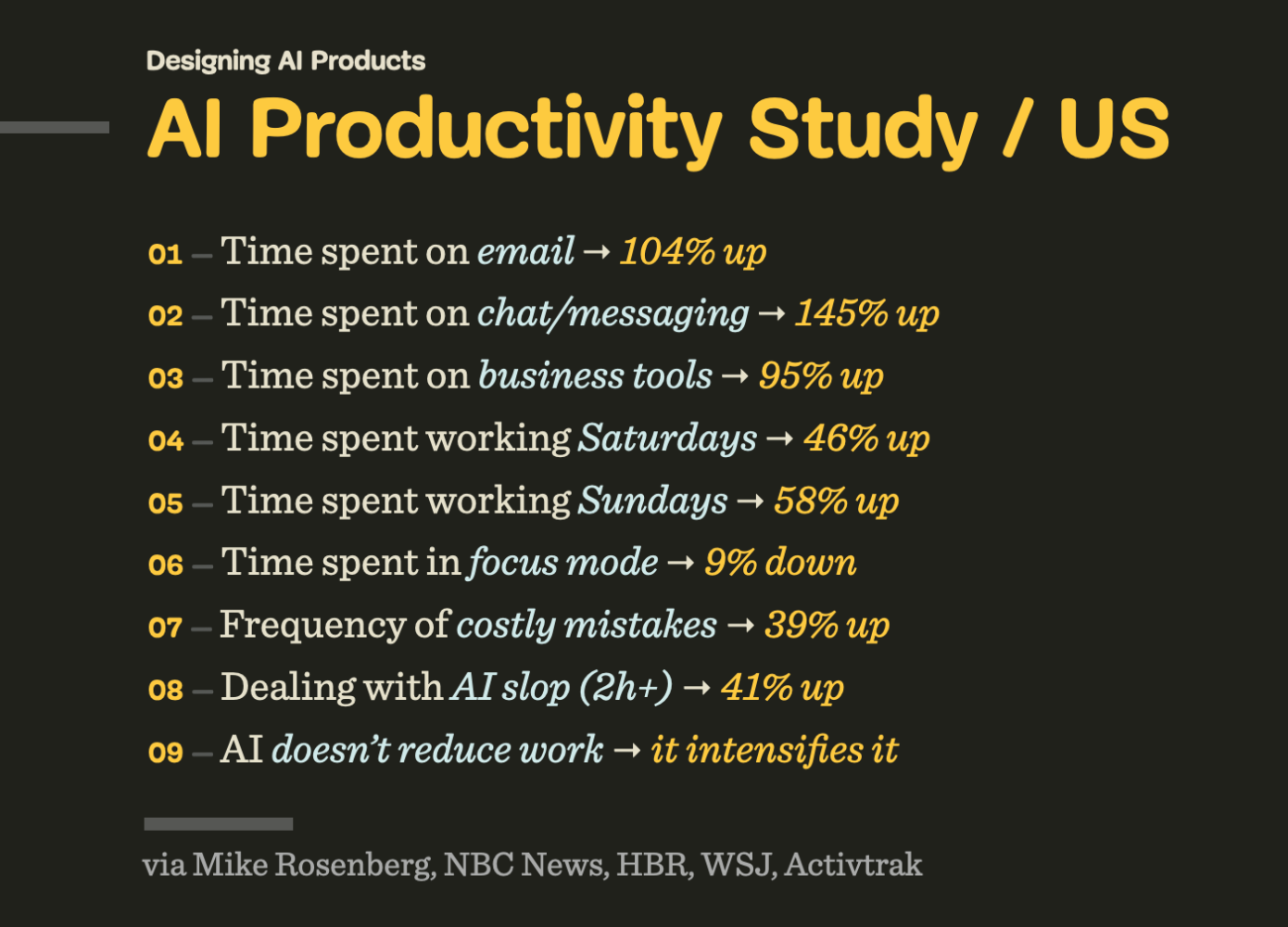
A dark-background slide listing 9 AI productivity study findings: email time up 104%, chat/messaging up 145%, business tools up 95%, working Saturdays up 46%, working Sundays up 58%, focus mode down 9%, costly mistakes up 39%, dealing with AI slop up 41%, and ‘AI doesn't reduce work. It intensifies it’.
AI Productivity Study / US: AI doesn’t reduce work — it intensifies it. Via Mike Rosenberg, NBC News, HBR, WSJ, Activtrak. (Large preview)

At best, AI features might be silently accepted or nodded away. At worst, AI raises concerns, doubts, caution — and calls for a healthy dose of skepticism. And sometimes it’s perceived as a threat or liability — because unlike other features, AI is neither predictable nor reliable.

People don’t dream of AI art museums or AI fridges or AI hotel reception or AI-narrated children’s books. They don’t want their children to have romantic AI partners. Most people don’t want to actively manage (and clean up after) a swarm of AI agents roaming in their bank accounts and acting on their behalf in the real world. And most notably, people don’t really want a magical box to speak to or type into all the time.

The AI People Actually Need

I’m always puzzled by the comparison of AI features with how unreliable humans are. But people don’t compare software with other people. They compare features with features — and if one feature in one product is unreliable, while a similar feature works flawlessly in another, they choose the latter. It’s not about AI or not AI, but rather what works consistently and reliably, and what doesn’t.

Many conversations about AI are conversations about the speed of delivery. But to many people, there is little value in increasing the speed of delivery. They want to do things well, with enough time to think and make good decisions. They also want to enjoy the time they spend working on things, rather than just ship faster. There is an enormous feeling of reward and achievement that slowly disappears, one vibe-coded change at a time.

People don’t change much. And after all these years, they (still) want features that are fast, accessible, reliable, predictable and useful — every single time. And ideally not the ones that replace their entire workflow, but that augment their way of working — and that take over the most mundane, annoying, and boring tasks that they find no pleasure in.

A bubble chart showing jobs least and most vulnerable to AI, with axes for exposure and adaptability. Software developers and public relations specialists are most exposed; firefighters are least exposed.
Jobs least and most vulnerable to AI. Sources: GovAI and Brookings Institution, via The Washington Post. (Large preview)

Many jobs are exposed to AI automation, but in many of them there is a rewarding, unique, creative part that requires taste, point of view, and perhaps even human intuition. And if AI automates boring parts of it, that’s an advantage for everyone. That’s also what enhances productivity and brings more joy in daily life.

When AI automates tedious and mentally exhausting tasks, its value is much easier to grasp. But for that, AI shouldn’t feel like a bolt-on. It should be deeply integrated into people’s existing workflows. It must also match existing mental models that they have developed and fine-tuned for years or decades. AI should adapt to how people think and make decisions, not the other way around.

And it doesn’t really matter if these features are branded as “AI”, “smart” or “automation”. However, they must work well for people using them. And that means that people must be aware of use cases where it actually helps them, and be inspired to find more use cases on their own.

Ironically, tools that work well there aren’t “AI-first” — they are “AI-second”. Subtle, humble, calm, ambient, taking a supportive role in the background for work that otherwise is remarkably dull and unnecessary.

I don’t want to read books written by AI. I don’t want to gaze upon paintings by AI. I don’t want AI to teach my children. I don’t want to have an AI therapist. I don’t want AI making my medical decisions. I want AI to do all the physical and mental labor that taxes me so I can read books written by humans and go to art galleries to engage with art made by humans. I want AI that makes my life easier rather than forces me to change myself.

Bo Young Lee

Wrapping Up

Perhaps I’m missing a bigger picture, and perhaps I’m just old school — but I really do like people. Their stories, their thinking, their emotions, their enthusiasm, their laughing. AI can be remarkably helpful in many situations, but so are people. And between the two, I would favor spending time with a human — however imperfect they are — every single time.

No, people don’t need more AI in their lives — they need AI to automate all the boring stuff they have to deal with every day, so they have more time and headspace to do things that they actually love and enjoy doing. That doesn’t mean spending more time with AI — but spending more time with people they love.

Meet “Design Patterns For AI Interfaces”

Meet Design Patterns For AI Interfaces, Vitaly’s new video course with practical examples from real-life products — with a live UX training happening soon. Jump to a free preview.

Design Patterns For AI Interfaces promo picture
Meet Design Patterns For AI Interfaces, Vitaly’s video course on interface design & UX.

Useful Resources

Smashing Editorial (yk)