





Earlier this year, Creative Commons published our Recommendations for Better Sharing of Climate Data, a seminal resource to help national and intergovernmental climate data-producing agencies use legal terms, licenses, and metadata values that ensure climate data is accessible, shareable, and reusable. Our goal is to share strategies and provide resources that enable interconnected and interoperable climate data to be used to find faster solutions to mitigating the climate crisis. The Recommendations are available in Arabic, Chinese, English, French, Portuguese, and Spanish.
With generous funding from the McGovern Foundation, we are now focused on supporting climate agencies that are implementing the Recommendations at scale. Our Recommendations suggest two options for legal terms and licenses on climate data:
In developing these Recommendations, we consulted with some of the largest producers of climate data around the globe to ensure successful implementation. Our Recommendations also address the use of metadata values that center legal terms, attribution, and provenance. Additionally, we detail how to navigate license stacking and attribution stacking for users working with multiple climate data sources.
To highlight the impact of this work, we collaborated with GEO (the Group on Earth Observations). GEO facilitates access to Earth observation data crucial for decision-making in nine priority areas, including disasters, climate change, and ecosystem management. This data is collected and shared by GEO’s 116 members spanning the entire world. Collaborating with GEO connects us to a vast network of experts and resources dedicated to addressing critical global challenges. The GEO Programme Board has endorsed new and aligned guidance promoting the use of CC0 or CC BY as standard open data licenses on GEO data, as a continuation of GEO’s own leadership role in advancing open Earth Observation (EO) data policy. Their goal is to facilitate the use of open EO data and products for GEO members, participating organizations, and initiatives.
The principle of open data has been embraced throughout the EO community, with more than 400 million open data resources from national, regional, international, and commercial providers now available. It is also reflected through efforts such as the FAIR Principles, Open Science initiatives, and the GEO Statement on Open Knowledge.
For climate data to be most effective, data users need to understand their legal rights and obligations when using data. Unfortunately, while data may be described as “full and open”, this does not always provide sufficient legal clarity. Additionally, some data providers have begun to use custom, lengthy “End User License Agreements” that include restrictions on use and require close legal review. This creates challenges when trying to use a single dataset, and those challenges are greatly compounded when combining multiple datasets. Our goal with the Recommendations for Better Sharing of Climate Data is to address this challenge head-on by providing alternate, values-aligned data licensing recommendations that ensure this climate data is used to its fullest potential in understanding and mitigating the climate crisis.
Creative Commons has been a participating member of the GEO Data Working Group since 2023, when we learned that the GEO Data Management Principles aligned with our Recommendations. We have worked with GEO to help shape the priorities and programs of the organization as we jointly support members with implementing GEO Data Sharing Principles.
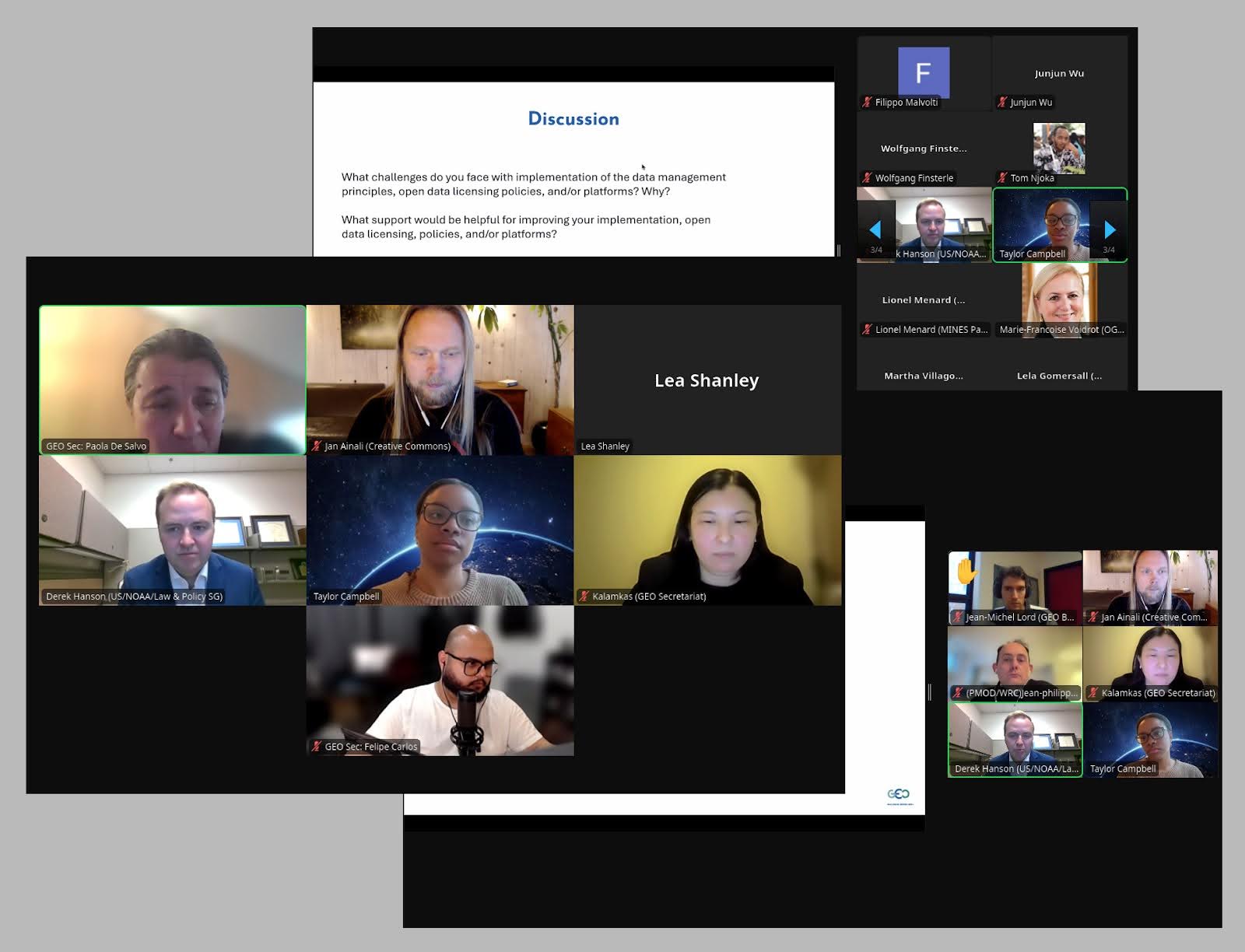
On 21 November 2024, members of the Creative Commons team met with the GEO membership to provide an overview of the Recommendations and discuss their application across GEO Work Programme Activities. After an introduction of the work on open data in the Law and Policy subgroup, we showed how our recommendations were aligned with GEO principles and how their data will be easier to reuse through more open licenses and appropriate metadata. Two use cases from GEO were also presented, highlighting some challenges that may arise during implementation. The participants came well prepared with questions related to their own organizations and policies and the discussion was lively all the way to the end. Thank you to GEO for making a recording of the webinar available on the GEO Knowledge Hub. Take a look!
You can also take a look at the presentation slides from all participants.
One challenge, repeated by several participants, is incoming data having unclear or restrictive licenses, making derivative products challenging to license openly. We acknowledge this is complicated, and therefore it is often most fruitful to discuss directly with the data providers to try to get a license that would be compatible with the principles, leveraging the GEO community behind them.
Another challenge that was highlighted through the poll questions in the workshop was knowledge about where to find the policies of the organizations’ own data sharing policies. This can be mitigated by internal knowledge sharing, and also prominent and public posting of data sharing policies on organizational l websites. A third challenge was that the policy may say that data should be opened but not specifying a license. Here, our Recommendations can really be of help by giving concrete options of licenses along with instructions on how to apply them.
GEO members are now equipped with the tools and guidance to review their policies and data sharing platforms. As a next step, GEO members will begin implementing the Recommendations, which will mean that the workflows of the people publishing the climate data will be smoother, more datasets will be published with the proper and open license, and there will be less confusion for the reusers of the data.
Thanks to the funding from the McGovern Foundation, we can continue to guide and mentor the GEO community in reviewing their data policies and implementing the Recommendations to more practically streamline their workflows for sharing data.
At Creative Commons, we not only steward the CC licenses and the legal infrastructure of sharing, but we also are partners in learning and training on all things open and the CC licenses. We empower people to grow and sustain the thriving commons of shared knowledge and culture. We aim to address the world’s most pressing challenges and create a brighter future for all. Access to knowledge is necessary to solve big, complex problems, like the UN Sustainable Development Goal (SDG) for Climate Action. The Creative Commons Open Climate work promotes open access to research and data, to accelerate progress towards solving the climate crisis and preserving global biodiversity and ecology. If you are in an organization publishing climate data, we would also love to help you to make it open, accessible and reusable to help mitigate and adapt to the effects of climate change. Please contact us by email at info@creativecommons.org. If you are looking for general training about licenses or consulting not related to climate, please visit our training and consulting page to see our offers.
Posted 05 December 2024
此内容由惯性聚合(RSS阅读器)自动聚合整理,仅供阅读参考。 原文来自 — 版权归原作者所有。