




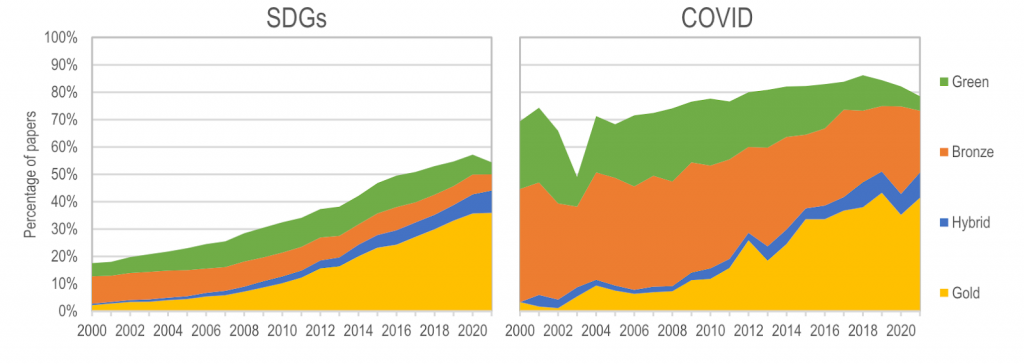
Percentage of open access for SDG-related (left) and COVID-related (right) research papers, by open access type, 2000-2021. Much more COVID-19 research relative to SDG-related research is open access. Image from Contrasting the open access dissemination of COVID-19 and SDG research, Vincent Larivière, Isabel Basson, Jocalyn P. Clark. bioRxiv 2023.05.18.541286
In early 2020, something unusual happened in the academic community. A normally guarded community accustomed to holding their data and research papers close, began to adopt much more open practices. Researchers came in droves to preprint servers to post versions of their research papers – that had not yet been peer reviewed – to make their work freely and publicly available. New data repositories emerged and pledges (Wellcome, Chief Science Advisors) to make research open were signed. This demonstrable change in behavior was due to the recognition, including public and political pressure, that COVID-19 was a global threat to humanity. Biologists, geneticists, statisticians and others in biomedical fields came together to share their work; they realized in order to develop COVID-19 treatments and vaccines, the knowledge about the virus needed to be open and shared rapidly.
We now know over 90,000 preprints¹ have been posted to various preprint servers since January 2020 and a new preprint by Lariviére et al. (2023) found that 79.9% of COVID-19 papers between January 2020² and December 2021 are open access. So if researchers recognized and responded to the need for rapid, open access to COVID-19 research, what about other global challenges?
The United Nations Sustainable Development Goals (SDGs) are effectively 17 global challenges “for peace and prosperity for people and the planet.” Many of the world’s greatest challenges can be encapsulated in the SDGs. Lariviére et al. found that unlike COVID-19, only 55% of papers relating to one or more SDGs were open access for the same period or put another way, 45% of all research applicable to tackling humanity’s greatest challenges is closed. Research on climate change, arguably one of the world’s greatest challenges, had the second-lowest level of open access at just 55.5%. The contrast between open access of COVID-19 and climate research suggests that a sense of urgency and importance is elicited in one crisis but not the other. Why the disconnect?
It’s possible that publishers and climate researchers are simply subject to the many pressures and incentives against open access and that climate change research, while widely considered important, does not match the level of awareness, global solidarity and disruption that COVID-19 had on the world. In reality, climate change is an even bigger threat to humanity and is deserving of a higher sense of urgency.
The Open Climate Campaign is a response to this lack of urgency and is working to make the open sharing of research the norm in climate science through global advocacy, one-on-one work with funders, national governments and environmental organizations; and partnerships with open projects and publishers. The Campaign recognizes that in order to generate solutions and mitigations to climate change, the knowledge (research papers, data, educational resources) about it must be open.
We are living through a climate crisis and a very real, effective action we can take is to make climate change research accessible. On our website you can find action kits detailing tools on what you can do to open climate research and how you can work with the Open Climate Campaign. Join us at openclimatecampaign.org or reach out at contact@openclimatecampaign.org.
¹ A preprint is a version of a scholarly or scientific paper that precedes formal peer review and publication in a peer-reviewed scholarly or scientific journal (https://en.wikipedia.org/wiki/Preprint)
² https://github.com/nicholasmfraser/covid19_preprints
Posted 06 September 2023
此内容由惯性聚合(RSS阅读器)自动聚合整理,仅供阅读参考。 原文来自 — 版权归原作者所有。