
惯性聚合 高效追踪和阅读你感兴趣的博客、新闻、科技资讯
阅读原文 在惯性聚合中打开

推荐订阅源

S
Schneier on Security
The Register - Security
月光博客
月光博客
freeCodeCamp Programming Tutorials: Python, JavaScript, Git & More
OSCHINA 社区最新新闻
OSCHINA 社区最新新闻
The GitHub Blog
The GitHub Blog
博客园 - 司徒正美
罗磊的独立博客
U
Unit 42
S
SegmentFault 最新的问题
Y
Y Combinator Blog
博客园_首页
Hugging Face - Blog
Hugging Face - Blog
J
Java Code Geeks
Schneier on Security
Know Your Adversary
Know Your Adversary
C
Check Point Blog
Cyber Security Advisories - MS-ISAC
Simon Willison's Weblog
V
Vulnerabilities – Threatpost
让小产品的独立变现更简单 - ezindie.com
阮一峰的网络日志
阮一峰的网络日志
The Hacker News
The Hacker News
博客园 - 叶小钗
C
Cybersecurity and Infrastructure Security Agency CISA
Spread Privacy
Spread Privacy
L
LINUX DO - 热门话题
T
The Exploit Database - CXSecurity.com
P
Palo Alto Networks Blog
cs.CL updates on arXiv.org
Latest news
Latest news
L
Lohrmann on Cybersecurity
A
About on SuperTechFans
L
LangChain Blog
Stack Overflow Blog
Stack Overflow Blog
S
Securelist
A
Arctic Wolf
D
Darknet – Hacking Tools, Hacker News & Cyber Security
T
Threatpost
Scott Helme
Scott Helme
博客园 - 聂微东
博客园 - 【当耐特】
T
Tenable Blog
I
Intezer
D
DataBreaches.Net
B
Blog RSS Feed
Security Latest
Security Latest
C
Cisco Blogs
T
Tor Project blog
N
Netflix TechBlog - Medium

AlgoMaster Newsletter

Kafka vs RabbitMQ vs SQS I Created 1000+ Interactive Animations for Interviews How LLMs are Actually Trained Amazon's Bar Raiser Reveals How to Crack Tech Interviews 20 Networking Concepts Explained in 15 Minutes A deep dive into the Transformer architecture Neural Networks Explained In Plain English Top 10 API Gateway Use Cases in System Design How to build an autonomous AI agent like OpenClaw (from scratch) Launching comprehensive resources to master coding interviews Tech Stack I used to build my coding platform (algomaster.io) 300+ Engineering Articles to Level Up Your System Design Skills 20 AI Concepts Explained in 20 Minutes 12 OOP Concepts EVERY Developer Should Know I created a comprehensive resource to master Concurrency Interviews 7 Graph Algorithms You Should Know for Coding Interviews in 2026 Polling vs. Long Polling vs. SSE vs. WebSockets vs. Webhooks How to Scale a System from 0 to 10 million+ Users DSA was HARD until I Learned these 20 Patterns How Git Works Internally How Load Balancers Actually Work The Hidden Cost of Database Indexes I Created the Most Comprehensive System Design Interview Resource How to Use AI Effectively in Large Codebases
Monolith vs Microservices vs Modular Monoliths
Ashish Pratap Singh · 2026-05-12 · via AlgoMaster Newsletter

Most software systems start simple. A small team, a single codebase, one database, and a few features. At this stage, a monolith is often the fastest and simplest choice.

But as the product grows, that simplicity can become a bottleneck. Teams step on each other’s code, deployments become risky, and one small change can affect the entire system. That is when many teams start looking at microservices.

Microservices can help, but they also introduce distributed systems complexity: network failures, data consistency challenges, observability overhead, and more operational burden.

This is where modular monoliths offer a middle path. They keep the simplicity of a monolith while adding stronger internal boundaries and clearer ownership.

In this article, we will break down monoliths, microservices, and modular monoliths, understand how they differ, when each one makes sense, how to choose the right architecture for your system, and how to migrate between these architectures.

A monolithic application is built and deployed as a single unit.

The UI, business logic, and data access code all live in the same codebase. They are compiled into one artifact, deployed together, and usually run as one process.
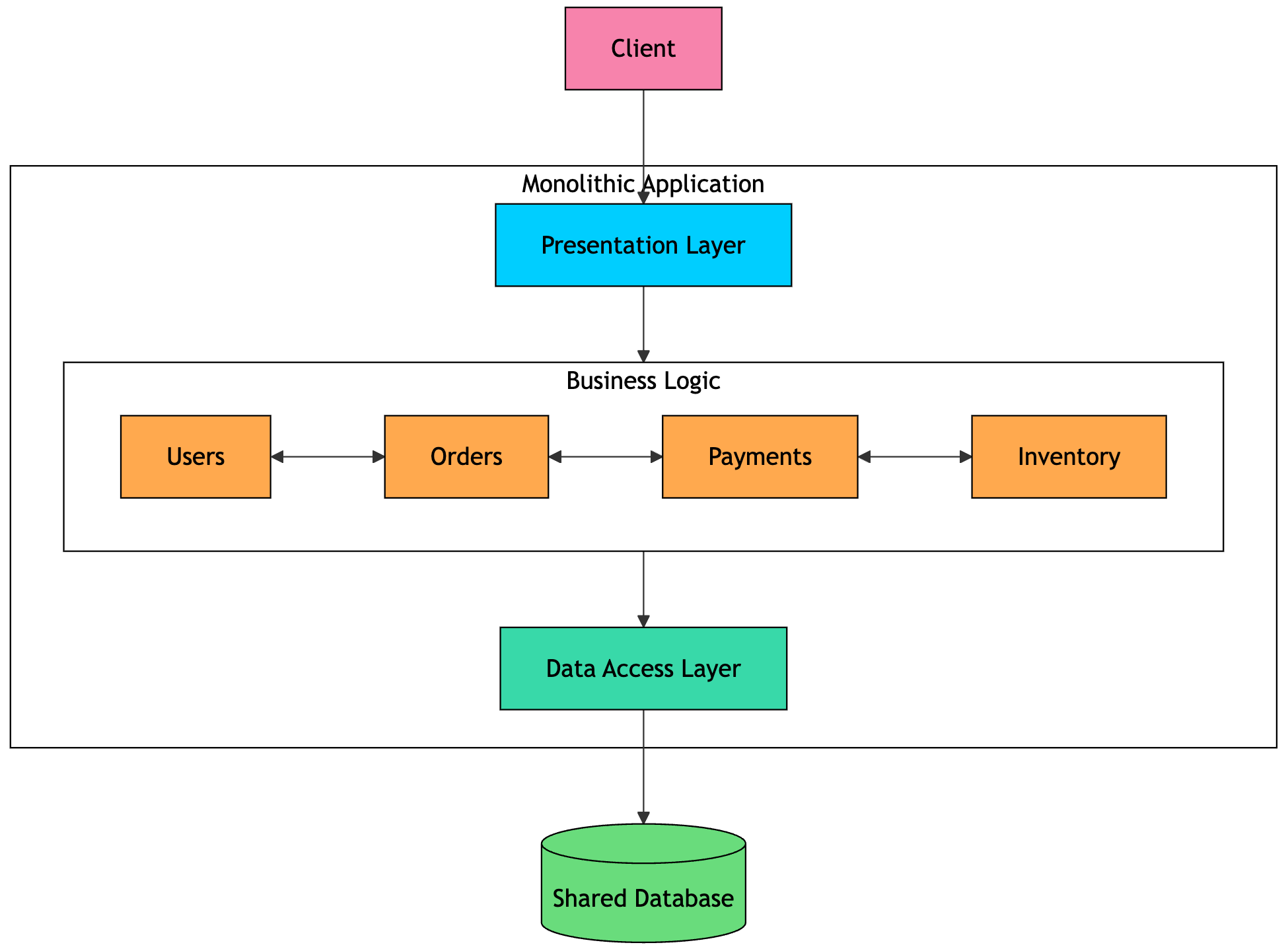
Different parts of the application communicate through direct function calls and often share the same database.

For example, a simple e-commerce monolith might organize code by technical layers:

This structure is easy to understand in the early stages of a product. You clone one repository, run one application, connect one database, and start building.

That simplicity is the biggest strength of a monolith.

There is one codebase to maintain, one deployment pipeline to manage, one process to monitor, and one place to look when something breaks. Database transactions are straightforward, and communication between modules is fast because it happens through normal function calls, not network requests.

But the same simplicity can become painful as the system grows.

A small change in one module may require rebuilding, retesting, and redeploying the entire application. If one module gets heavy traffic, you often have to scale the whole app. One bad query, memory leak, or unhandled exception can affect the entire system. Over time, internal boundaries can blur, and developers may start reaching across modules directly.

Almost every successful application starts as a monolith. The real question is not whether monoliths are bad. The real question is: what should you do when the monolith starts slowing you down?