
惯性聚合 高效追踪和阅读你感兴趣的博客、新闻、科技资讯
阅读原文 在惯性聚合中打开

推荐订阅源

WordPress大学
WordPress大学
Cyberwarzone
Cyberwarzone
The GitHub Blog
The GitHub Blog
云风的 BLOG
云风的 BLOG
P
Proofpoint News Feed
小众软件
小众软件
Recent Announcements
博客园 - 三生石上(FineUI控件)
Security Archives - TechRepublic
W
WeLiveSecurity
Cloudbric
Cloudbric
博客园 - 司徒正美
美团技术团队
N
News and Events Feed by Topic
Exploit-DB.com RSS Feed
PCI Perspectives
PCI Perspectives
宝玉的分享
宝玉的分享
H
Help Net Security
H
Hackread – Cybersecurity News, Data Breaches, AI and More
Google DeepMind News
Help Net Security
Help Net Security
Last Week in AI
Last Week in AI
S
Schneier on Security
N
News | PayPal Newsroom
B
Blog RSS Feed
L
LINUX DO - 最新话题
T
Troy Hunt's Blog
S
Secure Thoughts
雷峰网
雷峰网
aimingoo的专栏
aimingoo的专栏
L
Lohrmann on Cybersecurity
G
Google Developers Blog
Microsoft Azure Blog
Hacker News - Newest:
Hacker News - Newest: "LLM"
T
Tenable Blog
S
Securelist
L
LangChain Blog
Recent Commits to openclaw:main
I
InfoQ
H
Heimdal Security Blog
Cisco Talos Blog
Cisco Talos Blog
F
Full Disclosure
Y
Y Combinator Blog
酷 壳 – CoolShell
酷 壳 – CoolShell
K
Kaspersky official blog
T
Tailwind CSS Blog
奇客Solidot–传递最新科技情报
奇客Solidot–传递最新科技情报
钛媒体:引领未来商业与生活新知
钛媒体:引领未来商业与生活新知
阮一峰的网络日志
阮一峰的网络日志
C
Cisco Blogs

kmcd.dev

gRPC-Web Should Have Fixed gRPC Making Dynamic Protobuf Fast in Go Proxy, Record, and Mock gRPC APIs with FauxRPC Exploring Protocol Buffers Interactively Introducing ProtoDocs Ghost in the Shell: The Manga Behind the Anime The Hidden Cost of google.protobuf.Value Why Networking Built Its Own Data Modeling Language Zero-Friction Demos with WASM Let's Learn About BGP ConnectRPC: Where is it now? Building APIs with Contracts The Case for Greppable Code Unknown Fields in Protobuf IRC Log: Reactionary Faking protobuf data in Go Y'all are Sleeping on Mise-en-Place IRC Log: Standup 2 HTTP/2 From Scratch: Part 4 IRC Log: rm -rf /var/opt/gitlab/postgresql/data HTTP/2 From Scratch: Part 3 Building a Live BGP Map HTTP/2 From Scratch: Part 2 IRC Log: The Cloud Scale Incident Visualizing the Internet (2026) Shell Log: Namaste HTTP/2 From Scratch: Part 1 IRC Log: Standup HTTP/1.1 From Scratch WHOIS is dead, long live RDAP Months Considered Harmful Encryption vs. Compression Traceroute Tool from Scratch in Go My Favorite Interview Question From JSON to Protobuf Breaking gRPC Morse Code Can You Hack a Phone with Your Voice? Visualizing the Internet (2025) HTTP QUERY and Go I made a daily word game Protovalidate: Can Input Validation Be This Easy? Behold! The Barcode Scanner Mixing CEL and Protobuf for Fun FauxRPC and Protovalidate The Call of the Monolithic Codebase FauxRPC + Test Containers Self-Documenting Connect Services gRPC Over HTTP/3: Followup JSON to Protobuf Conversion gRPC: The Ugly Parts Working with Protobuf in 2024 Introducing FauxRPC HTTP/1.0 From Scratch Y'all are sleeping on HTTP/3 HTTP/0.9 From Scratch What version of HTTP are you using? Texans in Denmark gRPC Over HTTP/3 gRPC: The Good Parts Leaving Texas for Greener Pastures gRPC: The Bad Parts Unit Testing ConnectRPC Servers Daily Prompts Adding chart.js to Hugo Why I'm Rebranding Benchmarking gRPC (golang) Blog Update gRPC From Scratch: Part 3 - Protobuf Encoding Tracking the Wins Visualizing the Internet (2024) Dropping Unknown Fields in ConnectRPC RESTless: Web APIs After REST Introducing unknownconnect-go Making gRPC more approachable with ConnectRPC Inspecting Protobuf Messages Introducing protoc-gen-connect-openapi gRPC From Scratch: Part 2 - Server gRPC From Scratch: Part 1 - Client Why you should use gNMI over SNMP in 2026 The Rollercoaster of Productivity in Side Projects Lessons from a Decades-Long Project How I learned to code Economists with (virtual) Guns Visualizing the Internet (2023) softlayer-python: language bindings/CLI for a cloud company SwFTP: SFTP/FTP Server For Openstack Swift Video: Morning Copenhagen Commute Goodbye Evepraisal Visualizing the spectrum of the sun (Part 2) Visualizing the Internet (2022) Evepraisal: A price estimation tool for Eve Online Visualizing the spectrum of the sun
On Creating My Own Cover Art
2025-12-15 · via kmcd.dev

I felt guilty using AI-generated art for my blog.

When AI tools first appeared, they felt like magic. A simple text prompt could conjure a unique, often beautiful image to accompany my writing. Sometimes it would even have the correct number of fingers. Amazing! It felt like a powerful new way to communicate, especially for me, who is not artistically inclined. Over time, however, the process felt hollow. Beyond the feeling of it being a shortcut, I found that AI art often fell short of capturing the vision I had in mind for my cover art. It felt like the cover art was the result of me complaining at a machine until it produced something that was kind-of what I wanted and had the fewest obvious flaws.

I was doing this as a shortcut but it began to feel like a chore. So starting with my previous post, I’m changing how the covers are generated for my posts.

I’ve always loved generative art: art created from code, algorithms, and a touch of randomness. It just felt right to spend time generating my own cover art with code, rather than asking an AI. For a blog about making things with code, it just makes sense that code would generate the cover art as well.

So, I built a small Go program that generates a raster image, and then feeds it into a Go tool/library called primitive which reinterprets it into a stylized vector piece.

The Go script generates random shapes of different sizes, pulling from a few color palettes that I created. It also randomly draws lines connecting the shapes together, because I like the “graph diagram” feel that it gives. For example, here’s the little chunk of code that draws a star. For drawing the initial shapes, I decided to use a library called Go Graphics (github.com/fogleman/gg):

func drawStar(dc *gg.Context, points, centerX, centerY, outerRadius float64) {
	innerRadius := outerRadius * 0.4
	dc.NewSubPath()
	for i := 0.0; i < points*2; i++ {
		r := outerRadius
		if int(i)%2 != 0 {
			r = innerRadius
		}
		angle := (math.Pi*2/(points*2))*i - math.Pi/2
		x := centerX + r*math.Cos(angle)
		y := centerY + r*math.Sin(angle)
		dc.LineTo(x, y)
	}
	dc.ClosePath()
}

The output is a chaotic but structured smattering of shapes and lines.

To transform this into something with more visual interest, I turned to primitive. This library attempts to recreate the input image using a limited number of geometric shapes. It smooths out the chaos, turning the harsh lines into a stylized, abstract vector piece.
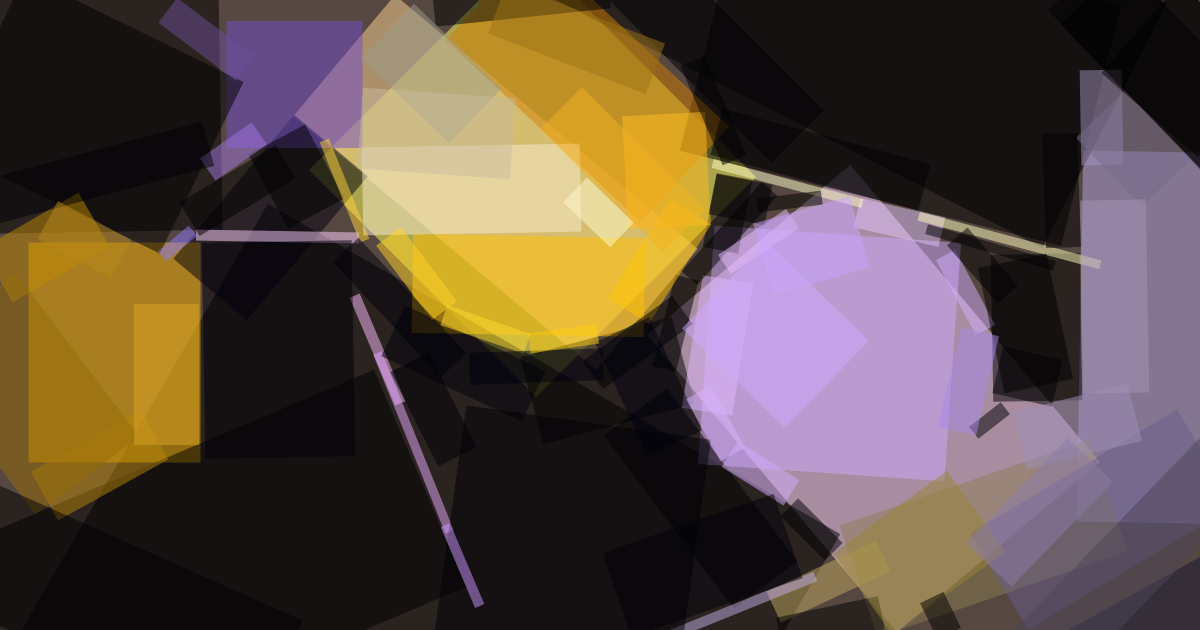

After

Before

Before and after applying the primitive transformation.

It’s also worth noting that the resulting images from primitive are SVGs. Because they’re vector-based, they are often much smaller than their raster counterparts (PNG, JPG) and scale perfectly to any size. This means they look crisp on everything from a mobile phone to a 4K monitor without increasing the file size.

This new process feels right. I’m pretty happy with how this has turned out. It’s more personal, and there’s a fun element of surprise in seeing what the code comes up with each time. If I ever get bored of the results, I have the ability to change the code or some of the settings.

Here’s a gallery of the art this process has helped create. Note that not all of these images look amazing. When creating new articles, I plan on generating images with this script until I find one that I like well enough to use for the cover.

Click here for the full source code.