








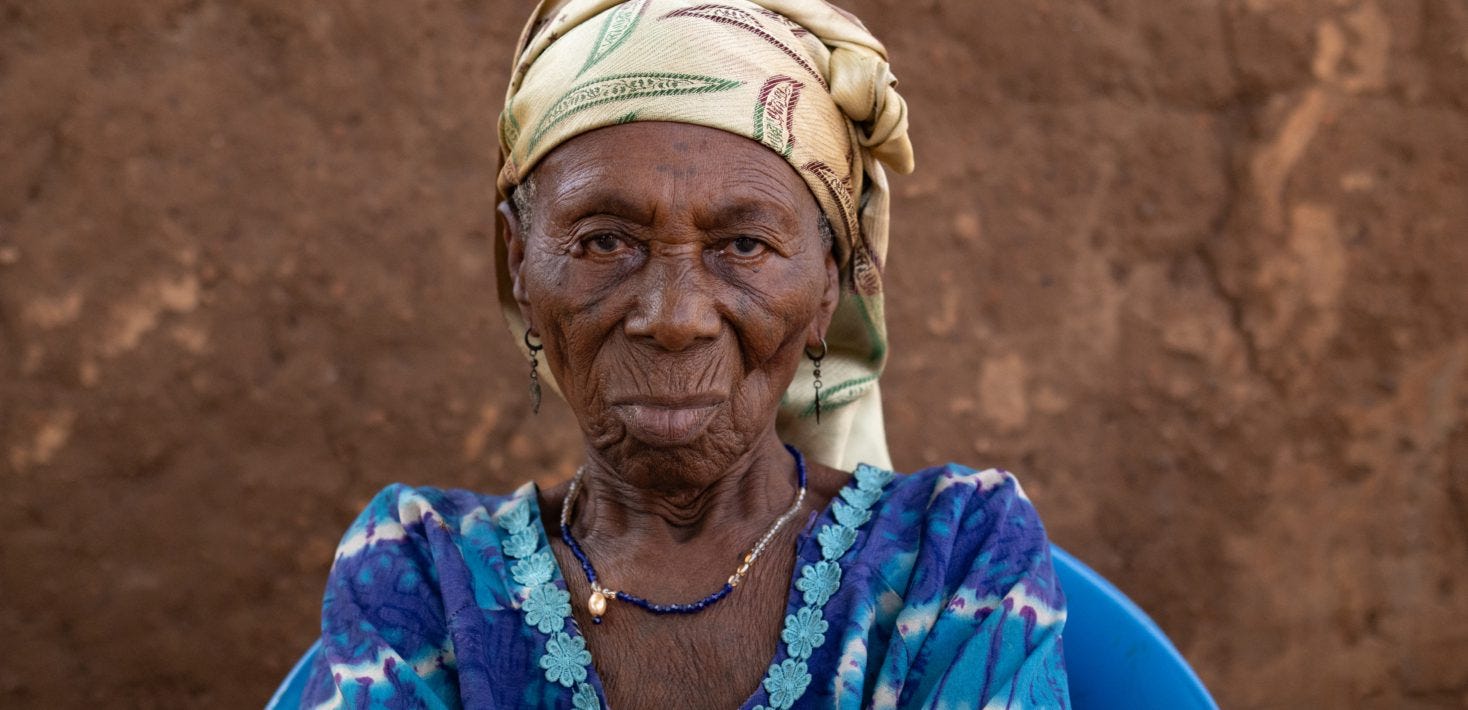
Here is the story of a murder.
In northern Ghana, on the western bank of the Volta river, there is a village called Kafaba. There’s not much I can say about Kafaba that would make it seem special or remarkable in any real way: indeed there’s no real sense in which Kafaba is very different from the other villages nearby. Like the other villages around it, Kafaba is a farming community, populated by members of an ethnic group called the Gonja; and like the other villages around it, Kafaba is very poor.
Our story starts in the summer of 2020. It was a difficult time for the people of Kafaba.
The rains that year had been spasmodic and disappointing, heralding a bad harvest to come. So things were already uneasy. Then, in early July, Kafaba’s “youth shed”—a gathering place for the young people of the town, affiliated with the local branch of Ghana’s ruling party—burned down. One misfortune might be bad luck: but for the people of the town, superstitious and fearful, two misfortunes in a row suggested some malevolent force at work. People began to talk of witchcraft: Kafaba, they said, had been cursed.
And so the people of Kafaba invited a soothsayer into town. The soothsayer called herself Sherina Mohammed, though she operated under other names; and she spent her days traveling around the Gonja region, performing miracles and hunting witches. She arrived in the third week of July, spoke with the locals, and soon announced that she’d identified the witch who was cursing Kafaba. It was, she said, none other than the oldest woman in the village, a 90-year-old widow named Akua Denteh.
Akua Denteh had resided in Kafaba for decades. She had raised six children there, and since the death of her husband she’d lived with one of her granddaughters, farming yams and maize. After her death, she was described as a pious and simple woman. But clearly there was some reason to dislike her: among those accusing her, it seems, was the same granddaughter who looked after her. And so people began to talk of Akua Denteh the witch.
Witches, of course, must be confronted.
And so one night, the soothsayer and a few accomplices—the granddaughter among them—confronted Akua Denteh at her home. They dragged her to another location, where they spent a long night attempting to torture a confession out of her. They whipped her, beat her, and forced her to drink concoctions that the soothsayer had prepared. The soothsayer demanded that Akua Denteh give her the names of the people she had killed through magic; but the old woman continued to deny that she was a witch. At some point, the soothsayer held a machete to Akua Denteh’s chest, and the old woman’s resistance broke: she admitted that she was a witch. The soothsayer had what she needed. She told the granddaughter that she was lucky to be alive: Akua Denteh would have killed her next.
And witches, of course, must also be dealt with.
And so on the morning of July 23, the soothsayer and the granddaughter dragged Akua Denteh to the town square, announced that she had been “limiting the progress of the town” through her witchcraft, and began to beat her with whips and rocks. Soon the whole village gathered to watch. Several people took out smartphones to record the scene: a few women even joined in. Akua Denteh begged the attackers for mercy: but it was no use. Eventually she fell unconscious, and when she stopped responding her attackers simply left her body in the street. The next day, never having regained consciousness, Akua Denteh died.
Such things, horrible as they are, are not unheard of in northern Ghana. It wasn’t even the soothsayer’s first murder: she had been involved in two previous killings of alleged witches. The next month, in the same Gonja region of northern Ghana, another alleged witch was attacked by a mob and nearly killed. Murders, though, are only the most extreme expression of the witch phenomenon: typically those accused of witchcraft flee before they can be killed, relocating to one of the “witch camps” that dot the region.
But the Akua Denteh killing was different. Videos of it circulated widely on WhatsApp and Facebook: and the public was furious. Soon Ghana’s president condemned the murder; lawmakers introduced a bill to make witchcraft accusations illegal; and the police descended on Kafaba and arrested the chief of the village and various others who had been involved in Akua Denteh’s death. Almost all of them were eventually released for one reason or another; ultimately only the soothsayer and Akua Denteh’s granddaughter were convicted of a crime.
Akua Denteh’s family, for their part, defended her memory. She had simply been a loving mother and grandmother: she had certainly not been a witch. Indeed, as her eldest son told a radio interviewer: “If my mother was a witch, I would have killed her myself.”
There are quite a few people in the world who agree with that sentiment.
It’s strange to think, in our age of self-driving cars and mythically capable machine intelligences, that so many people around the world not only believe in witchcraft but are also willing to murder their relatives on its account. Witch accusations and witch killings remain alive and well not just in northern Ghana but in much of the world. We see them in Papua New Guinea; in eastern Indian states like Bihar and Jharkhand; and across much of sub-Saharan Africa, from Burundi to Liberia to the Central African Republic.
And there’s something peculiar about many of these cases.
Consider, for example, a few recent stories from Zambia. In January 2026, an 80-year-old man was poisoned to death by his children and grandchildren, “on suspicion of practicing witchcraft.” In March, a 17-year-old beheaded his 80-year-old grandmother with an axe “accusing her of practicing witchcraft.” And then in April two village elders—one 70, the other 67—were “accused of practicing witchcraft” by the people of their village, confronted by “an expert witch-hunter,” and made to drink a poisonous concoction that killed them.
You’ve probably noticed the pattern here. The victims are elderly; and they are killed by people who know them well, typically by younger members of their own family. Sometimes this occurs directly, with a family member murdering an older relative; in other instances it happens through the intermediation of a hired witch hunter.
I find this pattern very strange and very surprising.
A few weeks ago, I wrote an essay on funerals in sub-Saharan Africa. I talked a lot about kinship: the reason that people are willing to spend such enormous amounts on funerals, I suggested, was to signal adherence to the sharing obligations that define family life in kinship societies. In a kinship society, your family is the basic unit of economic and social life; you support them when they’re in need, and they do the same for you; and these sharing obligations are the price of membership in the kinship network, which amounts to the only safety net you have. At the apex of the kinship system, of course, sit the elders: the members of the group who have accumulated a lifetime’s worth of social debts owed to them. Kinship societies are societies that venerate elders. Among the Gonja, for example, each day starts with a younger member of the household prostrating at the open door of an elder in order to greet them.
And yet these same elder-venerating societies also murder their elders in horrific ways. Why is that? Why do kinship societies kill their old?
I want to propose a cold sort of answer: witch killings function as a way to ration resources.
Kinship societies are redistributive societies: they redistribute from the young, productive, and healthy to the old, unproductive, and sick. Of course, all societies have some sort of redistribution. But in kinship societies, that redistribution occurs within the household: and—particularly in bad years, when households are close to scarcity—amounts to a zero-sum choice between feeding the young and feeding the old. The young, productive, and healthy would like some way to escape these obligations: but they can’t do that without violating the fundamental norms of kinship.
So witch killings are a way out: they allow you to repudiate kinship obligations while publicly reaffirming your commitment to them. By accusing your grandfather of witchcraft and killing him, you can dispose of an unwanted dependent without ever admitting that you wanted him gone. Of course, you might really believe that your grandfather is a witch: but that’s also a tremendously convenient thing to believe. There’s a reason why the people targeted by witchcraft tend to be marginal members of the household whose consumption can’t justify itself. Witch killings are a perverse sort of resource management.
And to understand how people arrive at that point—how the logic of venerating elders is also the logic of killing them—we should think a little about what families do in the first place.
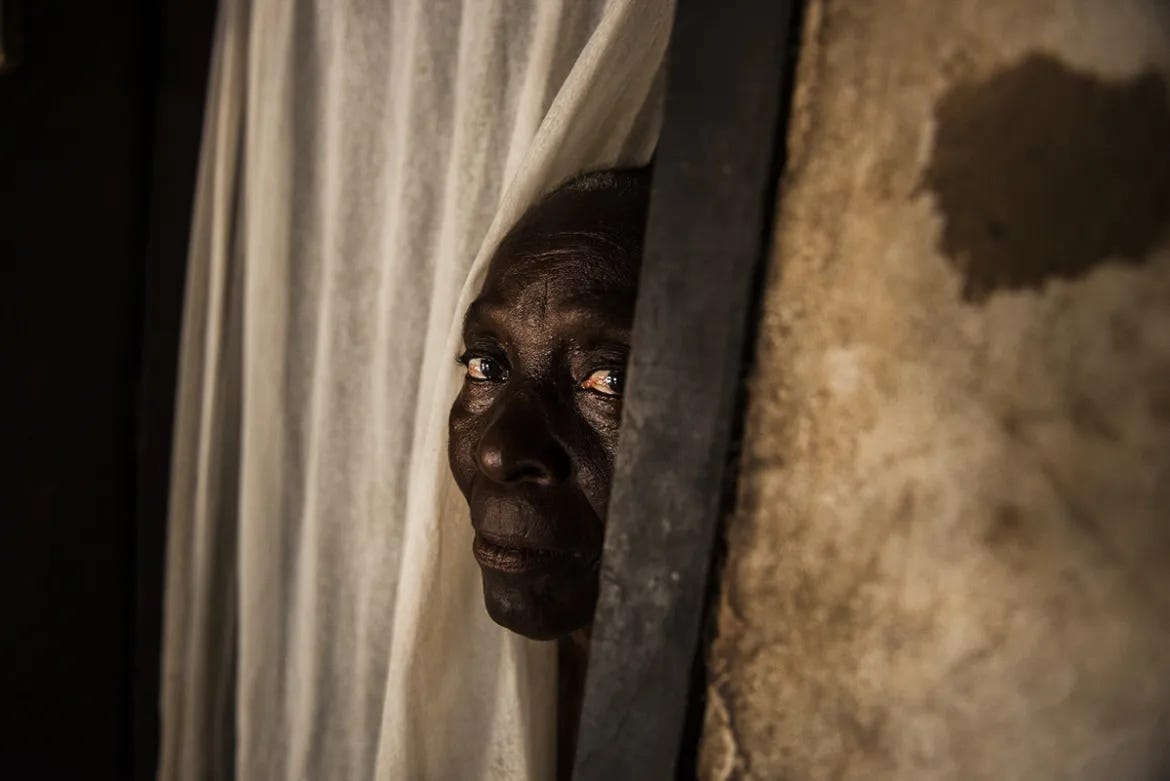
You can think of the human family unit, in a very bare-bones sense, as a mechanism for sharing resources across time. When you’re young and unable to provide for yourself, your older relatives feed you and care for you. Eventually things flip: you become old enough to provide for yourself, and you have children of your own who you need to feed and look after; and your older relatives become unable to provide for themselves, and need you to look after them as well. Eventually you’ll be too old to look after yourself, and your children, and their children, will look after you, just as you looked after them.
And that means that at any given moment, family life is a constant process of redistribution from net producers to net consumers—with the identity of those producers and consumers changing over years and decades.
Of course, giving up your resources for your relatives is always painful. Usually you do so because you love them. But even setting aside the question of love and filial piety, there are ways to justify the expense. Children, for example, are an investment: you care for them now, and eventually they’ll care for you.
But it’s a different story with the old.
Let’s say you’re a farmer in a poor and traditional society, and you live in an intergenerational household of some kind: you live with your wife, your children, your mother, your grandmother, and perhaps a few others who are more distantly related to you. (Or, as is often the case, not really related at all, but “part of the family.”) You and other able-bodied adults are the net producers; everyone does something, whether it’s farming or working around the house or selling your surplus in the market. Your grandmother is the oldest person in the household. For a while she does her part, helping raise the kids and such; but at some point she won’t be able to do that. At some point, she’ll have become a pure dependent.
Of course, some version of this problem surfaces everywhere in human life: every society has some process of redistribution that takes from the net producers and gives it to the net consumers. In modern societies, that redistribution is mediated by impersonal institutions, like pensions, schools, and healthcare programs; and that means that the cost is spread across millions of strangers, with no individual household bearing the full weight of its dependents, whether they’re young or old.
But that’s not the case in traditional societies. In such societies, redistribution takes place inside the home, with producers forfeiting resources to support their elders directly: and because those societies tend to be poorer and much closer to scarcity, that reallocation is much more painful. You are taking food off your plate, or your children’s plate, to give to your grandmother. Probably you love and care about her a great deal. But as a purely material matter, it would be better for the household—for everyone, really—if she were just gone.
You can see where this logic might lead.
Looking at the historical record, we can find quite a few examples of societies that practiced one form or another of elder-killing. The Aché hunter-gatherers of Paraguay, for instance, traditionally killed women who were too old to be useful with an axe to the head, and killed men who were too old to be useful by sending them away and telling them never to return. Sometimes senicide occurs with the consent of the elders: accounts of Inuit elder-killing practices, for example, typically suggest that victims were willing to die, and might even request the killing in order to spare others the burden of supporting them. (Immanuel Kant, discussing Inuit senicide practices in his Lectures on Ethics, called it a “loving service” motivated by “true filial love.”)
But such open killing of elders is typically only a feature of nomadic hunter-gatherer societies, in large part because social groups tend to be small, mobile, and relatively egalitarian. But in settled societies, elders are able to accumulate decades’ worth of standing and social debt: and that authority makes open senicide not just taboo but structurally impossible. You can’t simply dispatch the person on whom the entire social order of the household depends.
And this results in a great deal of suppressed tension. Elders are burdens; but no one can say so. Kinship societies, under the surface, are very tense societies. We can see that tension sublimated in traditional folklore: countless societies around the world have stories that focus on why old people are useful as repositories of wisdom despite being materially unproductive. (This is the “wisdom of the hidden old man saves the kingdom” motif, which you can see everywhere from Serbia to Ghana to Japan.) You might occasionally see senicidal or “death-hastening” practices—like the Tamil practice of thalaikoothal, in which elders are made to drink coconut water until their kidneys fail. But these are not, and never can be, acknowledged in the open.
And so life in kinship societies is defined by the demands of the elderly. It’s only natural, then, that this breeds a simmering resentment toward them, a resentment best expressed, to comport with kinship obligations, in the language of witchcraft: it is not you who betrays the kinship obligation, but the elder. The anthropologist Sjaak van der Geest, who spent years in the southern Ghanaian town of Kwahu Tafo, regarded this “ambivalence towards old age” as the central fact of the town’s intergenerational life. In public, the young people of the town honored the old for their wisdom and spiritual authority; but in private, they spoke of the old as practitioners of bayie, witchcraft, who had achieved their advanced age at the expense of their relatives.
When van der Geest asked young people what made them resent the elderly, the most frequent answer was that they “did not go.” The old would tell van der Geest the same thing. Why were old people accused of bayie? “It’s because you’ve grown old, that’s why you are being called a witch. You won’t go,” one old person told him. Won’t go where? Simple: “you won’t die.”
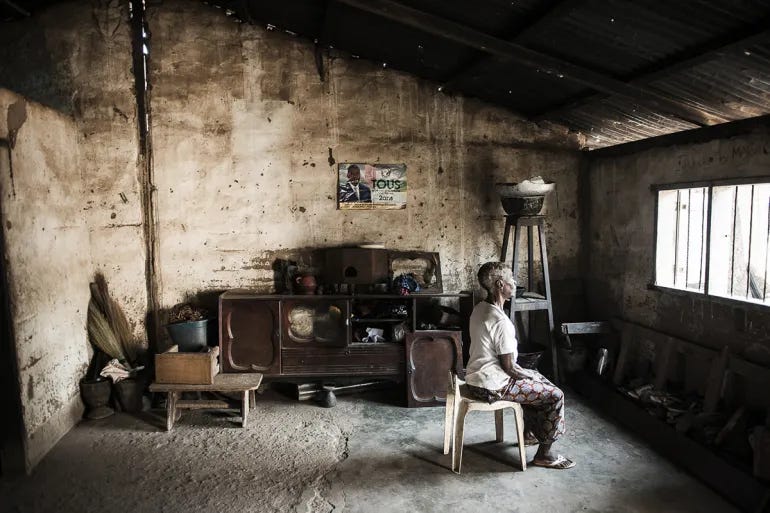
In 2005, the economist Edward Miguel published a study of witch killings in Sukumaland, a poor and almost entirely agricultural region of northwestern Tanzania. Sukumaland was a hotbed of witch killings. Between 1970 and 1988, it had seen about 3,000 people killed as witches, not counting those merely driven from their villages. And the pattern of those killings was always the same. The targets would be elders, typically older widows; some negative event would occur, for which the elder would be blamed; and as things reached a crescendo a younger member of the household would arrive at their hut at night and kill them with a machete. In the words of one woman, who had escaped murder by fleeing to a witch camp:
I ran away from Rusule in Shinyanga District after being suspected of being a witch. … There were many deaths in the family … then rumour began to spread in the village that I was the one who killed them. … [M]y own children started to hate me, … some of them started taunting me as a witch. I tried to explain but they did not give me the chance to vindicate myself. I knew what would befall me in view of what had happened to others previously, for they were brutally killed. Thus, when … one of the grandchildren whispered to me that they were about to kill me, I left the same evening. … I have lived in this camp for three years now, and though I love my family, there is no way of going back to face certain death.
But the most interesting part is the pattern that Miguel found in these murders: they clustered in years of irregular rainfall, either droughts or floods, and thus when agricultural conditions were worst, and thus when households were most desperate for food. The frequency of witch killings roughly doubled in years of irregular rainfall, while the frequency of every other type of murder stayed flat. And there was no spike in witch killings during disease outbreaks, even though witches were thought to be responsible for disease. Witch killings correlated with economic stress in the household, and only with economic stress in the household.
That pattern suggested a disturbing reading of the Sukumaland witch murders: they were a way for households to ration resources. In a famine year, an elderly relative is the most expendable member of a household, and their death frees food for everyone else; so you have plenty of incentive to get rid of them. But you can’t just kill them openly: you need to find a framework through which the killing is not only excusable but even virtuous. Witchcraft is that framework. By accusing your elder of being a witch, you can declare that the elder defected first: she had been cursing the family for her own evil purposes.
So killing her isn’t a breach of your kinship obligations: it’s an enforcement of them. The same with hiring a witch hunter. Witch hunters exist because there’s a market for their services: and the essence of the value they provide is providing an outside verdict that sanctifies what the family already wanted to do. Strange as it sounds, accusing your elderly relative of witchcraft and murdering them with a machete is the respectable option.
And this perverse logic also shapes who is targeted.
If witch killings are a way to shed dependents in difficult times, then they’ll tend to target the household members who are costliest to carry and least able to defend themselves. Widows are vulnerable because they are old, consume without producing, and lack the protection of a living spouse. And they are particularly vulnerable when they’re not surrounded by their own kin. Societies with high rates of witchcraft murder tend to be patrilineal—where descent and inheritance flow through the male line—and patrilocal, meaning a wife moves at marriage into her husband’s village and typically stays there even after her husband’s death.
The town that van der Geest was staying in, for example, was an Akan town; the Akan are matrilineal and matrilocal, so elderly widows were surrounded by their own kin, and while there was plenty of witchcraft gossip there were no witchcraft murders. The Sukuma, by contrast, are predominantly patrilineal and patrilocal. The elderly widow, in such a system, is surrounded by in-laws rather than kin: structurally, she is by far the most vulnerable person in the village, and the first to be a witch when things get tough.
This logic is particularly brutal in times of deprivation, like famines: but the same basic logic applies when inheritance is at play. In the tribal belts of eastern India—states like Jharkhand, Bihar, and Odisha—witch killings are usually instruments of land grabs. A widow holds a claim on her dead husband’s plot; her brothers-in-law want the land for themselves; some misfortune occurs, or is manufactured; the brothers-in-law pay an ojha, a local diviner, to name the woman as a witch responsible for the incident, and then either kill or excommunicate her; and the plot reverts, after she’s gone, to the men who accused her. (Researchers who interview the accusers find the property motive barely concealed.) We see the same on the Kilifi coast of Kenya, where elderly people are regularly accused of witchcraft by their families and then murdered for their land. So common is this pattern that elderly people have taken to dyeing their hair to look younger: “When they see the grey hair of their grandmother,” one local activist told the BBC, “they claim she is a witch and execute her.”
And that same brutal logic also explains why it’s not only old people who are accused of witchcraft.
This is what we see, for example, with the rise of the “child witch” in the Democratic Republic of the Congo. Until a few decades ago, Congolese society had no concept of child witchcraft: witchcraft was understood as something practiced by elders, not children. But starting in the 1980s, the DRC experienced several mass mortality events—two civil wars and a brutal AIDS epidemic—that left hundreds of thousands of children orphaned. Those orphaned children went to live with their relatives: but in their new households they were marginal members without close blood ties. And so when times got tough, households would turn on them the way they might otherwise turn on an elderly dependent. Families would go to revival churches and pay pastors for “deliverance” services: the pastor would diagnose the child as a witch, attempt an exorcism, and when the exorcism inevitably failed the child would be expelled from the household and left to roam the streets. In the 2000s, 70 percent of the tens of thousands of “street children” in Kinshasa had ended up there because of a witchcraft accusation.
Who, then, is the witch? The witch in all cases is the member of the household whose consumption is most difficult to justify: witchcraft is simply the dark side of kinship. This doesn’t mean that people don’t actually believe that their relatives are witches: it’s very easy to believe something that’s advantageous to you, especially if you resent the burden they impose. But it’s not a coincidence that witches are always the most unwanted members of a kinship group: the belief is flexible enough to justify the need.
When people talk about witch killings, or about other practices that seem archaic or grotesque, they tend to treat them as problems of belief. And indeed belief in witchcraft plays an important role in justifying the murder of family members. But witchcraft accusations, expulsions, and killings have a particular function: there’s a reason why we’ve seen them in so many different societies across history, from early modern England to contemporary northern Ghana. They are an excuse to kill dependents, and particularly the old and infirm.
There’s something deeply ironic about the fact that the societies that place the greatest emphasis on family obligation are also the ones that butcher those who can no longer support themselves—the very people who would benefit most from a warm and loving family. In kinship societies, the family is above all else an economic unit, a pool for the sharing of resources; and whatever measure of love enters into the equation, its members cannot escape the cold logic of necessity. That logic does not require declaring your grandmother to be a witch in order to justify murdering her. But the tension between family love and economic necessity is a constant force in societies defined by kinship: it is, indeed, the central antinomy of traditional life.
The best thing that can be done, then, is to divorce the one from the other: to make the family less of an economic unit and more of a personal one. Human societies will always have to deal with the problem of dependence: some share of the population will inevitably require resources they can’t generate themselves. But mediating institutions—like pensions and social insurance—turn that inevitable redistribution from a household burden into a societal one: and by doing so they defuse the resentment that builds when a household must choose between its young and its old.
That, I think, is the deepest case for impersonal institutions: that they weaken the link between love and material obligation. Families, of course, will still be economic units, dedicated to the sharing of resources, and that will always lead to tensions: these questions are the substance of daily life, whether in rich countries or poor ones. But the more that family life is governed by love and affection rather than material necessity, the better for everyone.
The Akan have a proverb, abusua do funu: “the family loves the corpse.” I quoted it in my essay on funerals, as a sort of wry comment on the tendency to spend more on funerals than on the living. But really it’s much darker than that: it’s one of the proverbs that Ghanaian taxi drivers paint on the backs of their cars as charms against witchcraft, alongside others like sura nea oben wo, “fear the one who is close to you” and otan firi fie, “hatred comes from the home.” They are sayings about the dangers that lurk within the family unit. The family loves the corpse because the corpse no longer eats. The living elder, in bad times, is not always loved at all.