

惯性聚合 高效追踪和阅读你感兴趣的博客、新闻、科技资讯
阅读原文 在惯性聚合中打开

推荐订阅源

Spread Privacy
Spread Privacy
Engineering at Meta
Engineering at Meta
钛媒体:引领未来商业与生活新知
钛媒体:引领未来商业与生活新知
D
DataBreaches.Net
N
Netflix TechBlog - Medium
T
The Blog of Author Tim Ferriss
L
LangChain Blog
Jina AI
Jina AI
MongoDB | Blog
MongoDB | Blog
B
Blog
酷 壳 – CoolShell
酷 壳 – CoolShell
让小产品的独立变现更简单 - ezindie.com
月光博客
月光博客
freeCodeCamp Programming Tutorials: Python, JavaScript, Git & More
T
Tailwind CSS Blog
Google DeepMind News
WordPress大学
WordPress大学
T
Threatpost
V
V2EX
Security Archives - TechRepublic
GbyAI
GbyAI
Scott Helme
Scott Helme
Cyberwarzone
Cyberwarzone
H
Help Net Security
大猫的无限游戏
大猫的无限游戏
Security Latest
Security Latest
T
The Exploit Database - CXSecurity.com
T
Tenable Blog
S
Schneier on Security
博客园 - 叶小钗
Apple Machine Learning Research
F
Full Disclosure
腾讯CDC
cs.CL updates on arXiv.org
S
Security @ Cisco Blogs
A
Arctic Wolf
S
Securelist
Recent Commits to openclaw:main
T
Tor Project blog
The Register - Security
L
LINUX DO - 最新话题
Blog — PlanetScale
Blog — PlanetScale
U
Unit 42
V
Vulnerabilities – Threatpost
Google Online Security Blog
L
LINUX DO - 热门话题
TaoSecurity Blog
TaoSecurity Blog
Y
Y Combinator Blog
博客园 - 三生石上(FineUI控件)
C
CERT Recently Published Vulnerability Notes

Stonecharioteer on Tech

I Traced My Traffic Through a Home Tailscale Exit Node What Was I Reading Last? In Three Not-So-Easy Pieces Dogfooding Is Hard Code blocks in your books, finally GoForGo v0.9.0 Merrilin - We built an app to read books I use a Macbook now Data Structures & Algorithms - Preparing for Interviews Using a local DNS namespace for local service discovery Direction KOllector - Publishing KOReader Highlights gbt: branches touched in the last 24 hours A Soiree into Symbols in Ruby Some Smalltalk about Ruby Loops Ruby Blocks Returning from Ruby Blocks, Procs and Lambdas My Linux Laptop Finally Works: How Claude Helped Me Fix Years of Annoyances TIL: Watchexec - Modern File Watching for Development Workflows A Less Busy Mind GoForGo - Learn Go through live examples Migrating My Old Blog to Hugo with Claude The Qtile Window Manager: A Python-Powered Tiling Experience Read the RFCs that Built the Internet Py-x-Protobuf - Or How I Learned to Stop Worrying and Love Protocol Buffers Python Reverse a List New Beginnings Leaving ChainSafe Systems Screen Lock for Cinnamon Desktop using Zenity and Terminal Commands Crews Not Teams A System for Getting Better at LeetCode So Far So Rust Retrying HTTP Requests with Rust A Primer on Control Charts Learning Rust Explicit is Better than Implicit: Rust for Pythonistas Using Custom Delimiters in Jinja Templates TIL: Creating Fixed Length Iterables in Python Documentation Without Assumption Vagrant Python - A Reflection in 2022 Learning Golang No, A Virtual Machine Is Not Enough: Why Developers Need Native Linux Empathy in Tech For Those Who Came in Late A Weekend With PostgreSQL TIL: Gooey and Python Fire for Quick GUIs and CLIs TIL: 2ality - Dr. Axel Rauschmayer's JavaScript Blog TIL: MassDNS - High-Performance Bulk DNS Lookups TIL: Matomo Analytics, Google Tech Writing, Memory Programming, and NES TV Signals TIL: MontyDB - MongoDB Implemented in Python Returning to the Craft of Programming TIL: CPUFetch, OneFetch, and Learn CSS TIL: DNS Performance Testing and Pi-hole with Unbound TIL: Eli Bendersky's Blog, Awesome By Example, NoCoDB, and Martin Kleppmann TIL: CRDTs, Extreme HTTP Performance, and BYTEPATH Game TIL: AutoInvent, ASGI, Python Packaging, RAPIDS GPU Computing, and FlaskCon TIL: MangaDesk - Terminal Client for MangaDex TIL: McFly - Smart Shell History Search TIL: Siege Load Testing and Awesome FastAPI Resources TIL: Ventoy Bootable USB and Justniffer Network Analysis TIL: CLI Code Review, Git Split Diffs, and Internal Combustion Engine TIL: Benford's Law, Web Security Headers, Event Sourcing, and Mozilla Security Guidelines How to Write Documentation - The README.md File The Importance of Documentation TIL: NNgroup UX Research, SponsorBlock, and Labella Python Library TIL: The Little Book of Rust Macros and Rust Performance Book TIL: Git-Bug Distributed Issue Tracker and Omni Kubernetes Monitoring TIL: Zellij - Modern Terminal Multiplexer TIL: How Discord Handles 2.5 Million Concurrent Voice Users TIL: Volumio - The Audiophile Music Player TIL: Areopagitica - Milton's Defense of Free Speech TIL: Fast Node Manager, Zoxide Smart CD, Technical Writing, PyO3, and Qubes OS TIL: Slurm Workload Manager for HPC Clusters TIL: Data Visualization Guide and Oso Authorization Academy TIL: CORS Deep Dive, Piku Tiny PaaS, Rust Strings, and Deno Standard Library TIL: Raspberry Pi OS Development, Vim Beginner Guide, Password Management, and QueryBook TIL: uBlock Origin Performance Optimization on Firefox TIL: Breaking PostgreSQL at Scale and LeetCode Problem Patterns TIL: Awesome Tmux Resources for Terminal Multiplexing TIL: Grit - A Multitree-Based Personal Task Manager TIL: Lens 4.2 Kubernetes IDE, Shell Scripting Guide, and Dark HTTP Server Do The Job You Hate So You Won't Hate The Job You Love TIL: Innernet VPN Solution and NoteCalc Calculator App TIL: Argo CD for GitOps and Lens Kubernetes IDE TIL: Modern Rust CLI Tools - System Monitoring, HTTP Requests, and DNS TIL: tz - A Time Zone Helper Tool TIL: Distributed Systems Education, Fallacies, and Self-Hosted Internet Archiving TIL: Real-Time Voice Cloning Technology TIL: ChartMuseum for Helm, AMD's Corporate Journey, and Kubernetes Pod Scaling TIL: Docker and Kubernetes Tools - Whaler, Descheduler, and Dive TIL: Post-Mortem Collection, Terminal Plotting, and Technical Twitter TIL: Dark Mode Toggle Web Component by Google Chrome Labs TIL: Python eval(), exec(), and compile() Functions TIL: Camelot PDF Tables, PostgreSQL Row Level Security, Zerodha Varsity, and Write Yourself a Git TIL: fuser Command for Process and File Investigation TIL: i Hate Regex - The Ultimate Regex Cheat Sheet TIL: Dolt - Git for Data and Database Version Control TIL: x86 Assembly Programming and SafeEyes Break Reminder TIL: Comprehensive Distributed Systems Reading List TIL: Cosmopolitan C Library, Distributed Systems Book, High Performance Browser Networking, and Rust Roguelike Tutorial
A Primer on Control Charts
2022-05-12 · via Stonecharioteer on Tech

I’m a trained statistician. I worked on a motorcycle manufacturing shop floor for 3 years of my early career, and compared to tech companies, that was hell. However, the lessons I learnt there have moulded me forever.

The most important lessons revolved around a statistical quality tool called control charts or Shewart charts, named after Walter A. Shewart, who pioneered them. Shewart’s name is spoken in the same tones as that of Deming, who is responsible for the 14 Principles of Management.

What Are Control Charts?

A control chart, in its multiple forms, monitors a process for changes in a specific parameter, designated as the control parameter. This parameter helps us measure a desired outcome of a process. If a factory wishes to produce a shaft of diameter 25mm with a tolerance of 1mm on either side, then they should strive to make shafts from 24-26mm in size. While that’s a worthwhile exercise, it’s better to further limit the manufacturing process so that while the process sticks to the design requirements, it is also consistent within itself. This doesn’t mean you’re striving for a better design tolerance, but it speaks about whether your process even allows for better tolerances.

The control chart is a line plot that measures this parameter, or a statistic associated with it such as the average of a couple of readings taken at consistent timestamps. Control charts are divided into 2 areas, a portion of the chart is above a line called the control limit (CL), and the range of values is bounded on either side by an Upper Control Limit (UCL), and a Lower Control Limit (LCL), which tell us how much our process is capable of fluctuating.
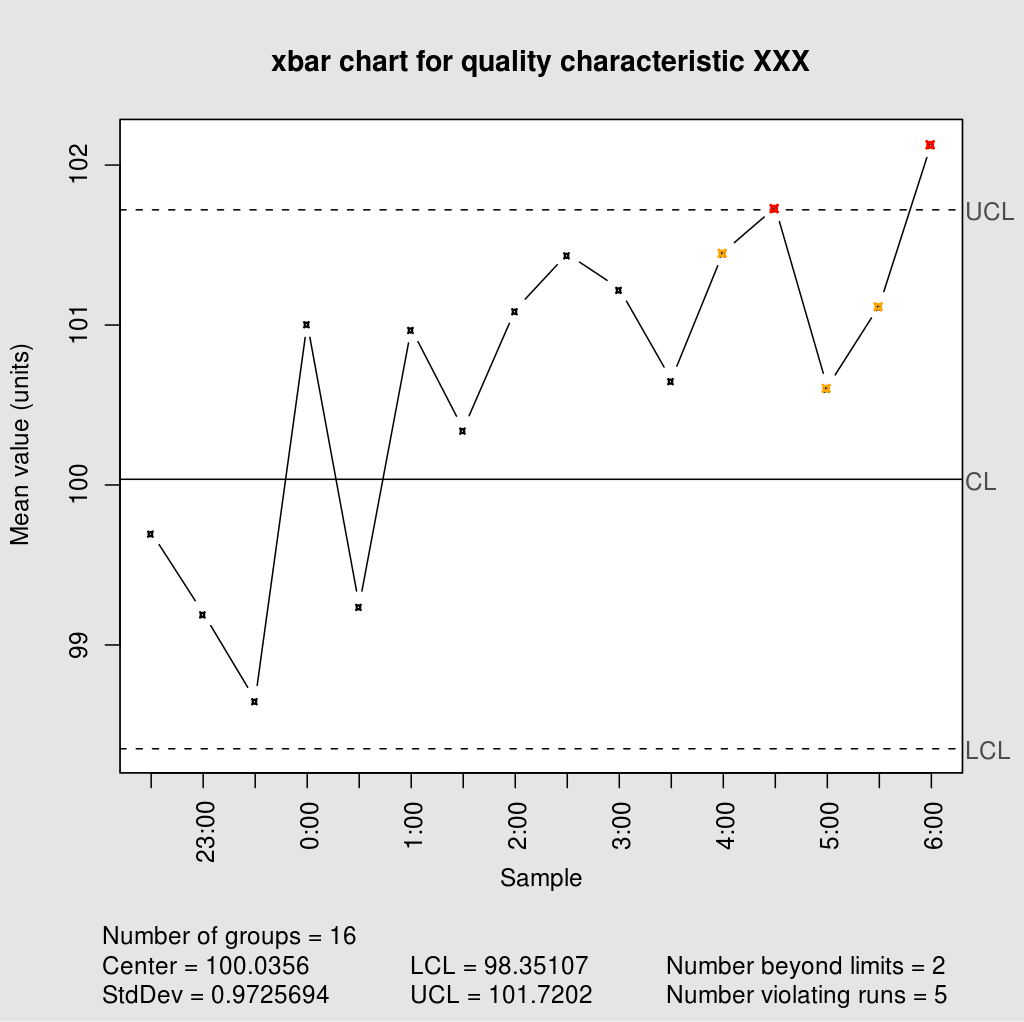
Control Charts

A sample control chart, marking the limits and showing how a process is slowly deviation from its control limits.

These limits aren’t decided by us. Indeed, they have nothing to do with the tolerances that the design engineer has set. Instead, they have everything to do with the statistical limits of your process. That means that the last 25 readings you take in your process decide the UCL, CL and LCL for the next couple of readings.

Statistical Viability

25 is an arbitrary number, mind you. It is the bare minimum that you need to start plotting charts. However, it is not even statistically viable to do this. Instead start with a 100 readings if you want to do some meaningful analytics of process control study.

Interpreting Control Charts

If 7 consecutive readings on a control chart fall on one side of the limits, that’s your chart telling you that you have serious problems. Your process is slowly deviating to one side of your limits. It doesn’t need to be negative by the way. Perhaps you want your process to shift in one direction. This is an indication that whatever you’re doing to your process is shifting the metric to one side.

These shifts are predicatable, and they also indicate a shift in your process that could arise from inherent causes. However, there are sudden shifts that could happen because of uncontrollable causes. These problems will not cause long-lasting errors in your readings, and they’re usually the sort that need a lot of brain-wracking to solve immediately. If they’re not addressed immediately, this will indicate that something is really wrong with your process management, and not really reflect whether your process is doing well or now.

Applications Beyond Manufacturing

While a control chart is something you can definitely use in technology companies – in fact, control charts are strongly associated with LEAN manufacturing, but I’m not experienced enough at Software applications in LEAN to say whether these are actually used in a tech company – the principles behind control charts extend far beyond manufacturing processes.

The core insight is that any process has inherent variation, and understanding that variation helps you distinguish between normal fluctuations and meaningful changes that require intervention. This thinking can be applied to software metrics, team performance, and even career decisions.

References

These are a list of books I love recommending if you’re interested in the topic of statistics and process control:

  1. Edward Deming - Out of the Crisis
  2. Walter A. Shewart - Statistical Method From the Viewpoint of Quality Control
  3. Taiichi Ohno - Toyota Production System: Beyond Large-Scale Production
  4. Taiichi Ohno - Workplace Management

These books were written in a time where statistical quality control was applied predominantly to manufacturing processes, but I’d recommend looking at them through the lens of a general engineer, as opposed to a software engineer. If you ever find yourself wanting to discuss these topics, I’m always available.