惯性聚合 高效追踪和阅读你感兴趣的博客、新闻、科技资讯
阅读原文 在惯性聚合中打开

推荐订阅源

IntelliJ IDEA : IntelliJ IDEA – the Leading IDE for Professional Development in Java and Kotlin | The JetBrains Blog
G
GRAHAM CLULEY
P
Privacy & Cybersecurity Law Blog
Threat Intelligence Blog | Flashpoint
宝玉的分享
宝玉的分享
P
Proofpoint News Feed
H
Help Net Security
V
Visual Studio Blog
阮一峰的网络日志
阮一峰的网络日志
C
Cisco Blogs
人人都是产品经理
人人都是产品经理
Know Your Adversary
Know Your Adversary
freeCodeCamp Programming Tutorials: Python, JavaScript, Git & More
Recorded Future
Recorded Future
I
Intezer
罗磊的独立博客
T
The Exploit Database - CXSecurity.com
Blog — PlanetScale
Blog — PlanetScale
Malwarebytes
Malwarebytes
Spread Privacy
Spread Privacy
T
Tor Project blog
V
Vulnerabilities – Threatpost
云风的 BLOG
云风的 BLOG
腾讯CDC
B
Blog RSS Feed
Stack Overflow Blog
Stack Overflow Blog
F
Future of Privacy Forum
MyScale Blog
MyScale Blog
Latest news
Latest news
IT之家
IT之家
MongoDB | Blog
MongoDB | Blog
The Hacker News
The Hacker News
S
Securelist
博客园 - 【当耐特】
C
CXSECURITY Database RSS Feed - CXSecurity.com
T
Threat Research - Cisco Blogs
Jina AI
Jina AI
Cisco Talos Blog
Cisco Talos Blog
B
Blog
博客园 - 三生石上(FineUI控件)
Last Week in AI
Last Week in AI
CTFtime.org: upcoming CTF events
M
MIT News - Artificial intelligence
V
V2EX
D
Darknet – Hacking Tools, Hacker News & Cyber Security
The Cloudflare Blog
The GitHub Blog
The GitHub Blog
博客园 - 聂微东
F
Full Disclosure
C
CERT Recently Published Vulnerability Notes

ByteByteGo Newsletter

How Netflix is Using Multimodal AI to Power Video Search How Snapchat Serves a Billion Predictions Per Second How Grab is Using AI Agents to Boost Team Productivity EP215: The Anatomy of an AI Agent LAST CALL FOR ENROLLMENT: Become an AI Engineer - Cohort 6 A Guide To Event-Driven Architectural Patterns High Performance Rate Limiting at Databricks How Figma Upgraded Data Pipeline from Multi-Day Latency to Real-Time How Pinterest Built a Production MCP Ecosystem EP214: Claude Code vs. OpenClaw: 5 Design Dimensions Become an AI Engineer | Enrollment Ends Soon Container Design Patterns for Distributed Systems How Instacart Built a Search for Billions of Products Connecting LLMs to the Real World: Tool Use, Function Calling, and MCP EP213: MCP vs Skills, Clearly Explained A Beginner’s Guide to Kubernetes The Tech Stack Powering Wise How Stripe Detects Fraudulent Transactions Within 100 ms How Amazon Uses LLMs to Recommend Products EP212: Data Warehouse vs Data Lake vs Data Mesh B-Trees vs LSM Trees: Comparison and Trade-Offs How DoorDash Launches a New Country in One Week The Security Architecture of GitHub Agentic Workflow EP211: How the JVM Works A Guide to Relational Database Design Figma Design to Code, Code to Design: Clearly Explained How LinkedIn Feed Uses LLMs to Serve 1.3 Billion Users EP210: Monolithic vs Microservices vs Serverless Must-Know Cross-Cutting Concerns in API Development How Spotify Ships to 675 Million Users Every Week Without Breaking Things Nextdoor’s Database Evolution: A Scaling Ladder A Guide to Context Engineering for LLMs EP209: 12 Claude Code Features Every Engineer Should Know Our New Book on Behavioral Interviews Is Now Available on Amazon Database Performance Strategies and Their Hidden Costs How Datadog Redefined Data Replication How Meta Turned Debugging Into a Product How Roblox Uses AI to Translate 16 Languages in 100 Milliseconds EP208: Load Balancer vs API Gateway LAST CALL FOR ENROLLMENT: Become an AI Engineer - Cohort 5 How to Implement API Security How Anthropic’s Claude Thinks How Netflix Live Streams to 100 Million Devices in 60 Seconds How Agentic RAG Works? Last Chance to Enroll | Become an AI Engineer | Cohort-Based Course EP207: Top 12 GitHub AI Repositories Event Sourcing Explained: Benefits and Use Cases How OpenAI Codex Works
A Guide to Async Patterns in API Design
ByteByteGo · 2026-05-21 · via ByteByteGo Newsletter

The default model for client-server communication is request-response. The client sends a request, the server returns a response, and the connection closes. This handles the majority of what most software needs to do, and it covers an enormous range of practical scenarios in modern web applications.

It doesn’t handle everything. Some work takes too long to complete inside a single request. Some events happen on the server’s schedule, not the client’s. Some interactions are continuous rather than one-shot. And some messages need to outlive the moment they were sent.

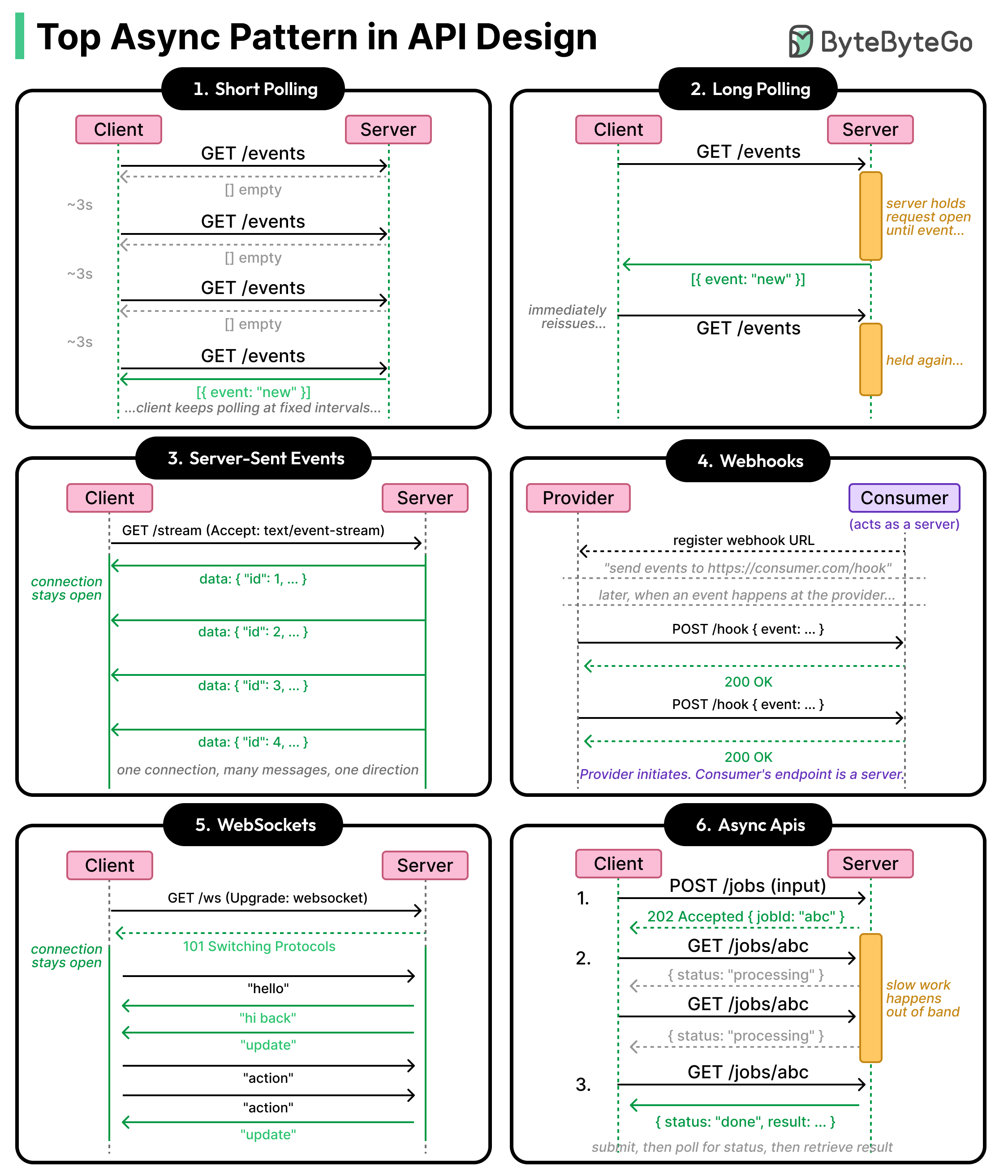
Async API patterns are the techniques engineers use for these cases, and the list has grown over the years. It now includes short polling, long polling, server-sent events, WebSockets, webhooks, async APIs with status polling, message queues, and GraphQL subscriptions. Each has its own design and preferred use case. What they share is one purpose, which is to extend what’s possible beyond a single HTTP request and response.

In this article, we will look at each of these patterns in detail, along with their advantages. We’ll start by looking at where request-response stops fitting and then walk through each pattern in turn.