


惯性聚合 高效追踪和阅读你感兴趣的博客、新闻、科技资讯
阅读原文 在惯性聚合中打开

推荐订阅源

雷峰网
雷峰网
Security Archives - TechRepublic
奇客Solidot–传递最新科技情报
奇客Solidot–传递最新科技情报
OSCHINA 社区最新新闻
OSCHINA 社区最新新闻
Last Week in AI
Last Week in AI
博客园 - 司徒正美
阮一峰的网络日志
阮一峰的网络日志
WordPress大学
WordPress大学
爱范儿
爱范儿
J
Java Code Geeks
T
Tailwind CSS Blog
Apple Machine Learning Research
人人都是产品经理
人人都是产品经理
宝玉的分享
宝玉的分享
博客园 - 【当耐特】
Exploit-DB.com RSS Feed
Help Net Security
Help Net Security
Hacker News: Ask HN
Hacker News: Ask HN
月光博客
月光博客
S
Secure Thoughts
freeCodeCamp Programming Tutorials: Python, JavaScript, Git & More
K
KPMG report finds enterprise disconnect between AI and its ROI | CIO
博客园 - 聂微东
Hugging Face - Blog
Hugging Face - Blog
V
Visual Studio Blog
博客园 - 三生石上(FineUI控件)
O
OpenAI News
酷 壳 – CoolShell
酷 壳 – CoolShell
N
News and Events Feed by Topic
腾讯CDC
让小产品的独立变现更简单 - ezindie.com
cs.AI updates on arXiv.org
Webroot Blog
Webroot Blog
博客园 - Franky
有赞技术团队
有赞技术团队
美团技术团队
Jina AI
Jina AI
S
Security @ Cisco Blogs
博客园 - 叶小钗
钛媒体:引领未来商业与生活新知
钛媒体:引领未来商业与生活新知
博客园_首页
C
CERT Recently Published Vulnerability Notes
T
Threat Research - Cisco Blogs
Project Zero
Project Zero
A
Arctic Wolf
大猫的无限游戏
大猫的无限游戏
Latest news
Latest news
小众软件
小众软件
IT之家
IT之家
S
Security Affairs

ByteByteGo Newsletter

A Guide to Multi-Tenancy: Benefits and Challenges AI Customer Support at Scale: The Travel Industry’s $Billion Bet How LLMs Learn to Be Helpful (RLHF vs DPO) How Microsoft Ships AI Agents at Enterprise Scale EP221: How Docker Works Under the Hood LAST CALL FOR ENROLLMENT: Become an AI Engineer - Cohort 7 Streaming vs Batch: Two Philosophies of Data Processing The Agent Loop: How AI Goes From Answering Questions to Doing Things ChatGPT vs Gemini vs Claude: How They Differ LAST CALL FOR ENROLLMENT: Become an AI Engineer - Cohort 7 Proof of Human: How to Verify a Person Is Real and Unique Multi-Region Architecture: Going Global Without Going Broke How OpenAI Delivers Low-Latency Voice AI for 900M Users Inside Thinking Machines’ Interaction Models How AI Agents Manage Memory and Avoid Forgetfulness EP220: RAG vs Graph RAG vs Agentic RAG Top Anti-Patterns to Avoid in Service Architecture Large Language Models vs Small Language Models An Ex-Meta L8’s Agentic Engineering Setup AI-Native Leaders: The Organizational Playbook for Engineering Transformation at Scale EP219: 12 Open-source LLMs Observability for Beginners: Logs, Metrics, Traces, and Everything Around Them LAST CALL FOR ENROLLMENT: Build with Claude Code - Cohort 2 How Open-Weight Models Changed the AI Landscape A Guide to AI Inference Engineering EP218: The Typical AI Agent Stack, Explained Must- Know Deployment Strategies: From Big-Bang to Progressive Delivery Love Teaching? ByteByteGo Is Hiring Part-Time AI & Engineering Instructors What Salesforce Learned from 20,000 Enterprise Agent Deployments Token Spend Out of Control? The Case for Smarter Routing The Path of a Request: A Tour of Modern Web Architecture How OpenAI Built Its Data Agent A Practical Guide to Becoming an AI-Native Engineer How DoorDash Built a Testing System to Evaluate LLMs Must-Know Failure Modes in Distributed Systems How Airtable Built the Search Layer Behind Their AI Features How Vercel Cut Build Wait Times From 90 Seconds To 5 How CockroachDB Built Vector Indexing at Scale EP216: RAGs vs Agents 🚀 New cohort based course launch: Build with Claude Code A Guide to Async Patterns in API Design How Netflix is Using Multimodal AI to Power Video Search How Snapchat Serves a Billion Predictions Per Second How Grab is Using AI Agents to Boost Team Productivity EP215: The Anatomy of an AI Agent LAST CALL FOR ENROLLMENT: Become an AI Engineer - Cohort 6 A Guide To Event-Driven Architectural Patterns High Performance Rate Limiting at Databricks How Figma Upgraded Data Pipeline from Multi-Day Latency to Real-Time How Pinterest Built a Production MCP Ecosystem EP214: Claude Code vs. OpenClaw: 5 Design Dimensions Become an AI Engineer | Enrollment Ends Soon Container Design Patterns for Distributed Systems How Instacart Built a Search for Billions of Products Connecting LLMs to the Real World: Tool Use, Function Calling, and MCP EP213: MCP vs Skills, Clearly Explained A Beginner’s Guide to Kubernetes The Tech Stack Powering Wise How Stripe Detects Fraudulent Transactions Within 100 ms How Amazon Uses LLMs to Recommend Products EP212: Data Warehouse vs Data Lake vs Data Mesh B-Trees vs LSM Trees: Comparison and Trade-Offs How DoorDash Launches a New Country in One Week The Security Architecture of GitHub Agentic Workflow EP211: How the JVM Works A Guide to Relational Database Design Figma Design to Code, Code to Design: Clearly Explained How LinkedIn Feed Uses LLMs to Serve 1.3 Billion Users EP210: Monolithic vs Microservices vs Serverless Must-Know Cross-Cutting Concerns in API Development How Spotify Ships to 675 Million Users Every Week Without Breaking Things Nextdoor’s Database Evolution: A Scaling Ladder A Guide to Context Engineering for LLMs EP209: 12 Claude Code Features Every Engineer Should Know Our New Book on Behavioral Interviews Is Now Available on Amazon Database Performance Strategies and Their Hidden Costs How Datadog Redefined Data Replication How Meta Turned Debugging Into a Product How Roblox Uses AI to Translate 16 Languages in 100 Milliseconds EP208: Load Balancer vs API Gateway LAST CALL FOR ENROLLMENT: Become an AI Engineer - Cohort 5 How to Implement API Security How Anthropic’s Claude Thinks How Netflix Live Streams to 100 Million Devices in 60 Seconds How Agentic RAG Works? Last Chance to Enroll | Become an AI Engineer | Cohort-Based Course EP207: Top 12 GitHub AI Repositories Event Sourcing Explained: Benefits and Use Cases How OpenAI Codex Works
EP217: Latency vs Throughput vs Bandwidth
ByteByteGo · 2026-06-06 · via ByteByteGo Newsletter

QA Wolf’s AI agent maps and tests your app’s most complex user flows.

It turns your prompts into real Playwright and Appium code that runs 12x faster and more reliably than other computer-use agents.

What sets our AI apart:

  • Maps 200+ test cases in minutes instead of weeks of manual planning.

  • Executes tests 12x faster than computer-use agents.

  • Runs entire suites 100% parallel with consistent results.

  • Produces open-source tests your team owns, with zero vendor lock-in.

Get started today

This week’s system design refresher:

  • CPU vs GPU vs TPU (Youtube video)

  • Latency vs Throughput vs Bandwidth

  • What is Google’s TPU?

  • 7 Permission Modes Every Claude Code User Should Know

  • Top AI Trends to Watch in 2026

  • We’re hiring at ByteByteGo

Ever wondered why your app feels slow even when the bandwidth looks fine? Latency, throughput, and bandwidth often get used interchangeably, but each one tells a different story about performance.
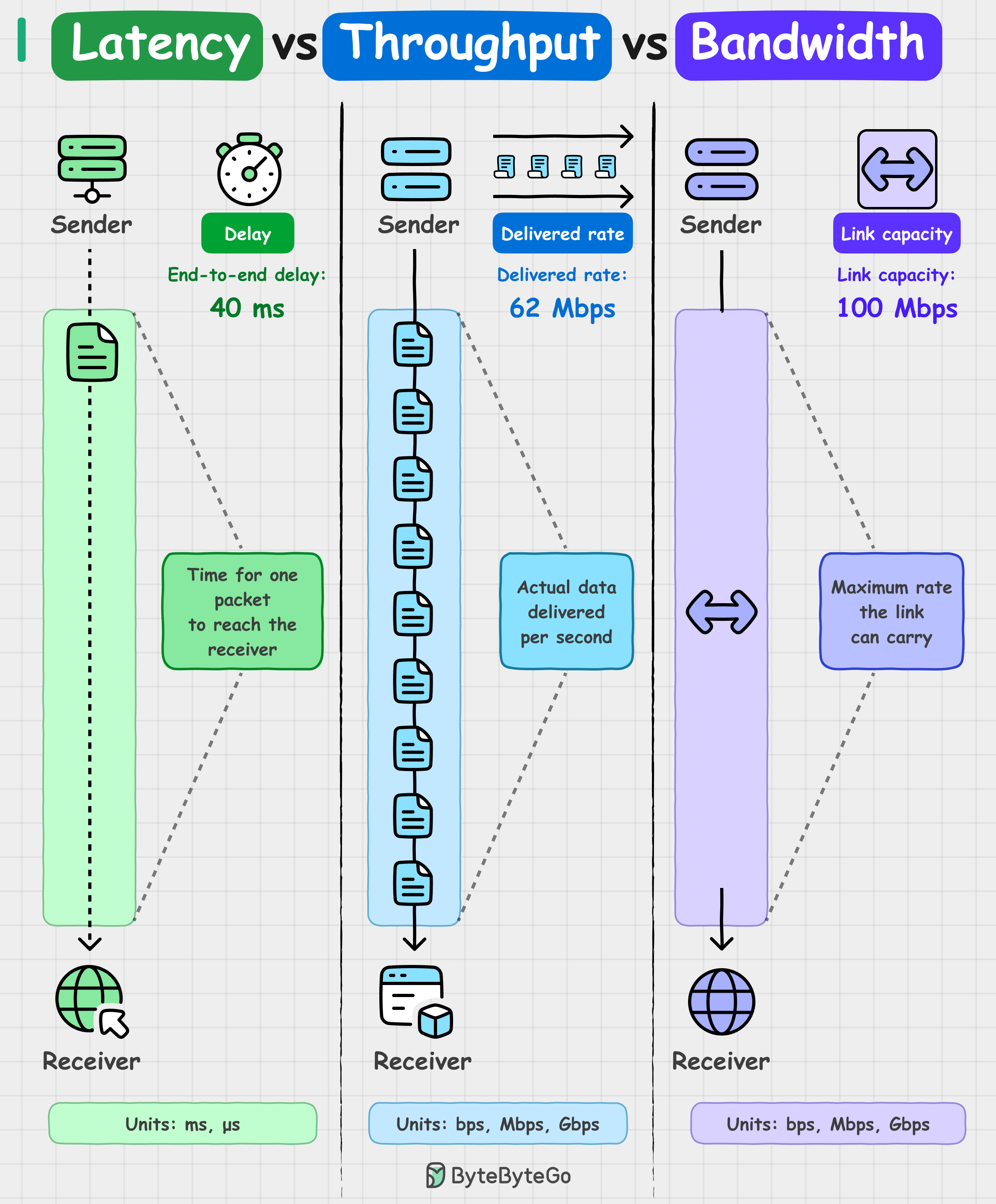
Latency is the delay. How long it takes for a single packet to travel from sender to receiver. If your ping shows 40 ms round-trip, that's latency.

Throughput is the actual delivery rate. How much data is successfully transferred per second. If your download shows 62 Mbps, that’s throughput.

Bandwidth is the maximum capacity of the link. For example, a 100 Mbps connection is the upper limit under ideal conditions.

Throughput is always less than bandwidth. Network congestion, packet loss, and protocol overhead all affect throughput, which is why you never actually hit the maximum bandwidth capacity in practice.

Similarly, low latency doesn't always mean high throughput. Small payloads, single connections, and tight window sizes can all keep throughput low, which is why fast responses don't guarantee you're sending a lot of data.

Another way to understand these three concepts: Bandwidth is the highway width. Throughput is the traffic flow. Latency is how long it takes a car to go from A to B.

All three matter, but they solve different problems.

Over to you: How do you measure these metrics in a way that actually predicts when things will break?

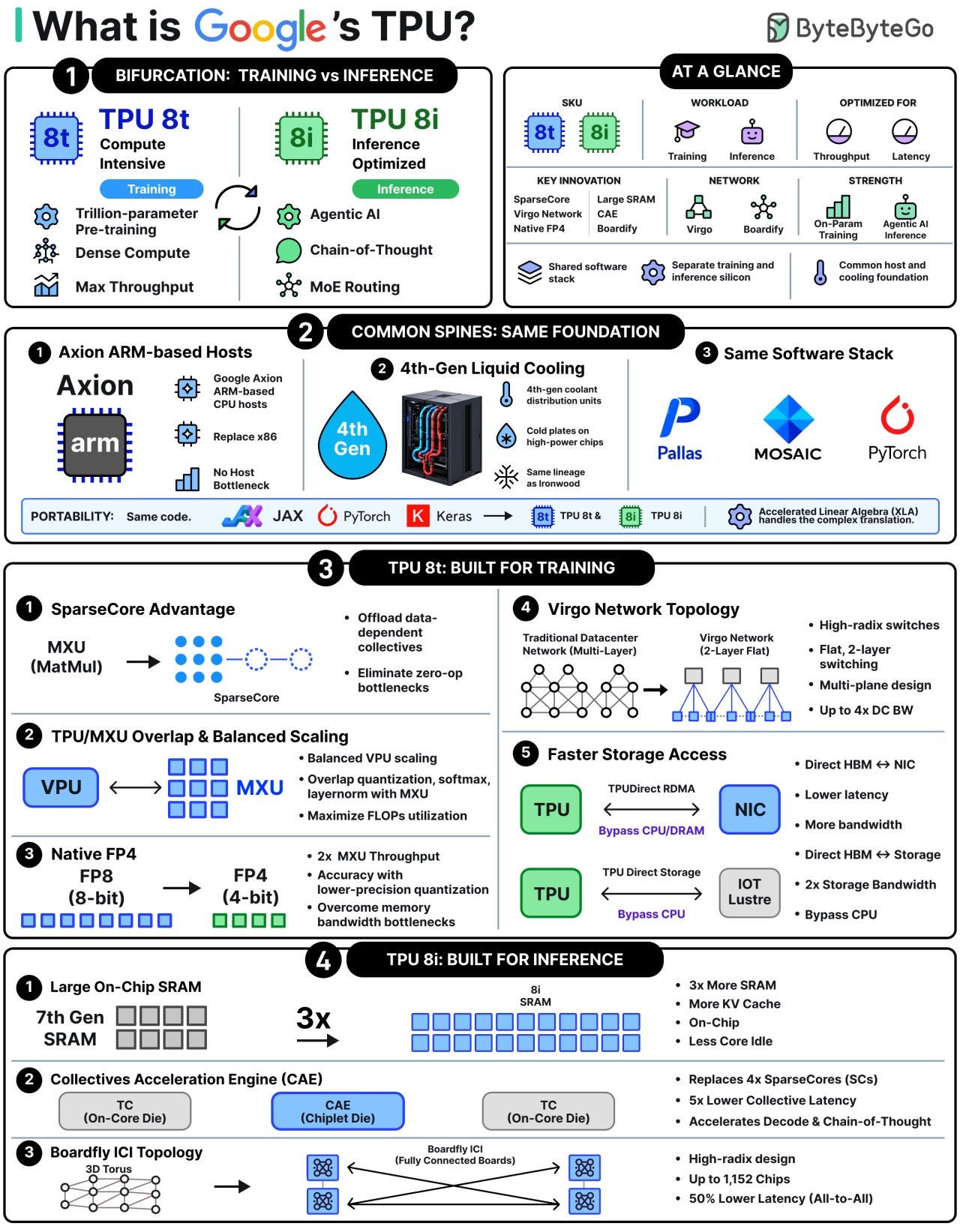
A TPU (Tensor Processing Unit) is Google’s custom AI chip, designed from scratch for the giant matrix multiplications that modern models live on. GPUs were built for graphics first.
No alternative text description for this image

TPUs were built for deep learning from day one.

At Cloud Next ’26, Google unveiled its 8th generation, and for the first time it ships in two flavors. TPU 8t is built for training, where raw throughput wins. TPU 8i is built for inference, where latency and chip-to-chip speed matter most.

Both still share the same Axion CPUs, liquid cooling, and software stack, so code written for one runs on the other.

The diagram is a quick study guide to what’s the same, what’s different, and why, based on our understanding of published Google articles.
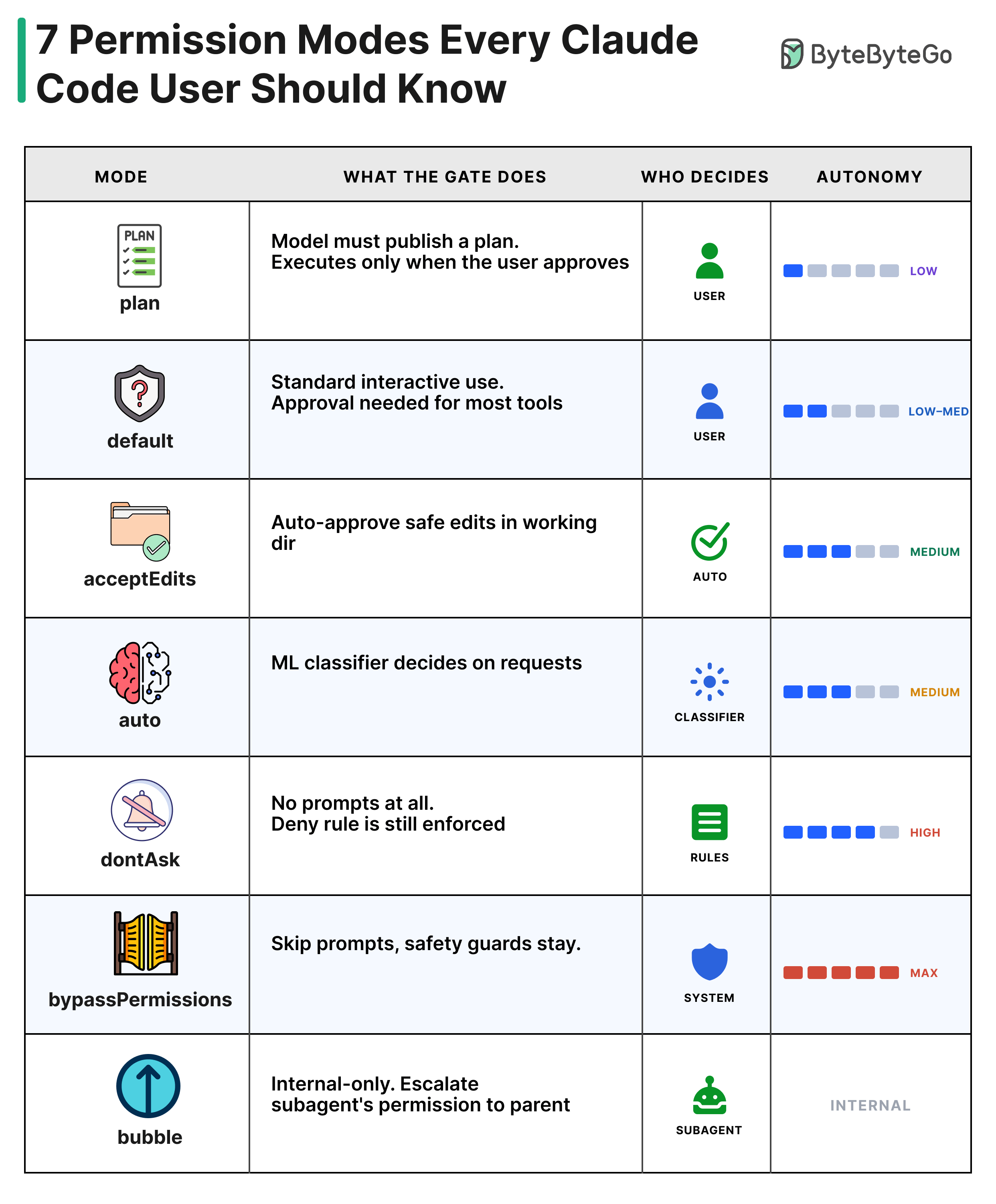
  1. plan: The model drafts a plan. Nothing executes until the user approves.

  2. default: Standard interactive use. Most tool calls require user approval.

  3. acceptEdits: Edits in the working directory are auto-approved. Other shell commands still prompt.

  4. auto: An ML classifier decides on requests that miss the fast path.

  5. dontAsk: No prompts shown. Deny rules are still enforced.

  6. bypassPermissions: Most prompts are skipped. Safety-critical guards still apply.

  7. bubble: A subagent escalates its permission request to the parent.

Only 5 modes are user-selectable. “auto” is gated by a feature flag, and “bubble” is internal.

Over to you: Which mode do you reach for most, and what made you pick it?

2026 is already moving faster than anyone expected. Anthropic released Opus 4.7, OpenAI introduced GPT5.5-Codex, and open-source releases like Kimi K2.5 and GLM-5 showed impressive agentic performance.
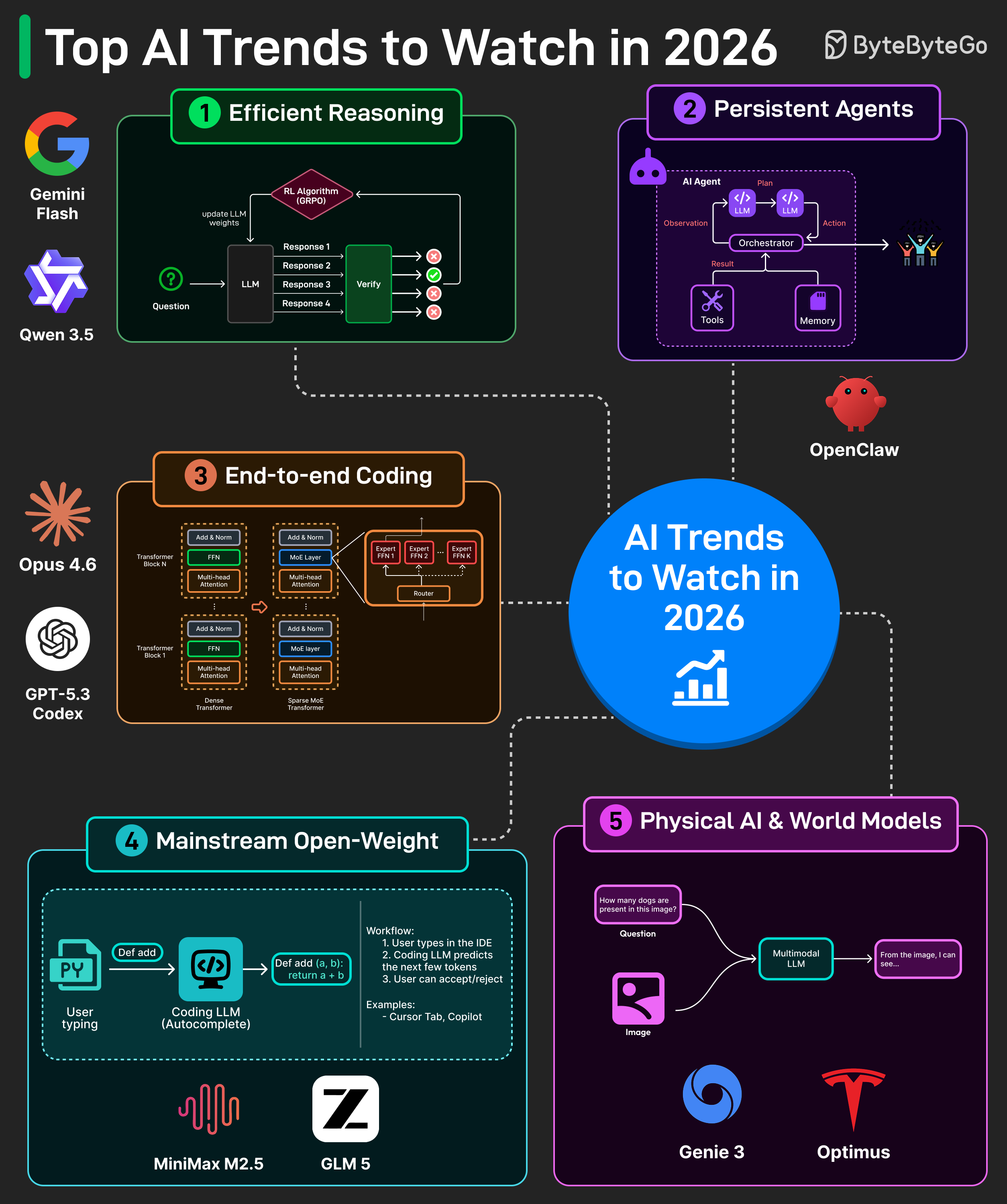
These launches point to bigger trends. Here are the five categories to closely watch in 2026.

1. Efficient Reasoning: RLVR-style training scales reasoning by auto-checking math and code. In 2026, expect more adaptive reasoning and extremely sparse architectures. Early signs include Gemini’s adaptive thinking and Qwen3.5’s sparse MoE architecture.

2. Persistent Agents: Agents now plan in loops with tools and memory, not just chat. In 2026, expect always-on personal agents that live across days, have access to your files, and can complete tasks safely. OpenClaw is an early example of this direction.

3. Repo-Scale Coding: Coding has moved from autocomplete to multi-file edits with tests, builds, and terminal tools. In 2026, expect agents that understand very large repos and can ship security-aware PRs by default.

4. Open-Weight Everywhere: Open-weight models are now strong enough to compete with closed ones. In 2026, expect more of them to get leaner, agent-ready, and easier to deploy. Models like GLM5 and Kimi K2.5 are already pushing in this direction.

5. World Models + Physical AI: Multimodal models have reached impressive quality across vision, image, and video generation. In 2026, expect these models to become the foundation for physical AI and world models, with early examples like Google Genie 3 and humanoid robots already pointing the way.

Over to you: which shift do you think will change how teams build products the most in 2026?

We’re looking for multiple part-time instructors to teach AI and engineering cohort-based live courses.

This is a great fit if you love teaching, enjoy sharing what you know, and want a meaningful side thing alongside your main work.

The role has some upfront time investment to get familiar with the curriculum and prepare, but after that, it’s designed to be a limited commitment (2-5 hours bi-weekly). It offers stable income, good upside, and a chance to share your knowledge while working with ambitious learners.
table

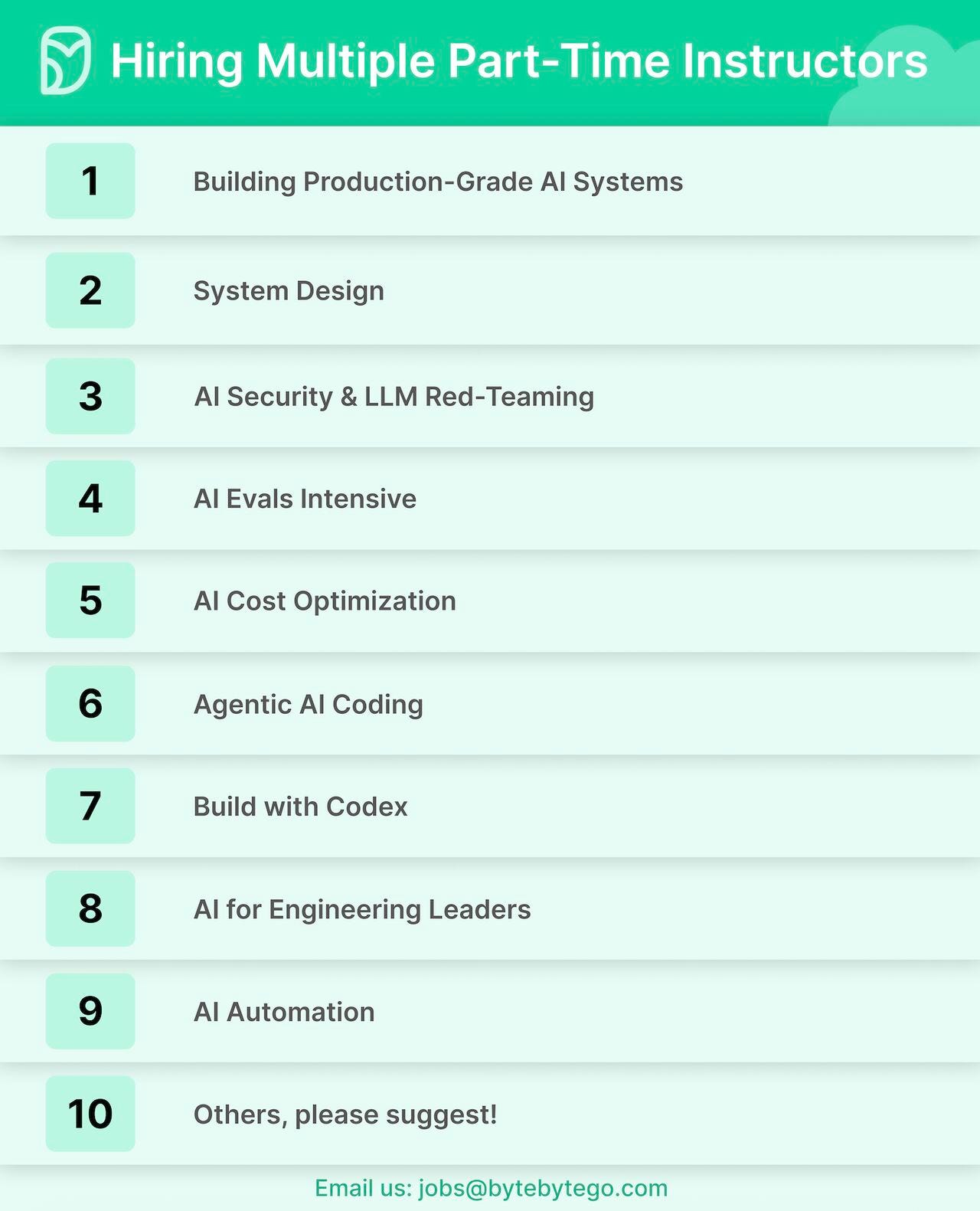
We’re especially looking for instructors in:

  • Building Production-Grade AI Systems

  • System Design

  • AI Security & LLM Red-Teaming

  • AI Evals Intensive

  • AI Cost Optimization

  • Agentic AI Coding

  • Build with Codex

  • AI for Engineering Leaders

  • AI Automation

  • Others, please suggest

Ideal instructors are hands-on, clear communicators, and excited to teach.

If this sounds like you, email us at jobs@bytebytego.com with your background, the topics you’d be excited to teach, and any teaching, writing, or speaking samples.

Discussion about this post

Ready for more?