


惯性聚合 高效追踪和阅读你感兴趣的博客、新闻、科技资讯
阅读原文 在惯性聚合中打开

推荐订阅源

Microsoft Security Blog
S
Secure Thoughts
酷 壳 – CoolShell
酷 壳 – CoolShell
S
SegmentFault 最新的问题
WordPress大学
WordPress大学
Hugging Face - Blog
Hugging Face - Blog
人人都是产品经理
人人都是产品经理
美团技术团队
博客园 - 三生石上(FineUI控件)
Jina AI
Jina AI
V
Visual Studio Blog
腾讯CDC
小众软件
小众软件
有赞技术团队
有赞技术团队
博客园 - 聂微东
cs.CL updates on arXiv.org
IT之家
IT之家
C
CERT Recently Published Vulnerability Notes
大猫的无限游戏
大猫的无限游戏
T
Threat Research - Cisco Blogs
SecWiki News
SecWiki News
奇客Solidot–传递最新科技情报
奇客Solidot–传递最新科技情报
宝玉的分享
宝玉的分享
freeCodeCamp Programming Tutorials: Python, JavaScript, Git & More
The Hacker News
The Hacker News
OSCHINA 社区最新新闻
OSCHINA 社区最新新闻
T
Troy Hunt's Blog
月光博客
月光博客
雷峰网
雷峰网
T
Tor Project blog
I
Intezer
S
Securelist
罗磊的独立博客
The Register - Security
H
Hackread – Cybersecurity News, Data Breaches, AI and More
NISL@THU
NISL@THU
Google Online Security Blog
Exploit-DB.com RSS Feed
Cisco Talos Blog
Cisco Talos Blog
云风的 BLOG
云风的 BLOG
www.infosecurity-magazine.com
让小产品的独立变现更简单 - ezindie.com
L
Lohrmann on Cybersecurity
The Cloudflare Blog
Attack and Defense Labs
P
Privacy International News Feed
W
WeLiveSecurity
Forbes - Security
Forbes - Security
量子位
Last Week in AI
Last Week in AI

ByteByteGo Newsletter

A Guide to Multi-Tenancy: Benefits and Challenges AI Customer Support at Scale: The Travel Industry’s $Billion Bet How LLMs Learn to Be Helpful (RLHF vs DPO) How Microsoft Ships AI Agents at Enterprise Scale EP221: How Docker Works Under the Hood LAST CALL FOR ENROLLMENT: Become an AI Engineer - Cohort 7 Streaming vs Batch: Two Philosophies of Data Processing The Agent Loop: How AI Goes From Answering Questions to Doing Things ChatGPT vs Gemini vs Claude: How They Differ LAST CALL FOR ENROLLMENT: Become an AI Engineer - Cohort 7 Proof of Human: How to Verify a Person Is Real and Unique Multi-Region Architecture: Going Global Without Going Broke How OpenAI Delivers Low-Latency Voice AI for 900M Users Inside Thinking Machines’ Interaction Models How AI Agents Manage Memory and Avoid Forgetfulness EP220: RAG vs Graph RAG vs Agentic RAG Top Anti-Patterns to Avoid in Service Architecture Large Language Models vs Small Language Models An Ex-Meta L8’s Agentic Engineering Setup AI-Native Leaders: The Organizational Playbook for Engineering Transformation at Scale Observability for Beginners: Logs, Metrics, Traces, and Everything Around Them LAST CALL FOR ENROLLMENT: Build with Claude Code - Cohort 2 How Open-Weight Models Changed the AI Landscape A Guide to AI Inference Engineering EP218: The Typical AI Agent Stack, Explained Must- Know Deployment Strategies: From Big-Bang to Progressive Delivery Love Teaching? ByteByteGo Is Hiring Part-Time AI & Engineering Instructors What Salesforce Learned from 20,000 Enterprise Agent Deployments Token Spend Out of Control? The Case for Smarter Routing EP217: Latency vs Throughput vs Bandwidth The Path of a Request: A Tour of Modern Web Architecture How OpenAI Built Its Data Agent A Practical Guide to Becoming an AI-Native Engineer How DoorDash Built a Testing System to Evaluate LLMs Must-Know Failure Modes in Distributed Systems How Airtable Built the Search Layer Behind Their AI Features How Vercel Cut Build Wait Times From 90 Seconds To 5 How CockroachDB Built Vector Indexing at Scale EP216: RAGs vs Agents 🚀 New cohort based course launch: Build with Claude Code A Guide to Async Patterns in API Design How Netflix is Using Multimodal AI to Power Video Search How Snapchat Serves a Billion Predictions Per Second How Grab is Using AI Agents to Boost Team Productivity EP215: The Anatomy of an AI Agent LAST CALL FOR ENROLLMENT: Become an AI Engineer - Cohort 6 A Guide To Event-Driven Architectural Patterns High Performance Rate Limiting at Databricks How Figma Upgraded Data Pipeline from Multi-Day Latency to Real-Time How Pinterest Built a Production MCP Ecosystem EP214: Claude Code vs. OpenClaw: 5 Design Dimensions Become an AI Engineer | Enrollment Ends Soon Container Design Patterns for Distributed Systems How Instacart Built a Search for Billions of Products Connecting LLMs to the Real World: Tool Use, Function Calling, and MCP EP213: MCP vs Skills, Clearly Explained A Beginner’s Guide to Kubernetes The Tech Stack Powering Wise How Stripe Detects Fraudulent Transactions Within 100 ms How Amazon Uses LLMs to Recommend Products EP212: Data Warehouse vs Data Lake vs Data Mesh B-Trees vs LSM Trees: Comparison and Trade-Offs How DoorDash Launches a New Country in One Week The Security Architecture of GitHub Agentic Workflow EP211: How the JVM Works A Guide to Relational Database Design Figma Design to Code, Code to Design: Clearly Explained How LinkedIn Feed Uses LLMs to Serve 1.3 Billion Users EP210: Monolithic vs Microservices vs Serverless Must-Know Cross-Cutting Concerns in API Development How Spotify Ships to 675 Million Users Every Week Without Breaking Things Nextdoor’s Database Evolution: A Scaling Ladder A Guide to Context Engineering for LLMs EP209: 12 Claude Code Features Every Engineer Should Know Our New Book on Behavioral Interviews Is Now Available on Amazon Database Performance Strategies and Their Hidden Costs How Datadog Redefined Data Replication How Meta Turned Debugging Into a Product How Roblox Uses AI to Translate 16 Languages in 100 Milliseconds EP208: Load Balancer vs API Gateway LAST CALL FOR ENROLLMENT: Become an AI Engineer - Cohort 5 How to Implement API Security How Anthropic’s Claude Thinks How Netflix Live Streams to 100 Million Devices in 60 Seconds How Agentic RAG Works? Last Chance to Enroll | Become an AI Engineer | Cohort-Based Course EP207: Top 12 GitHub AI Repositories Event Sourcing Explained: Benefits and Use Cases How OpenAI Codex Works
EP219: 12 Open-source LLMs
ByteByteGo · 2026-06-20 · via ByteByteGo Newsletter

AI shows up in 60% of engineering work. But only about a fifth of it can be handed off without someone babysitting the output. That’s because agents are missing context.

This 8-stage context maturity model gives a real answer on why you still get inconsistent output for all the tokens burned.

Join Unblocked live on June 24 (FREE) to learn:

  • Why more MCPs provides agents access but not understanding

  • What it takes to deploy agents you can trust without supervision

  • How a context layer solves for quality, efficiency and cost

Register now

This week’s system design refresher:

  • Claude Fable 5: Everything You Need to Know! (Youtube video)

  • 12 Open-source LLMs

  • SLMs vs. LLMs, Clearly Explained

  • Single Agent vs. Multi-Agent Architecture

  • 7 Permission Modes Every Claude Code User Should Know
Image

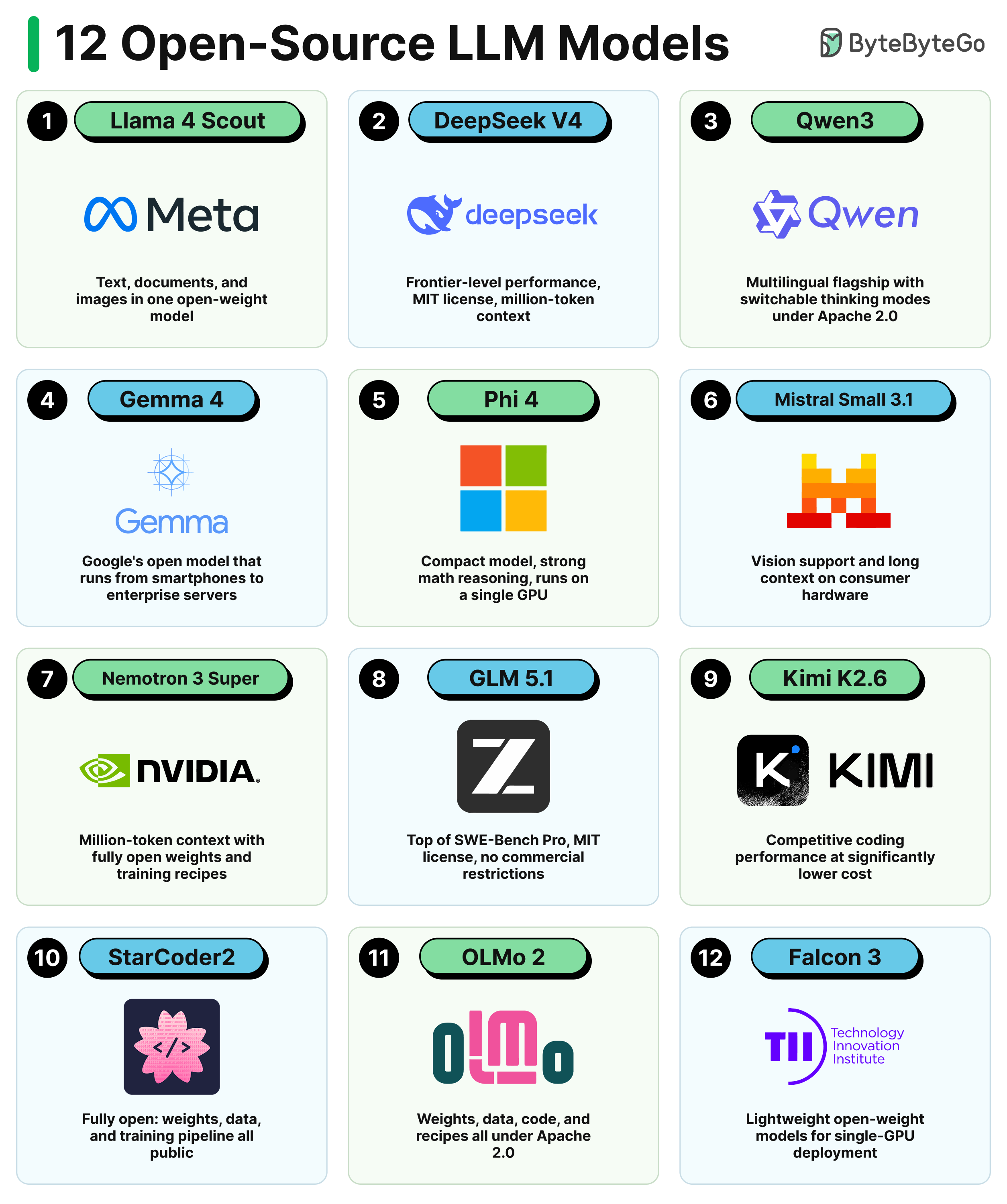
Twelve models worth knowing in 2026, each with one standout strength.

  1. Llama 4 Scout: Meta's first natively multimodal open-weight model.

  2. DeepSeek V4: A Mixture-of-Experts model under MIT license with a native million-token context window. Near-frontier performance at a fraction of the cost per token.

  3. Qwen3: Alibaba's flagship open-weight model with switchable thinking and non-thinking modes, all under Apache 2.0.

  4. Gemma 4: Google's open-weight family released under Apache 2.0, with the widest language coverage of any model on this list.

  5. Phi 4: Microsoft’s compact model trained almost entirely on synthetic, curated data. A practical choice for edge and on-device deployment.

  6. Mistral Small 3.1: A VLM with a long context window that fits on a consumer laptop.

  7. Nemotron 3 Super: NVIDIA’s hybrid MoE with a million-token context window. Fully open weights, datasets, and recipes, with strong results on agentic coding benchmarks.

  8. GLM 5.1: The first open-weight model to top SWE-Bench Pro. Released under MIT with no commercial restrictions.

  9. Kimi K2.6: Competitive with leading closed models on coding while costing far less per million tokens. Available on Hugging Face under a Modified MIT license.

  10. StarCoder2: One of the most transparent code models available.

  11. OLMo 2 (AI2): The most complete example of open-source reproducibility on this list. Weights, training data, code, and full recipes all released under Apache 2.0.

  12. Falcon 3: A family of lightweight open-weight models built to run on a single GPU.

Over to you: which open-source model would you add to this list?

Speed without control is a false economy. As AI code-generation accelerates software delivery, the FeatureOps Summit 2026 is here to ensure that when we ship more, we break less.This premier virtual event brings together engineers, architects, and product leaders from companies like Samsung, Lloyds Banking Group, Wayfair, Visa, AWS, Allianz and many others, to explore the infrastructure of fearless delivery.

Key Themes:

  • AI Safety Nets: Guardrails for the flood of automated code.

  • Edge Resilience: Sub-millisecond evaluation at scale.

  • Continuous Flow: Moving past the “fixed-release” mindset. Register today to master the tools and patterns required for a fail-safe release environment.
Register Today

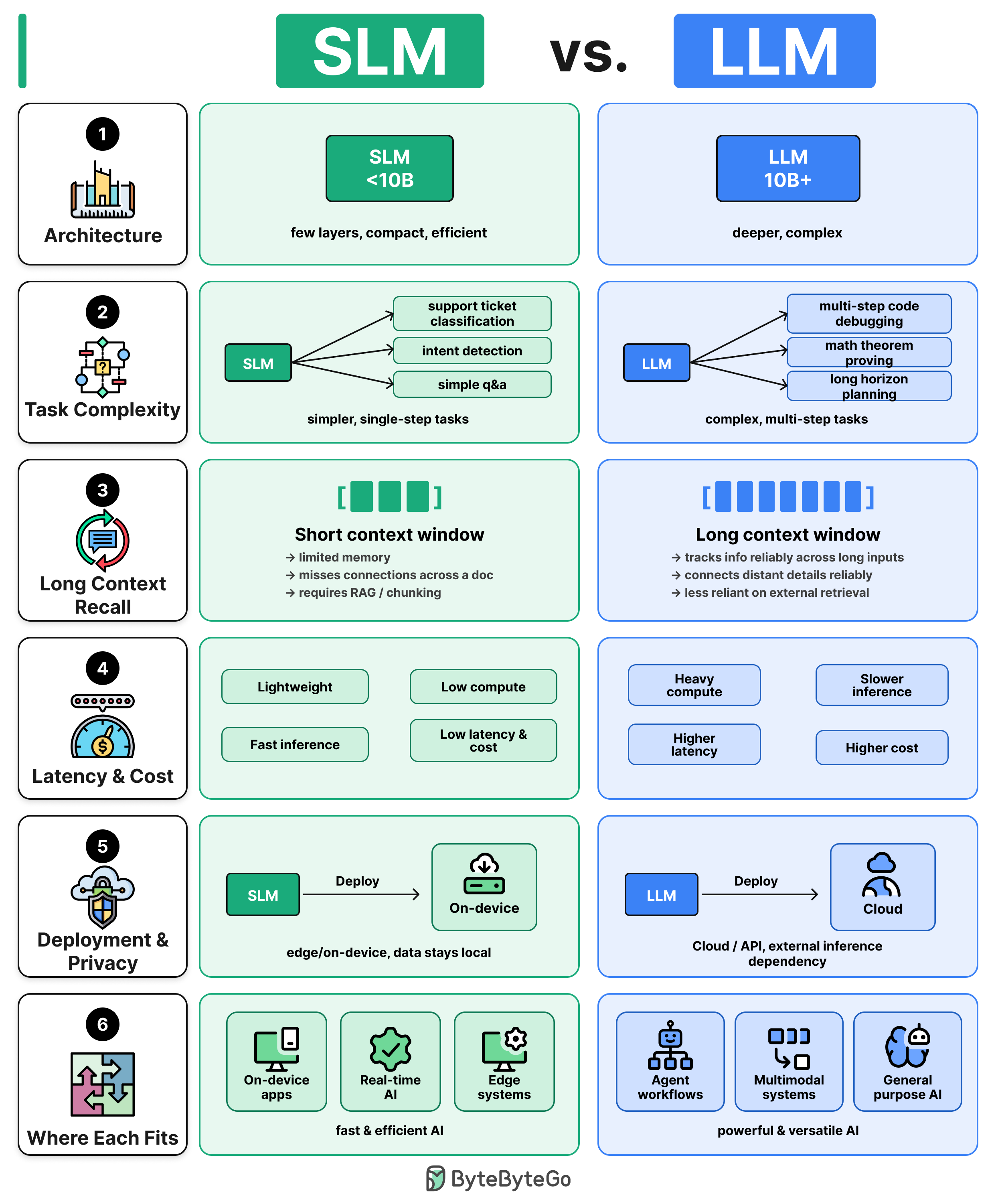
Big models cost more. Small models do less. Here's how SLMs and LLMs differ across the dimensions that matter in production:

  1. Architecture: SLMs are usually under 10B parameters and run on a laptop or phone. LLMs sit at 10B+ with deeper layers and more attention heads, built for broad reasoning across tasks.

  2. Task Complexity: SLMs work well on simple tasks but fail on complex multiple reasoning steps. LLMs handle difficult math, multi-step code, and long-horizon planning.

  3. Long Context Recall: SLMs lose the thread across long documents or extended conversations. LLMs reliably track and connect information across large inputs.

  4. Latency and Cost: SLMs run on consumer hardware with low response times and significantly lower inference costs. LLMs require GPU and carry higher costs per request.

  5. Deployment and Privacy: SLMs run on-device or on-premise. LLMs are typically cloud-hosted, which adds data governance complexity.

  6. Where each fits:
    SLMs: on-device assistants, real-time classification, or privacy-sensitive applications
    LLMs: complex reasoning, agent workflows, or broad knowledge tasks.

Are you using SLMs, LLMs, or a hybrid setup in production?

Some tasks need a single agent. Others need a whole team. Knowing the difference is the skill.
Image

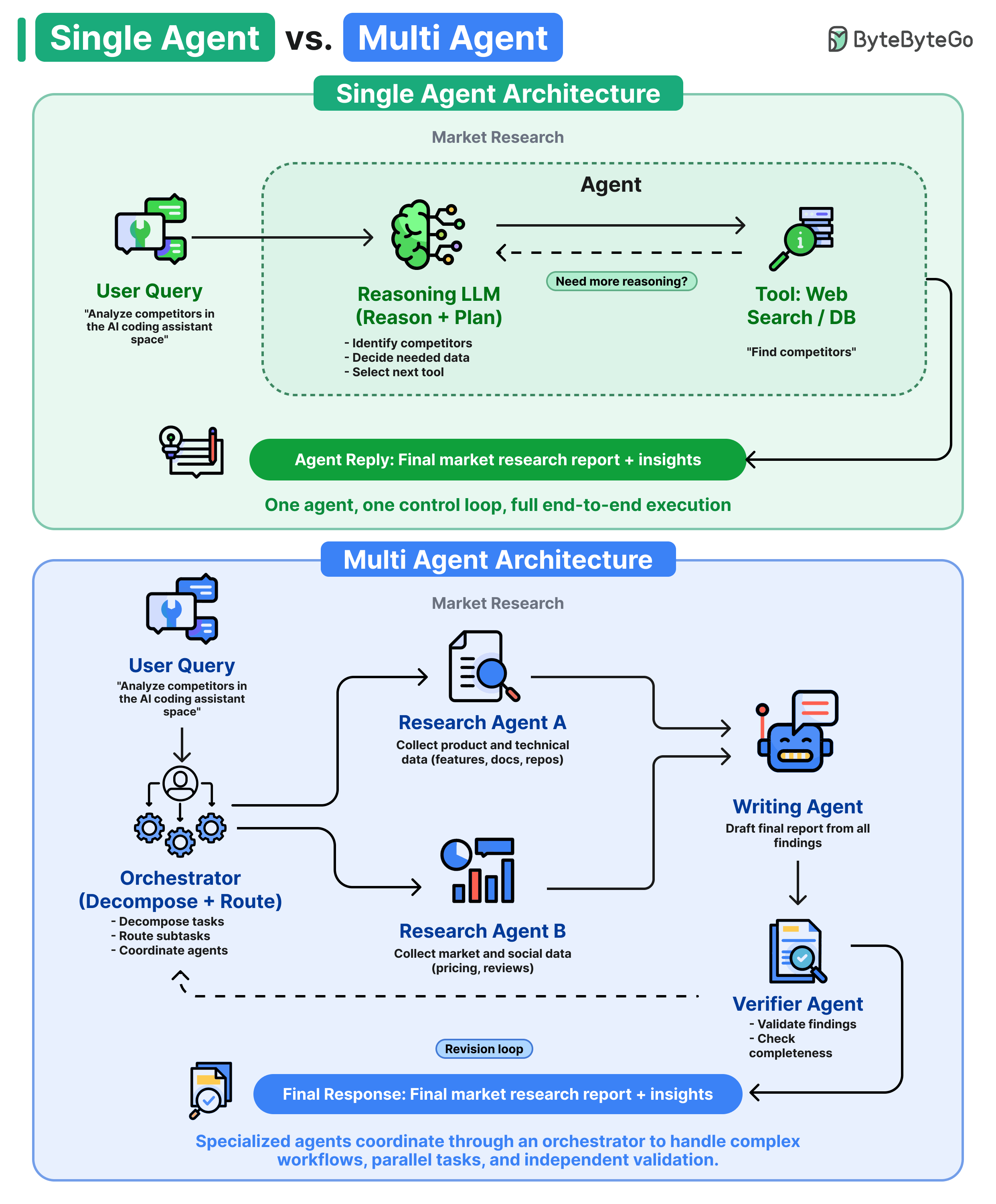
Single-agent system: One reasoning LLM that plans, picks a tool, and loops on its own until the task is done. Use a single agent when:

  • the task is a clear, linear sequence

  • one agent can hold the whole problem in its head

  • you want something simple to build and easy to debug

Multi-agent system: An orchestrator that splits a task into subtasks and routes each one to a specialized agent. Use multi-agent when:

  • subtasks can run in parallel

  • one agent writes and another independently verifies the work

  • the problem is too big for one agent to coordinate alone

Single agents are cheaper and easier to build, but they hit a ceiling on complex work.

Multi-agent systems are more capable and more reliable, but they add coordination cost.

Start with a single agent. Move to multi-agent only when context or reliability become the bottleneck.

Over to you: Are you running single-agent or multi-agent systems in production?
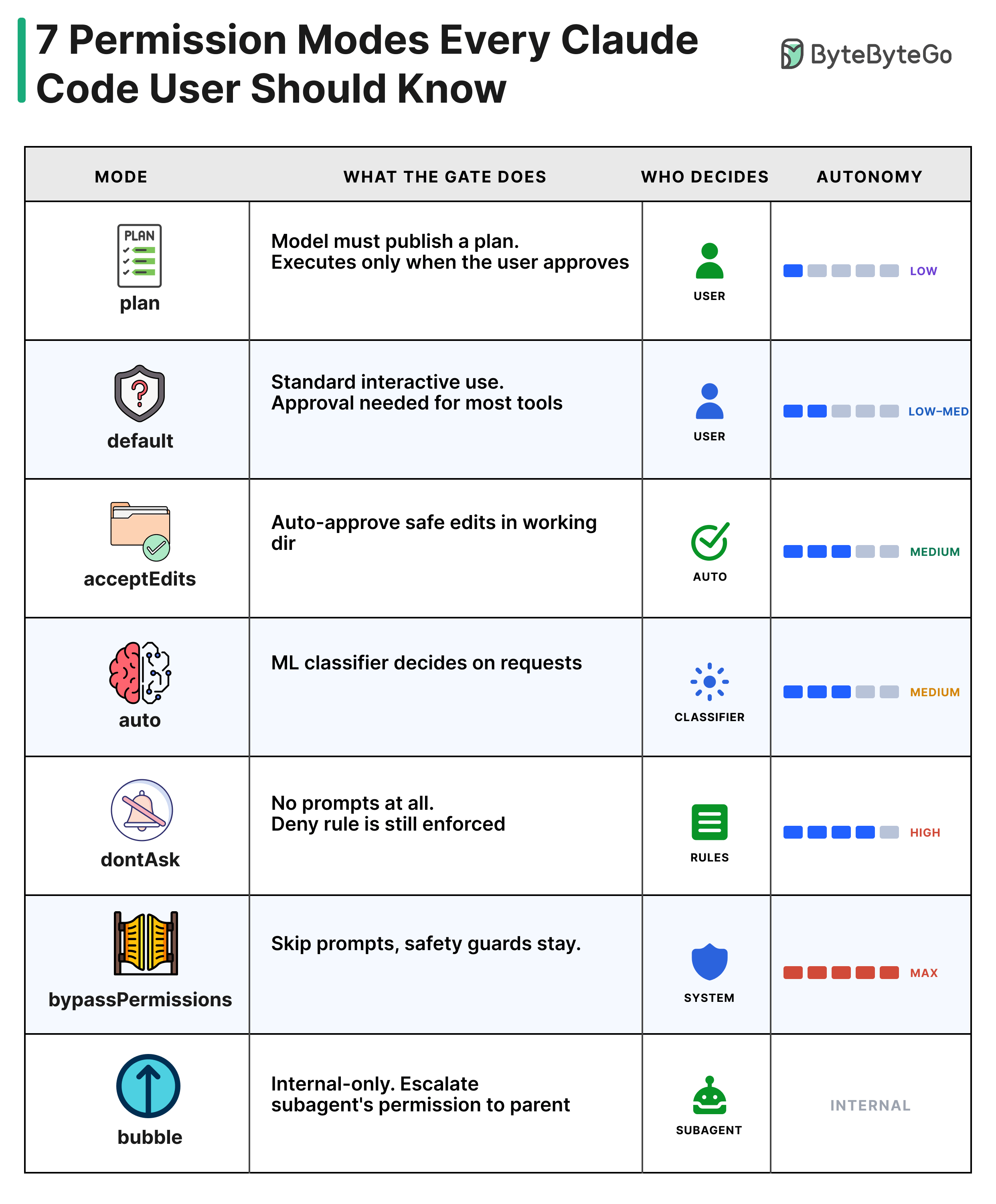
  1. plan: The model drafts a plan. Nothing executes until the user approves.

  2. default: Standard interactive use. Most tool calls require user approval.

  3. acceptEdits: Edits in the working directory are auto-approved. Other shell commands still prompt.

  4. auto: An ML classifier decides on requests that miss the fast path.

  5. dontAsk: No prompts shown. Deny rules are still enforced.

  6. bypassPermissions: Most prompts are skipped. Safety-critical guards still apply.

  7. bubble: A subagent escalates its permission request to the parent.

Only 5 modes are user-selectable. “auto” is gated by a feature flag, and “bubble” is internal.

Over to you: Which mode do you reach for most, and what made you pick it?

Discussion about this post

Ready for more?