









When querying ActiveRecord for greater than and less than, most people turn to including raw SQL in their codebase... But raw SQL isn't required!
Ally Piechowski · · 2 min read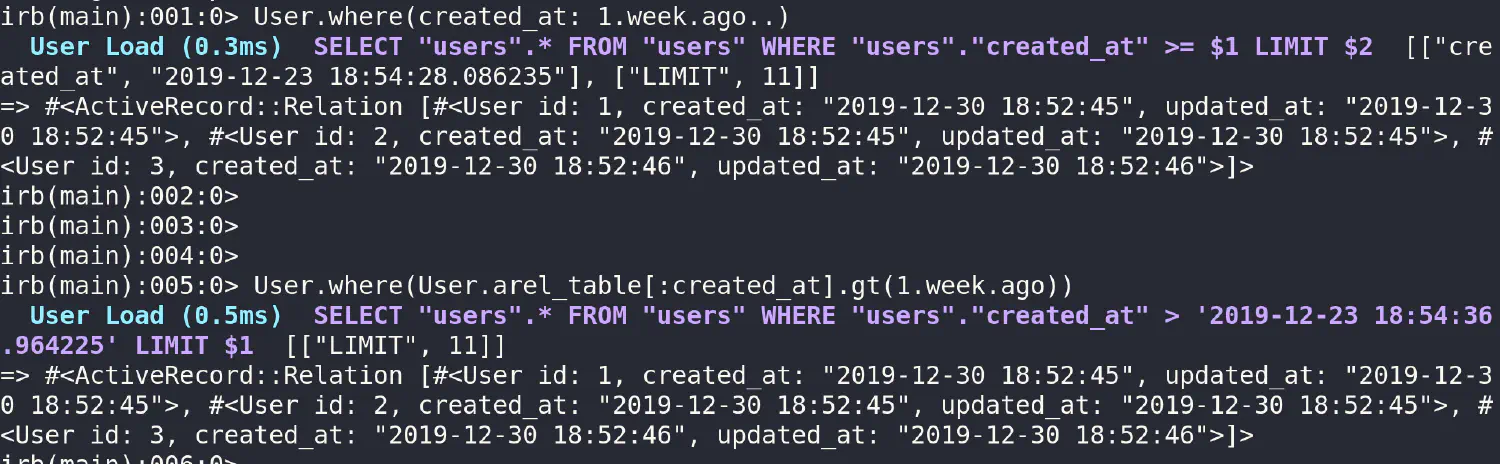
For example, if I want to find all users created within the last week, I would
ask for all users from my User model in which the column updated_at is
greater than 1 week ago, or 1.week.ago.
In Rails 5+ and Ruby 2.6+, the infinity range can be used like so:
User.where(created_at: 1.week.ago..)
If you haven’t upgraded to Ruby 2.6 yet, you can specify the end of the range as
the constant Float::INFINITY:
User.where(created_at: 1.week.ago..Float::INFINITY)
This is the best option because it is the closest syntax to actuality.
From 1 week ago until infinity == greater than or equal to 1 week ago
It also doesn’t have any of the caveats that using a raw string has (explained later in this post)
Utilizing arel directly, we can signal to ActiveRecord the logical SQL we want to do functionally:
User.where(User.arel_table[:created_at].gt(1.week.ago))
When faced with a challenging ActiveRecord Query that doesn’t fit into the core
ruby-style syntax, I typically turn to Arel to provide me with a functional
core and extra safety.
In ActiveRecord, it’s possible to utilize a raw string to access sql’s interface directly, like so:
User.where('users.created_at > ?', 1.week.ago)
Or even the keyword interpolation style:
User.where('users.created_at > :after_date', after_date: 1.week.ago)
While this works, using SQL strings with ActiveRecord isn’t always the best due to:
此内容由惯性聚合(RSS阅读器)自动聚合整理,仅供阅读参考。 原文来自 — 版权归原作者所有。