

惯性聚合 高效追踪和阅读你感兴趣的博客、新闻、科技资讯
阅读原文 在惯性聚合中打开

推荐订阅源

Forbes - Security
Forbes - Security
The Hacker News
The Hacker News
V
Vulnerabilities – Threatpost
C
CXSECURITY Database RSS Feed - CXSecurity.com
Spread Privacy
Spread Privacy
P
Proofpoint News Feed
AWS News Blog
AWS News Blog
S
Securelist
S
Security @ Cisco Blogs
Cloudbric
Cloudbric
T
Troy Hunt's Blog
SecWiki News
SecWiki News
cs.CL updates on arXiv.org
K
KPMG report finds enterprise disconnect between AI and its ROI | CIO
Security Latest
Security Latest
C
Cyber Attacks, Cyber Crime and Cyber Security
AI
AI
Threat Intelligence Blog | Flashpoint
Stack Overflow Blog
Stack Overflow Blog
I
Intezer
I
InfoQ
Attack and Defense Labs
H
Hackread – Cybersecurity News, Data Breaches, AI and More
Recent Commits to openclaw:main
T
The Exploit Database - CXSecurity.com
Cyber Security Advisories - MS-ISAC
N
News | PayPal Newsroom
云风的 BLOG
云风的 BLOG
S
Secure Thoughts
T
The Blog of Author Tim Ferriss
Martin Fowler
Martin Fowler
L
LINUX DO - 最新话题
Exploit-DB.com RSS Feed
D
Darknet – Hacking Tools, Hacker News & Cyber Security
A
About on SuperTechFans
Hacker News - Newest:
Hacker News - Newest: "LLM"
TaoSecurity Blog
TaoSecurity Blog
www.infosecurity-magazine.com
Webroot Blog
Webroot Blog
L
LangChain Blog
MyScale Blog
MyScale Blog
Recent Announcements
P
Privacy & Cybersecurity Law Blog
Vercel News
Vercel News
Engineering at Meta
Engineering at Meta
C
Cybersecurity and Infrastructure Security Agency CISA
Y
Y Combinator Blog
L
Lohrmann on Cybersecurity
B
Blog RSS Feed
The Last Watchdog
The Last Watchdog

Codebase Audits & Rescue | Ally Piechowski

How to Be a Good Open Source Maintainer "The Git Commands I Run Before Reading Any Code" "Ruby 3.2 Is EOL: What You Actually Need to Do" "Rails 7.2 to 8.1 Upgrade: What Actually Breaks and How to Fix It" "Why Your Engineering Team Is Slow (It's the Codebase, Not the People)" "Migrating from Sprockets to Propshaft: Is It Worth It?" "How to Close a Tab in Vim" "How I Audit a Legacy Rails Codebase in the First Week" "How to Open a New Tab in Vim" "Rails default_scope: Why You Should Never Use It" "Solved: ActionController::ParameterMissing (param is missing or the value is empty)" "Solved: Warning: Using the last argument as keyword parameters is deprecated" "Vim: How to Open Current Opened File in New Tab" "Rails: How to Use Greater Than/Less Than in Active Record where Statements" "What is the best time for stand-up meetings?" "What Is Fed vs Unfed Sourdough Starter?" "My Father, My Mentor, My Teacher" "How to Get Over Burnout" "What's the difference between a Good Developer and a Good Googler?" Codebase Audits & Rescue | Ally Piechowski
"Using Let and Context to Modularize RSpec Tests"
"Ally Piechowski" · 2019-12-24 · via Codebase Audits & Rescue | Ally Piechowski

When test suites contain a lot of duplication, coupling occurs at an individual spec basis. By utilizing core RSpec functionality, developers can clean up specs in order to reduce duplication and add clarity to the focal point of the spec.

Ally Piechowski · · 2 min read
Using Let and Context to Modularize RSpec Tests

When test suites contain a lot of duplication, coupling occurs at an individual spec basis. By utilizing core RSpec functionality, developers can clean up specs in order to reduce duplication and add clarity to the focal point of the spec.

If I want to test an invalid and valid email, it’s pretty easy to test with a basic RSpec test:

RSpec.describe User do
  it '[email protected] is a valid email' do
    expect(
        User.new(
          name: 'John Doe',
          email: '[email protected]',
          phone: '555-555-5555'
        )
    ).to be_valid
  end
  
  it 'johnatexampledotcom is not a valid email' do
    expect(
      User.new(
        name: 'John Doe',
        email: 'johnatexampledotcom',
        phone: '555-555-5555'
      )
  ).to_not be_valid
  end
end

While this may work for the first few specs, this starts to get a bit tedious and duplicative.

This is not optimal because our setup code has a lot of duplication and this duplicated code.

The RSpec Let + Context Pattern

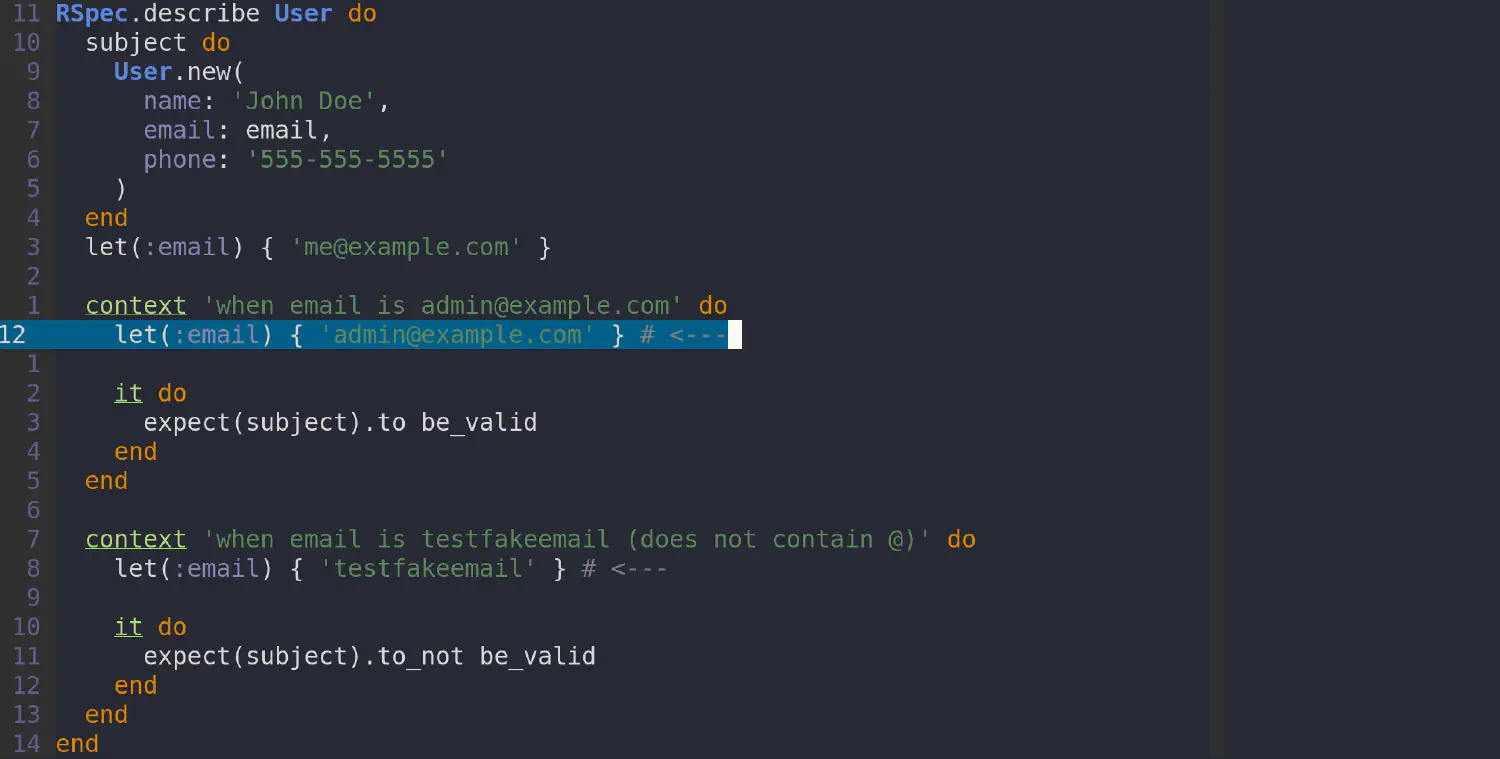
By using core Rspec functionality, we can spruce up these 2 tests like so:

RSpec.describe User do
  subject do
    User.new(
      name: 'John Doe',
      email: email,
      phone: '555-555-5555'
    )
  end
  let(:email) { '[email protected]' }

  context 'when email is [email protected]' do
    let(:email) { '[email protected]' }

    it do
      expect(subject).to be_valid
    end
  end

  context 'when email is testfakeemail (does not contain @)' do
    let(:email) { 'testfakeemail' }

    it do
      expect(subject).to_not be_valid
    end
  end
end

This provides us with:

  • DRY specs
  • Re-usable setup code
    • Additional specs within each context
    • New specs, such as “phone number validations”
  • Easily interpretable differences between specs

The context / let pattern brings the most clarity into the differences between the 2 tests. This pattern can be used with in combination with Factories in order to make my tests extra clear and extra dry. Additionally, this pattern typically results in a more thoughtful test output.


Related Articles