A view from the hot seat
“I’ve been thinking about reentry for three straight years.”
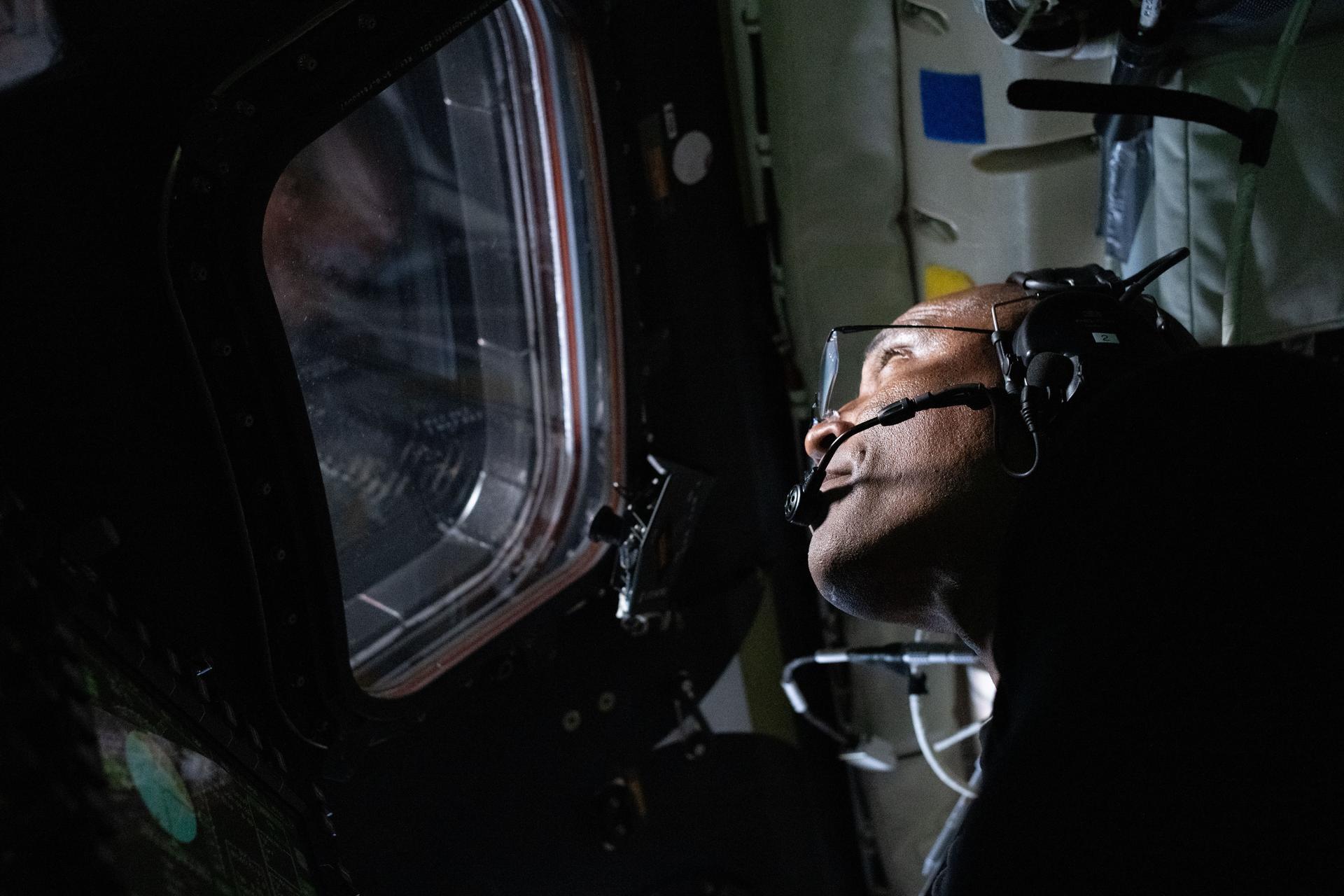
Artemis II Pilot Victor Glover pictured here in the Orion spacecraft during the Artemis II lunar flyby. Credit: NASA
Artemis II Pilot Victor Glover pictured here in the Orion spacecraft during the Artemis II lunar flyby. Credit: NASA
The crew of Artemis II spoke with the media on Thursday, six days after returning to Earth following their mission around the Moon. After a news conference, the astronauts gave a handful of interviews, and Ars was able to speak with Orion’s pilot, Victor Glover.
Glover and Ars first connected nearly a decade ago as part of our homage to Apollo, The Greatest Leap. Glover now stands at the vanguard of our modern Apollo program, named Artemis, which aims to return humans to the Moon and establish a semi-permanent base there.
Glover, an accomplished naval aviator, first went to space in November 2020 as the pilot on the first operational Crew Dragon mission to the International Space Station. Two years after he landed back on Earth, Glover was assigned to the Artemis II mission and tasked with a majority of the test piloting of the Orion spacecraft during the outbound and return journey from the Moon.
We spoke mostly about that experience at NASA’s Johnson Space Center on Thursday afternoon. This interview has been lightly edited for clarity.
Ars: You flew Dragon with touchscreens and Orion with more traditional, hands-on controls. I’m pretty sure I know the answer, but which did you prefer?
Victor Glover: You know me. We talked about Dragon a lot before, and it’s a fantastic ship to get humans to the space station. But I was really thrilled to have a translational hand controller, a THC, on Orion.
Ars: How did Orion handle compared to the simulations you did on Earth?
Glover: The real vehicle had better springs. There was less pre-play, less wobble in the stick, so when I would move something, the thruster sounds we had in the sim? Totally wrong. It was more of a rumble like driving a pickup on a dirt road.
The SM (Service Module) was nice—we could tell it was pressurizing and thrusting. It felt responsive. I could feel the push, but also I could see it in the camera instantly that there was motion. The integrated system flew so much better than the sim. That team should be very proud.
The modelers, the flight controllers, they came up with something. And even though there were pleasant surprises, overall, the real thing is better than we simulated. And that’s part of what being a test pilot is: to verify and validate manufacturing processes, software development processes, and sometimes teams. And all three of those, in this case, crushed it.
Ars: What do you think the implications are for Artemis III and Artemis IV when there will be some pretty complex rendezvous and docking operations with a lander?
Glover: The Lunar Science team won’t like it when I say this, but it’s the truth. If we had launched, done the rendezvous and proximity operations demo, and then had to emergency de-orbit, I would have considered us a massive success. Because that may be the only chance we get to test this really important capability.
We don’t plan to manually dock. It’s a crew interrupt. Boeing CFT (the Starliner Crew Flight Test in 2024, during which Butch Wilmore had to take control of the spacecraft during an emergency) has shown us when these things might need to be done. And Butch held position manually. He had to use his eyeballs to correlate where he was and just hold position. That was a critical moment for them to breathe, and for the team to collect themselves, because if they had tried to retreat or tried to continue docking with ISS, both of those would have been catastrophic.
So this capability, to me, was a huge milestone—now Artemis II gets to pass the baton to III and IV, whatever they are, docking, proximity ops again, landing. Those crews will have the peace of mind that the Artemis II test pilot said it was good to go. An engineer said it was good to go, and an F-18 pilot said it was good to go. That, to me, is unreal. We got so much juice for the squeeze on that.
Ars: But you had some fun?
Glover: It was also a ton of fun, truly a test pilot’s dream. I mean, I feel bad. I got to fly Dragon as well. I got to manually pilot Dragon. We got to do a fly-around for the port relocation. It was the first time that software got used in space, and I did that. So I got to do a few touchscreen commands and listen, I prefer a stick-and-throttle over a touchscreen any day.
But Dragon also flew like a dream. It worked. It does what they say it’s going to do. It’s really about the mission. They both are great tools. If I’m doing something where I’m so busy that I cannot stop and look down at my hands to fly, this is the biggest difference. I have to touch the screen, which means I have to look, because if I touch right next to that arrow, it doesn’t work. In Orion, I have a feel. I don’t have to look. I can focus on precision because I can look out the window the whole time. That’s the difference. So stick-and-throttle, or hand controllers, are vital depending on the type of tasks.
Ars: Did you guys ever do any flying off the books? I’m thinking of Apollo 12, during the ascent from the Moon. They’re in the shadow of the Moon, and Pete Conrad tells Alan Bean to take the Lunar Module controls for a spin when they were out of contact with Mission Control. Bean later recalled it as an unforgettable experience.
Glover: [laughs] OK, that’s good. Listen, we wanted everybody to have a meaningful role. I think you saw that everybody did critical things. Jeremy and Christina got us to the Moon and back. We [Reid and Glover] did ascent, prox-ops, and entry. But they monitored all the burns. The team really wrote the original plan for Reid and I to do all the flying, but we knew that it’s important to get this data because on future missions, you might have a doctor in that seat, and it’s important to know the vehicle from varying perspectives. We didn’t have to be sneaky because the team built a plan that capitalized on the strengths of the whole crew. Everyone got to fly it per the plan. And so Jeremy flew the vehicle, and Christina flew the vehicle.
Ars: You’ve talked about reentry, 13 minutes and 36 seconds. You called it “very intense.” You and I have talked about the heat shield concerns before. Walk me through the experience you just lived.
Glover: We got assigned on April 3, 2023. It was almost three years exactly ago. I’ve been thinking about reentry for three straight years, maybe too much. Maybe I focused on that too much, but I knew if anybody has to be on that day, I have to be a part of it. It’s not just me, but to back up Reid, or Reid backing me up. We’ve got to be in flow that day.
Having gone through something similar in Dragon was helpful. But that window on Orion was right in front of me, that view was so different. When the flames started, I was like, “That’s big. Is it supposed to be that big?” And then my brain just locked onto “OK, it all looks the same.” That’s a good sign. If I start to see changes, that’s something. And then there was a point—there’s something that I feel that I am not ready to say to the public yet.
Ars: OK.
Glover: But you know, I know what happened to Columbia, and that this is a system with no backup. But I was not worried. I wasn’t focused on that because we had already said we’re go for launch—and go for launch is go for entry. And I just said, “Hey, they need me to be on.” Reid needs me to be on. I need him to be on. What I’m saying is kind of what folks are expecting. So I need to do it like we’ve trained to do it.
And I was able to focus on that because whether or not the heat shield worked, there was nothing I could do. I couldn’t go outside and hold my hands over the spot. So the best I could do is if a parachute didn’t go out, to assess “do I need to do anything?” Or if the risers didn’t cut after we hit the water, to not get flipped over, I would have had to flip a switch, and I need to flip the right switch. So I just wanted to be present.
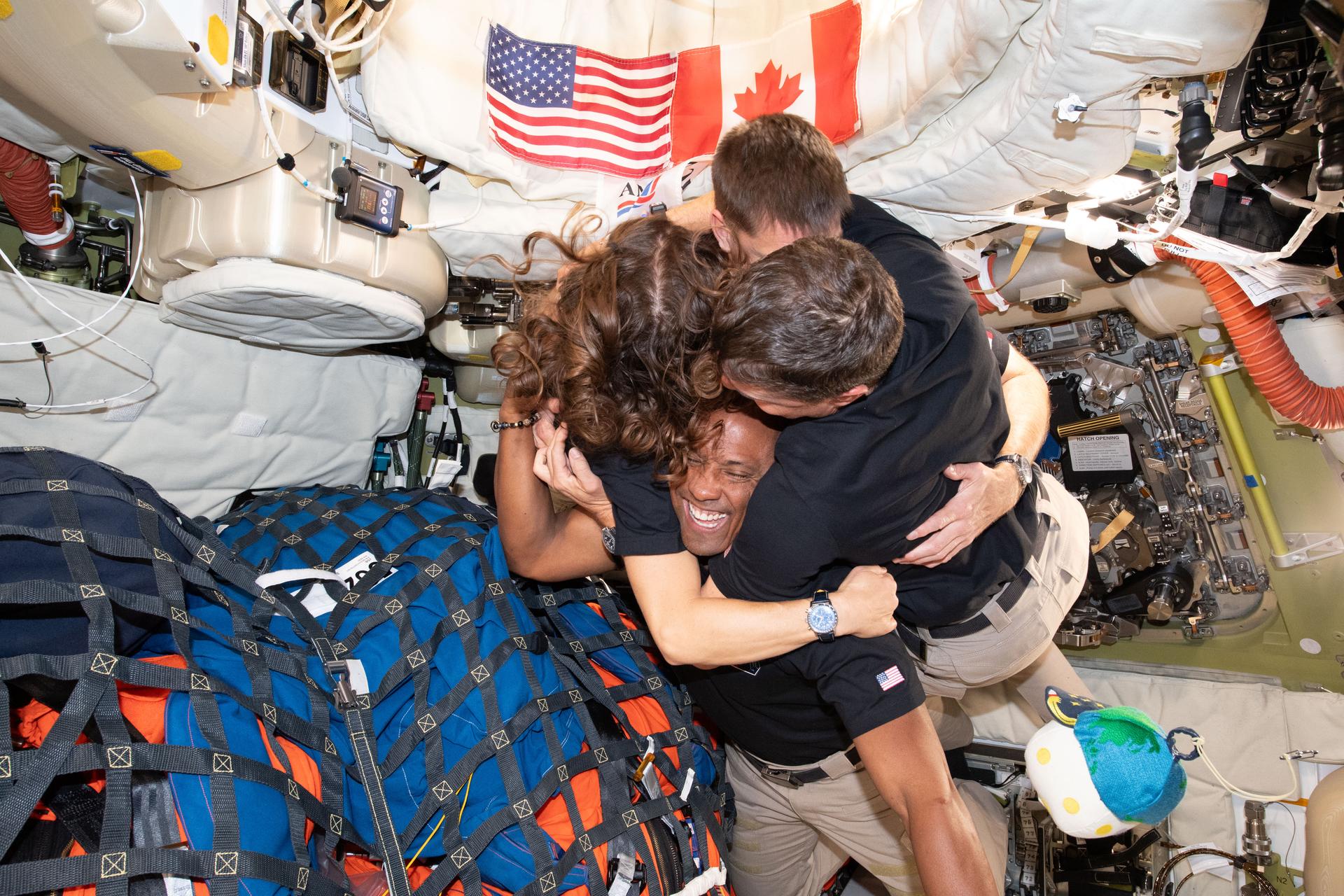
The Artemis II crew takes time out for a group hug before returning to Earth.
Credit: NASA
The Artemis II crew takes time out for a group hug before returning to Earth. Credit: NASA
Ars: What did you hear?
Glover: The sounds were something we didn’t simulate. There’s so much we didn’t model correctly on entry. But I still had to be present. Even when there was a new bump-bump-bump. Then there was the moment after the drogue parachutes released. [There was a break between the pull of the drogues and deployment of the main parachutes, when Orion started falling rapidly again.]
We were in free fall again. It wasn’t scary. I was just amazed because Dragon didn’t do that. I think the drogues on Dragon actually helped pull out the mains, so we stayed under tension. In Orion, we had a few seconds of free fall after the drogues. I just was—wow. That sensation was very vivid. And when those parachutes came out, when the mains came out, it was like God himself led us down to the water. And I had a big old grin on my face. It was intense. It went from intense to pure elation.
Ars: Where I was watching, there was silence during those final minutes, the parachutes, and the splashdown, just holding our collective breath. It was amazing. I think Artemis managed to break through.
Glover: I know we’re on to something. I know the 10 days we were up there are a big part of it, but I’m gonna say this to you as a person because, you know, I consider you a friend. A part of this is how we frame what we’re doing now, what we do next, the stories we choose to tell. There’s a lot of this we haven’t talked to you about, but now we have the challenge of keeping it going.
Eric Berger is the senior space editor at Ars Technica, covering everything from astronomy to private space to NASA policy, and author of two books: Liftoff, about the rise of SpaceX; and Reentry, on the development of the Falcon 9 rocket and Dragon. A certified meteorologist, Eric lives in Houston.