The interior is spectacular; the exterior looks better in person than on screen.
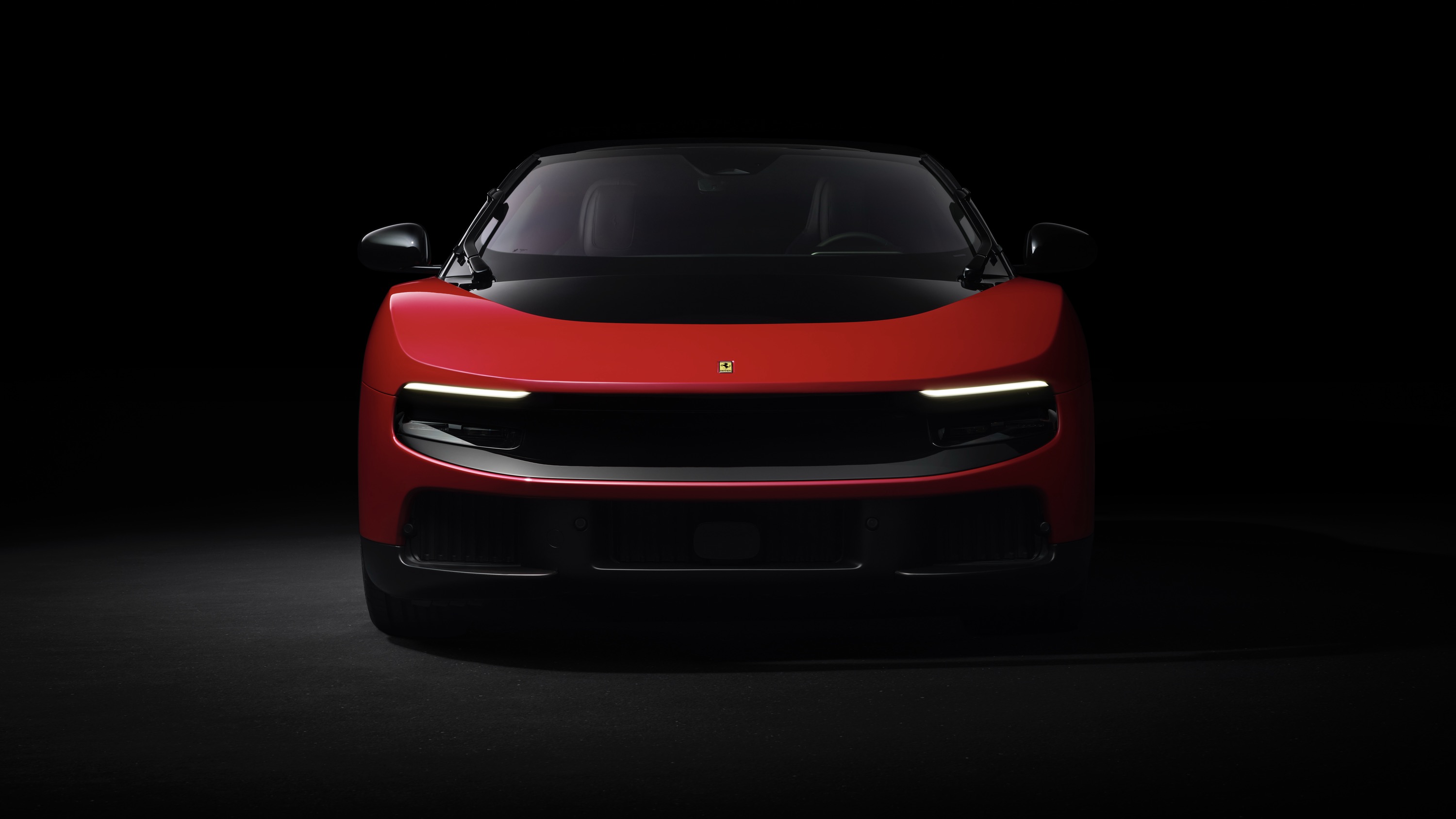
I think the shape works best in Rosso Dino, but I still need to see the car in sunlight. Credit: Ferrari
I think the shape works best in Rosso Dino, but I still need to see the car in sunlight. Credit: Ferrari
ROME—The arrival of any new Ferrari that isn’t a two-seater is usually controversial, but the Luce might be the most divisive yet. It’s Ferrari’s first four-door sedan and first five-seater, but perhaps most importantly—especially for readers of Ars Technica—it’s Ferrari’s first battery-electric vehicle.
Each of those individually is probably anathema to some Ferrari fans, never mind all three together. But it’s 2026, and the reality is that the manufacturer absolutely needs an emissions-free offering for vitally important markets like China and Silicon Valley. And now, here it is.
Like some legendary Ferraris of the past, the company chose to work with an outside design team for the Luce, in this case LoveFrom, helmed by Jony Ive and Marc Newson. Many will detect some hints of Apple in the car’s design; more than one journalist said they could imagine it wearing that computer company’s logo rather than the prancing horse shields that dot its exterior. But the almost cab-forward glasshouse perhaps calls to mind the Lotus Etna concept, with some Ferrari F90 (a one-off for the Sultan of Brunei) here and there, too. And the four round tail lights obviously reference ’90s designs like the 360 and 550.
I will say it looks a little better in the metal than it does in photos or on screen, although some of the shades we saw don’t do the shape many favors. I may even go as far as to say some of the more… unhinged reactions I’ve seen are negatively polarizing me into appreciating the design more, but perhaps that just makes me a contrarian.
I don’t think the Luce was what anyone was expecting. Ferrari
It’s a drag
Of course, the Luce looks the way it does for good reason. The initial aerodynamic studies began seven years ago, two years before Ferrari actually greenlit a plan to build a BEV. Their charge? Figure out how to make the lowest-drag Ferrari they could, without sacrificing aerodynamic downforce that keeps its cars planted to the road surface at speed.
They certainly put in some effort: 6,000 computational fluid dynamics simulations and more than 300 hours of wind tunnel time, including 80 hours with full-size models.
At the front, the hood dives down below a wing, funneling airflow up and over the roof to another wing that forms the rear deck. Equally important are the myriad active air vents that feed cooling radiators but also shape the airflow through and under the car’s body, with different configurations of opening and closing depending on whether the driver is going for efficiency or performance.
Official range estimates are a ways off, but Ferrari is targeting 330 miles (530 km) for Europe’s WLTP test in the most efficient configuration. That uses the aerodisc wheels, each machined from a single piece of aluminum and designed to minimize range-sapping eddies and wakes by funneling the air like a turbine.
A look at how the Ferrari Luce manages airflow.
A new standard
The Luce’s interior, by contrast, isn’t just the best interior of any Ferrari to date; it might be one of the best of any car we see in 2026 and needs to be the standard for all new Ferraris from here on out. We first saw some of the design elements—the steering wheel, instrument binnacle, and pivot-mounted infotainment screen—in isolation in February, but in the context of the full interior, I think they actually look even better.
The dash is machined from a single piece of brushed aluminum—happily, this means no chance of a third screen up front for the passenger—as are the components of the steering wheel, the door handles, and the round air vents that are delightfully tactile and valved like a car’s exhaust.
The main instrument binnacle is fixed to the steering column and moves with it; it’s made up of two OLED displays sandwiched together, with the second one visible through circular cutouts to create dials. The middle of these is the speedometer, which uses a physical needle rather than one made of pixels. To its left is a power and regeneration meter, and to the right is a multifunction display.
The pivoted infotainment screen is also rather impressive. Brushed aluminum rocker switches let you easily control the climate without taking your eyes off the road, and there are physical buttons (made of the same gorilla glass as the rest of the screen) to access settings and media. I can confirm that Apple CarPlay is present and correct—when active, it spans the width of the display and uses maybe half its height. Perhaps the coolest bit is the clock in the top-right corner, which, at the press of a button, cycles into a 60-second stopwatch, and then a compass. People can argue if the look is more Apple Watch or Ikepod; either way, I think it’s fantastic.
Frankly, this interior is worth the price of admission. Ferrari
How fast, how much?
Some of the Luce’s technical details have been public since last October, when we learned it would feature four electric radial flux motors with a peak combined output of 1,035 hp (772 kW) and 730 lb-ft (990 Nm), powered by a 122 kWh battery pack operating at 800 V.
Ferrari went for pouch cells developed with SK On and promises that it will continue to support the pack decades from now, pointing out that more than 90 percent of the cars it has built are still on the road and that that shouldn’t change just because this one doesn’t use gasoline. DC Charging is at up to 350 kW, and Ferrari says the Luce can add 70 kWh in just 20 minutes; AC charging tops out at 22 kW.
The two front motors each generate 140 hp (105 kW) and 103 lb-ft (140 Nm) and share a 300 kW inverter. Meanwhile, the rear motors offer 415 hp (310 kW) and 261 lb-ft (355 Nm). The rear axle uses a 600 kW inverter that also handles a DC/DC conversion to power the suspension: some very clever 48 V spool dampers developed with Multimatic (and already used to good effect on Ferraris like the F80 and Purosangue).
The suspension should do a decent job of hiding the Luce’s curb weight, which at 4,895 lb (2,260 kg) makes it slightly heavier than Porsche’s stripped-out Taycan Turbo GT but a heavy adult lighter than either the Lucid Air Sapphire or Mercedes-AMG’s new GT. Then again, I think you might be able to buy all three of those for the price of a well-configured Luce; we expect pricing in Europe to start at 550,000 euros ($640,000).
It needs to be engaging
As you might imagine from a company that has spent decades perfecting electronic chassis control systems, the four motors are tightly integrated into the Ferrari’s handling. Governing the whole thing is what Ferrari calls the Vehicle Control Unit, which constantly monitors torque and grip at each corner, as well as driver inputs and other relevant data from the vehicle’s sensors, with different levels of intervention or torque vectoring depending upon your drive mode.
What we didn’t quite learn back in October is how those two aluminum paddles behind the wheel contribute to the experience. At the time, we assumed Ferrari was following Hyundai’s example with the Ioniq 5 N, which replicates a semi-automatic transmission by changing regenerative braking and throttle map profiles.
That’s actually not quite how the paddles work here. The one on the left increases regenerative braking through five levels, from 0.05–0.6 G, but as you increase regen, you also decrease power output. The right paddle decreases regen but increases torque delivery. So as you approach a corner and want some deceleration, you use the left paddle as you would to downshift a conventional Ferrari, then use the right paddle from the apex to add more power. It sounds intriguing, and I’m told it’s very intuitive.
That’s if you’re in one of the two modes that use the paddles—you can also just drive the car without bothering with the paddles.
In Range mode, the Luce limits itself to just 430 hp (320 kW), rarely uses its front motors, and tops out at 161 mph (260 km/h). Use the e-Manettino—the brushed-aluminum dial on the right side of the wheel—to switch into Tour and power up to 577 hp (460 kW). The top speed remains the same, but this mode is permanently in all-wheel drive, and it’s also when you’ll start to hear amplified sounds from the motors and inverters as they deploy and harvest power, giving the driver some familiar audio feedback.
Performance mode unlocks full nominal power: 972 hp (725 kW), a top speed of 192 mph (310 km), and the most aggressive control maps. To access the Luce’s peak output, use the launch control dial on the roof; it will send you to 62 mph (100 km/h) from a standstill in 2.5 seconds and 125 mph (200 km/h) in 6.8 seconds.
An animation showing the Ferrari Luce’s torque-vectoring and handling.
As noted, Ferrari has a lengthy history of using electronics to control traction and stability; at the twist of the red Manettino on the right side of the wheel, you can make the cars docile in the rain or ice, or playful and permissive on track. The latest version is called Side Slip Control X, which integrates an alphabet soup’s worth of subsystems: ASC 3.0, PCV 3.0, FDE+, ABS Evo, vDiff, eTrac, and FLOW.
There’s also a full complement of advanced driver assists, like adaptive cruise, automatic emergency braking, and so on. Refreshingly, I’ve heard nothing at all about any future self-driving mode, although I’m now imagining what Ferrari could do with the idea of a “rollercoaster mode,” one of the entries to a design forum held by Audi back in 2014.
Is it like Marmite?
Thanks to the dubious reliability of transatlantic Internet service, you’re reading this a few hours after the embargo expired, and the online reaction has been predictable. With the exception of the other 200-odd journalists present inside the ribcage-like Vela di Calatrava on Sunday night, none of those critics has actually seen the design in person, and many fewer still are likely to be in the market for an electric car that costs more than much of its competition combined.
In person, it’s a less challenging design, and like BMW’s i7 before it, the interior is magical enough to make up for exterior design elements I don’t care for. After all, you can’t see the outside when you’re sitting inside it.
But I’m not sure it will matter. Luces will definitely sell to customers who want to make sure they’re in line for the next Ferrari supercar, and I’d imagine more than a few Ferrari owners will buy one as a daily driver, particularly in regions where heavy EV penetration and tech wealth intersect.

Jonathan is the Automotive Editor at Ars Technica. He has a BSc and PhD in Pharmacology. In 2014 he decided to indulge his lifelong passion for the car by leaving the National Human Genome Research Institute and launching Ars Technica's automotive coverage. He lives in Washington, DC.