Fireball
SpaceX has more to prove before flying Starship all the way to low-Earth orbit.
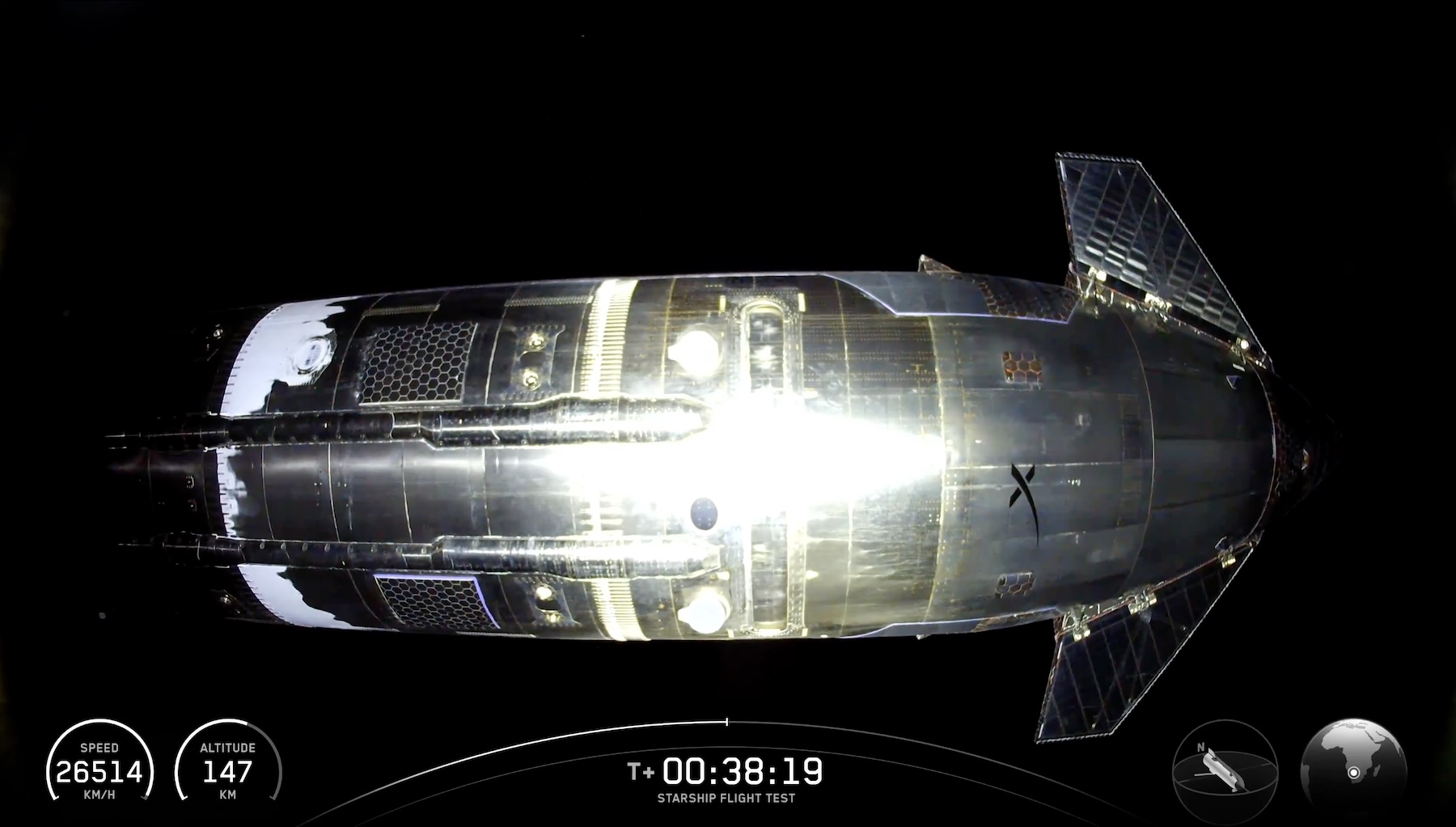
A spacecraft deployed from Starship captured this view of the vehicle in darkness over the South Atlantic Ocean. Credit: SpaceX
A spacecraft deployed from Starship captured this view of the vehicle in darkness over the South Atlantic Ocean. Credit: SpaceX
SpaceX launched the first test flight of its upgraded Starship rocket and Super Heavy booster Friday, with mostly positive results.
The powerful rocket, propelled by 33 methane-fueled main engines, climbed away from SpaceX’s Starbase launch facility in South Texas at 5:30 pm CDT (6:30 pm EDT; 22:30 UTC) Friday. Within a few seconds, the 408-foot-tall (124-meter) rocket, the largest ever built, cleared the launch tower and turned onto an eastward heading over the Gulf of Mexico.
Starship splashed down on target in the Indian Ocean a little more than an hour later to conclude the first flight of the latest version of SpaceX’s stainless-steel mega-rocket. Starship V3 fared better on its debut than the first flights of Starship V1 and V2 in 2023 and 2025. Both past versions of Starship broke apart during launch on their inaugural flights.
SpaceX officials appeared pleased with the performance of Starship V3 on Friday. Elon Musk, the company’s founder and CEO, congratulated his engineers with a post on X: “Congratulations SpaceX team on an epic first Starship V3 launch & landing! You scored a goal for humanity.”
“Congrats and a huge thank you to the SpaceX team that always delivers,” Gwynne Shotwell, SpaceX’s second in command, wrote in an X post. “This was an incredible first flight of a brand new vehicle. Our collective future flying amongst the stars has become so much closer.”
Leaders at NASA, relying on SpaceX to provide Starship as a human-rated Moon lander, were closely watching the launch. NASA Administrator Jared Isaacman was in Texas to witness the launch in person. He lauded SpaceX for a “hell of a V3 Starship launch.”
Starship’s 12th test flight was a long time coming. The last Starship test flight took off last October. The gap of more than seven months was the longest interval between Starship flights since the program’s first full-scale launch in April 2023. SpaceX used the time to complete construction and activation of a second launch pad at Starbase as engineers steered Starship V3 through ground testing, which had its own share of setbacks.
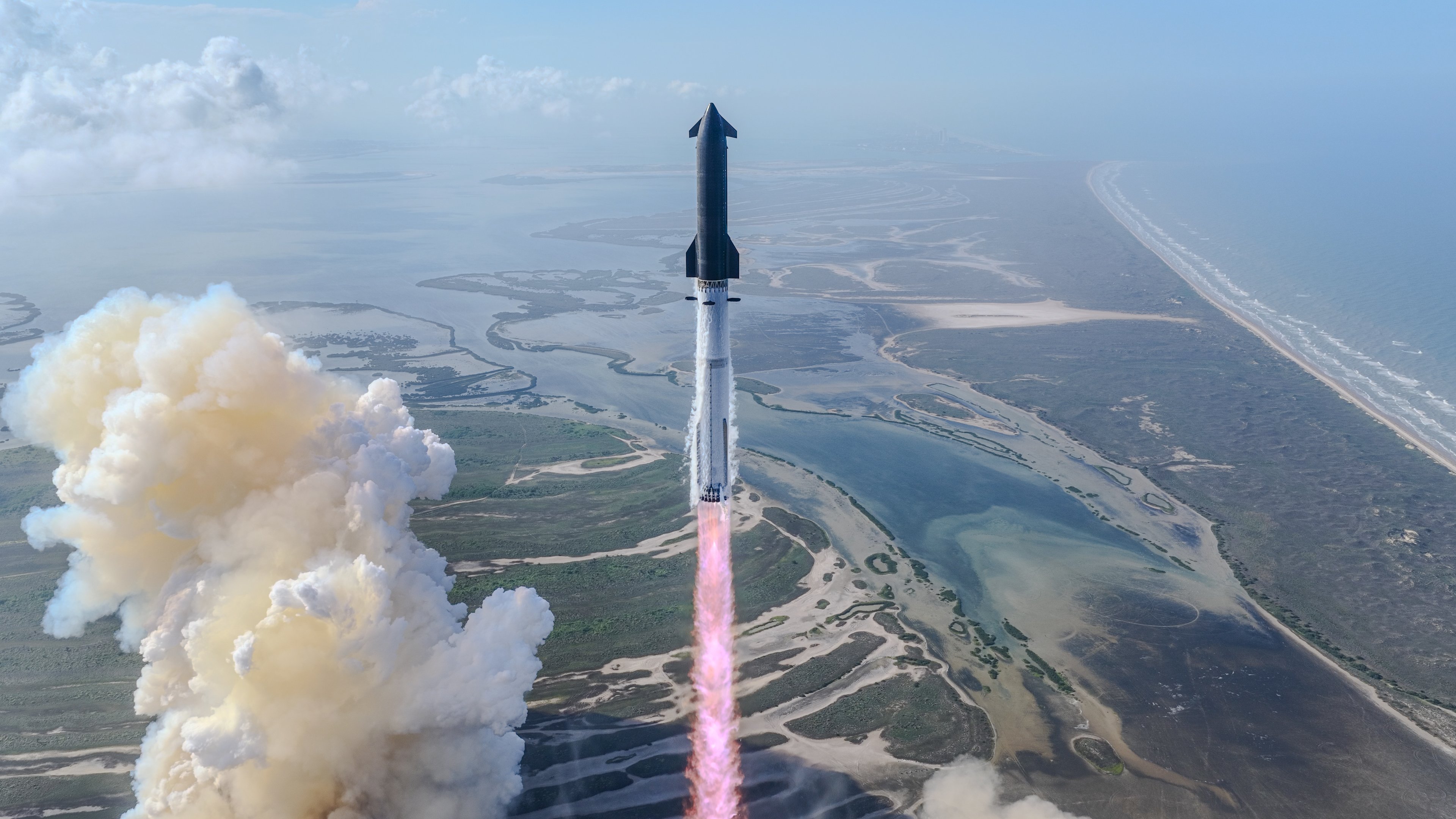
Starship climbs away from Starbase, Texas, after liftoff at 5:30 pm local time Friday.
Credit: SpaceX
Starship climbs away from Starbase, Texas, after liftoff at 5:30 pm local time Friday. Credit: SpaceX
What was good?
So what worked on Friday’s test flight? Plenty. Most importantly, the ship’s heat shield appeared to hold up during reentry over the Indian Ocean. Onboard cameras showed the vehicle’s aerodynamic flaps intact throughout the fiery descent through the atmosphere. The heat shield and flaps didn’t always fare so well on past Starship test flights. Starship executed a series of banking maneuvers on the way toward the splashdown zone northwest of Australia, simulating the path future ships will take returning to landings at Starbase.
That all went well, with the descent culminating in a dramatic maneuver to flip from horizontal to vertical. A final landing burn with the ship’s Raptor engines downshifted from three to two, then to a single engine as the rocket settled to a gentle water landing. Drones and buoy cameras recorded live views of the on-target splashdown. As expected, the ship—wider than and nearly as long as a Boeing 777 jetliner—tipped over and exploded in a fireball, putting an exclamation point on V3’s trip halfway around the world from the Texas Gulf Coast.
Earlier in the flight, SpaceX demonstrated Starship V3’s improved payload deployment mechanism. The system is tailored for releasing SpaceX’s flat-packed Starlink Internet satellites. SpaceX tested the Pez-like deployment system on past test flights, but upgrades on Starship V3 allow the mechanism to release satellites at a faster rate. On Friday, the dispenser deployed 20 mockups of SpaceX’s next-generation Starlink satellites, plus two spacecraft fitted with flashlights and cameras to inspect Starship’s exterior in space.
All of this worked perfectly as the ship soared to a maximum altitude of 121 miles (195 kilometers) in darkness over the South Atlantic Ocean. SpaceX says this version of Starship can haul up to 100 metric tons of payload into low-Earth orbit, more than double the capacity of Starship V2.
Meanwhile, initial inspections of SpaceX’s new launch pad at Starbase, used for the first time Friday, showed the facility weathered the intensity of liftoff with no significant problems. This is a promising sign for SpaceX’s plans for new launch pads at Cape Canaveral, Florida, which use the new Starbase pad as a design template.
Splashdown confirmed! Congratulations to the entire SpaceX team on the twelfth flight test of Starship! pic.twitter.com/XXBAtryPpL
— SpaceX (@SpaceX) May 22, 2026
What needs more work?
Something caused two Raptor engines—one of 33 on the Super Heavy booster and one of six on Starship itself—to fail during Friday’s launch sequence. Raptor failures are nothing new for SpaceX, but this flight marked the first use of the company’s upgraded Raptor 3, a redesign with higher thrust, lighter weight, and improved efficiency. Collectively, the 33 Raptor engines on the booster produced up to 18 million pounds of thrust at full throttle, twice the power of NASA’s Space Launch System rocket used on last month’s Artemis II mission.
Starship and Super Heavy have engine-out capability, meaning they can recover from an early shutdown of an engine. Both stages proved this Friday. First, an engine in the outer ring on the Super Heavy booster shut down prematurely shortly after liftoff. A few moments later, an outer engine on the Starship upper stage cut off soon after the ship and booster separated from one another high over the Gulf.
The ship compensated by burning its five remaining engines a little longer than usual, and the rocket was still able to reach its planned trajectory. The booster, however, hurtled toward a high-speed impact in the Gulf after it was unable to complete maneuvers to return to a controlled splashdown offshore from Starbase. It was not immediately clear what caused the early end to the rocket’s boost-back burn: whether the malfunction stemmed from an external problem during stage separation or a separate issue within the booster’s propulsion system.
One key objective SpaceX did not accomplish Friday was a planned restart of one of the ship’s Raptor engines in space. Officials elected to forego the brief ignition after the ship’s engine failure during ascent.
What does this mean?
Friday’s results give SpaceX a lot to build on. The performance of the heat shield, widely recognized as perhaps the program’s most challenging engineering problem, must be reassuring for SpaceX officials seeking to eventually recover and rapidly reuse future ships. The ship’s resilience to an engine failure was also encouraging news for SpaceX.
But there’s still more work ahead for SpaceX to perfect the Raptor 3 engine, and skipping the engine relight in space will likely prevent SpaceX from attempting a full orbital flight of Starship on the next launch. All 12 of SpaceX’s Starship test flights to date have flown on suborbital trajectories. Officials want to ensure they can guide Starship back to Earth before putting a vehicle into orbit, because an unguided reentry could endanger the public with falling debris. Starship, after all, is the world’s largest and most massive spacecraft other than the International Space Station.
A perfect performance on Flight 12 may have given engineers the data they need for an orbital flight on the next launch, and perhaps even attempt to bring Starship back to the launch site in Texas for a catch by giant mechanical arms on the launch tower. An orbital flight would also move SpaceX closer to beginning critical orbital refueling tests for NASA’s Artemis program, along with deploying real Starlink satellites from Starship.
The results from Friday’s flight show there’s still room for improvement, but SpaceX will be ready to chase perfection again soon. The company has more ships and boosters on track for test flights later this summer.

Stephen Clark is a space reporter at Ars Technica, covering private space companies and the world’s space agencies. Stephen writes about the nexus of technology, science, policy, and business on and off the planet.