

惯性聚合 高效追踪和阅读你感兴趣的博客、新闻、科技资讯
阅读原文 在惯性聚合中打开

推荐订阅源

量子位
Google DeepMind News
爱范儿
爱范儿
OSCHINA 社区最新新闻
OSCHINA 社区最新新闻
NISL@THU
NISL@THU
T
Threat Research - Cisco Blogs
freeCodeCamp Programming Tutorials: Python, JavaScript, Git & More
L
Lohrmann on Cybersecurity
V
Visual Studio Blog
Cyberwarzone
Cyberwarzone
D
Docker
The Hacker News
The Hacker News
C
CERT Recently Published Vulnerability Notes
Vercel News
Vercel News
Project Zero
Project Zero
S
Schneier on Security
aimingoo的专栏
aimingoo的专栏
I
Intezer
腾讯CDC
M
MIT News - Artificial intelligence
Hugging Face - Blog
Hugging Face - Blog
P
Palo Alto Networks Blog
C
CXSECURITY Database RSS Feed - CXSecurity.com
AWS News Blog
AWS News Blog
GbyAI
GbyAI
MongoDB | Blog
MongoDB | Blog
Cyber Security Advisories - MS-ISAC
V
Vulnerabilities – Threatpost
G
Google Developers Blog
N
Netflix TechBlog - Medium
The Cloudflare Blog
Microsoft Security Blog
Y
Y Combinator Blog
A
Arctic Wolf
S
Securelist
酷 壳 – CoolShell
酷 壳 – CoolShell
Cisco Talos Blog
Cisco Talos Blog
Recent Announcements
C
Cyber Attacks, Cyber Crime and Cyber Security
L
LINUX DO - 热门话题
T
Threatpost
Latest news
Latest news
Blog — PlanetScale
Blog — PlanetScale
Security Latest
Security Latest
Engineering at Meta
Engineering at Meta
大猫的无限游戏
大猫的无限游戏
H
Help Net Security
The GitHub Blog
The GitHub Blog
T
Tor Project blog
P
Proofpoint News Feed

Ars Technica - All content

Pentagon wants $54B for drones, more than most nations’ military budgets Mozilla: Anthropic's Mythos found 271 security vulnerabilities in Firefox 150 Supreme Court arguments make it clear that FCC fines are "nonbinding" Silo S3 teaser hints at the wasteland's origins Framework's CEO on the RAM crisis and creating a "MacBook Pro for Linux users" Florida probes ChatGPT role in mass shooting. OpenAI says bot "not responsible." Report: Meta will train AI agents by tracking employees' mouse, keyboard use Microsoft removes Call of Duty from Game Pass, lowers subscription pricing Framework Laptop 13 Pro is a major overhaul for the modular, upgradeable laptop Framework Laptop 16 upgrades make it look less like an unfinished prototype Internal emails show how Amazon raises prices across the Internet, lawsuit says Anthropic gets $5B investment from Amazon, will use it to buy Amazon chips CATL's new LFP battery can charge from 10 to 98% in less than 7 minutes AMD Ryzen 9 9950X3D2 Dual Edition review: Tons of cache for tons of dollars What's the deal with spacesuits for the Moon? Will they be ready in time? Loneliness in older adults can often lead to memory impairment Contrary to popular superstition, AES 128 is just fine in a post-quantum world Pentagon pulls the plug on one of the military's most troubled space programs John Ternus will replace Tim Cook as Apple CEO Blue Origin's rocket reuse achievement marred by upper stage failure I’ve fired one of America’s most powerful lasers—here’s what a shot day looks like Great white sharks are overheating US-sanctioned currency exchange says $15 million heist done by "unfriendly states" Man with @ihackedthegovernment Instagram account tells judge, “I made a mistake" Trump picks qualified, normal health leader to head CDC; experts still cautious $25,000 buys plenty of used EVs: Here are some options Satellite and drone images reveal big delays in US data center construction Amazon won’t release Fire Sticks that support sideloading anymore Ridley Scott's post-apocalyptic The Dog Stars drops first trailer Artemis II pilot talks about what it was really like to fly and land in Orion Meta's AI spending spree is helping make its Quest headsets more expensive Rocket Report: Starship V3 test-fired; ESA's tentative step toward crew launch Recent advances push Big Tech closer to the Q-Day danger zone After a saga of broken promises, a European rover finally has a ride to Mars Lucasfilm drops The Mandalorian and Grogu final trailer at CinemaCon Intel refreshes non-Ultra Core CPUs with new silicon for the first time OpenAI starts offering a biology-tuned LLM As they got close to the Moon, Artemis II astronauts were eager to land Mozilla launches Thunderbolt AI client with focus on self-hosted infrastructure Ad firms settle with Trump FTC over claims they boycotted conservative media New Codex features include the ability to use your computer in the background The Ukraine war's deep impact on Metro 2039’s development, story New undersea cable cutter risks Internet’s backbone Microsoft and Stellantis want to use AI to help car owners Gemini can now create personalized AI images by digging around in Google Photos RFK Jr. forces FDA to reconsider 12 unproven peptides after 2023 ban First look: Also's upcoming e-bike disconnects the pedals and wheels Meet the Quantum Kid The race to Shackleton Crater is on—will Jeff Bezos or China get there first? Florida surgeon charged with killing man after removing liver instead of spleen Jury finds Live Nation/Ticketmaster is illegal monopoly that overcharged fans "TotalRecall Reloaded" tool finds a side entrance to Windows 11's Recall database Google releases new apps for Windows and MacOS Boston Dynamics’ robot dog now reads gauges and thermometers with Google's AI Prime Video shows “technical difficulties” sign instead of NBA game in overtime New teaser gives us first look at Godzilla Minus Zero Vulcan woes will "absolutely" be a factor in Pentagon's next rocket competition Adobe takes Creative Cloud into Claude Code-esque territory Good Omens S3 trailer sets up a blessed conclusion Bubble watch: Fashion brand Allbirds pivots hard to become AI services company New 3D map of Universe could solve dark energy mystery What’s the deal with Alzheimer’s disease and amyloid? Blue Origin has a new employee stock plan, but not everyone is happy It's Tax Day, and no one knows how to file for prediction market winnings Ukraine’s military robot surge aims to offset drone risks to humans Sony killing features for antenna, set-top box users of Bravia smart TVs in May Americans ask AI for health care. Hospitals think the answer is more chatbots. NASA chose the right crew to launch a new era of human space exploration Google will begin punishing sites for back button hijacking in June Retro Rewind re-creates the glorious drudgery of working a '90s video store Google shoehorned Rust into Pixel 10 modem to make legacy code safer NZXT agrees to let customers keep their rental PCs in class-action settlement Your tech support company runs scams. Stop—or disguise with more fraud? Sunrise on the Reaping teaser brings us a Second Quarter Quell IBM folds to Trump anti-DEI push, admits no misconduct but pays $17M penalty Slate Auto raises $650 million as production gets closer and closer Meta spins up AI version of Mark Zuckerberg to engage with employees To teach in the time of ChatGPT is to know pain Shock from Iran war has Trump's vision for US energy dominance flailing The Artemis II mission has ended. Where does NASA go from here? AI models are terrible at betting on soccer—especially xAI Grok Four astronauts are back home after a daring ride around the Moon Californians sue over AI tool that records doctor visits New paper argues history, not mantle plume, powers Yellowstone F1 moves a step closer to fixing its 2026 hybrid problem Report: US demands Reddit unmask ICE critic, summons firm to grand jury Microsoft's "commitment to Windows quality" starts with overhaul of beta program "Oobleck" still holds some surprises YouTube increases Premium price again, says 90-second unskippable ads are a bug Oldest octopus fossil found to not be an octopus What leaked "SteamGPT" files could mean for the PC gaming platform's use of AI Here's what to expect from the fiery, 14-minute return of Artemis II Pro-Iran Explosive Media trolls Trump with AI-generated Lego cartoons Dad stuck in support nightmare after teen lied about age on Discord Rocket Report: Chinese version of Falcon 9 fails; Artemis depends on rapid heavy lift Orion helium leak no threat to Artemis II reentry but will require redesign RFK Jr. rewrites CDC panel's charter, opening door to anti-vaccine quacks AI on the couch: Anthropic gives Claude 20 hours of psychiatry Clinical trial shows gene editing works for β-Thalassaemia, too “Negative” views of Broadcom driving thousands of VMware migrations, rival says
Carbon nanotube wiring gets closer to competing with copper
John Timmer · 2026-04-24 · via Ars Technica - All content

Skip to content

While this material degrades over time, it could point to better ones.

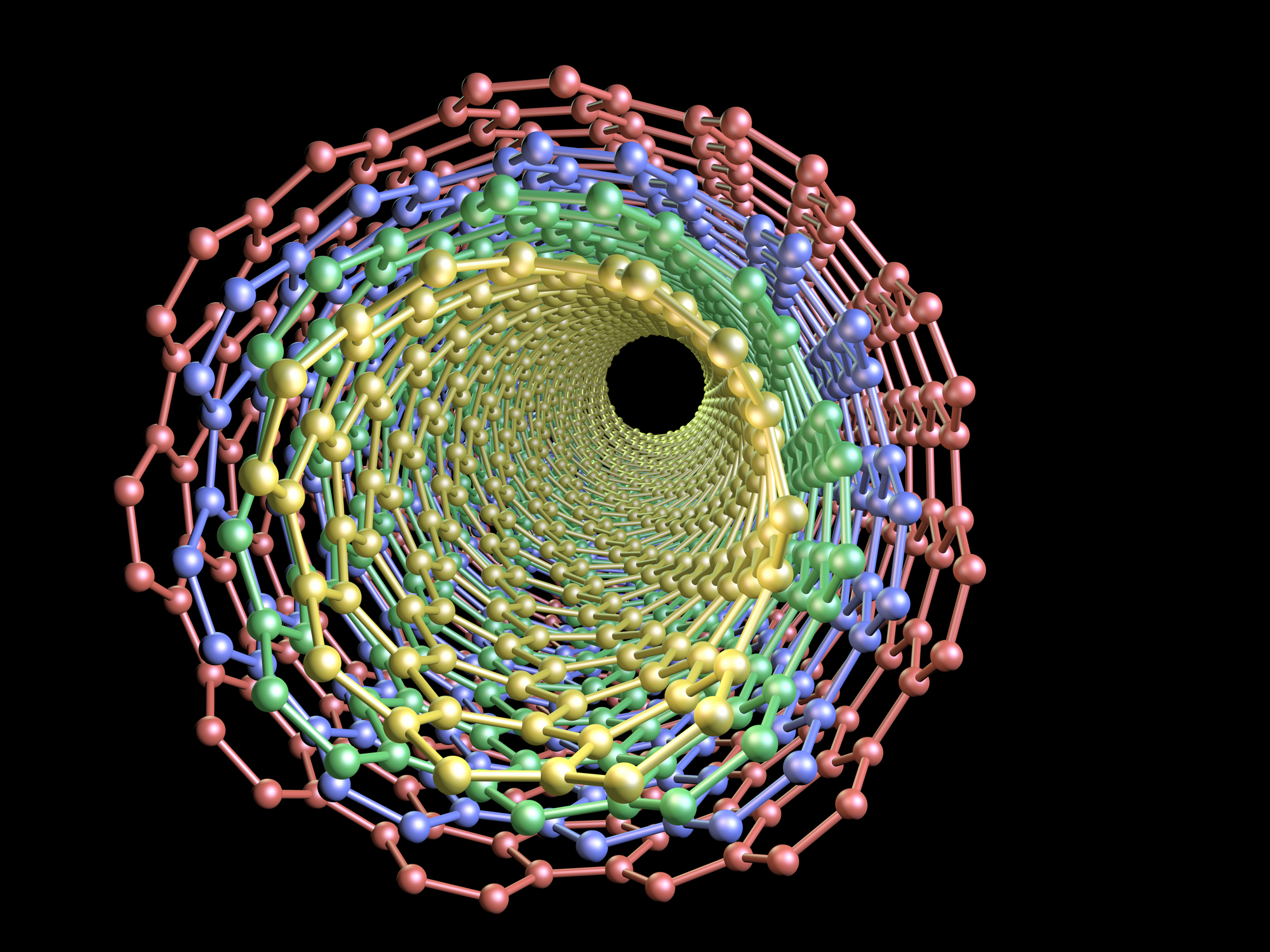
Image of a ball-and-stick model of carbon nanotubes. The main tube is composed of four individual tubes wrapped concentrically around each other, each a different color.

A multi-walled carbon nanotube. In this work, the tubes only had two layers. Credit: theasis

A multi-walled carbon nanotube. In this work, the tubes only had two layers. Credit: theasis

Shortly after their discovery, carbon nanotubes seemed to be a material wonder. There were metallic and semiconducting forms; they were tiny and incredibly light; and they could only be broken by tearing apart chemical bonds. The ideas for using them seemed endless.

But then the reality of working with them set in. It was hard to get a pure population of metallic or semiconducting forms. Synthesis techniques tended to produce a tangle of mostly short nanotubes; those that extended for more than a couple of centimeters remain rare. And while the metallic version offered little resistance to carrying electric current, it was hard to send many electrons down the nanotube.

Materials scientists, however, are a stubborn bunch, and they’re still trying to get them to work. Today’s issue of Science includes a paper describing the addition of a chemical to carbon nanotube bundles to boost their ability to carry current to levels closer to those of copper. While the more conductive nanotubes weren’t stable, the discovery may point the way toward something with a longer shelf life.

Doped nanotubes

Carbon nanotubes come in various forms. In the case of single-walled nanotubes, you can think of them as taking a sheet of graphene, rolling it up into a circle, and linking together the two opposite ends you just brought together. These can also be different diameters. There are also multi-walled carbon nanotubes, where a second nanotube (and maybe third, and maybe more beyond that) is wrapped around the first.

When metallic, these offer little resistance to electron flow along the nanotube. But, because most of their electrons are tied up in the chemical bonding needed to form the nanotube, there’s not a lot of them available to carry current. So, a lot of people have tried developing dopants—chemicals that can be mixed in small quantities that change the behavior of the bulk material. In this case, the goal was to find chemicals that would act as electron donors, adding to the amount of current that could potentially be sent down the nanotube.

Obviously, isolated nanotubes can’t really have dopants, since they’re pretty self-contained. But the team behind the new work, based in Spain, was working with bulk nanotube fibers, which are a mixture of nanotubes of various lengths bundled into a larger fiber, with most individual nanotubes oriented along the fiber’s long axis. In this case, the fiber was made from double-walled nanotubes, given its interior a pretty consistent structure.

You can think of the interior space of these fibers as a bit like what you’d get if you were packing spherical objects into a box. Even under the most efficient packing arrangement, there will be gaps between neighboring spheres. In the same way, these fibers have internal spaces that can allow additional chemicals to be incorporated inside the fiber.

The nanotube fibers themselves came from a commercial supplier. To dope these fibers, the researchers decided to use tetrachloroaluminate, or AlCl4, a charged molecule that has electrons to spare. To get it into the spaces between the nanotubes, they used a vapor composed of aluminum trichloride plus a source of additional chlorine. This seeped into the fibers themselves and formed the charged tetrachloroaluminate in place.

Current carrying

A large chunk of the paper simply consists of imaging and spectroscopy that confirms the expected chemical is present in the spaces between the nanotubes. There was also a fair bit of modeling using Density functional theory to confirm that the resulting doping would be expected to make additional electrons available to carry current. Overall, they estimate that the resulting material has a chemical formula of C39AlCl4 and that the chemical changes occur without altering the fiber’s physical size.

The interesting results come when the researchers start looking into the material’s current-carrying capacity. Doping with the aluminum stuff boosted the mean conductivity by a factor of 10. That is about as high as any previously tested dopant achieved. The highest individual fiber they tested saw this rise to an over 15x improvement and is about 70 percent as conductive as aluminum (which makes it a bit less than half as good as copper).

However, a key feature of this is that the doping doesn’t add much mass to what’s a very light material to start with. So, normalized by density, the doped carbon nanotube fibers actually outperformed copper.

This may sound like an artificial standard, but it could actually matter in applications where space isn’t a concern, and/or where weight is. So, if you could tolerate the wiring being a bit over twice the thickness, then it should be an option to just use a nanotube fiber that’s thicker than the copper wire you’d otherwise need. Another application might be high-capacity transmission lines, where getting the same performance with a lower weight could save money on the support towers needed.

Relevant to this last application, the doping doesn’t alter the durability of the (very tough) carbon nanotube fibers. They have higher tensile strength than either copper or aluminum, and they are closer to steel.

Before you rush out to invest in carbon nanotube futures, however, there is a major issue: The tetrachloroaluminate isn’t stable under normal environmental conditions, as it will react with water molecules in the air. The researchers could extend its useful life by sealing the fibers in a polymer coating, but it still had a lifetime measured in weeks rather than the decades we would want to see.

That doesn’t mean this research is useless. It clearly demonstrates the potential of these materials if the price of carbon nanotube fibers could be brought down. It has identified the structural and chemical features of a highly effective dopant that boosts conductivity, which may ultimately allow us to identify a similar yet more stable chemical to replace it.

Science, 2026. DOI: 10.1126/science.aeb0673 (About DOIs).

Photo of John Timmer

John is Ars Technica's science editor. He has a Bachelor of Arts in Biochemistry from Columbia University, and a Ph.D. in Molecular and Cell Biology from the University of California, Berkeley. When physically separated from his keyboard, he tends to seek out a bicycle, or a scenic location for communing with his hiking boots.
48 Comments