




惯性聚合 高效追踪和阅读你感兴趣的博客、新闻、科技资讯
阅读原文 在惯性聚合中打开

推荐订阅源

freeCodeCamp Programming Tutorials: Python, JavaScript, Git & More
T
Tailwind CSS Blog
J
Java Code Geeks
Microsoft Azure Blog
GbyAI
GbyAI
爱范儿
爱范儿
量子位
Martin Fowler
Martin Fowler
V
V2EX
博客园 - 三生石上(FineUI控件)
I
InfoQ
MongoDB | Blog
MongoDB | Blog
奇客Solidot–传递最新科技情报
奇客Solidot–传递最新科技情报
N
Netflix TechBlog - Medium
D
DataBreaches.Net
钛媒体:引领未来商业与生活新知
钛媒体:引领未来商业与生活新知
Last Week in AI
Last Week in AI
U
Unit 42
Apple Machine Learning Research
H
Help Net Security
T
The Blog of Author Tim Ferriss
Hugging Face - Blog
Hugging Face - Blog
美团技术团队
Engineering at Meta
Engineering at Meta

Ars Technica - All content

Pentagon wants $54B for drones, more than most nations’ military budgets Mozilla: Anthropic's Mythos found 271 security vulnerabilities in Firefox 150 Supreme Court arguments make it clear that FCC fines are "nonbinding" Silo S3 teaser hints at the wasteland's origins Framework's CEO on the RAM crisis and creating a "MacBook Pro for Linux users" Florida probes ChatGPT role in mass shooting. OpenAI says bot "not responsible." Report: Meta will train AI agents by tracking employees' mouse, keyboard use Microsoft removes Call of Duty from Game Pass, lowers subscription pricing Framework Laptop 13 Pro is a major overhaul for the modular, upgradeable laptop Framework Laptop 16 upgrades make it look less like an unfinished prototype Internal emails show how Amazon raises prices across the Internet, lawsuit says Anthropic gets $5B investment from Amazon, will use it to buy Amazon chips CATL's new LFP battery can charge from 10 to 98% in less than 7 minutes AMD Ryzen 9 9950X3D2 Dual Edition review: Tons of cache for tons of dollars What's the deal with spacesuits for the Moon? Will they be ready in time? Loneliness in older adults can often lead to memory impairment Contrary to popular superstition, AES 128 is just fine in a post-quantum world Pentagon pulls the plug on one of the military's most troubled space programs John Ternus will replace Tim Cook as Apple CEO Blue Origin's rocket reuse achievement marred by upper stage failure I’ve fired one of America’s most powerful lasers—here’s what a shot day looks like Great white sharks are overheating US-sanctioned currency exchange says $15 million heist done by "unfriendly states" Man with @ihackedthegovernment Instagram account tells judge, “I made a mistake" Trump picks qualified, normal health leader to head CDC; experts still cautious $25,000 buys plenty of used EVs: Here are some options Satellite and drone images reveal big delays in US data center construction Amazon won’t release Fire Sticks that support sideloading anymore Ridley Scott's post-apocalyptic The Dog Stars drops first trailer Artemis II pilot talks about what it was really like to fly and land in Orion
Report: Samsung execs worried company could lose money on...
Ryan Whitwam · 2026-04-25 · via Ars Technica - All content

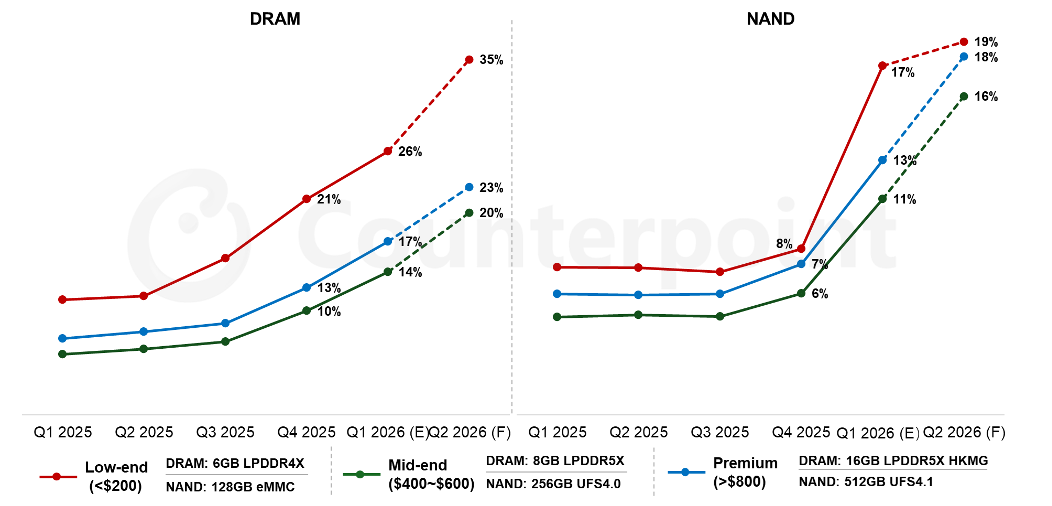
chart of memory and storage component prices

Manufacturing smartphones is getting much more expensive.

Credit: Counterpoint Research

Manufacturing smartphones is getting much more expensive. Credit: Counterpoint Research

The good news for Samsung is that while the MX division struggles, its semiconductor division is raking it in. Samsung Semiconductor has smashed records in the first quarter of 2026, earning an estimated $38 billion (KRW 57.2 trillion) in profit. That’s more than seven times its net from Q1 2025.

Samsung, Micron, and SK Hynix are all accelerating plans to expand memory and storage production lines—Samsung specifically has started spinning down LPDDR4 production to boost the supply of LPDDR5—but Nekkei Asia projects that won’t be enough. Even with best-case improvements in output, DRAM production in 2027 could fall 40 percent short of expected demand. The only thing that could challenge that prediction is a substantial change in demand for AI applications. With most of the world’s tech giants firmly committed to expanding AI compute through next year, it’s unlikely that supply constraints will ease soon.

Higher demand, higher prices

There are already signs that RAM and storage costs are making phones more expensive. Motorola recently raised the price of its Moto G budget phones by up to 50 percent. Low-cost devices like the Moto G will feel the rising cost of components the most, making the very idea of a budget phone in the coming years suspect.

With the prospect of sinking profitability in 2026, Samsung is also making changes. The recently released Galaxy A37 and A57 mid-range devices come with a $50 price hike over the last generation. The company has also increased prices on some more expensive devices, adding $80 to the Galaxy Z Flip 7 (512 GB) and Z Fold 7 (512 GB and 1 TB). Some of its tablets are also more spendy, including a $100 increase for the Galaxy Tab S11.

With profitability in doubt, Samsung is on the verge of releasing new, ultra-expensive phones. This summer, the company will debut a new generation of Galaxy Z foldables, which are always priced even higher than the Galaxy S series. These devices come with ample storage and RAM to help justify the exorbitant price tags. That makes them prime candidates for price hikes that leave foldables even more unrealistically expensive.