

惯性聚合 高效追踪和阅读你感兴趣的博客、新闻、科技资讯
阅读原文 在惯性聚合中打开

推荐订阅源

酷 壳 – CoolShell
酷 壳 – CoolShell
H
Hacker News: Front Page
P
Palo Alto Networks Blog
T
ThreatConnect
Apple Machine Learning Research
博客园_首页
T
True Tiger Recordings
P
Privacy & Cybersecurity Law Blog
B
Blog
IT之家
IT之家
Last Week in AI
Last Week in AI
F
Full Disclosure
Hacker News: Ask HN
Hacker News: Ask HN
C
Comments on: Blog
Microsoft Azure Blog
C
Cybersecurity and Infrastructure Security Agency CISA
Microsoft Security Blog
博客园 - 【当耐特】
N
News and Events Feed by Topic
NISL@THU
NISL@THU
腾讯CDC
雷峰网
雷峰网
Security Latest
Security Latest
李成银的技术随笔
M
Microsoft Research Blog - Microsoft Research
L
LangChain Blog
L
Lohrmann on Cybersecurity
cs.CL updates on arXiv.org
C
Check Point Blog
Y
Y Combinator Blog
Recent Announcements
博客园 - Franky
N
News | PayPal Newsroom
V
V2EX
A
About on SuperTechFans
The Register - Security
月光博客
月光博客
奇客Solidot–传递最新科技情报
奇客Solidot–传递最新科技情报
Google Online Security Blog
MyScale Blog
MyScale Blog
Cisco Talos Blog
Cisco Talos Blog
Vercel News
Vercel News
WordPress大学
WordPress大学
C
Cyber Attacks, Cyber Crime and Cyber Security
The Hacker News
The Hacker News
IntelliJ IDEA : IntelliJ IDEA – the Leading IDE for Professional Development in Java and Kotlin | The JetBrains Blog
爱范儿
爱范儿
A
Arctic Wolf
L
LINUX DO - 最新话题
freeCodeCamp Programming Tutorials: Python, JavaScript, Git & More

Ars Technica - All content

Famously secret about its finances, SpaceX opens its books for the first time Trump admin didn't want Ebola-exposed Americans, sent them to Berlin, Prague NASA's Psyche spacecraft returns unfamiliar views of a familiar world Masters of the Universe final trailer brings the '80s nostalgia Leaving the V8 in the past: The all-electric Mercedes-AMG GT 4-Door AMD reportedly plans Ryzen 5800X3D re-release for upgraders on a budget Google publishes exploit code threatening millions of Chromium users Trump wants $1B to protect White House ballroom from drones and other threats Hulu set to keep existing as standalone streaming service and app (for now) Chickens without eggs? De-extinction company creates artificial egg. Minnesota prohibits prediction markets, promptly gets sued by Trump admin Buckle up: Google is set to remake search with agentic AI in 2026 Man wins $835K after sheriff jailed him for a month over Charlie Kirk post Russia's plan to advertise on rockets and spacecraft takes off Yearslong fight over users' right to tweak smart TV software heads to trial China banned RTX 5090D V2 while Nvidia CEO Jensen Huang was visiting The Internet can't stop watching Figure AI's humanoid robots handling packages Moose-proof and megacasting: Ars drives the new Volvo EX60 FBI seeks US-wide access to license plate cameras, wants "data in near real time" Spider-Noir's final trailer leans into the deadpan humor "I'll buy 10 of those"—NASA science chief yearns for mass-produced satellites Plex's 200% Lifetime Pass price hike tries forcing users to another subscription Two AI-based science assistants succeed with drug-retargeting tasks Google's SynthID AI watermarking tech is being adopted by OpenAI, Nvidia, and more In stunning display of stupid, secret CISA credentials found in public GitHub repo RFK Jr. forced to withdraw charter that opened CDC panel to anti-vaccine quacks Google announces agent-optimized Gemini 3.5 Flash and a do-anything model called Omni The era of 1,000 Hz gaming monitors has arrived, but why? Bipartisan bill in Congress includes $130 annual EV registration fee Civilization VII finally lets you build a civ that stands the test of time Electrical utility megamerger is all about the data centers In addition to space stations, Vast says it will now build high-power satellites Iran demands Big Tech pay fees for undersea Internet cables in Strait of Hormuz Ebola outbreak: WHO declares emergency, US restricts travel, American infected Legal fail: Don’t use AI to sue Facebook users for calling you a bad date One Mars spacecraft, two Senators, and a cloud of questions 1,000-year-old burial reveals close bonds between people and dingoes Elon Musk loses trial accusing Sam Altman, OpenAI of stealing a charity Pompeii victim ID'd as a likely doctor New Lanterns teaser brings back the superhero vibes The Dory Sign is E ink, smart screen simplicity at its finest Five years later, Windows 11 brings back much-missed taskbar options (and more) BMW sends off the 6th-gen M3 CS with a manual gearbox, rear-wheel drive Did Artemis II break through? Registrations at Space Camp double afterward. Bug bounty businesses bombarded with AI slop The US space enterprise is desperately waiting for Starship—will it finally deliver? A revolutionary cancer treatment could transform autoimmune disease The US is betting on AI to catch insider trading in prediction markets Russia pressures university students to become wartime drone pilots Authors fight for higher payouts from Anthropic’s $1.5B copyright settlement US hantavirus case was false positive; outbreak cases drop from 11 to 10 Review: Chaotically uneven Good Omens finale still conjures up old magic Solar power production undercut by coal pollution Weather-monitoring firm hangs dark cloud over customers’ heads by forcing new app Three's a party: US, China, and now Russia are on the prowl in GEO Ebola outbreak confirmed in Congo and Uganda; 246 suspected cases, 65 deaths Preprint server arXiv will ban submitters of AI-generated hallucinations OpenAI feels “burned” by Apple’s crappy ChatGPT integration, insiders say How the other half lives: VW shows off electric Polo GTI for Europe Making cement from a different type of rock could clean up emissions Bill to keep online games playable clears key hurdle in California Honda shows off new hybrids for America as it absorbs $9 billion EV loss Casimir force co-opted to generate free energy, midichlorians not included Rocket Report: Russia claims success with new ICBM; spaceplane déjà vu in Europe Routine vaccines may cut dementia risk—experts have startling hypothesis on how Pennsylvanians use town hall meeting to rail against data center boom The perfect commuter bike? Velotric's Discover 3 makes its case. Claude Code's product lead talks usage limits, transparency, and the "lean harness" Men use "vocal fry" more than women, counter to stereotype Fired hacker twins forget to end Teams recording, capture own crimes Cell phone users can't stop incriminating themselves Energy supplier abandons Lake Tahoe residents to serve data centers AMD promises to bring improved, hardware-backed FSR 4 upscaling to older Radeon GPUs Judge probes whether Musk settlement with Trump admin is tainted by corruption Zero-day exploit completely defeats default Windows 11 BitLocker protections Your doctor’s AI notetaker may be making things up, Ontario audit finds Vaporware or not? Aptera assembles its first five validation models. Cisco announces record revenue and 4,000 layoffs in the same day Forecasters predict wildfires, floods, severe heatwaves from incoming El Niño Motorola Razr Fold review: Fits neatly in your pocket but not your budget Desperate Trump taps "Tim Apple," Jensen Huang, Elon Musk to attend Xi summit Solar drone with jumbo jet wingspan broke a flight record—then it crashed FCC angers small carriers by helping AT&T and Starlink buy EchoStar spectrum Protein in Homo erectus teeth suggests Denisovans gave us some of their DNA Foiled plot tried to sneak 49 lbs of cocaine into Australia via Xerox printers AI invades Princeton, where 30% of students cheat—but peers won't snitch The physics of how Olympic weightlifters exploit barbell's "whip" NASA provides some details about Artemis III, but hard decisions remain A new US military wargame series began by simulating a nuclear weapon in orbit Neanderthals drilled cavities to treat a toothache 59,000 years ago Altman forced to confront claims at OpenAI trial that he's a prolific liar Windows Update is getting better at saving your PC from buggy drivers Amazon devices chief says a new smartphone is “just not the goal” Anthropic blames dystopian sci-fi for training AI models to act “evil” Gravitational lens shows a galaxy just 800 million years post-Big Bang Blue Origin may need external funding to hit ambitious launch targets Daredevil: Born Again S2 gives us a darker, grittier canvas Rivian adds a new onboard AI assistant to its latest software update Could this be the moment that drug manufacturing takes off in orbit? The newest AI boom pitch: Host a mini data center at your home
After a saga of broken promises, a European rover finally has a ride to Mars
Stephen Clar · 2026-04-17 · via Ars Technica - All content

Skip to content

Looking rosy

Europe’s first Mars rover mission is now on its fourth rocket: SpaceX’s Falcon Heavy

In this image from 2019, engineers install the panoramic camera on the Rosalind Franklin rover at an Airbus facility in Stevenage, England. Credit: Airbus–M.Alexander

NASA confirmed Thursday that SpaceX will launch the European Space Agency’s Rosalind Franklin Mars rover, perhaps as soon as late 2028, on a Falcon Heavy rocket from Kennedy Space Center, Florida.

So why is NASA deciding which rocket will launch a flagship European Mars mission? It’s a long story involving the search for extraterrestrial life, crippling political hatchets, and of all things, Russia’s invasion of Ukraine.

You can trace the history of Europe’s Rosalind Franklin mission back nearly a quarter-century. A few years after NASA landed its first rover on Mars in 1997, the European Space Agency came up with a plan to send its own mobile robot to the red planet. The European rover was part of a program named Aurora, and officials hoped to launch it in 2009. Russia would have supplied a Soyuz rocket to send the rover on its way.

Stops and starts

“Delays ensued and plans changed,” ESA officials wrote in a 2016 fact sheet on the mission. This has become quite the understatement. What was originally a mostly European project, renamed ExoMars, became the centerpiece of a joint initiative with the United States in 2009, when NASA and ESA signed an agreement to pursue the exploration of Mars together.

The European rover was to fly to Mars in tandem with a similarly sized US rover in 2018. A landing system based on the Jet Propulsion Laboratory’s “sky crane” architecture would deliver both rovers to the surface of Mars at the same time. A European orbiter designed to sniff out traces of methane in the Martian atmosphere would launch in 2016, two years before the rovers. NASA agreed to launch the 2016 and 2018 missions on a pair of United Launch Alliance Atlas V rockets.

But NASA pulled out of the agreement less than three years later. The Obama administration canceled most of NASA’s participation in ExoMars in 2012, citing budgetary constraints such as cost overruns with the James Webb Space Telescope. ESA had its own funding limitations and could not afford to replace NASA’s launch and landing system contributions on its own.

Instead, the agency turned to Russia to launch the orbiter and rover on two Proton rockets and provide the descent system to deliver the rover to Mars. In exchange, ESA agreed to add Russian science instruments to the orbiter and rover missions. This was a boon for Russian scientific institutions. Without an international partnership like ExoMars, they lacked any realistic prospect of ever sending their own research payloads to the red planet.

Russia successfully launched the European-built ExoMars Trace Gas Orbiter spacecraft on a Proton rocket in 2016. The orbiter is still operating around Mars today, returning scientific data and serving as a communications relay for NASA’s Curiosity and Perseverance rovers. A small European tech demo probe riding piggyback on the orbiter crash landed upon reaching the red planet.
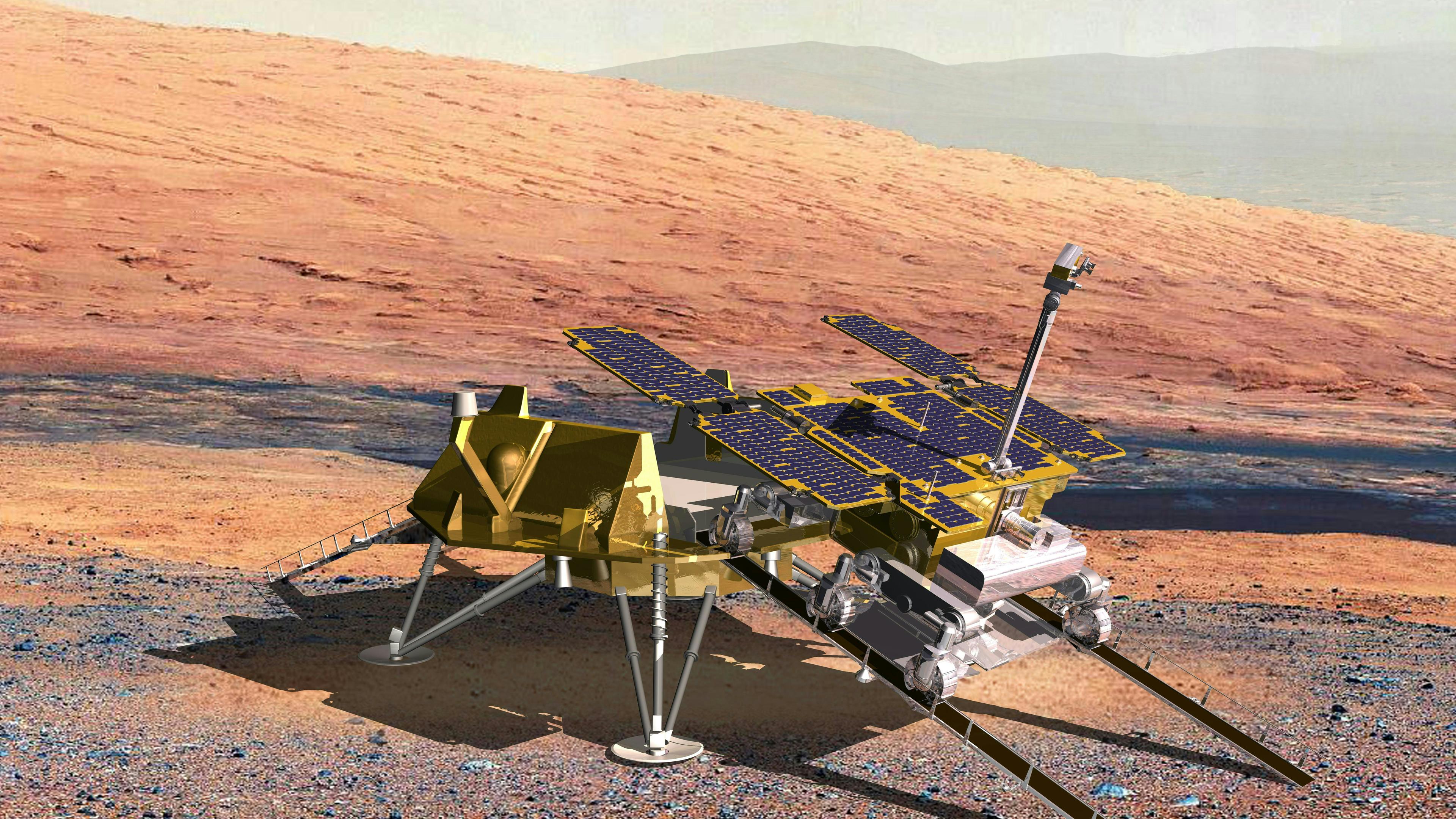
Artist’s illustration of the Rosalind Franklin rover departing its landing platform on Mars.

Credit: Airbus

Artist’s illustration of the Rosalind Franklin rover departing its landing platform on Mars. Credit: Airbus

Additional delays pushed the launch of the ExoMars rover from 2018 until 2020. The rover, by then named for the late British chemist and DNA research pioneer Rosalind Franklin, was nearly ready for launch in 2020 when a series of parachute test failures and the COVID-19 pandemic prompted another delay until late 2022.

Everything changed again when Russian forces invaded Ukraine in February 2022. ESA severed most ties with Russia’s space agency, ending the partnership on ExoMars after all of the mission’s elements, including the Russian rocket and Mars descent stage, were already built and ready for final assembly. ESA also removed two Russian science instruments from the mission.

Once again, the US government stepped in to give the Rosalind Franklin rover a ride to Mars. NASA and ESA formalized the new agreement in 2024, with the US side committing to provide a launch vehicle, the braking engines needed to land, and small nuclear-powered heaters to keep the rover’s sensitive electronics warm during Martian nights. NASA long ago delivered a mass spectrometer for the European rover that will analyze Martian soil to look for markers of organic molecules.

ESA is providing the rover and the carrier spacecraft to ferry it to Mars. Europe is also responsible for the overall assembly of the landing platform and operating the rover on the Martian surface. Airbus built the rover in the United Kingdom and is supplying the main structure for the lander, which will settle onto Mars and deploy ramps for the rover to disembark and begin its mission. German company OHB manufactured the carrier spacecraft, or cruise stage, to shepherd the rover from Earth to Mars. Thales Alenia Space of Italy is in charge of putting all the pieces together and readying the mission for launch.

Remaining relevant

But there was still one more hurdle to jump. Last year, just 12 months after NASA committed to help ESA with Rosalind Franklin, the Trump administration tried to cancel the US contributions, along with numerous other NASA science missions. Lawmakers rejected Trump’s proposed budget cuts when Congress passed the fiscal year 2026 budget bill for NASA.

Now, NASA has approved the agency’s Rosalind Franklin Support and Augmentation (ROSA) project to begin implementation. This announcement Thursday was accompanied by news of NASA’s decision to award the Rosalind Franklin launch contract to SpaceX. The Falcon Heavy now becomes the fourth rocket officials have planned to use for launching Europe’s first Mars rover. This time, there’s a real contract on the books. It will likely be SpaceX’s first launch to Mars.
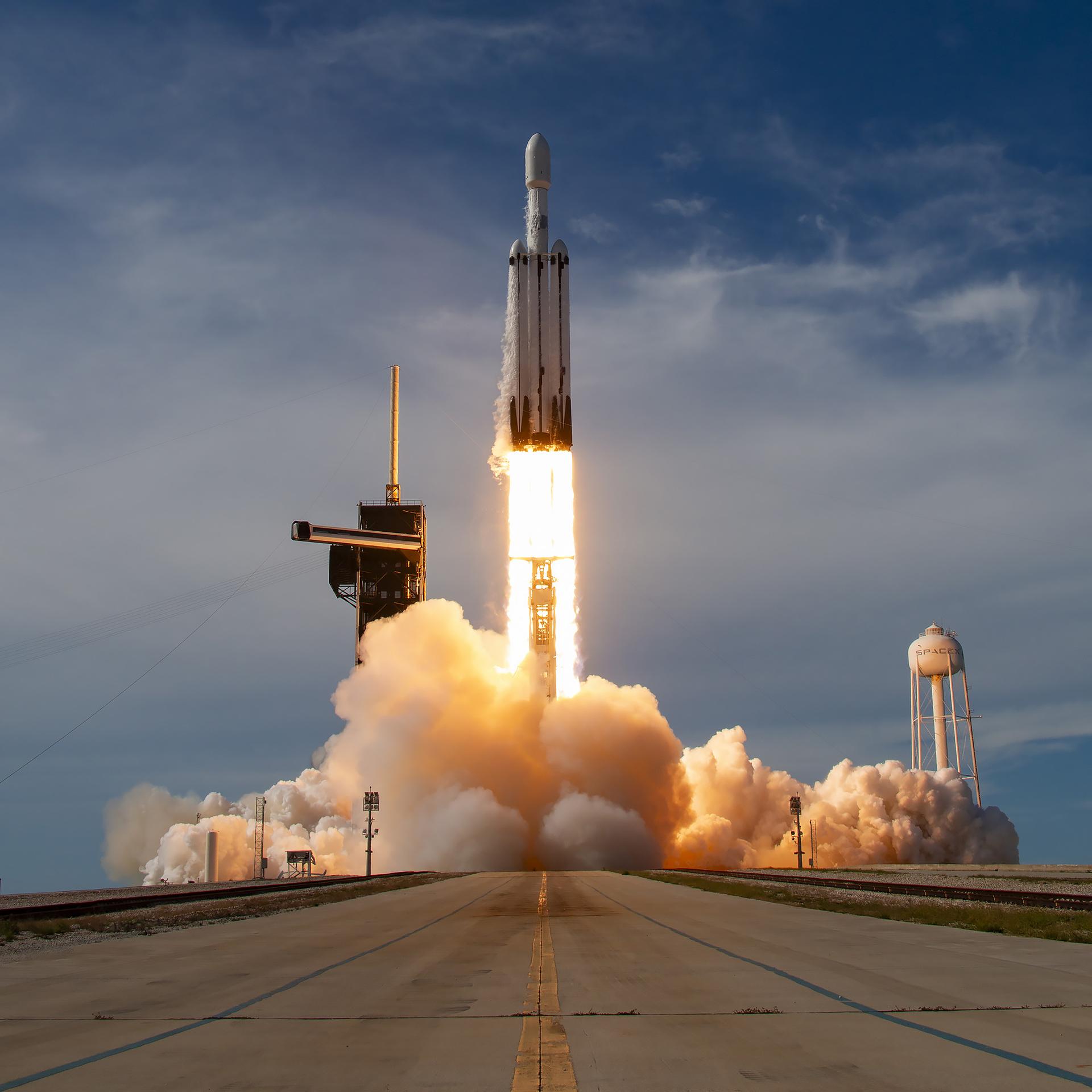
A SpaceX Falcon Heavy rocket lifts off with NOAA’s GOES-U weather satellite on June 25, 2024.

A SpaceX Falcon Heavy rocket lifts off with NOAA’s GOES-U weather satellite on June 25, 2024. Credit: SpaceX

ESA has never achieved a successful landing on Mars before. NASA’s contribution includes flight-proven retrorockets for ESA’s landing platform. Experts at NASA’s Jet Propulsion Laboratory also helped European engineers solve a problem with the lander’s parachute system, which slows the craft to subsonic speed before it ignites braking rockets for the final landing maneuver.

Assuming it launches in late 2028, Rosalind Franklin will reach Mars in 2030, taking a longer than usual route to avoid landing during the planet’s global dust storm season.

Despite the long wait to fly, ESA says the rover’s capabilities and science objectives “remain relevant” for Mars exploration. Rosalind Franklin will be the first mission to extract and analyze soil samples from as deep as 6 feet (2 meters) into the Martian crust. At that depth, organic molecules holding hints to ancient Martian life should have been protected from billions of years of radiation exposure, which can “irreversibly destroy ancient organic biomarkers,” NASA scientists wrote in a 2022 paper.

“No other mission is yet planned to take up this technological challenge,” ESA says in a fact sheet on the mission. “The rover’s mobility capabilities, notably six-wheel steering and ‘wheel walking’ are also novel.”

Photo of Stephen Clark

Stephen Clark is a space reporter at Ars Technica, covering private space companies and the world’s space agencies. Stephen writes about the nexus of technology, science, policy, and business on and off the planet.

62 Comments