



惯性聚合 高效追踪和阅读你感兴趣的博客、新闻、科技资讯
阅读原文 在惯性聚合中打开

推荐订阅源

freeCodeCamp Programming Tutorials: Python, JavaScript, Git & More
GbyAI
GbyAI
OSCHINA 社区最新新闻
OSCHINA 社区最新新闻
博客园 - 三生石上(FineUI控件)
美团技术团队
Last Week in AI
Last Week in AI
WordPress大学
WordPress大学
L
LangChain Blog
雷峰网
雷峰网
让小产品的独立变现更简单 - ezindie.com
博客园 - 叶小钗
Engineering at Meta
Engineering at Meta
腾讯CDC
Recent Announcements
The Register - Security
有赞技术团队
有赞技术团队
Blog — PlanetScale
Blog — PlanetScale
博客园 - Franky
博客园 - 司徒正美
The Cloudflare Blog
Google DeepMind News
T
Tailwind CSS Blog
C
Check Point Blog
小众软件
小众软件
V
Visual Studio Blog
V
V2EX
F
Full Disclosure
J
Java Code Geeks
MongoDB | Blog
MongoDB | Blog
罗磊的独立博客
人人都是产品经理
人人都是产品经理
量子位
Apple Machine Learning Research
F
Fortinet All Blogs
Microsoft Security Blog
奇客Solidot–传递最新科技情报
奇客Solidot–传递最新科技情报
博客园 - 【当耐特】
博客园_首页
Y
Y Combinator Blog
N
Netflix TechBlog - Medium
酷 壳 – CoolShell
酷 壳 – CoolShell
Stack Overflow Blog
Stack Overflow Blog
Recorded Future
Recorded Future
G
Google Developers Blog
Vercel News
Vercel News
大猫的无限游戏
大猫的无限游戏
Microsoft Azure Blog
U
Unit 42
爱范儿
爱范儿
Jina AI
Jina AI

Ars Technica - All content

Pentagon wants $54B for drones, more than most nations’ military budgets Mozilla: Anthropic's Mythos found 271 security vulnerabilities in Firefox 150 Supreme Court arguments make it clear that FCC fines are "nonbinding" Silo S3 teaser hints at the wasteland's origins Framework's CEO on the RAM crisis and creating a "MacBook Pro for Linux users" Florida probes ChatGPT role in mass shooting. OpenAI says bot "not responsible." Report: Meta will train AI agents by tracking employees' mouse, keyboard use Microsoft removes Call of Duty from Game Pass, lowers subscription pricing Framework Laptop 13 Pro is a major overhaul for the modular, upgradeable laptop Framework Laptop 16 upgrades make it look less like an unfinished prototype Internal emails show how Amazon raises prices across the Internet, lawsuit says Anthropic gets $5B investment from Amazon, will use it to buy Amazon chips CATL's new LFP battery can charge from 10 to 98% in less than 7 minutes AMD Ryzen 9 9950X3D2 Dual Edition review: Tons of cache for tons of dollars What's the deal with spacesuits for the Moon? Will they be ready in time? Loneliness in older adults can often lead to memory impairment Contrary to popular superstition, AES 128 is just fine in a post-quantum world Pentagon pulls the plug on one of the military's most troubled space programs John Ternus will replace Tim Cook as Apple CEO Blue Origin's rocket reuse achievement marred by upper stage failure I’ve fired one of America’s most powerful lasers—here’s what a shot day looks like Great white sharks are overheating US-sanctioned currency exchange says $15 million heist done by "unfriendly states" Man with @ihackedthegovernment Instagram account tells judge, “I made a mistake" Trump picks qualified, normal health leader to head CDC; experts still cautious $25,000 buys plenty of used EVs: Here are some options Satellite and drone images reveal big delays in US data center construction Amazon won’t release Fire Sticks that support sideloading anymore Ridley Scott's post-apocalyptic The Dog Stars drops first trailer Artemis II pilot talks about what it was really like to fly and land in Orion Meta's AI spending spree is helping make its Quest headsets more expensive Rocket Report: Starship V3 test-fired; ESA's tentative step toward crew launch Recent advances push Big Tech closer to the Q-Day danger zone After a saga of broken promises, a European rover finally has a ride to Mars Lucasfilm drops The Mandalorian and Grogu final trailer at CinemaCon Intel refreshes non-Ultra Core CPUs with new silicon for the first time OpenAI starts offering a biology-tuned LLM As they got close to the Moon, Artemis II astronauts were eager to land Mozilla launches Thunderbolt AI client with focus on self-hosted infrastructure Ad firms settle with Trump FTC over claims they boycotted conservative media New Codex features include the ability to use your computer in the background The Ukraine war's deep impact on Metro 2039’s development, story New undersea cable cutter risks Internet’s backbone Microsoft and Stellantis want to use AI to help car owners Gemini can now create personalized AI images by digging around in Google Photos RFK Jr. forces FDA to reconsider 12 unproven peptides after 2023 ban First look: Also's upcoming e-bike disconnects the pedals and wheels Meet the Quantum Kid The race to Shackleton Crater is on—will Jeff Bezos or China get there first? Florida surgeon charged with killing man after removing liver instead of spleen Jury finds Live Nation/Ticketmaster is illegal monopoly that overcharged fans "TotalRecall Reloaded" tool finds a side entrance to Windows 11's Recall database Google releases new apps for Windows and MacOS Boston Dynamics’ robot dog now reads gauges and thermometers with Google's AI Prime Video shows “technical difficulties” sign instead of NBA game in overtime New teaser gives us first look at Godzilla Minus Zero Vulcan woes will "absolutely" be a factor in Pentagon's next rocket competition Adobe takes Creative Cloud into Claude Code-esque territory Good Omens S3 trailer sets up a blessed conclusion Bubble watch: Fashion brand Allbirds pivots hard to become AI services company New 3D map of Universe could solve dark energy mystery What’s the deal with Alzheimer’s disease and amyloid? Blue Origin has a new employee stock plan, but not everyone is happy It's Tax Day, and no one knows how to file for prediction market winnings Ukraine’s military robot surge aims to offset drone risks to humans Sony killing features for antenna, set-top box users of Bravia smart TVs in May Americans ask AI for health care. Hospitals think the answer is more chatbots. NASA chose the right crew to launch a new era of human space exploration Google will begin punishing sites for back button hijacking in June Retro Rewind re-creates the glorious drudgery of working a '90s video store Google shoehorned Rust into Pixel 10 modem to make legacy code safer NZXT agrees to let customers keep their rental PCs in class-action settlement Your tech support company runs scams. Stop—or disguise with more fraud? Sunrise on the Reaping teaser brings us a Second Quarter Quell IBM folds to Trump anti-DEI push, admits no misconduct but pays $17M penalty Slate Auto raises $650 million as production gets closer and closer Meta spins up AI version of Mark Zuckerberg to engage with employees To teach in the time of ChatGPT is to know pain Shock from Iran war has Trump's vision for US energy dominance flailing The Artemis II mission has ended. Where does NASA go from here? AI models are terrible at betting on soccer—especially xAI Grok Four astronauts are back home after a daring ride around the Moon Californians sue over AI tool that records doctor visits New paper argues history, not mantle plume, powers Yellowstone F1 moves a step closer to fixing its 2026 hybrid problem Report: US demands Reddit unmask ICE critic, summons firm to grand jury Microsoft's "commitment to Windows quality" starts with overhaul of beta program "Oobleck" still holds some surprises YouTube increases Premium price again, says 90-second unskippable ads are a bug Oldest octopus fossil found to not be an octopus What leaked "SteamGPT" files could mean for the PC gaming platform's use of AI Here's what to expect from the fiery, 14-minute return of Artemis II Pro-Iran Explosive Media trolls Trump with AI-generated Lego cartoons Dad stuck in support nightmare after teen lied about age on Discord Rocket Report: Chinese version of Falcon 9 fails; Artemis depends on rapid heavy lift Orion helium leak no threat to Artemis II reentry but will require redesign RFK Jr. rewrites CDC panel's charter, opening door to anti-vaccine quacks AI on the couch: Anthropic gives Claude 20 hours of psychiatry Clinical trial shows gene editing works for β-Thalassaemia, too “Negative” views of Broadcom driving thousands of VMware migrations, rival says
Nvidia RTX Spark comes to Windows PCs with Arm CPU, RTX GPU, and unified memory
Andrew Cunningham · 2026-06-01 · via Ars Technica - All content

Skip to content

Nvidia’s new chips will power laptop workstations and mini desktop PCs at first.
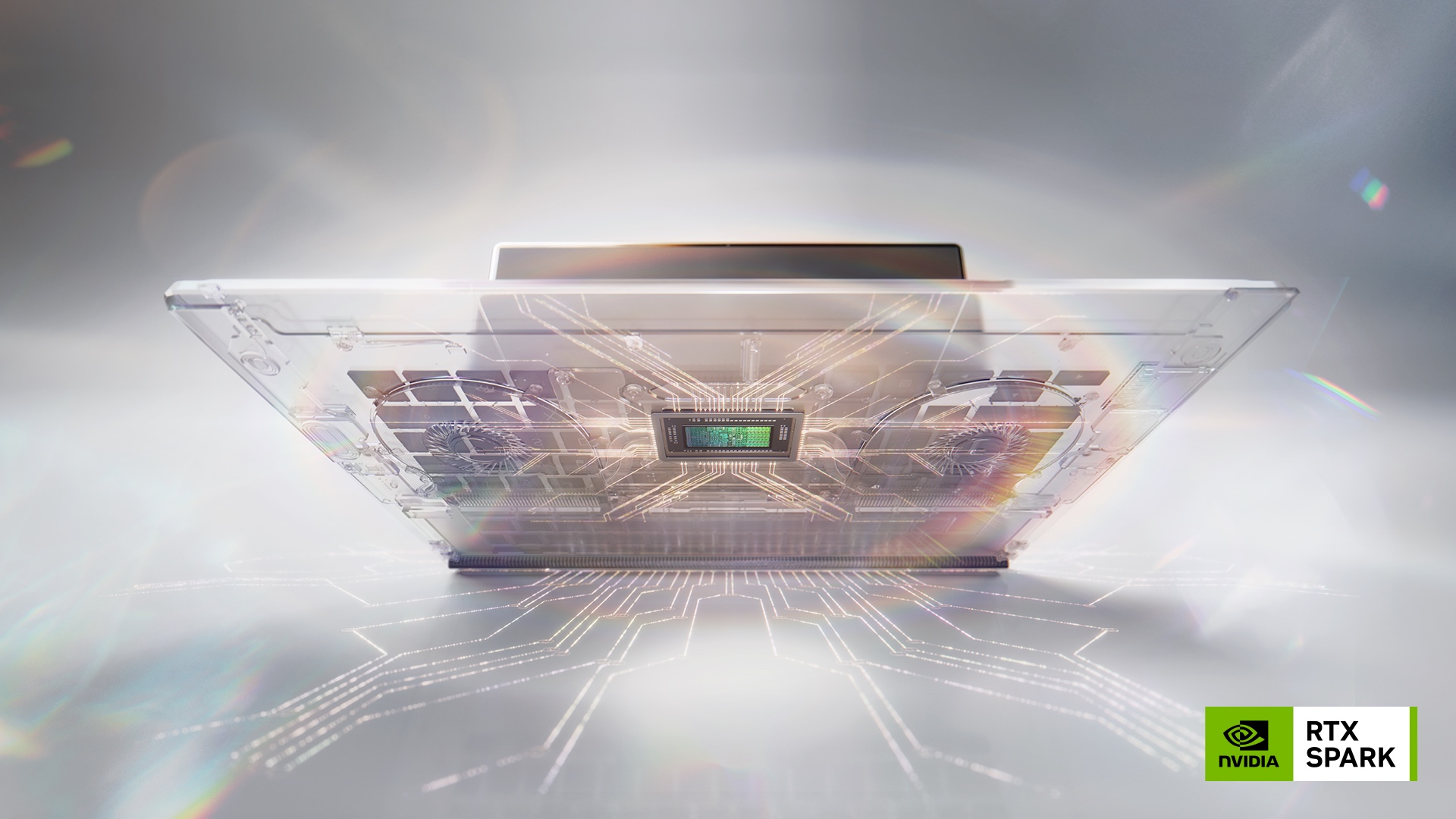
A high-concept render of Nvidia's new RTX Spark system-on-a-chip. Credit: Nvidia

A high-concept render of Nvidia's new RTX Spark system-on-a-chip. Credit: Nvidia

These days, Nvidia primarily sells AI data center products, and its traditional consumer devices feel like more of a side project. But the company occasionally still releases something designed for consumers. After a couple of years of rumors, Nvidia has announced an Arm-based chip designed to power Windows PCs. Dubbed RTX Spark, the new chip combines a 20-core Nvidia Grace CPU co-developed with MediaTek, up to 6,144 Blackwell-based GPU cores (the same architecture as the RTX 50-series GPUs), and support for up to 128GB of unified LPDDR5x memory.

Nvidia and its partners offered nothing about expected pricing, but both “slim Windows laptops with all-day battery life and premium displays” and “compact desktop PCs” are slated to be “available this fall” from partners including Asus, Dell, HP, Lenovo, Microsoft, MSI, Acer, and Gigabyte.

This isn’t Nvidia’s first chip for Windows PCs; earlier chips in the Tegra series powered several of the short-lived Windows RT tablets. But Tegra chips largely stopped appearing in consumer devices following the Tegra X1 in the late 2010s (variants power the original Nintendo Switch and the apparently unkillable Nvidia Shield TV box). Modern Arm-based PCs in the Windows 10 and Windows 11 eras have all used processors from Qualcomm.

Nvidia stands to benefit from the years of progress made on the Arm version of Windows since the Windows RT days. Microsoft’s x86-to-Arm code translation layer, codenamed Prism, has gotten better and faster. Many major apps now ship Arm-native versions that can run without the performance and responsiveness penalties that still crop up in translated apps. Most of the time, at least for productivity work and general computing, an Arm-based PC and an Intel or AMD-based PC look and feel indistinguishable.

And Nvidia’s entry into the market may help improve the gaming experience, one area where the Arm version of Windows still falls short. Translated games often play, but they can show lag or responsiveness issues even when running at a reasonable frame rate; many games that require kernel-level anti-cheat software to be installed still don’t run at all. Nvidia and Microsoft told The Verge that they were actively working with Riot Games to support League of Legends and Valorant on Arm PCs; with Krafton to support PUBG; and with the developers of Easy Anti-Cheat, BattlEye, and Denuvo.

What we know about specs

The RTX Spark appears to be the same silicon Nvidia used in its DGX Spark workstation late last year.

Credit: Nvidia

The RTX Spark appears to be the same silicon Nvidia used in its DGX Spark workstation late last year. Credit: Nvidia

The RTX Spark appears to be a consumer rebrand for the silicon Nvidia launched late last year as the DGX Spark, the heart of a tiny developer workstation for people working with AI models. And while that desktop is about as high-specced as an RTX Spark system might get—it includes 128GB of RAM and a 4TB SSD—its current $4,699 price tag suggests that the fastest RTX Spark machines won’t come cheap. (That’s also, for the record, already $700 more than the box’s $3,999 launch price, a reminder of the RAM and storage supply crunch that Nvidia has helped drive with its AI data center products.)

Knowing the DGX Spark’s specifications gives us a better idea of how RTX Spark will perform, at least in its most capable form. The Nvidia Grace CPU combines 10 high-performance Arm Cortex-X925 CPU cores and 10 medium-sized Cortex-A725 cores; Arm makes a smaller, higher-efficiency Cortex-A520 core, but it isn’t used here. That makes the RTX Spark a bit more like Apple’s M5 Pro or M5 Max, which use a mix of medium-sized performance cores and large “super” cores without any of the M5’s smaller efficiency cores.

Having 6,144 Blackwell-based GPU cores puts the RTX Spark’s GPU on the same level as the desktop version of the GeForce RTX 5070, well above the mobile version of the RTX 5070 (4,608 cores) but below the mobile version of the RTX 5080 (7,680 cores).

The GPU’s performance will be limited somewhat by the size of the power envelope in laptops and mini PCs (Nvidia says RTX Spark’s power use maxes out at 80 W, whereas a desktop 5070 can consume up to 250 W by itself), and by using slower LPDDR5x memory instead of the GDDR7 RAM that RTX 50-series GPUs use.

But for some games and for AI and machine learning workflows, the relative slowness of the RAM will be offset by the amount you can get—unified memory means the CPU and GPU can both access almost all of the RAM available in the system, giving users access to over 100GB of VRAM instead of the paltry 8GB or 12GB that you get with an RTX 5070. Unified memory pools attached to good-enough GPUs have also made systems like Apple’s Mac mini and Mac Studio and the Ryzen-based Framework Desktop useful platforms for developers and people looking to run AI models locally.

The Blackwell-based architecture will also mean that RTX Spark can take advantage of the same DLSS upscaling and frame generation features as other RTX 50-series GPUs, including the controversial upcoming DLSS 5 release.

As for the lower-end RTX Spark models, Nvidia didn’t have much to say, but we can glean some details. Rumors and leaked specs (via VideoCardz) suggested that Nvidia was working on two distinct pieces of silicon, one codenamed “N1X” and one codenamed “N1.” Both chips would come in two different flavors—one with all CPU and GPU cores fully enabled and one with some defective cores disabled, a process called “binning” that is commonly used to maximize the amount of sellable silicon you get out of a manufacturing run.

The fully enabled N1X aligns with the specs for the RTX Spark; there’s also allegedly an N1X version with 18 CPU cores and 5,120 CUDA cores. The slower, smaller N1 chip is said to include up to 12 CPU cores (8 Cortex-X925 and 4 Cortex-A725) and 2,560 CUDA cores, which is the same number as the desktop GeForce RTX 5050.

A binned version of that chip is also said to exist, with 10 CPU cores and 2,048 CUDA cores. The basic N1 is said to support up to 64GB of RAM and have a lower maximum power draw of 45 W. This would put its power envelope closer to something like Intel’s Core Ultra Series 3 (codenamed Panther Lake) chips, implying we could see versions of RTX Spark appear in premium thin-and-light laptops eventually.

Photo of Andrew Cunningham

Andrew is a Senior Technology Reporter at Ars Technica, with a focus on consumer tech including computer hardware and in-depth reviews of operating systems like Windows and macOS. Andrew lives in Philadelphia and co-hosts a weekly book podcast called Overdue.
122 Comments