


惯性聚合 高效追踪和阅读你感兴趣的博客、新闻、科技资讯
阅读原文 在惯性聚合中打开

推荐订阅源

钛媒体:引领未来商业与生活新知
钛媒体:引领未来商业与生活新知
Google DeepMind News
Martin Fowler
Martin Fowler
罗磊的独立博客
The GitHub Blog
The GitHub Blog
酷 壳 – CoolShell
酷 壳 – CoolShell
Google DeepMind News
Engineering at Meta
Engineering at Meta
P
Proofpoint News Feed
J
Java Code Geeks
小众软件
小众软件
Y
Y Combinator Blog
M
MIT News - Artificial intelligence
A
About on SuperTechFans
Last Week in AI
Last Week in AI
Jina AI
Jina AI
云风的 BLOG
云风的 BLOG
阮一峰的网络日志
阮一峰的网络日志
D
DataBreaches.Net
Threat Intelligence Blog | Flashpoint
Project Zero
Project Zero
美团技术团队
I
Intezer
Vercel News
Vercel News
CTFtime.org: upcoming CTF events
N
Netflix TechBlog - Medium
F
Fortinet All Blogs
T
Threatpost
P
Privacy International News Feed
Latest news
Latest news
K
Kaspersky official blog
博客园 - 聂微东
月光博客
月光博客
P
Palo Alto Networks Blog
T
The Exploit Database - CXSecurity.com
C
Cyber Attacks, Cyber Crime and Cyber Security
The Hacker News
The Hacker News
D
Docker
Cisco Talos Blog
Cisco Talos Blog
P
Privacy & Cybersecurity Law Blog
L
LINUX DO - 热门话题
Blog — PlanetScale
Blog — PlanetScale
Security Latest
Security Latest
Know Your Adversary
Know Your Adversary
Recent Announcements
T
Tenable Blog
B
Blog RSS Feed
Recorded Future
Recorded Future
雷峰网
雷峰网
SecWiki News
SecWiki News

Ars Technica - All content

Pentagon wants $54B for drones, more than most nations’ military budgets Mozilla: Anthropic's Mythos found 271 security vulnerabilities in Firefox 150 Supreme Court arguments make it clear that FCC fines are "nonbinding" Silo S3 teaser hints at the wasteland's origins Framework's CEO on the RAM crisis and creating a "MacBook Pro for Linux users" Florida probes ChatGPT role in mass shooting. OpenAI says bot "not responsible." Report: Meta will train AI agents by tracking employees' mouse, keyboard use Microsoft removes Call of Duty from Game Pass, lowers subscription pricing Framework Laptop 13 Pro is a major overhaul for the modular, upgradeable laptop Framework Laptop 16 upgrades make it look less like an unfinished prototype Internal emails show how Amazon raises prices across the Internet, lawsuit says Anthropic gets $5B investment from Amazon, will use it to buy Amazon chips CATL's new LFP battery can charge from 10 to 98% in less than 7 minutes AMD Ryzen 9 9950X3D2 Dual Edition review: Tons of cache for tons of dollars What's the deal with spacesuits for the Moon? Will they be ready in time? Loneliness in older adults can often lead to memory impairment Contrary to popular superstition, AES 128 is just fine in a post-quantum world Pentagon pulls the plug on one of the military's most troubled space programs John Ternus will replace Tim Cook as Apple CEO Blue Origin's rocket reuse achievement marred by upper stage failure I’ve fired one of America’s most powerful lasers—here’s what a shot day looks like Great white sharks are overheating US-sanctioned currency exchange says $15 million heist done by "unfriendly states" Man with @ihackedthegovernment Instagram account tells judge, “I made a mistake" Trump picks qualified, normal health leader to head CDC; experts still cautious $25,000 buys plenty of used EVs: Here are some options Satellite and drone images reveal big delays in US data center construction Amazon won’t release Fire Sticks that support sideloading anymore Ridley Scott's post-apocalyptic The Dog Stars drops first trailer Artemis II pilot talks about what it was really like to fly and land in Orion Meta's AI spending spree is helping make its Quest headsets more expensive Rocket Report: Starship V3 test-fired; ESA's tentative step toward crew launch Recent advances push Big Tech closer to the Q-Day danger zone After a saga of broken promises, a European rover finally has a ride to Mars Lucasfilm drops The Mandalorian and Grogu final trailer at CinemaCon Intel refreshes non-Ultra Core CPUs with new silicon for the first time OpenAI starts offering a biology-tuned LLM As they got close to the Moon, Artemis II astronauts were eager to land Mozilla launches Thunderbolt AI client with focus on self-hosted infrastructure Ad firms settle with Trump FTC over claims they boycotted conservative media New Codex features include the ability to use your computer in the background The Ukraine war's deep impact on Metro 2039’s development, story New undersea cable cutter risks Internet’s backbone Microsoft and Stellantis want to use AI to help car owners Gemini can now create personalized AI images by digging around in Google Photos RFK Jr. forces FDA to reconsider 12 unproven peptides after 2023 ban First look: Also's upcoming e-bike disconnects the pedals and wheels Meet the Quantum Kid The race to Shackleton Crater is on—will Jeff Bezos or China get there first? Florida surgeon charged with killing man after removing liver instead of spleen Jury finds Live Nation/Ticketmaster is illegal monopoly that overcharged fans "TotalRecall Reloaded" tool finds a side entrance to Windows 11's Recall database Google releases new apps for Windows and MacOS Boston Dynamics’ robot dog now reads gauges and thermometers with Google's AI Prime Video shows “technical difficulties” sign instead of NBA game in overtime New teaser gives us first look at Godzilla Minus Zero Vulcan woes will "absolutely" be a factor in Pentagon's next rocket competition Adobe takes Creative Cloud into Claude Code-esque territory Good Omens S3 trailer sets up a blessed conclusion Bubble watch: Fashion brand Allbirds pivots hard to become AI services company New 3D map of Universe could solve dark energy mystery What’s the deal with Alzheimer’s disease and amyloid? Blue Origin has a new employee stock plan, but not everyone is happy It's Tax Day, and no one knows how to file for prediction market winnings Ukraine’s military robot surge aims to offset drone risks to humans Sony killing features for antenna, set-top box users of Bravia smart TVs in May Americans ask AI for health care. Hospitals think the answer is more chatbots. NASA chose the right crew to launch a new era of human space exploration Google will begin punishing sites for back button hijacking in June Retro Rewind re-creates the glorious drudgery of working a '90s video store Google shoehorned Rust into Pixel 10 modem to make legacy code safer NZXT agrees to let customers keep their rental PCs in class-action settlement Your tech support company runs scams. Stop—or disguise with more fraud? Sunrise on the Reaping teaser brings us a Second Quarter Quell IBM folds to Trump anti-DEI push, admits no misconduct but pays $17M penalty Slate Auto raises $650 million as production gets closer and closer Meta spins up AI version of Mark Zuckerberg to engage with employees To teach in the time of ChatGPT is to know pain Shock from Iran war has Trump's vision for US energy dominance flailing The Artemis II mission has ended. Where does NASA go from here? AI models are terrible at betting on soccer—especially xAI Grok Four astronauts are back home after a daring ride around the Moon Californians sue over AI tool that records doctor visits New paper argues history, not mantle plume, powers Yellowstone F1 moves a step closer to fixing its 2026 hybrid problem Report: US demands Reddit unmask ICE critic, summons firm to grand jury Microsoft's "commitment to Windows quality" starts with overhaul of beta program "Oobleck" still holds some surprises YouTube increases Premium price again, says 90-second unskippable ads are a bug Oldest octopus fossil found to not be an octopus What leaked "SteamGPT" files could mean for the PC gaming platform's use of AI Here's what to expect from the fiery, 14-minute return of Artemis II Pro-Iran Explosive Media trolls Trump with AI-generated Lego cartoons Dad stuck in support nightmare after teen lied about age on Discord Rocket Report: Chinese version of Falcon 9 fails; Artemis depends on rapid heavy lift Orion helium leak no threat to Artemis II reentry but will require redesign RFK Jr. rewrites CDC panel's charter, opening door to anti-vaccine quacks AI on the couch: Anthropic gives Claude 20 hours of psychiatry Clinical trial shows gene editing works for β-Thalassaemia, too “Negative” views of Broadcom driving thousands of VMware migrations, rival says
DNA identifies four more crew members of doomed Franklin expedition
Jennifer Ouellette · 2026-05-08 · via Ars Technica - All content

Skip to content

“some very hard ground to heave”

Three served on the HMS Erebus; the fourth was Petty Officer Harry Peglar of the HMS Terror.

Oil painting by Belgian marine artist François Etienne Musin depicting the HMS Erebus trapped in Arctic ice. Credit: Public domain

Archaeologists continue to use DNA analysis to identify the recovered remains of the doomed crew members of Captain Sir John S. Franklin’s 1846 Arctic expedition to cross the Northwest Passage. They can now add four more names to the list of previously identified crew members. The findings were reported in two papers, one published in the Journal of Archaeological Science and the other in the Polar Record.

As we’ve reported previously, Franklin’s two ships, the HMS Erebus and the HMS Terror, became icebound in the Victoria Strait, and all 129 crew members ultimately died. It has been an enduring mystery that has captured imaginations ever since. The expedition set sail on May 19, 1845, and was last seen in July 1845 in Baffin Bay by the captains of two whaling ships. Historians have compiled a reasonably credible account of what happened: The crew spent the winter of 1845–1846 on Beechey Island, where the graves of three crew members were found.

When the weather cleared, the expedition sailed into the Victoria Strait before getting trapped in the ice off King William Island in September 1846. Franklin died on June 11, 1847, per a surviving note signed by Fitzjames dated the following April. HMS Erebus Captain James Fitzjames had assumed overall command after Franklin’s death, leading 105 survivors from their ice-trapped ships. It’s believed that everyone else died while encamped for the winter or while attempting to walk back to civilization.

There was no concrete news about the expedition’s fate until 1854, when local Inuits told 19th-century Scottish explorer John Rae that they had seen about 40 people dragging a ship’s boat on a sledge along the south coast. The following year, several bodies were found . A second search in 1859 led to the discovery of a location some 80 kilometers to the south of that site, dubbed Erebus Bay, as well as several more bodies and one of the ships’ boats still mounted on a sledge. In 1861, yet another site was found just 2 kilometers away with even more bodies. When those two sites were rediscovered in the 1990s, archaeologists designated them NgLj-3 and NgLj-2, respectively.

The actual shipwrecks of the HMS Erebus and the HMS Terror were not found until 2014 and 2016, respectively. Thanks to the cold water temperature, lack of natural light, and the layers of silt covering many of the artifacts, the ship and its contents were in remarkably good condition. Even some of the windowpanes were still intact. The first underwater images and footage showing the ships’ exteriors and interiors were released in 2019.

It’s in the DNA
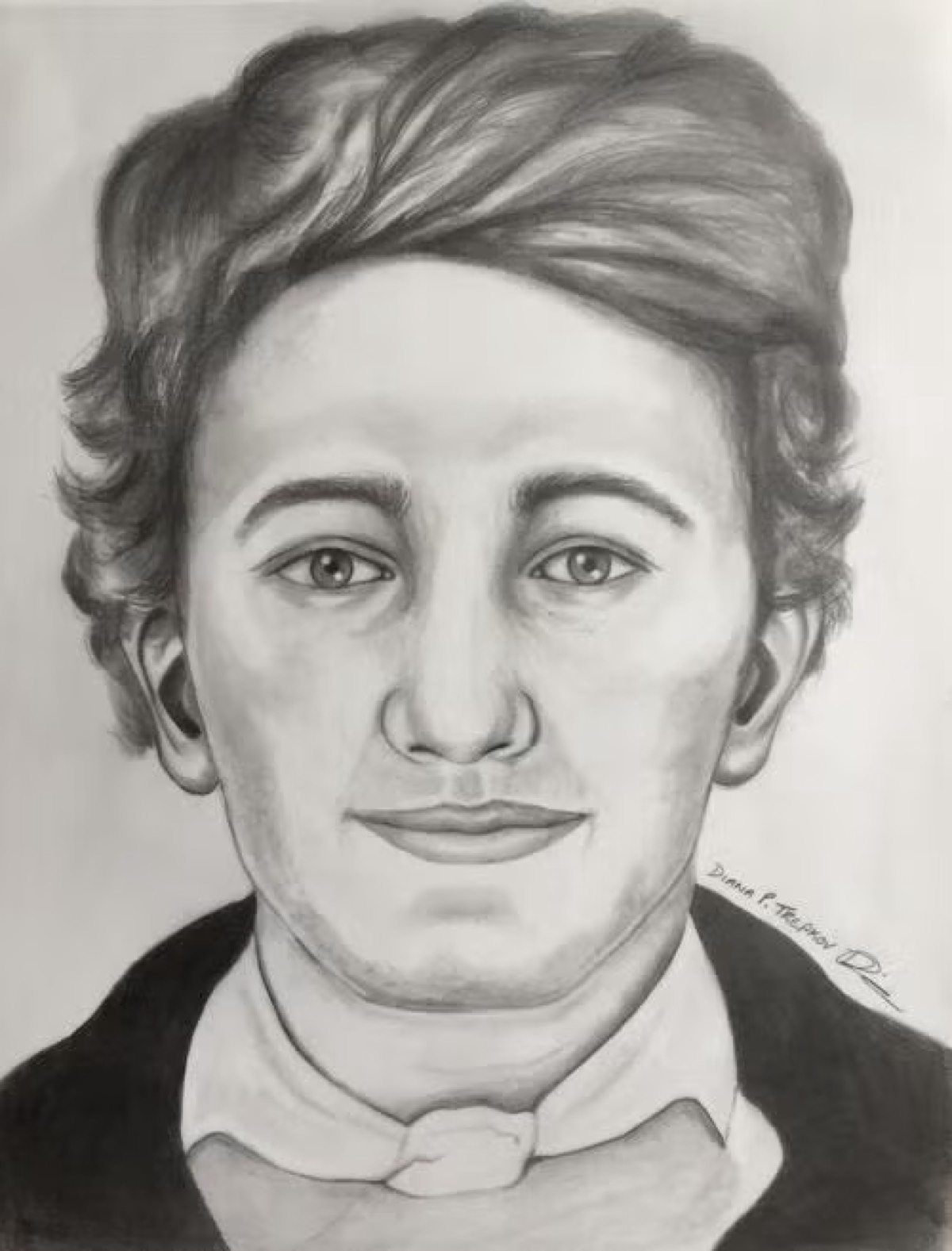
2D forensic facial reconstruction of David Young, Boy 1st Class from the HMS Erebus, who died at Erebus Bay.

2D forensic facial reconstruction of David Young, Boy 1st Class from the HMS Erebus, who died at Erebus Bay.

Credit: Diana Trepkov

2D forensic facial reconstruction of David Young, Boy 1st Class from the HMS Erebus, who died at Erebus Bay. Credit: Diana Trepkov

For several years, scientists have been conducting DNA research to identify the remains found at these sites by comparing DNA profiles of the remains with samples taken from descendants of the expedition members. Some 46 archaeological samples (bone, tooth, or hair) from Franklin expedition-related sites on King William Island have been genetically profiled and compared to cheek swab samples from 25 descendant donors. Most did not match, but in 2021, they identified one of those bodies as chief engineer John Gregory, who worked on the Erebus.

By 2024, the team had added four more descendant donors—one related to Fitzjames (technically a second cousin five times removed through the captain’s great-grandfather). That same year, DNA analysis revealed that a tooth recovered from a mandible at one of the relevant archaeological sites was that of Captain James Fitzjames of the HMS Erebus. His remains showed clear signs of cannibalism, confirming early Inuit reports of desperate crew members resorting to eating their dead.

We can now add three more crew members identified through their DNA. As before, to make the identifications, the team extracted DNA from archaeological samples and compared it with mitochondrial and Y-chromosome DNA from descendants. These included a molar and humerus shaft from NgLj-3; two molars, a premolar, and a temporal cranium bone from NgLj-2; and a sample taken from a left humerus found in 2018 at NgLj-1. The researchers were able to identify three individuals: William Orren, able seaman; David Young, boy 1st class; and John Bridgens, subordinate officers’ steward. All served on the HMS Erebus, and they all died at Erebus Bay.

Meanwhile, the Polar Reports paper focused on identifying an unburied skeleton found in 1859 on the south shore of King William Island. The skeleton was found with a seaman’s certificate and other papers in a leather pocketbook belonging to Petty Officer Harry Peglar of the HMS Terror. However, the clothing found scattered around the remains was not of the sort usually worn by seamen or officers. The items included a double-breasted waistcoat and a black silk neckerchief tied in a bowknot, more indicative of what would be worn by a steward or officer’s servant, as well as a clothes brush.

For a long time, the consensus was that the remains were most likely those of a steward. There were four on each of the two ships in the Franklin expedition, with the best candidates being Thomas Armitage, gunroom steward, or William Gibson, subordinate officers’ steward, both of whom served on the HMS Terror. The authors estimated the skeleton’s height via osteological analysis and compared DNA samples taken from the skeleton to those of descendants of six of the eight stewards and Harry Peglar. The DNA revealed that the skeleton was, in fact, Peglar.

DOI: Journal of Archaeological Science, 2026. 10.1016/j.jasrep.2026.105739  (About DOIs).

DOI: Polar Reports, 2026. 10.1017/S003224742610031X  (About DOIs).

Photo of Jennifer Ouellette

Jennifer is a senior writer at Ars Technica with a particular focus on where science meets culture, covering everything from physics and related interdisciplinary topics to her favorite films and TV series. Jennifer lives in Baltimore with her spouse, physicist Sean M. Carroll, and their two cats, Ariel and Caliban.
37 Comments