


惯性聚合 高效追踪和阅读你感兴趣的博客、新闻、科技资讯
阅读原文 在惯性聚合中打开

推荐订阅源

罗磊的独立博客
Y
Y Combinator Blog
Recent Announcements
OSCHINA 社区最新新闻
OSCHINA 社区最新新闻
V
Visual Studio Blog
MyScale Blog
MyScale Blog
M
MIT News - Artificial intelligence
奇客Solidot–传递最新科技情报
奇客Solidot–传递最新科技情报
T
The Blog of Author Tim Ferriss
Martin Fowler
Martin Fowler
博客园 - 【当耐特】
让小产品的独立变现更简单 - ezindie.com
宝玉的分享
宝玉的分享
Engineering at Meta
Engineering at Meta
WordPress大学
WordPress大学
Google DeepMind News
C
Check Point Blog
Last Week in AI
Last Week in AI
F
Fortinet All Blogs
博客园 - 聂微东
Blog — PlanetScale
Blog — PlanetScale
H
Help Net Security
GbyAI
GbyAI
云风的 BLOG
云风的 BLOG

Ars Technica - All content

Pentagon wants $54B for drones, more than most nations’ military budgets Mozilla: Anthropic's Mythos found 271 security vulnerabilities in Firefox 150 Supreme Court arguments make it clear that FCC fines are "nonbinding" Silo S3 teaser hints at the wasteland's origins Framework's CEO on the RAM crisis and creating a "MacBook Pro for Linux users" Florida probes ChatGPT role in mass shooting. OpenAI says bot "not responsible." Report: Meta will train AI agents by tracking employees' mouse, keyboard use Microsoft removes Call of Duty from Game Pass, lowers subscription pricing Framework Laptop 13 Pro is a major overhaul for the modular, upgradeable laptop Framework Laptop 16 upgrades make it look less like an unfinished prototype Internal emails show how Amazon raises prices across the Internet, lawsuit says Anthropic gets $5B investment from Amazon, will use it to buy Amazon chips CATL's new LFP battery can charge from 10 to 98% in less than 7 minutes AMD Ryzen 9 9950X3D2 Dual Edition review: Tons of cache for tons of dollars What's the deal with spacesuits for the Moon? Will they be ready in time? Loneliness in older adults can often lead to memory impairment Contrary to popular superstition, AES 128 is just fine in a post-quantum world Pentagon pulls the plug on one of the military's most troubled space programs John Ternus will replace Tim Cook as Apple CEO Blue Origin's rocket reuse achievement marred by upper stage failure I’ve fired one of America’s most powerful lasers—here’s what a shot day looks like Great white sharks are overheating US-sanctioned currency exchange says $15 million heist done by "unfriendly states" Man with @ihackedthegovernment Instagram account tells judge, “I made a mistake" Trump picks qualified, normal health leader to head CDC; experts still cautious $25,000 buys plenty of used EVs: Here are some options Satellite and drone images reveal big delays in US data center construction Amazon won’t release Fire Sticks that support sideloading anymore Ridley Scott's post-apocalyptic The Dog Stars drops first trailer Artemis II pilot talks about what it was really like to fly and land in Orion
Soaring solar and a surge in hydro push more coal off the...
John Timmer · 2026-05-23 · via Ars Technica - All content

Last year, the first few months of data from the US grid suggested that fears of a data-center-driven surge in demand were becoming a reality. Demand had risen by about 3 percent, triggering a surge in coal, interrupting what had been a long downward trend. But over the course of the year, both trends slowed considerably.

A year later, all of that seems to be in the past, as the US has returned to its normal pattern: slow growth, with renewables pushing coal off the grid. The one oddity is that hydroelectric production has surged without a corresponding increase in capacity, likely due to unusually warm weather in the western US causing the snowpack to melt early. That may have consequences later in the year.

Pushing fossil fuels out

Overall demand in the US grew by only 1.5 percent in the first quarter of 2026 compared to the same period the year before. Often, changes in demand during this part of the year are driven by weather-related heating demand. But the US had an unusual combination set of weather conditions to start 2026, with the western half baking in unseasonal warm temperatures, while the eastern half suffered a deep freeze. So we’ll probably need data from more of the year before we read too much into the small rise in demand we’ve seen so far.

As has been the case for a while now, the biggest trend on the US grid was the growth of solar. Compared to the same quarter the year earlier, solar was up by 24 percent. On its own, that was enough to offset 80 percent of the rising demand. Overall, the output of the major renewables (wind, solar, and hydro) grew by 11 percent compared to the same period the year prior, or about 1.8 times the growth in demand.
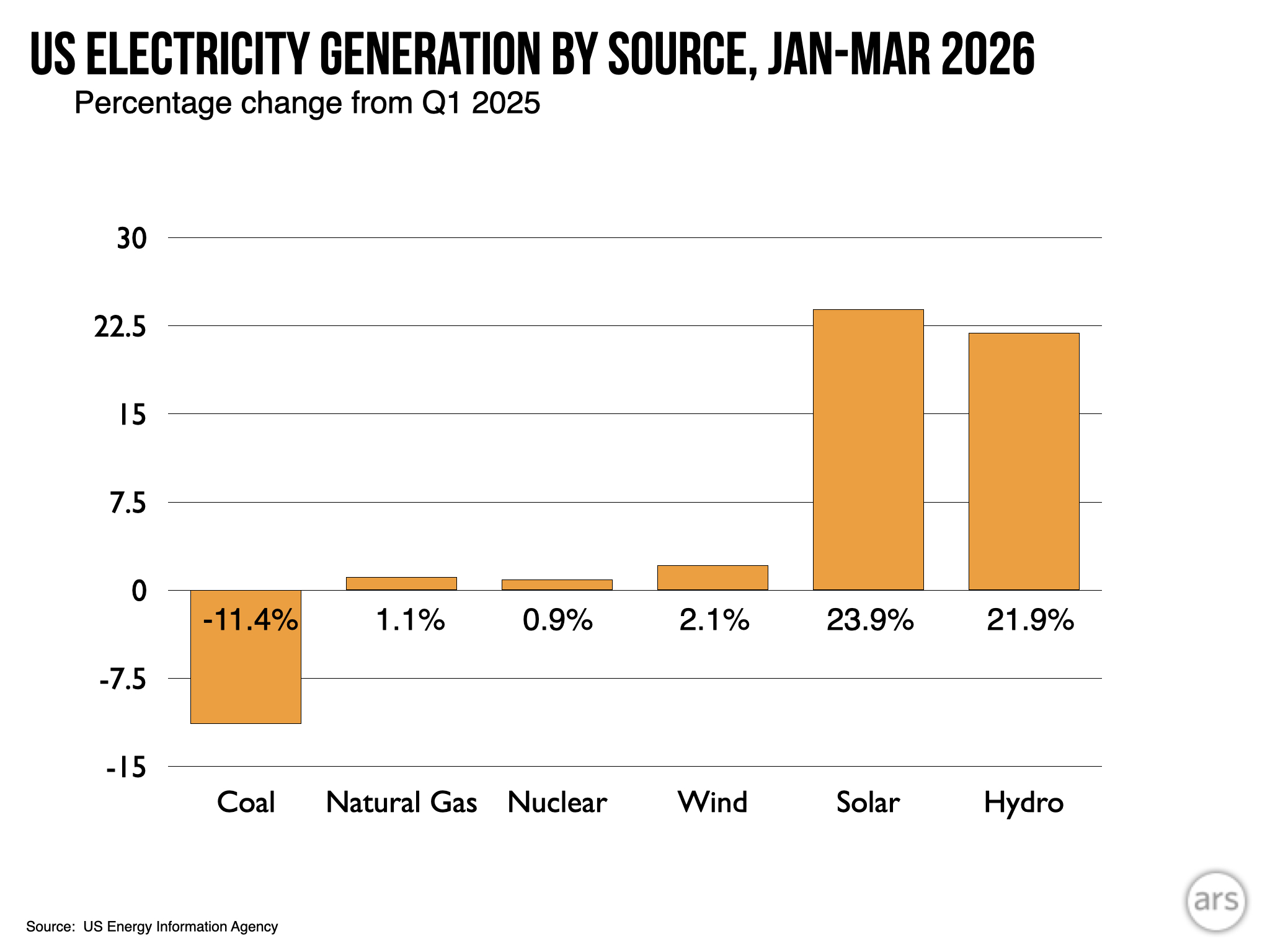
Image of a bar graph with most entries unchanged.

Wind and hydro are up, coal is down compared to this period a year earlier.

Credit: John Timmer

Wind and hydro are up, coal is down compared to this period a year earlier. Credit: John Timmer

Given that renewable growth greatly exceeded demand, there was nowhere to go for fossil fuels but down. Overall, they saw a drop of about 3 percent year-over-year, with an absolute change similar in magnitude (if not sign) to the growth in demand. But natural gas use actually grew slightly in the first quarter, which meant coal took an even greater hit, with its use dropping by over 10 percent. That may change as the Persian Gulf conflict drives global natural gas prices higher, but it was not yet a major factor in this data.