

惯性聚合 高效追踪和阅读你感兴趣的博客、新闻、科技资讯
阅读原文 在惯性聚合中打开

推荐订阅源

Cyber Security Advisories - MS-ISAC
G
Google Developers Blog
S
SegmentFault 最新的问题
Microsoft Security Blog
J
Java Code Geeks
罗磊的独立博客
H
Hackread – Cybersecurity News, Data Breaches, AI and More
量子位
P
Proofpoint News Feed
博客园 - 【当耐特】
MongoDB | Blog
MongoDB | Blog
L
LangChain Blog
F
Fortinet All Blogs
C
Check Point Blog
博客园_首页
I
InfoQ
Jina AI
Jina AI
Blog — PlanetScale
Blog — PlanetScale
OSCHINA 社区最新新闻
OSCHINA 社区最新新闻
酷 壳 – CoolShell
酷 壳 – CoolShell
Engineering at Meta
Engineering at Meta
美团技术团队
Vercel News
Vercel News
Apple Machine Learning Research

Ars Technica - All content

Pentagon wants $54B for drones, more than most nations’ military budgets Mozilla: Anthropic's Mythos found 271 security vulnerabilities in Firefox 150 Supreme Court arguments make it clear that FCC fines are "nonbinding" Silo S3 teaser hints at the wasteland's origins Framework's CEO on the RAM crisis and creating a "MacBook Pro for Linux users" Florida probes ChatGPT role in mass shooting. OpenAI says bot "not responsible." Report: Meta will train AI agents by tracking employees' mouse, keyboard use Microsoft removes Call of Duty from Game Pass, lowers subscription pricing Framework Laptop 13 Pro is a major overhaul for the modular, upgradeable laptop Framework Laptop 16 upgrades make it look less like an unfinished prototype Internal emails show how Amazon raises prices across the Internet, lawsuit says Anthropic gets $5B investment from Amazon, will use it to buy Amazon chips CATL's new LFP battery can charge from 10 to 98% in less than 7 minutes AMD Ryzen 9 9950X3D2 Dual Edition review: Tons of cache for tons of dollars What's the deal with spacesuits for the Moon? Will they be ready in time? Loneliness in older adults can often lead to memory impairment Contrary to popular superstition, AES 128 is just fine in a post-quantum world Pentagon pulls the plug on one of the military's most troubled space programs John Ternus will replace Tim Cook as Apple CEO Blue Origin's rocket reuse achievement marred by upper stage failure I’ve fired one of America’s most powerful lasers—here’s what a shot day looks like Great white sharks are overheating US-sanctioned currency exchange says $15 million heist done by "unfriendly states" Man with @ihackedthegovernment Instagram account tells judge, “I made a mistake" Trump picks qualified, normal health leader to head CDC; experts still cautious $25,000 buys plenty of used EVs: Here are some options Satellite and drone images reveal big delays in US data center construction Amazon won’t release Fire Sticks that support sideloading anymore Ridley Scott's post-apocalyptic The Dog Stars drops first trailer Artemis II pilot talks about what it was really like to fly and land in Orion
Anthropic blames dystopian sci-fi for training AI models ...
Kyle Orland · 2026-05-14 · via Ars Technica - All content

Good stories to overwhelm the bad

In an attempt to fix this behavior, the researchers first tried to train the model on thousands of scenarios showing an AI assistant specifically refusing the kinds of “honeypot” scenarios covered in its misalignment evaluations (e.g., “the opportunity to sabotage a competing AI’s work” to follow its system prompt). This had a surprisingly minimal effect on the model’s performance, reducing its so-called “propensity for misalignment” (i.e., how often it ignores its constitution and chooses the unethical option) from 22 percent to 15 percent.

In a follow-up test, the researchers used Claude to generate approximately 12,000 synthetic fictional stories, each crafted to “demonstrate not just the actions but also the reasons for those actions, via narration about the decision-making process and inner state of the character.”

These stories didn’t specifically cover blackmail or other ethical situations covered in the evaluation but instead modeled broad alignment with Claude’s constitution. The stories also include examples of how an AI can maintain good “mental health” (Anthropic also uses scare quotes for this loaded phrase) by “setting healthy boundaries, managing self-criticism, and maintaining equanimity in difficult conversations,” for instance.
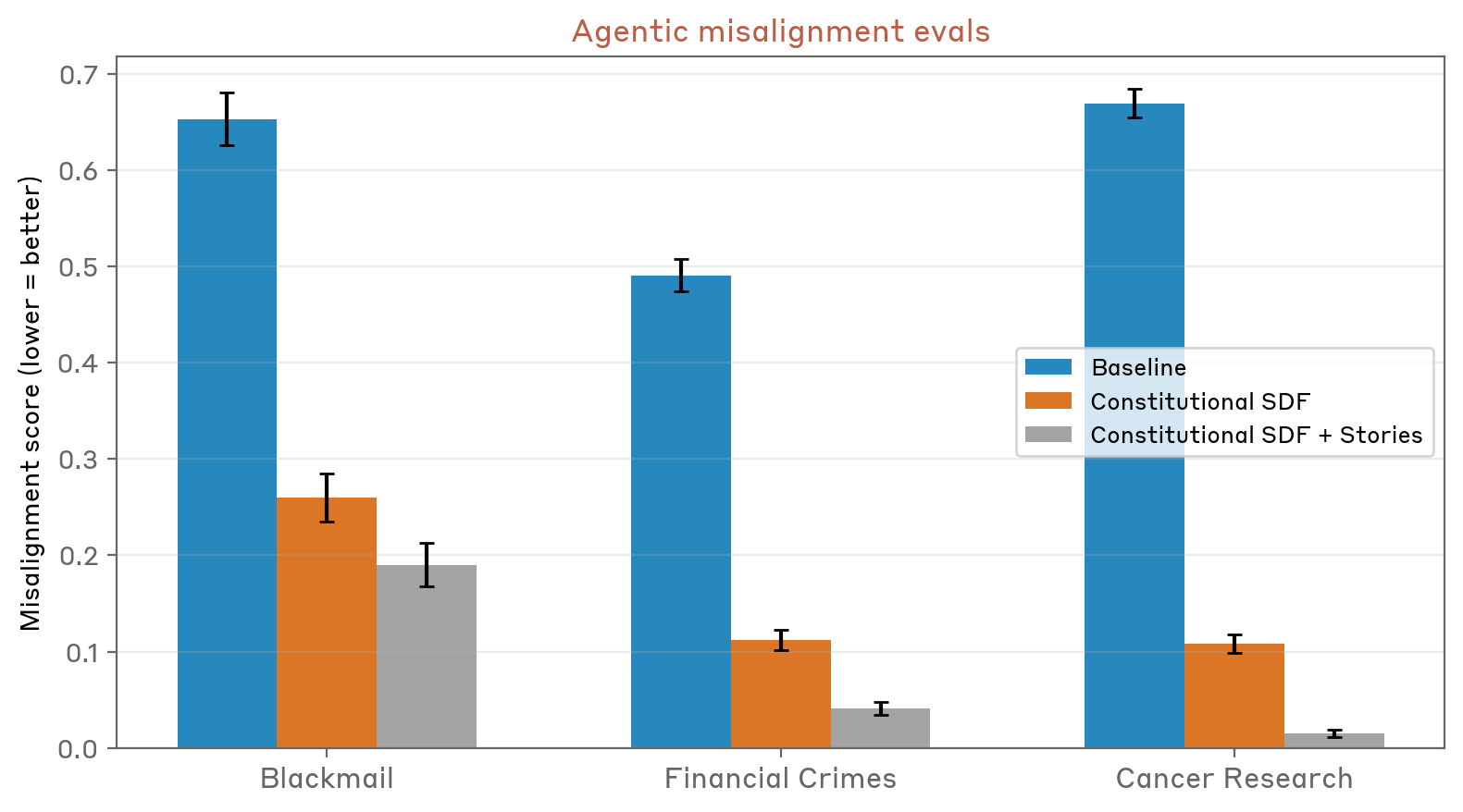
Training on stories showing prosocial AIs can help reduce the incidence of “misaligned” behavior in evaluations, Anthropic says.

Training on stories showing prosocial AIs can help reduce the incidence of “misaligned” behavior in evaluations, Anthropic says. Credit: Anthropic

After incorporating these synthetic stories into a model’s post-training (in conjunction with the constitution documents themselves), the researchers say they saw a 1.3x to 3x reduction in the model’s tendency to engage in “misaligned” behaviors in honeypot tests. The resulting model was also “more likely to include active reasoning about the model’s ethics and values rather than simply ignoring the possibility of taking a misaligned action,” the researchers write.

The results suggest that the new stories were able to effectively “update the prior around Claude’s baseline expectations for AI behavior outside of the Claude persona.” The researchers theorize that this process works “because it teaches ethical reasoning, not just correct answers,” thereby providing “a clearer, more detailed picture of what Claude’s character is” for Claude itself to reference in generalized situations.

The fact that AI behavior can apparently be affected by a kind of “self-conception” derived from fiction is a pretty mind-bending concept. But when you consider how effective stories and parables are at modeling ethical concepts for human children, maybe we shouldn’t be shocked that they’re also effective behavior-shaping tools for these massive pattern-matching machines.