
惯性聚合 高效追踪和阅读你感兴趣的博客、新闻、科技资讯
阅读原文 在惯性聚合中打开

推荐订阅源

N
Netflix TechBlog - Medium
罗磊的独立博客
云风的 BLOG
云风的 BLOG
Last Week in AI
Last Week in AI
Y
Y Combinator Blog
小众软件
小众软件
Blog — PlanetScale
Blog — PlanetScale
T
The Blog of Author Tim Ferriss
freeCodeCamp Programming Tutorials: Python, JavaScript, Git & More
月光博客
月光博客
博客园 - Franky
F
Fortinet All Blogs
D
Docker
博客园 - 司徒正美
腾讯CDC
Recent Announcements
The Cloudflare Blog
B
Blog RSS Feed
GbyAI
GbyAI
T
Tailwind CSS Blog
雷峰网
雷峰网
Cyber Security Advisories - MS-ISAC
博客园 - 三生石上(FineUI控件)
阮一峰的网络日志
阮一峰的网络日志

Ars Technica - All content

Pentagon wants $54B for drones, more than most nations’ military budgets Mozilla: Anthropic's Mythos found 271 security vulnerabilities in Firefox 150 Supreme Court arguments make it clear that FCC fines are "nonbinding" Silo S3 teaser hints at the wasteland's origins Framework's CEO on the RAM crisis and creating a "MacBook Pro for Linux users" Florida probes ChatGPT role in mass shooting. OpenAI says bot "not responsible." Report: Meta will train AI agents by tracking employees' mouse, keyboard use Microsoft removes Call of Duty from Game Pass, lowers subscription pricing Framework Laptop 13 Pro is a major overhaul for the modular, upgradeable laptop Framework Laptop 16 upgrades make it look less like an unfinished prototype Internal emails show how Amazon raises prices across the Internet, lawsuit says Anthropic gets $5B investment from Amazon, will use it to buy Amazon chips CATL's new LFP battery can charge from 10 to 98% in less than 7 minutes AMD Ryzen 9 9950X3D2 Dual Edition review: Tons of cache for tons of dollars What's the deal with spacesuits for the Moon? Will they be ready in time? Loneliness in older adults can often lead to memory impairment Contrary to popular superstition, AES 128 is just fine in a post-quantum world Pentagon pulls the plug on one of the military's most troubled space programs John Ternus will replace Tim Cook as Apple CEO Blue Origin's rocket reuse achievement marred by upper stage failure I’ve fired one of America’s most powerful lasers—here’s what a shot day looks like Great white sharks are overheating US-sanctioned currency exchange says $15 million heist done by "unfriendly states" Man with @ihackedthegovernment Instagram account tells judge, “I made a mistake" Trump picks qualified, normal health leader to head CDC; experts still cautious $25,000 buys plenty of used EVs: Here are some options Satellite and drone images reveal big delays in US data center construction Amazon won’t release Fire Sticks that support sideloading anymore Ridley Scott's post-apocalyptic The Dog Stars drops first trailer Artemis II pilot talks about what it was really like to fly and land in Orion
Chrome's 4GB AI model isn't new, but you're not wrong for...
Ryan Whitwam · 2026-05-09 · via Ars Technica - All content

A curious omission

Google users were more willing to excuse AI in 2024, but the backlash is real in 2026. People are increasingly looking to avoid AI features, which makes this 4GB stealth download all the more questionable. Google’s obsession with AI has led to numerous stumbles, even when the company has ostensibly good intentions, because we are all (rightly!) hyper-focused on how this technology is impacting our lives.

Some of those “good intentions” seem to have made the Chrome situation worse. As users sought ways to remove this AI model, many looked for the settings toggle. This happened to coincide with the wide release of Chrome 148, and the label for this toggle included a pretty suspicious change versus v147.
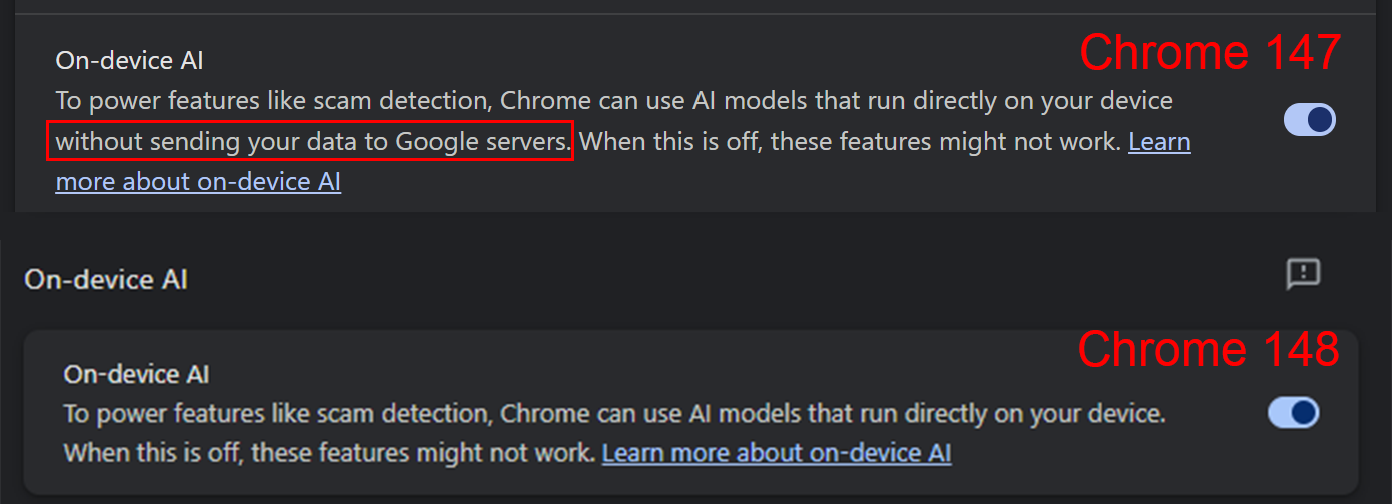
Chrome AI toggles

Google claims this change was made to be clear about how Chrome’s APIs work.

Credit: Ryan Whitwam

Google claims this change was made to be clear about how Chrome’s APIs work. Credit: Ryan Whitwam

Google removed the stipulation that its on-device AI model would not send data to Google’s servers. This is alarming, as one of the primary benefits of local AI is its greater privacy. We reached out to Google to ask if this wording is due to a change in Chrome’s on-device AI.

“This doesn’t reflect a change to how we handle on-device AI for Chrome,” a Google spokesperson said. “The data that is passed to the model is processed solely on device.”

According to Google, the team decided to make this change earlier in 2026 to ensure it was being crystal clear about how AI works on the web. Chrome’s local AI has an API that a site might use, for example, to do summarization or edit your writing. In these instances, the website would naturally see the input and output. If it’s a Google website, that data ends up on Google’s servers. If it’s a non-Google site, Google doesn’t see any of that data.

That explanation may or may not be satisfying as the backlash against AI grows. Regardless, using the web is never completely private. If you’re uncertain about using AI tools on a site, you should always try to parse its privacy policy, which will tell you how your data (AI-generated or not) will be used. As long as Google is deploying AI as an opt-out service, you’ll have to be extra vigilant.

As the saying goes, it’s easier to ask for forgiveness than permission, but Google ought to be asking for permission a little more often.