Most exciting events
“We had serious inbound attempts to the cosmodrome that day.”
Members of the Russian military supervise the installation of a European Space Agency environmental satellite on top of a modified Russian ballistic missile before a launch in 2016. Credit: ESA–Stephane Corvaja, 2016
If you believe official Russian reports, the country’s northern spaceport has come under attack from drones on multiple occasions in the last few months.
The drones did not succeed in striking the spaceport, but the attempted attacks come as Russia ramps up activity at Plesetsk Cosmodrome to deploy a new constellation of Internet and data relay satellites akin to SpaceX’s Starlink, a space-based network underpinning much of Ukraine’s military communications infrastructure. Plesetsk is a military base located in Russia’s Arkhangelsk region, some 500 miles north of Moscow.
The Russian space agency’s first acknowledgment of an attempted drone attack at Plesetsk came a few weeks ago, when the head of Roscosmos, the Russian state corporation for civilian spaceflight, met with Russian President Vladimir Putin in the Kremlin.
Dmitry Bakanov, the general director of Roscosmos, regaled Putin with a list of Russia’s recent accomplishments in the space sector. The list was modest, at least by the standards of an established space power, with 17 launches in 2025, a distant third to the United States and China.
“Serious inbound attempts”
Then the general director of Roscosmos told Putin about “perhaps the most exciting event” for Russia’s space program in the last year. This was the launch on March 23 of the first batch of communications satellites for Russia’s own version of Starlink. This network, called Rassvet, is undergoing development by a company called Bureau 1440, which the Russian government has backed with more than $1.2 billion. The network’s first 16 operational satellites launched from the Plesetsk Cosmodrome aboard a Soyuz-2.1b rocket.
“Our ‘friends’ did everything they could to prevent this launch from taking place,” Bakanov claimed in the April 11 meeting with Putin. “We had serious inbound attempts to the cosmodrome that day, but nevertheless, the joint combat crews of Roscosmos and the Space Forces accomplished their mission.”
The administration of the city of Mirny, the closest town to Plesetsk, warned of a “drone threat” to the region between March 22 and 25 on an official social media account. Local citizens replied to the warning, suggesting Internet connections in the town were cut. City officials said the “temporary restrictions” on mobile Internet service were “necessitated by security measures aimed at protecting citizens and critical infrastructure.”
Three months earlier, in December, local Russian news outlets reported another attempted drone attack at Plesetsk. This one reportedly occurred around the time of the launch of a Soyuz-2.1a rocket on December 25 with a radar observation satellite designed to provide Russia’s government with all-weather reconnaissance imagery.
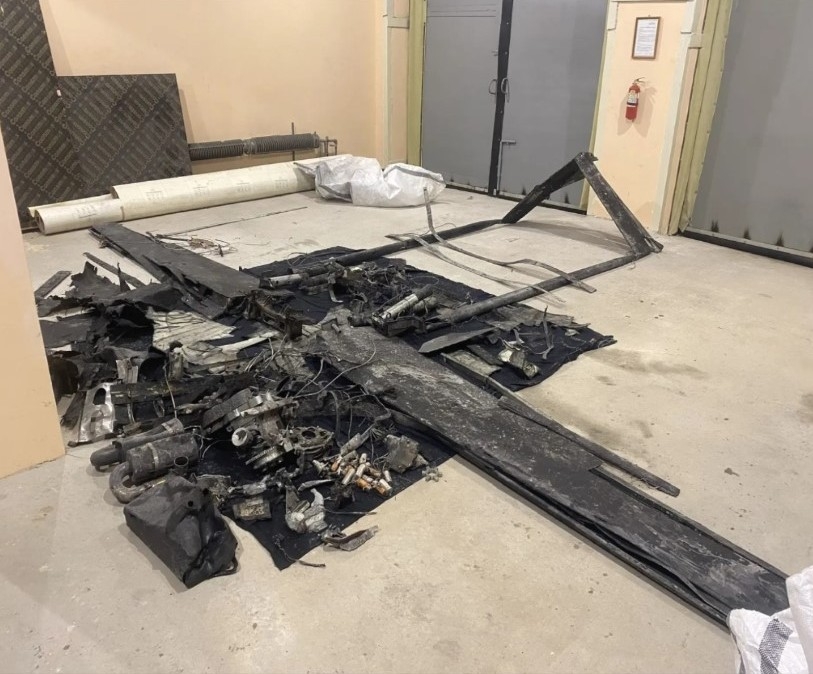
Debris from a downed drone near Plesetsk Cosmodrome in December.
Credit: Plesetsk Cosmodrome Press Service via Mirny Administration
Debris from a downed drone near Plesetsk Cosmodrome in December. Credit: Plesetsk Cosmodrome Press Service via Mirny Administration
A local news organization, News29.ru, published a photo it claimed showed a destroyed drone near Plesetsk. Reports by News29.ru and another regional news website, Kareliainform.ru, suggested multiple drones were part of the attempted strike on Plesetsk. “The targets were detected and neutralized in a timely manner,” Kareliainform.ru reported.
A statement attributed to the Cosmodrome Press Service was posted on Mirny’s social media page: “The Cosmodrome Command expresses its appreciation for the vigilance and high sense of civic responsibility demonstrated by residents of the Plesetsk and Kargopol districts of the Arkhangelsk Region upon detecting unmanned aerial vehicles (UAVs) flying toward the cosmodrome’s operational zone.”
“The timely receipt of information regarding the detection of these UAVs—and their flight trajectory—made it possible to prevent damage to the Cosmodrome’s military infrastructure facilities and to save lives,” the statement said.
“Legitimate target”
Russian officials did not identify the source of the drones, but Russia’s defense ministry has ascribed other drone swarms in the Arkhangelsk region to Ukraine, some 800 miles away. Ukrainian drones have routinely struck deep into Russian territory, hitting Russian military bases, oil refineries, and the Russian capital. Russia is scaling back its annual Victory Day parade in Red Square next month due to the threat of a Ukrainian drone attack.
Russia makes no secret of Plesetsk’s importance for the country’s military.
“It is particularly important to note that the success of the Special Military Operation is embedded in every launch conducted from this spaceport,” the cosmodrome’s acting chief, Dmitry Demin, said in public remarks earlier this month celebrating the 65th anniversary of Yuri Gagarin becoming the first person to fly into space.
Special military operation is Russia’s official euphemism for the country’s invasion of Ukraine. A Russian diplomat in 2022 suggested that civilian satellites, such as Starlink, used by Ukraine could become “legitimate targets” for Russian retaliation. Perhaps, then, it is no surprise that Ukraine has its sights set on the Plesetsk Cosmodrome.
Since the reported drone incursions, the Russian government put a tighter lid on information about its launches from Plesetsk. Authorities typically publish airspace warning notices called NOTAMs advising pilots to steer clear of a rocket’s flight path and downrange drop zones where spent booster rockets fall back to Earth. These NOTAMs usually cover a few minutes to a few hours for a primary launch date, and perhaps a backup date in the event of a delay. US and Chinese authorities release similar notices for their space launches.
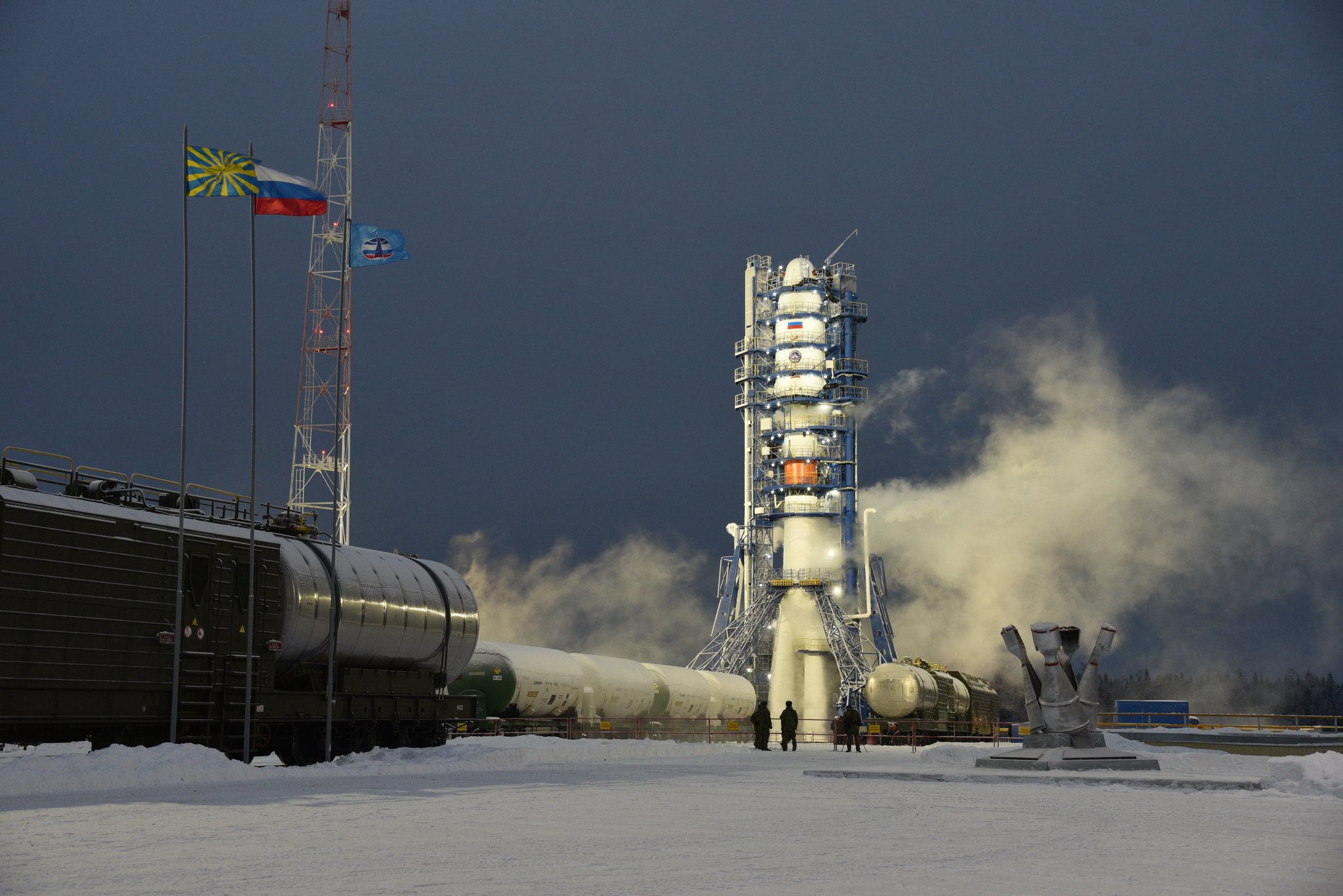
A Soyuz-2.1a rocket awaits liftoff from Plesetsk Cosmodrome in northern Russia on December 25, 2025.
Credit: Russian Ministry of Defense
A Soyuz-2.1a rocket awaits liftoff from Plesetsk Cosmodrome in northern Russia on December 25, 2025. Credit: Russian Ministry of Defense
The notices accompanying the most recent launches from Plesetsk covered much longer time periods, with daily windows of up to 10 hours over up to 14 consecutive days. And it appears as if Russian space officials are not necessarily aiming to launch at the first opportunity within these expanded windows. For example, a Soyuz launch from Plesetsk in February took off on the fourth day of a 10-day warning period. The next Soyuz launch from Plesetsk, with the first cluster of Rassvet broadband satellites, occurred more than six hours into a 10-hour window on the fifth day of a nine-day warning period.
The official public warnings for the next Soyuz rocket launch from Plesetsk were even more ambiguous, covering various periods between April 1 and 15. The launch went off on April 3, likely carrying a Russian military communications satellite into a high-altitude orbit.
“So there seems to be a new policy to issue much vaguer NOTAMs that make it much more difficult to predict the exact launch day and launch time (whether that is enough to fool intelligence agencies is, of course, another matter),” Bart Hendrickx, an expert on Russia’s space program and a professor at Ghent University in Belgium, wrote in an email to Ars. “I don’t think it’s a coincidence that this new policy was introduced after the December 25 attack.”
Please stay away
Russian officials released strange overlapping airspace and maritime warning notices for two different launches from Plesetsk sometime between April 13 and April 30, with launch windows for the two missions combining to cover up to 19 hours each day. Essentially, authorities were telling civilian pilots and sailors to remain clear of the warned areas for all but a few hours each day.
“Some of the warnings contain a mix of coordinates for impact zones of both rockets,” Hendrickx wrote on SeeSat-L, a long-running online forum of satellite and launch tracking enthusiasts. “This may have been done deliberately in an attempt to cover up the dual launch scenario. As has been the case for other launches from Plesetsk this year, the launch periods and daily launch windows in the navigation warnings are unusually long and most likely don’t entirely correspond to the actual launch windows.”
The overlapping warning notices “created the impression that they were for a single launch,” Hendrickx told Ars.
The first of these two cloaked launches departed from Plesetsk on April 16, when a Soyuz-2.1b rocket placed eight classified Russian military satellites into orbit for an unknown purpose. A week later, on April 23, a smaller Angara-1.2 rocket launched from the cosmodrome with a quartet of suspected military spy satellites. Russian government officials announced the launches and posted photos of them after confirming their success.
Plesetsk’s first few months of 2026 have been the busiest period for space launches at the cosmodrome since 2022. Dozens more launches will be required to fully deploy the Rassvet constellation, which Russian officials say will number 900 satellites by 2035. Russia’s Nivelir anti-satellite missions also launch from Plesetsk, the primary launch base for Russia’s military space program.
Seasoned observers of Russia’s space program might question if the drone attacks are a ruse to add another layer of secrecy over Russia’s launch activity at Plesetsk. But Russian officials continue to announce launches after they occur, and, in any event, US and other foreign intelligence agencies keep a close watch on Plesetsk. And Ukraine’s ability to strike fortified locations inside Russia is well-known.
“Bakanov didn’t literally use the words ‘Ukrainian drone attack’ (too shocking for Putin?), but that’s clearly what he was referring to,” Hendrickx told Ars. “I see no reason why the Russians would lie about these drone attacks, the more so because Putin himself was briefed about at least one of them.”
Listing image: Russian Ministry of Defense

Stephen Clark is a space reporter at Ars Technica, covering private space companies and the world’s space agencies. Stephen writes about the nexus of technology, science, policy, and business on and off the planet.