


惯性聚合 高效追踪和阅读你感兴趣的博客、新闻、科技资讯
阅读原文 在惯性聚合中打开

推荐订阅源

Vercel News
Vercel News
Y
Y Combinator Blog
H
Hackread – Cybersecurity News, Data Breaches, AI and More
The GitHub Blog
The GitHub Blog
N
Netflix TechBlog - Medium
MyScale Blog
MyScale Blog
F
Fortinet All Blogs
Microsoft Azure Blog
H
Help Net Security
C
Check Point Blog
博客园 - 聂微东
云风的 BLOG
云风的 BLOG
M
MIT News - Artificial intelligence
U
Unit 42
WordPress大学
WordPress大学
B
Blog
Last Week in AI
Last Week in AI
人人都是产品经理
人人都是产品经理
T
Tailwind CSS Blog
D
DataBreaches.Net
G
Google Developers Blog
T
The Blog of Author Tim Ferriss
Hugging Face - Blog
Hugging Face - Blog
IT之家
IT之家

Ars Technica - All content

Pentagon wants $54B for drones, more than most nations’ military budgets Mozilla: Anthropic's Mythos found 271 security vulnerabilities in Firefox 150 Supreme Court arguments make it clear that FCC fines are "nonbinding" Silo S3 teaser hints at the wasteland's origins Framework's CEO on the RAM crisis and creating a "MacBook Pro for Linux users" Florida probes ChatGPT role in mass shooting. OpenAI says bot "not responsible." Report: Meta will train AI agents by tracking employees' mouse, keyboard use Microsoft removes Call of Duty from Game Pass, lowers subscription pricing Framework Laptop 13 Pro is a major overhaul for the modular, upgradeable laptop Framework Laptop 16 upgrades make it look less like an unfinished prototype Internal emails show how Amazon raises prices across the Internet, lawsuit says Anthropic gets $5B investment from Amazon, will use it to buy Amazon chips CATL's new LFP battery can charge from 10 to 98% in less than 7 minutes AMD Ryzen 9 9950X3D2 Dual Edition review: Tons of cache for tons of dollars What's the deal with spacesuits for the Moon? Will they be ready in time? Loneliness in older adults can often lead to memory impairment Contrary to popular superstition, AES 128 is just fine in a post-quantum world Pentagon pulls the plug on one of the military's most troubled space programs John Ternus will replace Tim Cook as Apple CEO Blue Origin's rocket reuse achievement marred by upper stage failure I’ve fired one of America’s most powerful lasers—here’s what a shot day looks like Great white sharks are overheating US-sanctioned currency exchange says $15 million heist done by "unfriendly states" Man with @ihackedthegovernment Instagram account tells judge, “I made a mistake" Trump picks qualified, normal health leader to head CDC; experts still cautious $25,000 buys plenty of used EVs: Here are some options Satellite and drone images reveal big delays in US data center construction Amazon won’t release Fire Sticks that support sideloading anymore Ridley Scott's post-apocalyptic The Dog Stars drops first trailer Artemis II pilot talks about what it was really like to fly and land in Orion
Start with the sensors, then design the rest: How Zoox bu...
Jonathan M. Gitlin · 2026-04-28 · via Ars Technica - All content

These days, the hype is all about AI and robots, but almost a decade ago, the tech du jour was self-driving. You couldn’t swing a lanyard at CES for the latter half of the last decade without hitting a robotaxi; post-COVID, the number of startups has shrunk, but the technology has definitely matured. Go to the right cities—San Francisco and Austin, Texas, spring to mind—and you might see dozens of sensor-festooned vehicles among the downtown traffic.

The pod-like robotaxis belonging to Zoox stand out. Other robotaxi developers are retrofitting existing vehicles like Hyundai Ioniq 5s with sensors and the computing power necessary for self-driving. Zoox, which was bought by Amazon in 2020, did that with its test fleet, but as it starts to offer ride-hailing services—currently in Las Vegas and San Francisco—it’s doing so with a purpose-built design that looks like it just drove off the set of a big-budget sci-fi production.

“A robotaxi is not a car; it’s not a human-driven vehicle, and the requirements are wildly different, although it has to live in that world,” explained Chris Stoffel, director of robot industrial design and studio engineering at Zoox.

It all starts with the sensors, each perched on a little ledge projecting from the top four corners of the robotaxi’s body. From up there, each has an unobstructed, high-level view, giving the Zoox robotaxi good situational awareness, particularly straight ahead. “Because we don’t have a traditional hood, we’ve optimized our frontal coverage in a way that would be nearly impossible on a retrofitted vehicle,” said Zoox director of sensor engineering Ryan McMichaels.
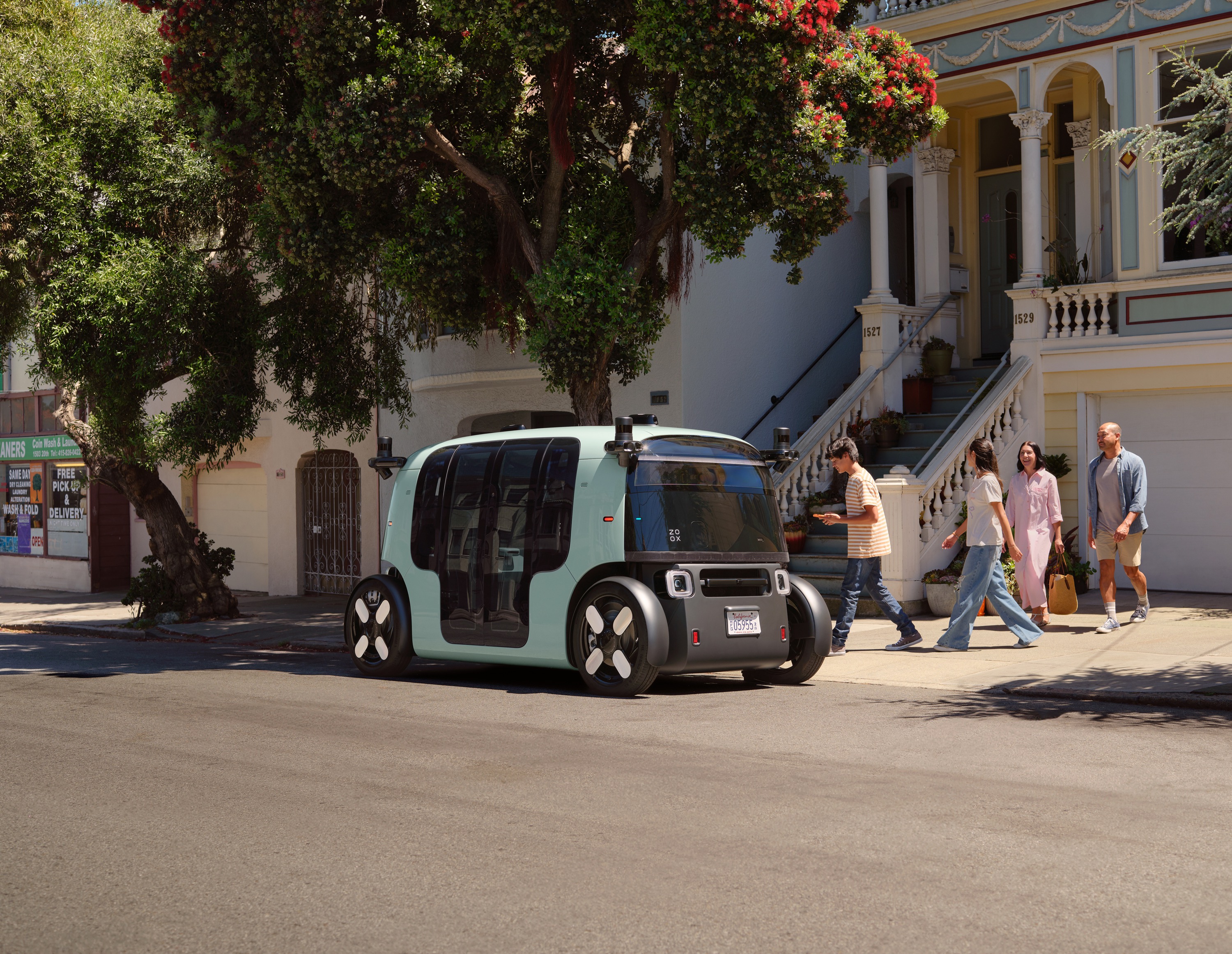
A Zoox robotaxi picks up riders

Zoox’s robotaxi has a friendly, welcoming design.

Credit: Zoox

Zoox’s robotaxi has a friendly, welcoming design. Credit: Zoox

Then there’s the fact that the robotaxi doesn’t care whether it’s coming or going, thanks to its symmetrical, bidirectional design. The advantages are tantalizing, particularly for a vehicle that’s going to be summoned on demand. There’s no more need for a three-point turn, and with its symmetrical steering axles, it should have unparalleled agility. For example, since both axles have the same degrees of steering, the Zoox robotaxi can crab walk far more effectively than the GM Hummer EV performing its party trick.