Off-nominal
Blue Origin’s reused first stage hit its targets, but New Glenn’s upper stage did not.
Blue Origin's New Glenn rocket lifts off from Cape Canaveral Space Force Station, Florida, at 7:25 am EDT (11:25 UTC) April 19, 2026. Credit: Paul Hennesy/Anadolu via Getty Images
The third flight of Blue Origin’s heavy-lift New Glenn launcher began Sunday with the company’s first successful reflight of an orbital-class booster, but ended with a setback for Jeff Bezos’ flagship rocket, a key element in NASA’s Artemis lunar program.
The 321-foot-tall (98-meter) New Glenn launch vehicle ignited its seven methane-fueled BE-4 engines at 7:25 am EDT (11:25 UTC) Sunday, beginning a slow climb from its launch pad at Cape Canaveral Space Force Station, Florida.
The main engines, each producing more than a half-million pounds of thrust, accelerated the rocket past the speed of sound in about a minute-and-a-half. Three minutes into the flight, the booster switched off its engines and fell away from New Glenn’s upper stage, powered by two BE-3U engines burning liquid hydrogen and liquid oxygen.
New Glenn’s first stage continued a downrange parabolic arc, briefly soaring into space before guiding itself toward Blue Origin’s landing platform in the Atlantic Ocean nearly 400 miles southeast of Cape Canaveral. Reigniting its engines for two braking burns, the booster settled onto the ship for a smoky but on-target touchdown less than 10 minutes after liftoff.
The landing marked the end of the second flight for this booster, named Never Tell Me the Odds, after debuting with a good launch and recovery on Blue Origin’s previous New Glenn mission in November. Blue Origin, founded and owned by Amazon’s Jeff Bezos, has landed and reused its smaller New Shepard suborbital booster numerous times, but New Glenn surpasses New Shepard in difficulty and scale. It flies higher, travels faster, and is three times the height of the New Shepard.
Technicians installed new engines on the booster for Sunday’s flight, but Blue Origin intends to reuse the engines from the November launch on future New Glenn missions, according to Dave Limp, the company’s CEO.
New Glenn allows Blue Origin to reach into a broader market for launches to low-Earth orbit and beyond. SpaceX has shown it can recycle a Falcon 9 booster for reflight in just nine days and launch Falcon 9s five or more times in one week using a fleet of reusable boosters and three active launch pads. Blue Origin officials expect reusing New Glenn boosters will unlock a vastly faster launch rate for them.
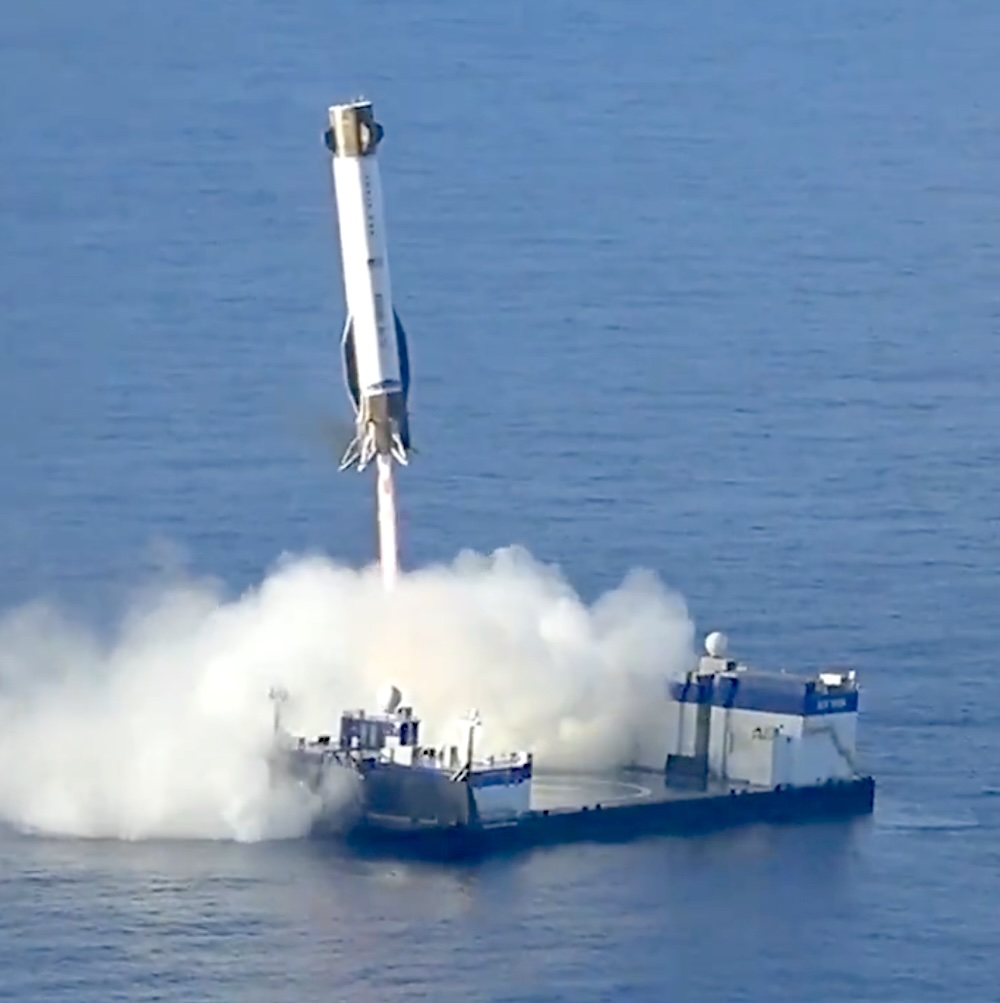
In this screenshot from Blue Origin video Sunday, the New Glenn booster descends toward the company’s recovery ship in the Atlantic Ocean.
Credit: Blue Origin
In this screenshot from Blue Origin video Sunday, the New Glenn booster descends toward the company’s recovery ship in the Atlantic Ocean. Credit: Blue Origin
Upper’s a downer
But Blue Origin could not celebrate the achievement for long. Within a couple of hours, it became clear that something went wrong with the mission’s remaining milestones. Blue Origin confirmed New Glenn’s upper stage missed its aim and released its payload, a cellular broadband communications satellite for AST SpaceMobile, into an inaccurate orbit.
“We have confirmed payload separation,” Blue Origin posted on X. “AST SpaceMobile has confirmed the satellite has powered on. The payload was placed into an off-nominal orbit. We are currently assessing and will update when we have more detailed information.”
Later Sunday, AST said in a statement that the satellite’s orbit was “too low to sustain operations” with its onboard thrusters. The spacecraft “will be de-orbited” and AST said it expects to recover the satellite’s undisclosed cost under an insurance policy.
The twin-engine upper stage was supposed to complete two burns to place AST SpaceMobile’s direct-to-cell satellite into an orbit approximately 285 miles (460 kilometers) above the Earth at aninclination of 49 degrees to the equator. There, the upper stage was expected to release AST’s BlueBird 7 satellite about 1 hour and 15 minutes into the mission. The roughly 6-ton spacecraft was supposed to unfurl a 2,400-square-foot communications array antenna and join a half-dozen other satellites undergoing tests for AST’s cellular broadband network.
Blue Origin’s upper stage performed well on the first two New Glenn flights last year. The rocket “nailed insertion” into the correct orbit on the first test flight in January 2025, according to Dave Limp, the company’s CEO. Officials reported a similarly precise trajectory on the second New Glenn launch, which dispatched two NASA science probes toward Mars in November.
Something, presumably a problem on the upper stage, prevented the New Glenn rocket from achieving the same success Sunday. A preliminary set of orbital tracking data from the US Space Force a few hours after launch indicated the rocket was in a much lower orbit than anticipated, with an altitude of just 95 miles (154 kilometers) at its closest point to Earth. This would bring about a destructive reentry within hours or days.
Upper stages have been a menace for other rockets of late. SpaceX suffered upper stage failures on three test flights of the massive Starship rocket last year. Second-stage problems are responsible for the only blemishes in SpaceX’s near-perfect reliability record with the workhorse Falcon 9 rocket. For SpaceX, these are the only pieces of the Falcon 9 and Starship that haven’t been recovered, inspected, and reused.
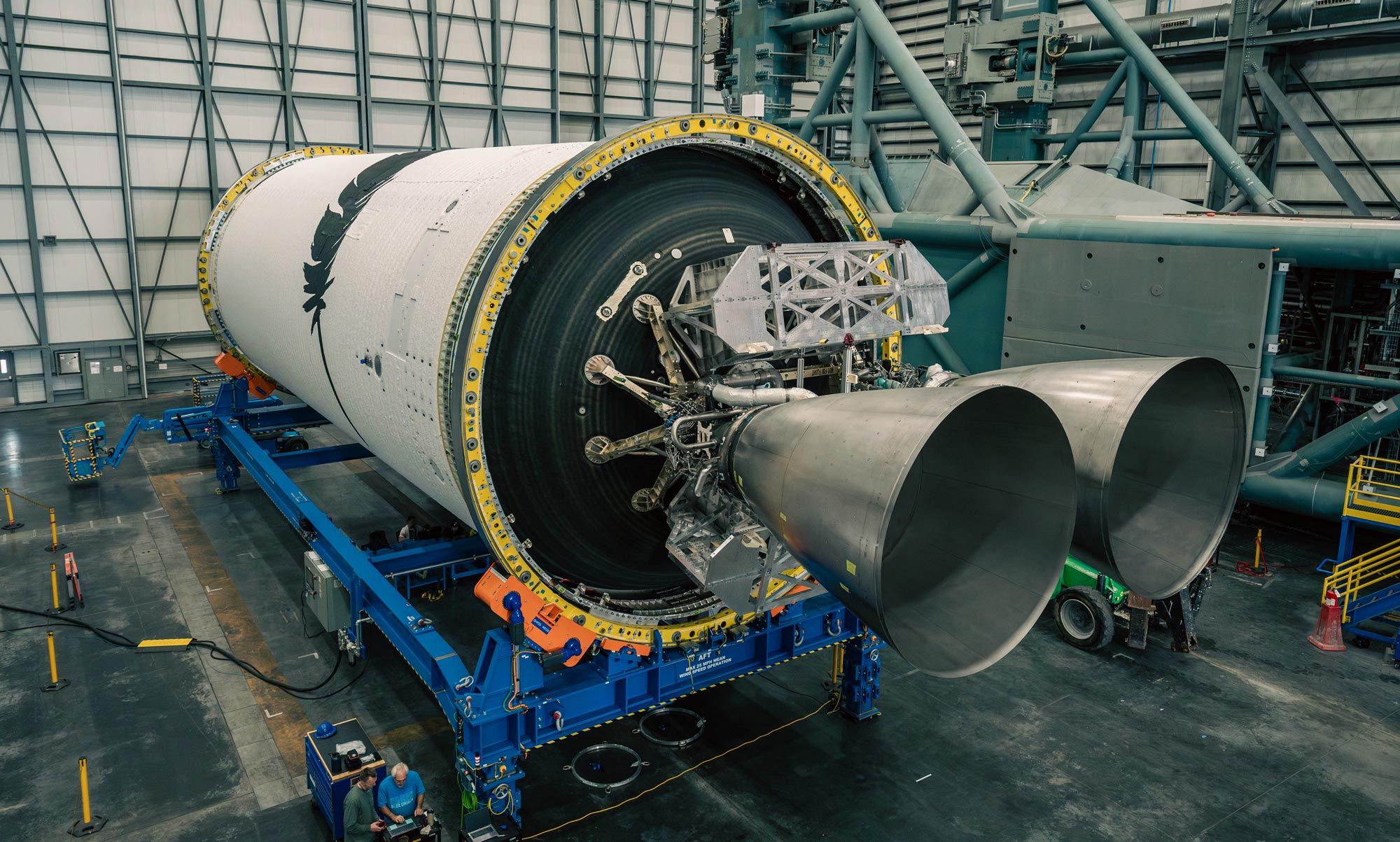
File photo of two BE-3U engines on a previous New Glenn upper stage.
Credit: Blue Origin
File photo of two BE-3U engines on a previous New Glenn upper stage. Credit: Blue Origin
The payload on Sunday’s New Glenn launch was AST’s second full-size BlueBird broadband satellite and seventh BlueBird spacecraft overall, counting prototypes. AST has multilaunch agreements with Blue Origin and SpaceX to place the satellites into low-Earth orbit (LEO), with each company capable of launching multiple BlueBirds on a single rocket. Now, AST officials are thankful just a single BlueBird was aboard Sunday’s launch.
SpaceX and Amazon are AST’s prime competitors in the market for satellites that provide connectivity directly to mobile phones. SpaceX’s initial direct-to-cell offering is already operational with the Starlink network, reaching more than 10 million active users earlier this year through partner carriers, led by T-Mobile in the United States. There are more than 10,000 working Starlink satellites in space today, and around 650 of them had the ability to link with unmodified smartphones.
Amazon is still in the early stages of building out its LEO network, with 241 satellites launched to date. Last week, the retailer announced deals to buy satellite operator Globalstar and partner with Apple to provide satellite service for iPhones and Apple Watches, moves to help it expand into the mobile connectivity market.
AST SpaceMobile, a startup founded nine years ago, lacks the deep pockets of Amazon and SpaceX, but it has cinched important deals with AT&T, Verizon, Vodafone, and other mobile network operators to connect their customers via satellite. AST’s network is designed to provide commercial services using a fewer number of larger satellites, with 45 to 60 satellites sufficient to enable continuous coverage over the United States and other “key strategic markets.” A fleet of approximately 90 satellites should be enough to provide “24/7 coverage worldwide,” AST says on its website.
The company said it expects to have the next three BlueBird satellites ready to ship to their launch site in about 30 days, and it anticipates having approximately 45 satellites in orbit by the end of 2026. In January, AST projected somewhere between 45 and 60 satellites in orbit by the end of the year.
Setback for Artemis
Failures such as Sunday’s are not unusual as new rockets come online. United Launch Alliance’s Vulcan rocket has reached orbit on all four of its missions to date, but two of the flights survived close calls after malfunctions in their solid-fueled strap-on boosters. After three successful flights, SpaceX’s Falcon 9 stranded a satellite in an unusable orbit on its fourth launch in 2012. The incidents triggered months-long investigations before the rockets flew again.
An investigation of similar length would delay Blue Origin’s next batch of New Glenn flights, which include launches for the Amazon Leo broadband constellation and, most visibly, the launch of the company’s first prototype Blue Moon lander to the Moon. Any schedule slip for Blue Moon is bad news for NASA, which plans to use a human-rated version of Blue Moon to ferry astronauts to and from the lunar surface on future Artemis missions. NASA has contracts with Blue Origin and SpaceX to develop landers to land astronauts on the Moon before the end of 2028.
Amazon is already dealing with launch reliability woes as its main launch contractor, United Launch Alliance, investigates the Vulcan rocket’s persistent solid rocket booster problem. A successful test of the first Blue Moon Mark 1 would demonstrate the spacecraft’s engine, structures, and avionics and grow confidence that Blue Origin’s New Glenn rocket is up to the task of reliably and precisely launching additional Blue Moon landers for NASA’s Artemis program.
NASA is closely watching advancements by the agency’s Moon lander contractors after the nearly flawless Artemis II mission around the Moon earlier this month. SpaceX plans to launch the first suborbital test flight of its upgraded Starship Version 3 rocket, itself a prototype for a future Artemis lunar lander, as soon as May.
Updated at 2:45 pm EDT (18:45 UTC) with AST SpaceMobile statement.

Stephen Clark is a space reporter at Ars Technica, covering private space companies and the world’s space agencies. Stephen writes about the nexus of technology, science, policy, and business on and off the planet.