It’s getting hot in here
Pacific heat pulse is temporary, but scientists warn that its climate impacts are not.
The 2024 El Niño in the Tropical Pacific, combined with human-caused warming, dried out vast tracts of the Amazon region, crushing livelihoods and displacing people, and also flipped some forests to release more carbon dioxide than they absorb and store, a “regime shift” in the Amazon carbon cycle. Credit: Luis Acosta/AFP via Getty Images
The Pacific Ocean is a giant climate cauldron, with a powerful heat engine that affects storms, fisheries, and rainfall patterns half a world away, and scientists are watching closely to see if it’s about to boil over.
Their projections suggest the tropical Pacific is simmering toward a strong El Niño, the warm phase of an ocean-atmosphere cycle that can intensify and shift those impacts.
In a world already superheated by greenhouse gases, a strong El Niño during the next 12 to 18 months could permanently push the planet’s average annual temperature past the 1.5 degrees Celsius warming threshold enshrined in scientific documents and political agreements as a turning point for potentially irreversible climate impacts.
Climate scientists also recently published a study showing that strong El Niño events can trigger what they called “climate regime shifts,” meaning abrupt, lasting changes in heat, rainfall, and drought patterns.
El Niño is one of the planet’s biggest natural release valves for ocean heat. The venting starts with periodic shifts of swirling ocean currents and winds over the Pacific. That causes huge stores of tropical ocean heat to surge eastward from the Western Pacific Warm Pool, roughly between Australia and Indonesia, northward to Japan. Those tropical seas are by far the warmest ocean region on Earth and span an area four times as large as the continental United States.
When that ocean heat spreads across the equatorial Pacific, it spills into the atmosphere in pulses that tilt weather patterns, reroute powerful high-elevation winds, raise global temperatures, bleach coral reefs, and disrupt fisheries and ocean ecosystems. The effects hit continents as well, intensifying rainstorms and flooding in some regions, while amplifying extreme heat, drought and wildfires in others.
In 2015, heat from the tropical Pacific helped raise the global annual average temperature irreversibly past 1 degree Celsius above the pre-industrial baseline. And in 2024, Earth experienced the hottest year recorded in human history, aided by another El Niño boost.
Even a moderately strong El Niño during the next 12 to 18 months could drive the average global temperature to about 1.7 degrees Celsius above the preindustrial level, climate scientist James Hansen told Inside Climate News. Hansen doubts the world will meaningfully cool back down to below the 1.5 degree Celsius mark after the El Niño fades.
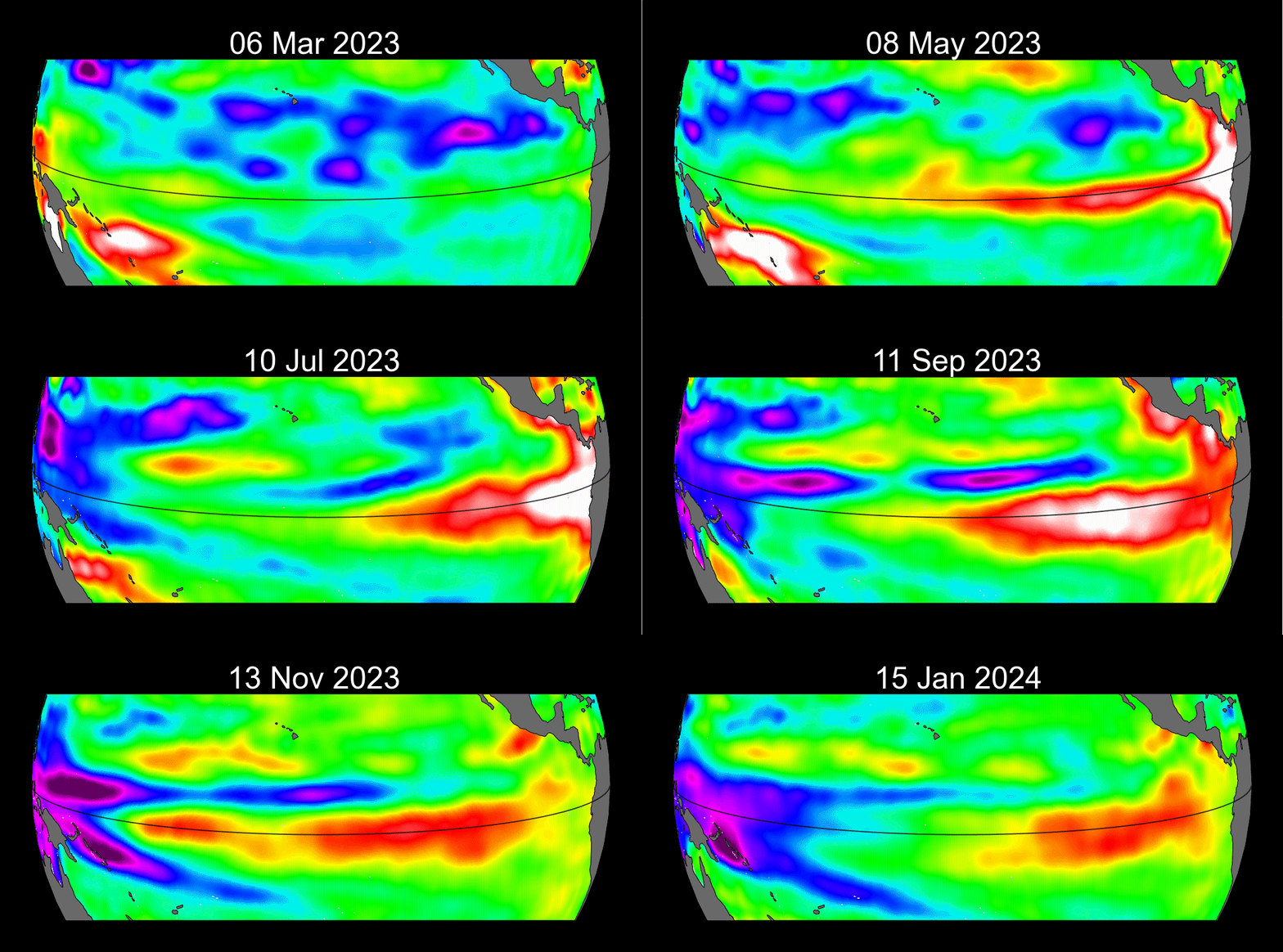
Hot El Niño cycles in the tropical Pacific Ocean release so much energy, as heat and moisture, to the atmosphere that it affects rainfall and drought patterns halfway around the world. Credit: NASA/JPL
Credit: NASA/JPL
Hot El Niño cycles in the tropical Pacific Ocean release so much energy, as heat and moisture, to the atmosphere that it affects rainfall and drought patterns halfway around the world. Credit: NASA/JPL Credit: NASA/JPL
Passing that threshold may not be like falling off a climate cliff, but it’s definitely the point when the edge starts crumbling, with rapid changes to relatively stable systems of forests, water, rain, and temperatures that have sustained people and ecosystems for millennia.
Even below the 1.5-degree Celsius threshold, California reservoirs no longer fill in some years and overflow with extreme rainfall in others. Coral reefs from Australia to the Caribbean have bleached beyond recovery and vast tracts of forests burned up in megafires. Traditional crop calendars don’t align with seasons. Deadly nighttime heat rises in cities, killing vulnerable people in apartments that never cool.
“Super El Niño” seen as game changer
Climate impacts amplified by strong El Niños keep hitting the same vulnerable regions, may be more widespread than previously thought, and can persist long after the tropical Pacific cools, according to an El Niño study published December 2025 in Nature Communications.
The study concluded that “super El Niños” are not just passing weather events, but more like climate shocks that can push parts of the Earth system into new states, co-author Jong-Seong Kug wrote in an email.
The study’s definition of a super El Niño is when the sea surface temperature anomaly in the tropical Pacific “exceeds 2 standard deviations above normal”—not an ordinary fluctuation, but more of a systemic warning sign.
The impacts are clustered in areas known to be sensitive to long-distance climate connections and regions “that are already prone to climate regime shifts,” wrote Kug, a climate researcher at Seoul National University in South Korea.
There are only three super El Niños on record: in 1982-83, 1997-98, and 2015-16. All of them contributed to regime shifts in regional ocean temperatures, leading to unprecedented marine heat waves that destroyed or damaged coral reefs and caused mass die-offs and starvation among many marine organisms, from starfish to seabirds and marine mammals.
Those impacts, as well as changes in drought and extreme heat over land areas, persisted for years and could shift some regional patterns for decades, according to the study.
Kug said the main “regime-shift hotspots” in oceans include the central North Pacific, the southeastern Indian Ocean, the southwestern Pacific, and the Gulf of Mexico, areas where globally linked atmospheric connections “can strongly perturb the ocean surface and, in some cases, help anomalies persist.”
Kug said the study identified super El Niño regime shifts in East Africa and the Maritime Continent—the island-rich region between the Indian and Pacific Oceans around Indonesia, Malaysia, and Papua New Guinea.
The research also uncovered strong El Niño signals in the form of soil moisture changes in central southern Asia, central Australia, the Amazon, and western Greenland. The land responses are “linked to the way super El Niño reshapes regional precipitation and temperature through teleconnections,” he said in an email.
“These shifts matter because they can turn a short-lived climate shock into a longer-lasting risk,” he wrote. If soil moisture stays below normal for several years, crops are exposed to repeated heat and water stress across multiple growing seasons with “direct consequences for food production and water security.”
Adapting to a changing baseline
The potential for more destructive physical impacts raises deeper concerns about how societies that developed under relatively stable climate conditions will function in a world with shifting baselines and sharper swings between droughts and floods, more intense tropical storms, expanded fire seasons and long-lasting unseasonal extreme heat.
Understanding how stronger El Niños reshape the climate can help countries close what the United Nations calls the global adaptation gap, which is the widening distance between known climate risks and actual preparation.
El Niño is the warm phase of a cyclical temperature shift in the tropical Pacific Ocean that can have immediate impacts, like the collapse of life-sustaining coastal fisheries and widespread coral reef die-offs, as well as impacts on land, including devastating flooding and extreme heatwaves.
The U.N. Environment Programme’s 2025 Adaptation Gap Report found that international public adaptation finance fell slightly to $26 billion in 2023, even as the cost of climate impacts rises sharply. Developing countries will need $310 billion to $365 billion per year by 2035 to prepare for worsening heat waves, floods, and droughts, but so far, global efforts will amount to less than a tenth of what’s needed.
The UNEP report warned that adaptation can no longer rely on reactive, incremental projects but must become anticipatory, strategic, and transformational: redesigning water systems, cities, agriculture, and infrastructure for the climate of the future, unlike anything people have experienced. Experts say adaptation doesn’t mean waiting for the old normal to return and that there is not a one-size-fits-all answer for building resilience to more intense climate impacts.
Kug said that El Niño and global warming may be locked into a vicious climate cycle. The study findings suggest global warming amplifies the impacts associated with super El Niños and “makes the climate system more prone to persistent shifts once those impacts are triggered.”
The practical challenge, Kug said, is not just preparing for a single season of extremes, but for a climate shift that will also alter conditions in the future.
“Super El Niño may not just cause a one-time extreme event,” he wrote. “It can shift the background climate conditions that people and ecosystems rely on.”
This story originally appeared on Inside Climate News.