








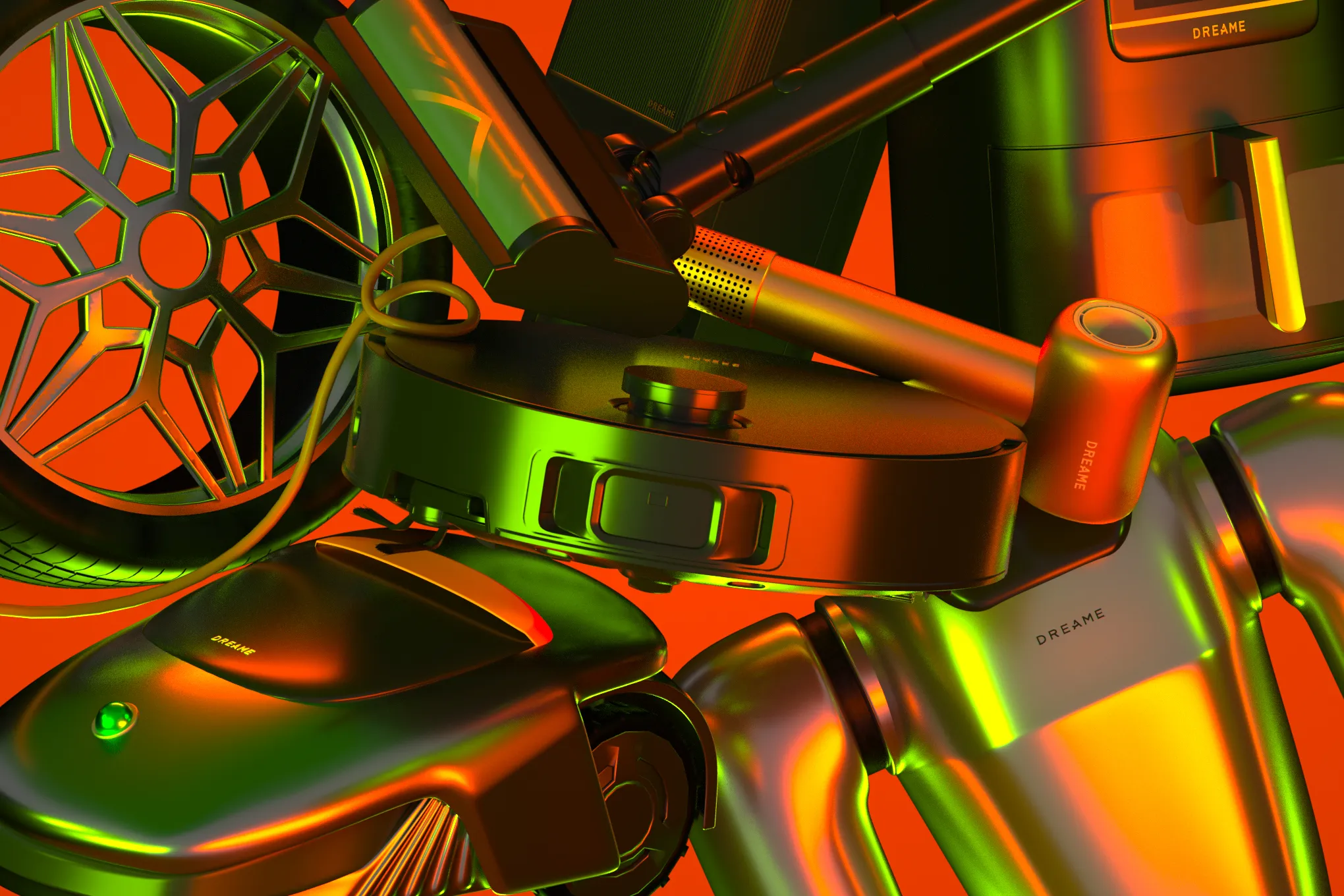
Dreame plans to build everything from hypercars and hair dryers to China’s Elon Musk. It’ll either win big or go down in flames.
by

is a senior reviewer with over twenty years of experience. She covers smart home, IoT, and connected tech, and has written previously for Wirecutter, Wired, Dwell, BBC, and US News.
Many startups spend years trying to become a household name. Others just spend $10 million on a Super Bowl ad. That’s Dreame’s bet. The little-known Chinese robot vacuum company has grand ambitions to become a global consumer electronics giant and chose to run a pricey 30-second spot as its opening move. If it works, the ad may be remembered as the beginning of the rise of the next global tech powerhouse. If it doesn’t? Well, let’s just say Quibi ran a Super Bowl ad, too.
Dreame’s CEO wants to be the Chinese Elon Musk
Dreame — pronounced dreamy — used its half-minute of exposure to promise a dizzying product evolution: from robot vacuums and lawnmowers to hypercars, humanoids, and even into outer space. Transformers-style robots took each product to the next level, hinting at a far bigger future than sweeping floors. “This commercial isn’t just about visibility; it’s a statement of commitment,” said Dreame’s North American CEO, Ana Wang.

Image: Janet Mac / The Verge
The Super Bowl debut followed a big splash at this year’s CES, where the robotic cleaning company occupied two giant booths packed with examples of its expanding ecosystem. Alongside robotic vacuums, lawnmowers, and pool cleaners, the company showed off a luxury hypercar designed to rival Bugatti, household appliances laden with robotics and AI, and entries into dozens of consumer electronics spaces — from smartphones and smart locks to televisions and smart refrigerators. Its stated aim? To create a “people-home-car” ecosystem. Whatever that means.
Then last month, according to reports from China, the company announced it is launching satellites into space, with plans to send up 2 million more. It’s also developing humanoid robots, solid-state batteries, smart telescopes, and more cars — even flying ones. Plus, it plans to make its own chip to power it all with its new NXMind brand.
Next week, on April 27th, it will bring its dream to America with a splashy San Francisco launch of new product lines across some highly competitive markets, all tied together by its “AI-powered whole-home smart ecosystem.”


1/6
Dreame’s breakneck growth and ambitious expansion raise more flags than an Olympic opening ceremony. A vacuum company barely through its first decade, expanding into categories like TVs, cars, and appliances, which require a mature corporate infrastructure, feels fragile at best. To say nothing of trying to do all of that globally. For every Samsung, which grew from trading dried fish and vegetables into a global electronics powerhouse, there are plenty of LeEcos, which burn through their reckless ambition in a fireball of publicity.

At the center of Dreame’s efforts is its young, charismatic founder and CEO, Yu Hao, who is betting that scale, speed, and (of course) AI can make the dream a reality. He’ll be in San Francisco at the launch, which is called “Dreame Next 2026” and will be a “four-day immersive experience,” according to a press release from the company. Dreame’s PR manager, Sam Tong, told me in an interview that they expect over 10,000 attendees, and that the event will feature product launches, exhibitions, and a keynote by Yu Hao. This is his moment to try to sell America on his vision of a Chinese technology company running every facet of your digital home life. It won’t be easy.
“His idol is Elon Musk,” Tong said. “Chinese media say he wants to be the Chinese version of Elon Musk.” When I asked about the enormous, seemingly impossible scale of his vision, she said, “We have the conditions, we have the funds, we have the technology, and he has the dream.”
So, where exactly did this upstart floor cleaning company come from?
The Dreame dream began in 2009, when Yu started the Sky Workshop, a student-run aerospace makerspace at Tsinghua University. The project attracted sponsorship from Boeing and, combined with his studies in computational fluid mechanics, became the underpinnings of Yu’s Dreame.
Dreame Technology was established by Yu in 2015 in Suzhou, China, to develop high-speed digital motor technology, with the goal of dethroning Dyson in home-cleaning appliances. The company started out building products for Xiaomi, and its first launch was the Dreame / Xiaomi V9 stick vacuum at the end of 2018. A cheaper near-clone of Dyson’s much-loved V8, the V9 featured a 100,000rpm brushless motor, just a hair slower than Dyson’s 110,000rpm. It received mostly positive reviews, largely because it was roughly half the price of Dyson’s premium cordless.
In early 2019, Dreame broke away from Xiaomi and launched its own brand of robot vacuums, quickly becoming a top global retailer in the category, with particular success in the European market. It innovated rapidly and, in 2022, launched the L10S Ultra, among the first robot vacuum-mop combos with a multifunctional dock that could empty the robot’s bin, fill its water tanks, and wash its mops — now a staple in the category. More recently, it introduced the first vacuum that could climb small steps, debuted a robot vacuum with a mechanical arm (although its competitor Roborock has actually shipped its), and developed a robot with track wheels that can carry a vacuum up flights of stairs.
On top of all this, in 2023, Dreame launched a sub-brand, Mova, which makes robot vacuums, robot lawnmowers, hair dryers, and more, all of which are nearly identical to Dreame’s. Initially positioned as a lower-priced brand, Mova is now a more direct competitor, complete with its own wild ideas and giant CES booths —this year it showed off a drone that can fly a robot vacuum between floors. It also plans to launch its own EV, the Kosmera Supercar, according to Yu.


1/4
Robotic household appliances were clearly just the beginning for Yu, now 38, who named the company Dreame to underscore its ambitions. “We’re a dreamer, and we want to shape the day we’re living our way,” Roger Tang, marketing director of Dreame Televisions, told me in an interview.
According to Tang, there is a method to all this product madness. The tech that powers Dreame, he says, is based on three pillars: AI algorithms (the brain), high-speed motors (the heart), and robotic arms (the body). “The high-speed motor is the foundational IP — Yu Hao developed it and now wants to put it in everything,” he said.
And by “everything,” he means everything. In addition to its core robotic products, Dreame is putting its motor tech — which it claims now exceeds 200,000rpm — into air purifiers, fans, hair dryers, and even cars. (Something Dyson also tried and failed to do.) The company is expanding into other consumer electronics spaces, from smart home gadgets such as door locks and security cameras to DJI-like action cameras, smartphones, AI-enhanced smart rings, and smart glasses. While some products feature new innovations (mostly related to AI), some closely resemble competitors’ products — particularly the Dyson Airwrap-inspired line of hair dryers. (Dyson has sued Dreame over the similarities.)


1/6
Dreame showed off some of its new gear at CES in Las Vegas, but it was at the Appliance and Electronics World Expo in Shanghai, China, last month that the company really turned up the volume. It took over an entire hall at the convention and, alongside even more home appliance launches, debuted the Aurora line of smartphones with 29 models, including a jewel-encrusted gold one that costs $10,000. Dreame also displayed a robotic window cleaner, a robot lawn mower with an arm that can water your yard, and a flying car (which, sadly, remained stationary on the show floor). Images on social media showed humanoid robots everywhere in Dreame’s over-the-top booth, basically “booth babe-ing” for its various innovations.
When I spoke with Michael Meng, president of Dreame’s robotic vacuums unit, at CES this January, he outlined yet another of Dreame’s grand visions: “Our ultimate goal is to eliminate human housework.” Today, Dreame robots are focused on cleaning the ground, but in the future, he says they will be “more like a family service robot that can help us improve our daily life,” most likely in a humanoid form. I witnessed a demo of this promised future in the AI Laundry Care Robot, which can collect, wash, and dry your clothes, working in concert with Dreame’s new L9 washer and dryer.

Image: Janet Mac / The Verge
The prototype I saw used a camera in its robotic arm to identify and sort clothes before loading them into the washing machine. Shortly after CES, Dreame announced the robot would also be capable of folding laundry, a long-held dream in robotics littered with failures and zero commercial products. However, Dreame seems confident it’s cracked it. David Ye, Dreame’s global product manager for washing machines, told me the laundry bot will come to market in three years.

Even if all these gadgets eventually ship — and that’s a big, history-defying “if” — it’s not clear how many will ever reach the US. So far, Dreame is launching just six “premium products” stateside this year: a mini-LED TV line, a fridge that dispenses sparkling water, a high-tech washer-dryer set that will work with the laundry robot, a mini-split air conditioner that uses mmWave-sensing robotic arms to direct air flow, and an air fryer and automatic espresso machine.
Combined with Dreame’s other products and plans, it’s a wildly ambitious lineup. Its success will depend hugely on Dreame’s ability to figure out how to make AI more than a layer of glitz and buzzwords on top of existing products. Otherwise, it feels less like a connected ecosystem and more like a factory masquerading as a lifestyle brand, taking a scattershot approach to finding the next big thing in consumer electronics.

While Yu’s vision, from homes to cars to space, draws comparisons to Elon Musk, it also mirrors the ambitions of Jia Yueting, the Chinese CEO of the ill-fated LeEco. Jia also attempted to rapidly branch out from a strong niche (TV streaming) into electric cars (Faraday Future), smartphones, and TVs, and failed spectacularly. The company collapsed shortly after launching in the US, and Jia self-exiled from China.
Dreame has already had its share of controversy. In 2024, in a CEO WeChat group, Segway-Ninebot President Wang Ye accused a company widely believed to be Dreame of implementing what became known as the “finger cutting plan.” This allegedly involved luring employees from Ecovacs, Roborock, and Ninebot with enormous salaries, tapping them for trade secrets, then quickly firing them. Dreame denied the allegations.
Yu gave each of Dreame’s over 18,000 employees a gram of gold as a bonus
The industry has also noticed that many of Dreame’s products closely resemble those of competitors. Its latest gadgets — the window-cleaning robot and action camera — have similar counterparts on the market from Ecovacs and DJI, respectively. Along with Dyson, Ecovacs has filed multiple lawsuits against Dreame. (Dreame has also filed some right back.)
According to reporting by PandaYoo, Dreame’s revenue grew tenfold between 2020 and 2022. Bloomberg reports it raised around $560 million in a Series C funding round in 2021 and planned to IPO as early as 2024 (Dreame refuted this at the time). As of 2024, the company was valued at $2.8 billion, and in Q3 2025, revenue was reportedly on track to hit over $4 billion in 2025. This positions it as one of China’s fastest-growing consumer tech firms.
However, at the same time, rumors of near-bankruptcy circulated. Yu dismissed the reports, saying the company “has sufficient cash flow,” and that he had spent around 5 billion yuan ($702 million in 2025) over two years to increase his stake in Dreame from 45 percent to 70 percent. Still, the breakneck pace of expansion hints at some internal instability. In another attempt to quash concerns, Yu reportedly gave each of Dreame’s over 18,000 employees a gram of gold as a bonus at the end of last year.
According to Dreame’s Sam Tong, the company receives significant funding from the local government. This is a common pattern among Chinese manufacturing companies, most famously exemplified by Shenzhen’s rise from a fishing village to China’s Silicon Valley, spurred by government investment. Dreame is based in Suzhou, a region of China that has grown into a major hub for advanced manufacturing and technology, thanks in part to government investment.
Dreame operates as if it has virtually unlimited funding — and ambitions to match. In addition to the launch spectacle next week, Tong tells me Dreame has installed a management team in Washington, DC, and is ramping up US-based customer support.
The company, which claims to operate in 120 countries and sell products in more than 4,000 physical stores (including 200 Targets in the US), is also opening physical “experiential” Dreame stores in high-profile locations from Silicon Valley to Paramus, New Jersey. It’s still looking to out-Dyson Dyson.
Dreame operates as if it has virtually unlimited funding — and ambitions to match
Dreame’s ambitions border on crazy. But it seems that’s the point. Musk himself would probably say it is. “Even Chinese media say it’s a crazy move. But that’s just us,” said Tong. Yu Hao has gone from trying to out-power a Dyson vacuum to trying to build, well, everything. “We have a car launching, we also have a rocket… he has funds from Chinese investors and the Chinese government,” she said. “So, why not?”
Well, because churning out Dyson and DJI lookalikes while handing out grams of gold and trying to emulate Elon Musk isn’t building a company, it’s putting on a show. Dreame’s vacuums are good products, and Yu’s intelligence and ambition appear real. That’s a solid foundation for making something truly great — just not for making everything.
Follow topics and authors from this story to see more like this in your personalized homepage feed and to receive email updates.
此内容由惯性聚合(RSS阅读器)自动聚合整理,仅供阅读参考。 原文来自 — 版权归原作者所有。