





惯性聚合 高效追踪和阅读你感兴趣的博客、新闻、科技资讯
阅读原文 在惯性聚合中打开

推荐订阅源

博客园 - 司徒正美
OSCHINA 社区最新新闻
OSCHINA 社区最新新闻
腾讯CDC
WordPress大学
WordPress大学
爱范儿
爱范儿
GbyAI
GbyAI
酷 壳 – CoolShell
酷 壳 – CoolShell
博客园 - 聂微东
Google DeepMind News
Recent Announcements
Latest news
Latest news
Last Week in AI
Last Week in AI
V2EX - 技术
V2EX - 技术
I
InfoQ
N
News | PayPal Newsroom
SecWiki News
SecWiki News
Microsoft Azure Blog
美团技术团队
T
Troy Hunt's Blog
H
Hacker News: Front Page
S
SegmentFault 最新的问题
TaoSecurity Blog
TaoSecurity Blog
V
Visual Studio Blog
Martin Fowler
Martin Fowler
钛媒体:引领未来商业与生活新知
钛媒体:引领未来商业与生活新知
博客园_首页
S
Security @ Cisco Blogs
K
KPMG report finds enterprise disconnect between AI and its ROI | CIO
小众软件
小众软件
L
LangChain Blog
奇客Solidot–传递最新科技情报
奇客Solidot–传递最新科技情报
T
Tor Project blog
L
LINUX DO - 热门话题
月光博客
月光博客
S
Schneier on Security
Y
Y Combinator Blog
freeCodeCamp Programming Tutorials: Python, JavaScript, Git & More
CTFtime.org: upcoming CTF events
P
Proofpoint News Feed
Forbes - Security
Forbes - Security
cs.CV updates on arXiv.org
Hugging Face - Blog
Hugging Face - Blog
A
Arctic Wolf
Webroot Blog
Webroot Blog
博客园 - 叶小钗
F
Fortinet All Blogs
S
Securelist
AI
AI
B
Blog RSS Feed
Security Latest
Security Latest

CloudCannon Blog

Building with AI: Git-based vs headless vs traditional CMS CloudCannon + Astro: performance meets powerful content management Introducing the Astro Component Starter Introducing Jetstream — built on the Astro Component Starter Why we switched to the system font stack Redesigning CloudCannon’s docs with Diátaxis, Lume, and Pagefind Make content editing more visual: upgraded Editable Regions How Configuration Mode makes building editing interfaces easy Your hosting just got an upgrade (and a price cut) Custom testing domains for professional branding Keep your content consistent with input validation Managing multilingual content in CloudCannon Simplify team publishing with conflict resolution and domain tools Open Beta: Publishing Conflict Resolution Getting started with CloudCannon and Astro: Bookshop, components, and live editing Welcome to the CloudCannon Community! Omnichannel delivery is just marketing spin from API-based CMS companies Getting started with CloudCannon and Astro: Snippets and Collections Managing digital assets in CloudCannon: a guide to smart asset storage Understanding CloudCannon's branching workflows and Projects: a complete guide What is a static website? CloudCannon’s 2024 wrapped Getting started with CloudCannon and Astro: WYSIWYG blogging Jamstack vs. WordPress: reasons to make the change The top five static site generators for 2025 (and when to use them!) Free Jekyll themes for 2025: ten great community options Eleventy (11ty) vs. Hugo How to set up WYSIWYG editing with MkDocs Material The rise of static-first websites: why major brands are making the switch Watching your Core Web Vitals on Jamstack Understanding the difference between static, dynamic, and hybrid websites Looking for an alternative to Netlify CMS or Decap CMS? Designing components for your website editors: a CloudCannon case study Does my website look big in this? Six tips to lower your page weight Content is sacred — so own your revision history The eternal balancing act: load time vs. delay time Streamlined Headless Mode, Unified Configuration, and live data editing What is a headless CMS? Looking for a TinaCMS or Tina Cloud alternative? The ultimate guide to Hugo Sections Coming soon: Live config editing and data reloading Faster publishing workflows out now! Why information architecture matters for your website Website UX vs SEO: picking your battles Easily manage your multilingual Astro site in CloudCannon How you can optimize publishing workflows for your content team How you can optimize your CMS for SEO success How you can optimize your Content Editor for long-form articles How you can optimize your Visual Editor for page building Secure, swift, and stable: static sites for the financial sector Enhanced flexibility for teams with Custom Permissions Building static sites that scale The Inaugural 11ty International Symposium on Making Web Sites Real Good How to manage hundreds of connected websites with a Git-based headless CMS How we’re building CloudCannon for accessibility CloudCannon’s new editing improvements are here! Open Beta | New ways to collaborate on editing your websites Top 11 free Eleventy themes for 2024 Top 10 free Astro themes to use in 2024 Why choose a Git-based headless CMS over a monolithic DXP in 2024? Learning web development: a self-guided roadmap Partner Site of the Month: Blüthner Piano Centre, by Winteractive CloudCannon’s 2023 wrapup Let’s create a microblog with visual editing using Bookshop and Eleventy Update and visualize your branches with CloudCannon Projects What is a Git-based CMS and why you should use one CloudCannon secures SOC 2 certification The complete guide to growing your web development agency Automatically optimize your images with Eleventy Image and CloudCannon Partner Site of the Month: Cru Uncorked, by Ed Meehan New web component for responsive HTML tables Wrapping up HugoConf 2023 Partner Site of the Month: Van Dillen Antieke Bouwmaterialen, by Fulldev How to become a freelance web developer: a comprehensive guide Q3 2023: CloudCannon features and improvements 22 ways to deliver more value to your web development clients Partner Site of the Month: DC Gay Flag Football League, by Ed Cupaioli A new way to configure your CloudCannon sites CloudCannon — the official CMS partner of Eleventy Full CloudCannon support for Nuxt static sites Partner Site of the Month: Stadium Bike, by Insight Creative, Inc. HugoConf 2023, brought to you by CloudCannon DAM Support for Cloudflare R2 and DigitalOcean Spaces Eleventy (11ty) vs. Gatsby in 2023 – which SSG is best for you? How CloudCannon’s live editing works with Astro and Bookshop Partner Site of the Month: Fiducian, by Croissant & Baguette Eleventy (11ty) vs. Astro How to customize CloudCannon’s Client Sharing interface Let anyone, anywhere, edit your CloudCannon sites Top 23 free Astro themes for building out-of-this-world static sites in 2023 How Jampack optimizes our Eleventy website and improves performance Astro vs. Next.js CloudCannon.com is now built with Eleventy! Out-of-this-world support for all Astro users Introducing the CloudCannon Partner Program Full CloudCannon support for Gatsby Top 10 Free SvelteKit Themes for Building Lighting-Fast Static Sites in 2023 Enhanced CloudCannon support for Next.js users Upcoming CloudCannon Interface improvements (Open Beta) Creating sites, the Jamstack way
Share components and syndicate content with Site Mounting
2023-11-09 · via CloudCannon Blog

We’ve just added a super-early Christmas present for CloudCannon users: Site Mounting, available right now for all CloudCannon developers on Standard, Team, and Enterprise plans.

By enabling Site Mounting with source files, you can easily reuse (’mount’) your centrally managed site components and shared layouts across multiple CloudCannon sites and keep these components on all of your sites up to date — all from one single source of truth.

Site Mounting is a brand-new feature to help users who manage multiple sites with common components — or anyone who has (until now) been relying on Git submodules, build hooks, or custom APIs controlling rebuild cascades to manage their site dependencies.

For CloudCannon developers on Team and Enterprise plans, Site Mounting also unlocks the ability to mount the build output of a site in addition to its source files. In effect, you’re now able to set up a pre-generated headless API without GraphQL, where you can aggregate content from multiple sites into a single content lake that you control — and from that single hub, you can publish to any number of separate sites.

Publish (in your) Own Repo, Site Mount Everywhere Direct link to this section

Site Mounting means no more prebuild scripts to clone in files from Git, no more environment variables to share access to private repositories, no more committing dependencies directly into your Git repository, and no more complex custom APIs to rebuild your dependent sites after you’ve changed a single component.

Site Mounting solves all of these problems immediately — and because it’s an incredibly open-ended feature, we’re sure it will allow a lot more flexibility in the way you choose to build and connect your static sites on CloudCannon.

You might, for example, have a single Git repo with your header and footer components, and want to reuse these across multiple sites. Here’s Zach Leatherman’s solution for that particular issue:

You could also create a public/private crossover repository where your content could be community moderated and edited, and then mounted into a private repo. This way, your source code and / or project files can remain entirely private, while your community can manage and edit your documentation or other public site content — the best of both worlds. (You might equally mount a private repo onto a public site in order to use a proprietary plugin — it’s entirely up to you!)

If you’re building for a large organization — a governmental agency, educational institution, or hospital network, for example, you may want your content to be syndicated across dozens or hundreds of sites. With Site Mounting this content can be edited from one single source of truth, and published to any number of sites whenever it is updated.

Aggregate your content by Site Mounting with build outputs Direct link to this section

In addition to mounting source files like components, CloudCannon users on Team and Enterprise plans can also mount build output files. This means with minimal configuration, developers can now manage a single static content hub aggregated from a suite of static sites — in essence a pre-generated headless API — all with complete control over every step of the process.

Let’s take a look at how that would work. Rather than mounting every site to every other site, we can mount source files from all relevant websites to one central site, aggregating our content in a single repository during the build process. That content lake repo would then build on CloudCannon, with the build output being aggregate JSON feeds.

Once we mount these build outputs we can make them available as static files for builds of our separate sites, and even choose to host the JSON files as an API for a classically headless approach. Because all paths are pre-generated, our sites remain fully static, and can simply reference the JSON data without needing to implement islands or dynamic content of any form.

Diagram showing the flow from a Content Lake / API to dependent sites

On a smaller scale, you might see two static sites sharing each other’s data, where an update to data on site A triggers a rebuild on site B, and vice versa.

However you set up Site Mounting, if a user edits any one of your mounted sites, this will trigger your content hub to re-aggregate your content, and rebuild any dependent sites — ensuring that your content is always up to date.

Most importantly to us, it’s possible to do all of this while keeping absolute ownership of every piece of your content — with CloudCannon, your data is always yours, and it’s always portable.

How to start using Site Mounting Direct link to this section

All CloudCannon developers on Standard, Team, and Enterprise plans have access to the Site Mounting feature immediately. Check out our new Site Mounting documentation section to help you get started.
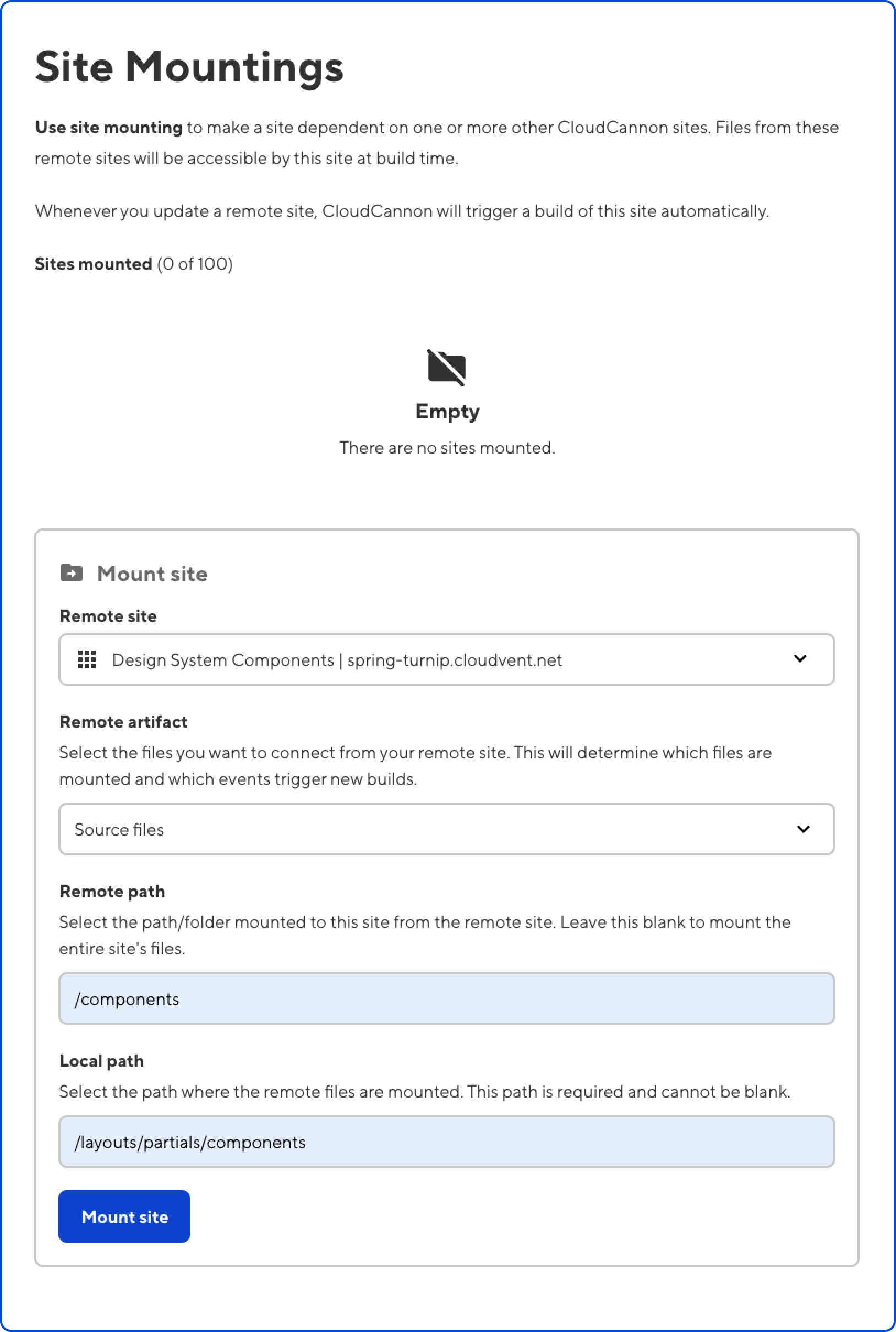
Under your Site Settings, select Site Mountings. Here, you’ll be able to select a remote site and path to mount to your current site. In this screenshot, you’ll see that I’ve mounted a remote site named ‘Design System Components’ to my local site, selected the “Source files” artifact, and specifically connected my /components directory in the mounted site to the /layouts/partials/components directory in my current site.

That’s all the setup I need to share my central site components from one CloudCannon site to another. Now, any time I update my central components in the remote site, every single site that mounts those components will rebuild automatically — CloudCannon handles all of the logic. I could even have dozens of different sites using different subsets of the same central components, and because I control every step, I’m able to select precisely which sites mount which components.

Even better, CloudCannon’s Site Mounting detects changes specific to the mounted folder, only triggering a downstream build if that folder has changed.

Let us know what you think! Direct link to this section

Site Mounting is an open-ended feature with a huge range of workflows that can be triggered from a single commit to a mounted repository. Any number of publishing actions can now be chained together with this feature. We’re excited to see what our power users will be able to build, and what kinds of problems they’ll now be able to solve.

It’s a delight to be able to build out a feature that simplifies existing workflows for our customers, and also opens up a huge range of architectural possibilities for CloudCannon users.

We’d love to hear how you plan to use Site Mounting in your workflows, and how CloudCannon can help you.


How Site Mounting grows with your CloudCannon plan Direct link to this section

Every CloudCannon Organization has access to Site Mounting, which includes mounting source files (e.g. shared components), and build triggers — when CloudCannon detects a commit to a source repository, all sites with that repo mounted will automatically rebuild.

Standard Plan Direct link to this section

On CloudCannon’s Standard Plan, you're automatically ready to connect a central components repository to both your staging and your production branches of two different CloudCannon sites — without the need for Git submodules and prebuild scripts.

  • Mount source files
  • Make up to four Site Mounting Connections
  • Includes build triggers — updates to mounted site files will trigger a build on your connected sites. 

Team Plan Direct link to this section

On CloudCannon’s Team Plan, which features branching workflows — copies of your static sites that allow you to work independently and merge back into main once you’re finished — we've increased the number of site connections you can make.

You also get access to build outputs through Site Mounting, enabling you to mount content generated by one site into any number of other sites, without triggering a rebuild on the syndicated sites. 

  • Mount source files and build output files
  • ​​​Make up to 50 Site Mounting Connections
  • Mount up to five sources onto one site
  • Includes build triggers

Enterprise Plan Direct link to this section

On CloudCannon’s Enterprise Plan, we’ve really opened the floodgates for our power users — the sky is the limit here!

  • Mount source files and build output files
  • ​​​Make up to 500 Site Mounting Connections
  • Mount as many sources as you like to one site.
  • Includes build triggers