
惯性聚合 高效追踪和阅读你感兴趣的博客、新闻、科技资讯
阅读原文 在惯性聚合中打开

推荐订阅源

cs.AI updates on arXiv.org
L
LINUX DO - 最新话题
OSCHINA 社区最新新闻
OSCHINA 社区最新新闻
Forbes - Security
Forbes - Security
博客园 - 司徒正美
Hugging Face - Blog
Hugging Face - Blog
W
WeLiveSecurity
Jina AI
Jina AI
钛媒体:引领未来商业与生活新知
钛媒体:引领未来商业与生活新知
N
News and Events Feed by Topic
V
V2EX
Stack Overflow Blog
Stack Overflow Blog
Engineering at Meta
Engineering at Meta
PCI Perspectives
PCI Perspectives
Martin Fowler
Martin Fowler
T
The Exploit Database - CXSecurity.com
F
Full Disclosure
WordPress大学
WordPress大学
S
Security Affairs
K
KPMG report finds enterprise disconnect between AI and its ROI | CIO
S
SegmentFault 最新的问题
P
Privacy International News Feed
IT之家
IT之家
M
MIT News - Artificial intelligence
G
GRAHAM CLULEY
Hacker News: Ask HN
Hacker News: Ask HN
D
DataBreaches.Net
奇客Solidot–传递最新科技情报
奇客Solidot–传递最新科技情报
Google Online Security Blog
cs.CV updates on arXiv.org
C
Check Point Blog
美团技术团队
Security Latest
Security Latest
Cyberwarzone
Cyberwarzone
N
News and Events Feed by Topic
MyScale Blog
MyScale Blog
H
Help Net Security
宝玉的分享
宝玉的分享
The Hacker News
The Hacker News
The Last Watchdog
The Last Watchdog
The Cloudflare Blog
Cyber Security Advisories - MS-ISAC
爱范儿
爱范儿
cs.CL updates on arXiv.org
I
Intezer
Threat Intelligence Blog | Flashpoint
AI
AI
I
InfoQ
N
News | PayPal Newsroom
TaoSecurity Blog
TaoSecurity Blog

CloudCannon Blog

Building with AI: Git-based vs headless vs traditional CMS CloudCannon + Astro: performance meets powerful content management Introducing the Astro Component Starter Introducing Jetstream — built on the Astro Component Starter Why we switched to the system font stack Redesigning CloudCannon’s docs with Diátaxis, Lume, and Pagefind Make content editing more visual: upgraded Editable Regions How Configuration Mode makes building editing interfaces easy Your hosting just got an upgrade (and a price cut) Custom testing domains for professional branding Keep your content consistent with input validation Managing multilingual content in CloudCannon Simplify team publishing with conflict resolution and domain tools Open Beta: Publishing Conflict Resolution Getting started with CloudCannon and Astro: Bookshop, components, and live editing Welcome to the CloudCannon Community! Omnichannel delivery is just marketing spin from API-based CMS companies Getting started with CloudCannon and Astro: Snippets and Collections Managing digital assets in CloudCannon: a guide to smart asset storage Understanding CloudCannon's branching workflows and Projects: a complete guide What is a static website? CloudCannon’s 2024 wrapped Getting started with CloudCannon and Astro: WYSIWYG blogging Jamstack vs. WordPress: reasons to make the change The top five static site generators for 2025 (and when to use them!) Free Jekyll themes for 2025: ten great community options Eleventy (11ty) vs. Hugo How to set up WYSIWYG editing with MkDocs Material The rise of static-first websites: why major brands are making the switch Watching your Core Web Vitals on Jamstack Understanding the difference between static, dynamic, and hybrid websites Looking for an alternative to Netlify CMS or Decap CMS? Designing components for your website editors: a CloudCannon case study Does my website look big in this? Six tips to lower your page weight Content is sacred — so own your revision history The eternal balancing act: load time vs. delay time Streamlined Headless Mode, Unified Configuration, and live data editing What is a headless CMS? Looking for a TinaCMS or Tina Cloud alternative? The ultimate guide to Hugo Sections Coming soon: Live config editing and data reloading Faster publishing workflows out now! Why information architecture matters for your website Website UX vs SEO: picking your battles Easily manage your multilingual Astro site in CloudCannon How you can optimize publishing workflows for your content team How you can optimize your CMS for SEO success How you can optimize your Content Editor for long-form articles How you can optimize your Visual Editor for page building Secure, swift, and stable: static sites for the financial sector Enhanced flexibility for teams with Custom Permissions Building static sites that scale The Inaugural 11ty International Symposium on Making Web Sites Real Good How to manage hundreds of connected websites with a Git-based headless CMS How we’re building CloudCannon for accessibility CloudCannon’s new editing improvements are here! Open Beta | New ways to collaborate on editing your websites Top 11 free Eleventy themes for 2024 Top 10 free Astro themes to use in 2024 Why choose a Git-based headless CMS over a monolithic DXP in 2024? Learning web development: a self-guided roadmap Partner Site of the Month: Blüthner Piano Centre, by Winteractive CloudCannon’s 2023 wrapup Let’s create a microblog with visual editing using Bookshop and Eleventy Update and visualize your branches with CloudCannon Projects What is a Git-based CMS and why you should use one CloudCannon secures SOC 2 certification The complete guide to growing your web development agency Automatically optimize your images with Eleventy Image and CloudCannon Share components and syndicate content with Site Mounting Partner Site of the Month: Cru Uncorked, by Ed Meehan New web component for responsive HTML tables Wrapping up HugoConf 2023 Partner Site of the Month: Van Dillen Antieke Bouwmaterialen, by Fulldev How to become a freelance web developer: a comprehensive guide Q3 2023: CloudCannon features and improvements 22 ways to deliver more value to your web development clients Partner Site of the Month: DC Gay Flag Football League, by Ed Cupaioli A new way to configure your CloudCannon sites CloudCannon — the official CMS partner of Eleventy Full CloudCannon support for Nuxt static sites Partner Site of the Month: Stadium Bike, by Insight Creative, Inc. HugoConf 2023, brought to you by CloudCannon DAM Support for Cloudflare R2 and DigitalOcean Spaces Eleventy (11ty) vs. Gatsby in 2023 – which SSG is best for you? How CloudCannon’s live editing works with Astro and Bookshop Partner Site of the Month: Fiducian, by Croissant & Baguette Eleventy (11ty) vs. Astro How to customize CloudCannon’s Client Sharing interface Let anyone, anywhere, edit your CloudCannon sites Top 23 free Astro themes for building out-of-this-world static sites in 2023 How Jampack optimizes our Eleventy website and improves performance Astro vs. Next.js CloudCannon.com is now built with Eleventy! Out-of-this-world support for all Astro users Introducing the CloudCannon Partner Program Full CloudCannon support for Gatsby Top 10 Free SvelteKit Themes for Building Lighting-Fast Static Sites in 2023 Enhanced CloudCannon support for Next.js users Upcoming CloudCannon Interface improvements (Open Beta)
Deploy Previews for better visibility, wherever your team works
2026-06-23 · via CloudCannon Blog

When you open a pull request in GitHub, GitLab, or Bitbucket, CloudCannon can now build a live preview of your Site for that branch, with the full editing experience you’d get on any CloudCannon Site, then comment back on the pull request so the rest of your team can find it. Developers stay in their Git workflow. Content editors and managers can open the previews in CloudCannon, check the real pages, and sign off before anything merges.

We built Deploy Previews partly to smooth out our own workflows. Every release day, someone on our engineering team spent about ten minutes gathering each open pull request and its preview Site into a single Slack post so the rest of the team could find them. That ritual was really about one thing: letting everyone see the same work, wherever they happen to be working. Now CloudCannon can post those details on the pull request the moment one opens, and surface every PR as a preview inside the CMS.

How it works Direct link to this section

Customers on Team plans and above can turn Deploy Previews on or off for each Project they own. When a PR opens, CloudCannon can build a Site for that branch, with its own build, testing domain, and the same editor you use everywhere else in CloudCannon. It can also comment back on the pull request with the build status, a link to the live preview, and another link directly back straight to the CloudCannon Site. These two automations are both optional and independent, so you can run one without the other, or neither if you’d prefer.

The main idea is visibility in both directions. A developer working in their editor, or straight from their Git provider, gets a comment on the PR pointing to the preview. A content editor or manager working in CloudCannon sees the same work as a real Site they can open and edit. Nothing your team is building stays stuck on one side.
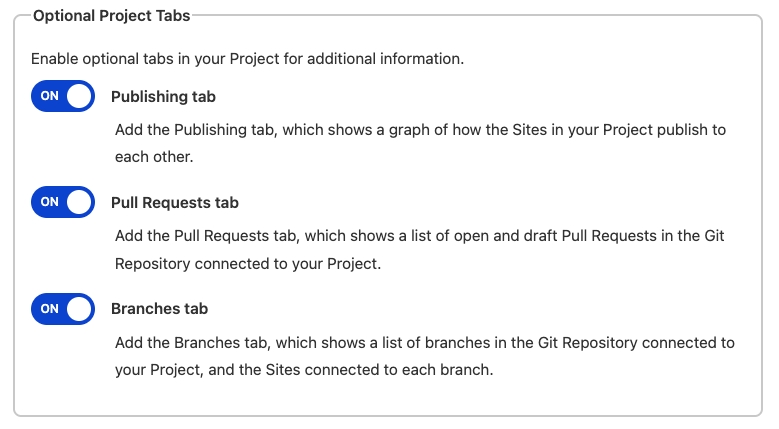
Screenshot showing optional tabs in CloudCannon Projects

Two new optional tabs in your Project help make this concrete. The Pull Requests tab shows what’s open and which previews are attached. The Branches tab gives you the same picture from the branch angle. Both tabs have quick actions available to users, without digging through settings. Even better, both of these new tabs are available on every plan, and you can choose whether to make them visible to your users.

In practice that means a reviewer can open the Pull Requests tab, see every open PR in the order they were last updated, and click into a working version of the site. They can read the actual page immediately, in CloudCannon, and they can approve the real thing rather than a picture of it.

Edit the preview, don’t just look at it Direct link to this section

Plenty of hosts offer deploy previews. Most give you a static build that isn’t easily pulled into a CMS, a snapshot you can look at but can’t easily change. Your previews on CloudCannon are fully editable Sites, presented within the CMS. A reviewer can open it and edit the content, with the same editor they already use everywhere else in CloudCannon. That matters most when the person reviewing isn’t a developer and what they care about is the words, the images, and the layout, not the diff.

It also fits how we think about CloudCannon in general. Some people want to work locally or in their IDE. Some want to work in the CMS within a browser. Some barely leave their Git provider. We’d rather fit around all of them than make everyone funnel through one workflow. Deploy Previews let a developer stay in their pull request and a content editor stay in CloudCannon, both looking at the same work.

Pull requests from outside your team Direct link to this section

For security reasons, CloudCannon won't automatically build a Site for pull requests opened from a fork. Any fork PRs get a comment explaining this, with a path to connect a Site by hand once your team has looked the changes over and decided they’re trustworthy. CloudCannon spots a fork PR the same way across GitHub, GitLab, and Bitbucket, so this behavior is consistent wherever your code lives.

If you’re running an open repo, or working with freelancers and external contributors, that’s the behavior you want.

Switch it on whenever you're ready Direct link to this section

Deploy Previews are available on Team plans and above. You’ll really start to feel the value once you’ve got a few people working in parallel and more than one of them needs to see what’s going on.

The Pull Requests and Branches tabs are slightly different. Because they add visibility to everyone working with Git (and therefore everyone on CloudCannon!), they’re free on every plan to turn on or off as you like.

To turn Deploy Previews on, open a Project, go to Project Settings, and find the Deploy Previews section. Automatic Sites and automatic PR comments are separate switches, and you're also able to add a custom footer to the comments, and decide whether draft pull requests should be included in either case.