



惯性聚合 高效追踪和阅读你感兴趣的博客、新闻、科技资讯
阅读原文 在惯性聚合中打开

推荐订阅源

A
About on SuperTechFans
D
DataBreaches.Net
K
KPMG report finds enterprise disconnect between AI and its ROI | CIO
V
Visual Studio Blog
奇客Solidot–传递最新科技情报
奇客Solidot–传递最新科技情报
B
Blog RSS Feed
Recent Announcements
The Register - Security
S
Secure Thoughts
Y
Y Combinator Blog
The Last Watchdog
The Last Watchdog
L
LINUX DO - 最新话题
V2EX - 技术
V2EX - 技术
腾讯CDC
GbyAI
GbyAI
G
Google Developers Blog
博客园 - 司徒正美
博客园 - 三生石上(FineUI控件)
T
The Exploit Database - CXSecurity.com
T
Threat Research - Cisco Blogs
P
Proofpoint News Feed
Schneier on Security
Microsoft Security Blog
Jina AI
Jina AI
WordPress大学
WordPress大学
aimingoo的专栏
aimingoo的专栏
MyScale Blog
MyScale Blog
Help Net Security
Help Net Security
K
Kaspersky official blog
P
Privacy & Cybersecurity Law Blog
www.infosecurity-magazine.com
AI
AI
MongoDB | Blog
MongoDB | Blog
Scott Helme
Scott Helme
J
Java Code Geeks
Engineering at Meta
Engineering at Meta
H
Heimdal Security Blog
H
Help Net Security
D
Darknet – Hacking Tools, Hacker News & Cyber Security
云风的 BLOG
云风的 BLOG
Microsoft Azure Blog
S
Security Affairs
TaoSecurity Blog
TaoSecurity Blog
The GitHub Blog
The GitHub Blog
Hacker News: Ask HN
Hacker News: Ask HN
Martin Fowler
Martin Fowler
cs.AI updates on arXiv.org
Project Zero
Project Zero
T
The Blog of Author Tim Ferriss
Last Week in AI
Last Week in AI

酷 壳 – CoolShell

感染新冠的经历 | 酷 壳 - CoolShell 从一次经历谈 TIME_WAIT 的那些事 | 酷 壳 - CoolShell 网络数字身份认证术 | 酷 壳 - CoolShell 我做系统架构的一些原则 | 酷 壳 - CoolShell 源代码特洛伊木马攻击 | 酷 壳 - CoolShell Go编程模式 : 泛型编程 | 酷 壳 - CoolShell 如何做一个有质量的技术分享 | 酷 壳 - CoolShell Go 编程模式:k8s Visitor 模式 | 酷 壳 - CoolShell Go编程模式:Pipeline | 酷 壳 - CoolShell Go编程模式:委托和反转控制 | 酷 壳 - CoolShell Go 编程模式:Go Generation | 酷 壳 - CoolShell Go编程模式:Map-Reduce | 酷 壳 - CoolShell Go 编程模式:错误处理 | 酷 壳 - CoolShell Go编程模式:切片,接口,时间和性能 | 酷 壳 - CoolShell 百度为什么掉队了 | 酷 壳 - CoolShell 程序员如何把控自己的职业 | 酷 壳 - CoolShell 计时攻击 Timing Attacks | 酷 壳 - CoolShell Rust语言的编程范式 | 酷 壳 - CoolShell HTTP的前世今生 | 酷 壳 - CoolShell 记一次Kubernetes/Docker网络排障 | 酷 壳 - CoolShell 可视化编程 | 酷 壳 - CoolShell 程序的本质复杂性和元语言抽象 | 酷 壳 - CoolShell 伙伴分配器的一个极简实现 | 酷 壳 - CoolShell C++11的Lambda使用一例:华容道求解 | 酷 壳 - CoolShell C++面试中string类的一种正确写法 | 酷 壳 - CoolShell C++模板”>>”编译问题与词法消歧设计 | 酷 壳 - CoolShell 数据即代码:元驱动编程 | 酷 壳 - CoolShell 数据的游戏:冰与火 | 酷 壳 - CoolShell 7个示例科普CPU Cache | 酷 壳 - CoolShell 加班与效率 | 酷 壳 - CoolShell 类型的本质和函数式实现 | 酷 壳 - CoolShell C语言全局变量那些事儿 | 酷 壳 - CoolShell 二叉树迭代器算法 | 酷 壳 - CoolShell Alan Cox:大教堂、市集与市议会 | 酷 壳 - CoolShell IoC/DIP其实是一种管理思想 | 酷 壳 - CoolShell 无锁HashMap的原理与实现 | 酷 壳 - CoolShell 浏览器的渲染原理简介 | 酷 壳 - CoolShell 疫苗:Java HashMap的死循环 | 酷 壳 - CoolShell Unix考古记:一个“遗失”的shell | 酷 壳 - CoolShell PFIF网上寻人协议 | 酷 壳 - CoolShell 实例分析Java Class的文件结构 | 酷 壳 - CoolShell 并发框架Disruptor译文 | 酷 壳 - CoolShell AWK 简明教程 | 酷 壳 - CoolShell 从面向对象的设计模式看软件设计 | 酷 壳 - CoolShell 应该知道的Linux技巧 | 酷 壳 - CoolShell Web工程师的工具箱 | 酷 壳 - CoolShell 程序员疫苗:代码注入 | 酷 壳 - CoolShell 如何测试洗牌程序 | 酷 壳 - CoolShell TF-IDF模型的概率解释 | 酷 壳 - CoolShell xkcd 神图“Click and Drag” | 酷 壳 - CoolShell Bret Victor – Learnable Programming | 酷 壳 - CoolShell C/C++语言中闭包的探究及比较 | 酷 壳 - CoolShell 对九个超级程序员的采访 | 酷 壳 - CoolShell “单元测试要做多细?” | 酷 壳 - CoolShell 一次Ajax查错的经历 | 酷 壳 - CoolShell 为什么我反对纯算法面试题 | 酷 壳 - CoolShell GCC 用 C++ 来编译 | 酷 壳 - CoolShell K Nearest Neighbor 算法 | 酷 壳 - CoolShell 对技术的态度 | 酷 壳 - CoolShell InfoQ的ArchSummit大会对我的采访 | 酷 壳 - CoolShell 各式各样的验证码 | 酷 壳 - CoolShell 代码执行的效率 | 酷 壳 - CoolShell 28个Unix/Linux的命令行神器 | 酷 壳 - CoolShell 少即是极多 | 酷 壳 - CoolShell 关于闰秒 | 酷 壳 - CoolShell K-Means 算法 | 酷 壳 - CoolShell 持续部署,并不简单! | 酷 壳 - CoolShell Git显示漂亮日志的小技巧 | 酷 壳 - CoolShell 性能调优攻略 | 酷 壳 - CoolShell 抄袭,腾讯 和 产品 | 酷 壳 - CoolShell Lisp的永恒之道 | 酷 壳 - CoolShell Javascript 中的 var | 酷 壳 - CoolShell Huffman 编码压缩算法 | 酷 壳 - CoolShell 扎克伯格的一封信:关于Facebook IPO | 酷 壳 - CoolShell 用Unix的设计思想来应对多变的需求 | 酷 壳 - CoolShell 做个环保主义的程序员 | 酷 壳 - CoolShell 游戏:VIM大冒险 | 酷 壳 - CoolShell 我们需要专职的QA吗? | 酷 壳 - CoolShell 谈谈数据安全和云存储 | 酷 壳 - CoolShell 需求变化与IoC | 酷 壳 - CoolShell 再谈javascript面向对象编程 | 酷 壳 - CoolShell 千万别惹程序员 | 酷 壳 - CoolShell 由一个问题到 Resin ClassLoader 的学习 | 酷 壳 - CoolShell 腾讯,竞争力 和 用户体验 | 酷 壳 - CoolShell SteveY对Amazon和Google平台的吐槽 | 酷 壳 - CoolShell 千万不要把 bool 设计成函数参数 | 酷 壳 - CoolShell 重构代码的7个阶段 | 酷 壳 - CoolShell 10个必需的iOS开发工具和资源 | 酷 壳 - CoolShell 你确信你了解时间吗? | 酷 壳 - CoolShell 为什么Scrum不行? | 酷 壳 - CoolShell 一个空格引发的惨剧 | 酷 壳 - CoolShell 一些软件设计的原则 | 酷 壳 - CoolShell 再谈“我是怎么招聘程序员的”(上) | 酷 壳 - CoolShell 再谈“我是怎么招聘程序员的”(下) | 酷 壳 - CoolShell 超强的验证码 | 酷 壳 - CoolShell 我是怎么招聘程序员的 | 酷 壳 - CoolShell 到处都是Unix的胎记 | 酷 壳 - CoolShell 谁写了Linux | 酷 壳 - CoolShell 在线代码编译服务Codepad.org | 酷 壳 - CoolShell 简单实用的Code Review工具 | 酷 壳 - CoolShell
Linus:利用二级指针删除单向链表 | 酷 壳 - CoolShell
Leo · 2013-02-04 · via 酷 壳 – CoolShell

感谢网友full_of_bull投递此文(注:此文最初发表在这个这里,我对原文后半段修改了许多,并加入了插图)

Linus大婶在slashdot上回答一些编程爱好者的提问,其中一个人问他什么样的代码是他所喜好的,大婶表述了自己一些观点之后,举了一个指针的例子,解释了什么才是core low-level coding

下面是Linus的教学原文及翻译——

“At the opposite end of the spectrum, I actually wish more people understood the really core low-level kind of coding. Not big, complex stuff like the lockless name lookup, but simply good use of pointers-to-pointers etc. For example, I’ve seen too many people who delete a singly-linked list entry by keeping track of the “prev” entry, and then to delete the entry, doing something like。(在这段话的最后,我实际上希望更多的人了解什么是真正的核心底层代码。这并不像无锁文件名查询(注:可能是git源码里的设计)那样庞大、复杂,只是仅仅像诸如使用二级指针那样简单的技术。例如,我见过很多人在删除一个单项链表的时候,维护了一个”prev”表项指针,然后删除当前表项,就像这样)”

if (prev)
    prev->next = entry->next;
else
    list_head = entry->next;

and whenever I see code like that, I just go “This person doesn’t understand pointers”. And it’s sadly quite common.(当我看到这样的代码时,我就会想“这个人不了解指针”。令人难过的是这太常见了。)

People who understand pointers just use a “pointer to the entry pointer”, and initialize that with the address of the list_head. And then as they traverse the list, they can remove the entry without using any conditionals, by just doing a “*pp = entry->next”. (了解指针的人会使用链表头的地址来初始化一个“指向节点指针的指针”。当遍历链表的时候,可以不用任何条件判断(注:指prev是否为链表头)就能移除某个节点,只要写)

*pp = entry->next

So there’s lots of pride in doing the small details right. It may not be big and important code, but I do like seeing code where people really thought about the details, and clearly also were thinking about the compiler being able to generate efficient code (rather than hoping that the compiler is so smart that it can make efficient code *despite* the state of the original source code). (纠正细节是令人自豪的事。也许这段代码并非庞大和重要,但我喜欢看那些注重代码细节的人写的代码,也就是清楚地了解如何才能编译出有效代码(而不是寄望于聪明的编译器来产生有效代码,即使是那些原始的汇编代码))。

Linus举了一个单向链表的例子,但给出的代码太短了,一般的人很难搞明白这两个代码后面的含义。正好,有个编程爱好者阅读了这段话,并给出了一个比较完整的代码。他的话我就不翻译了,下面给出代码说明。

如果我们需要写一个remove_if(link*, rm_cond_func*)的函数,也就是传入一个单向链表,和一个自定义的是否删除的函数,然后返回处理后的链接。

这个代码不难,基本上所有的教科书都会提供下面的代码示例,而这种写法也是大公司的面试题标准模板:

typedef struct node
{
    struct node * next;
    ....
} node;

typedef bool (* remove_fn)(node const * v);

// Remove all nodes from the supplied list for which the
// supplied remove function returns true.
// Returns the new head of the list.
node * remove_if(node * head, remove_fn rm)
{
    for (node * prev = NULL, * curr = head; curr != NULL; )
    {
        node * const next = curr->next;
        if (rm(curr))
        {
            if (prev)
                prev->next = next;
            else
                head = next;
            free(curr);
        }
        else
            prev = curr;
        curr = next;
    }
    return head;
}

这里remove_fn由调用查提供的一个是否删除当前实体结点的函数指针,其会判断删除条件是否成立。这段代码维护了两个节点指针prev和curr,标准的教科书写法——删除当前结点时,需要一个previous的指针,并且还要这里还需要做一个边界条件的判断——curr是否为链表头。于是,要删除一个节点(不是表头),只要将前一个节点的next指向当前节点的next指向的对象,即下一个节点(即:prev->next = curr->next),然后释放当前节点。

但在Linus看来,这是不懂指针的人的做法。那么,什么是core low-level coding呢?那就是有效地利用二级指针,将其作为管理和操作链表的首要选项。代码如下:

void remove_if(node ** head, remove_fn rm)
{
    for (node** curr = head; *curr; )
    {
        node * entry = *curr;
        if (rm(entry))
        {
            *curr = entry->next;
            free(entry);
        }
        else
            curr = &entry->next;
    }
}

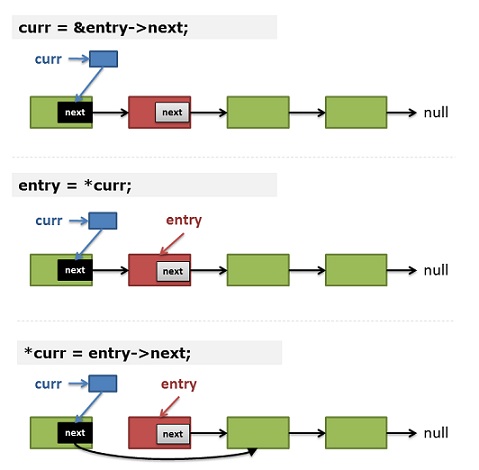
同上一段代码有何改进呢?我们看到:不需要prev指针了,也不需要再去判断是否为链表头了,但是,curr变成了一个指向指针的指针。这正是这段程序的精妙之处。(注意,我所highlight的那三行代码)

让我们来人肉跑一下这个代码,对于——

  • 删除节点是表头的情况,输入参数中传入head的二级指针,在for循环里将其初始化curr,然后entry就是*head(*curr),我们马上删除它,那么第8行就等效于*head = (*head)->next,就是删除表头的实现。
  • 删除节点不是表头的情况,对于上面的代码,我们可以看到——

1)(第12行)如果不删除当前结点 —— curr保存的是当前结点next指针的地址

2)(第5行) entry 保存了 *curr —— 这意味着在下一次循环:entry就是prev->next指针所指向的内存。

3)(第8行)删除结点:*curr = entry->next; —— 于是:prev->next 指向了 entry -> next;

是不是很巧妙?我们可以只用一个二级指针来操作链表,对所有节点都一样。

如果你对上面的代码和描述理解上有困难的话,你可以看看下图的示意:
(全文完)

Loading...