
惯性聚合 高效追踪和阅读你感兴趣的博客、新闻、科技资讯
阅读原文 在惯性聚合中打开

推荐订阅源

云风的 BLOG
云风的 BLOG
The GitHub Blog
The GitHub Blog
Y
Y Combinator Blog
博客园 - 三生石上(FineUI控件)
T
The Blog of Author Tim Ferriss
宝玉的分享
宝玉的分享
Hugging Face - Blog
Hugging Face - Blog
WordPress大学
WordPress大学
V
Visual Studio Blog
小众软件
小众软件
Cyber Security Advisories - MS-ISAC
MongoDB | Blog
MongoDB | Blog
V
V2EX
钛媒体:引领未来商业与生活新知
钛媒体:引领未来商业与生活新知
博客园 - 【当耐特】
Microsoft Azure Blog
The Cloudflare Blog
H
Hackread – Cybersecurity News, Data Breaches, AI and More
freeCodeCamp Programming Tutorials: Python, JavaScript, Git & More
Engineering at Meta
Engineering at Meta
L
LangChain Blog
Martin Fowler
Martin Fowler
GbyAI
GbyAI
博客园 - 司徒正美

WIRED

‘Avatar: Aang, The Last Airbender’ Leaked Online. Some Fans Say Paramount Deserves the Fallout NASA Wants to Put Nuclear Reactors on the Moon AI Could Democratize One of Tech's Most Valuable Resources Microsoft Surface PCs Are Getting Big Price Hikes, and the Cheaper Models Are Going Away Why Amazon Is Buying Globalstar—and What It Means for Your iPhone The US Government Will Ask Data Centers How Much Power They Use MAGA Is Starting to Look Beyond Trump Allbirds Is Pivoting to AI Compute. Sure, Why Not Best Smart Smoke Detector (and Why You Still Need a Dumb One) 12 Best Standing Desks of 2026, Tested and Reviewed Best Wi-Fi Routers of 2026 for Working, Gaming, and Streaming Best GoPro Camera (2026): Compact, Budget, Accessories The Caves That Could Help Us Find, or Become, Aliens AI Slop Is Making the Internet Fake-Happy X’s Big Bot Purge Wiped Out a Lot of People’s Secret Porn Feeds The Deepfake Nudes Crisis in Schools Is Much Worse Than You Thought In the Wake of Anthropic’s Mythos, OpenAI Has a New Cybersecurity Model—and Strategy Telegram Is Still Hosting a Sanctioned $21 Billion Crypto Scammer Black Market The FCC Has a Fast Lane for Complaints About Trump’s Media Critics Top iRestore Deals for Hair Growth and LED Therapy Devices Meta Is Warned That Facial Recognition Glasses Will Arm Sexual Predators You Should Be More Freaked Out by Shingles BYD’s Fastest-Charging Car in the World Is Astonishing—in Good and Bad Ways The 4 Best Water Filter Pitchers (2026): PFAS, Microplastics The Internet's Most Powerful Archiving Tool Is in Peril The Dumbest Hack of the Year Exposed a Very Real Problem AI Agents Are Coming for Your Dating Life ‘The Audacity’ Is the Broligarchy Takedown You Were Waiting For Why Is It So Hard to Fix an Electric Bike? (2026) Best 2-in-1 Laptops (2026): Microsoft, Lenovo, and the iPad
How and When to Watch the Artemis II Mission’s Return to ...
2026-04-10 · via WIRED

After a 10-day journey to the far side of the moon, the astronauts of the Artemis II mission are returning to Earth. But in the words of NASA administrator Jared Isaacman, the mission is not over until everyone arrives home safely. The reentry of the Orion capsule matters as much as the lunar journey itself: It is the ultimate test to prove that the space agency has mastered the technology needed to usher in a new era of deep space exploration.

According to NASA's schedule, Artemis II will reenter Earth's atmosphere on Friday, April 10, at 5:07 pm PDT. The broadcast, as with liftoff, will be available for viewing on NASA+ and streaming platforms such as Amazon Prime, Apple TV, Netflix, and HBO Max. You can also watch on NASA's YouTube livestream below.

Broadcast times across the US:

  • San Francisco: 5:07 pm
  • Denver: 6:07 pm
  • Chicago: 7:07 pm
  • New York: 8:08 pm

Reentry Details

If all goes according to plan, the crewed module will enter the atmosphere near southeast Hawaii at a maximum speed of 38,400 kmh and will take just 13 minutes to splash down in the Pacific Ocean off the coast of California.

During entry, the outside of the capsule will reach 2,760 degrees Celsius. The crew will experience up to 3.9 g’s, which means they will feel a force equivalent to nearly four times their weight after spending a week in microgravity.
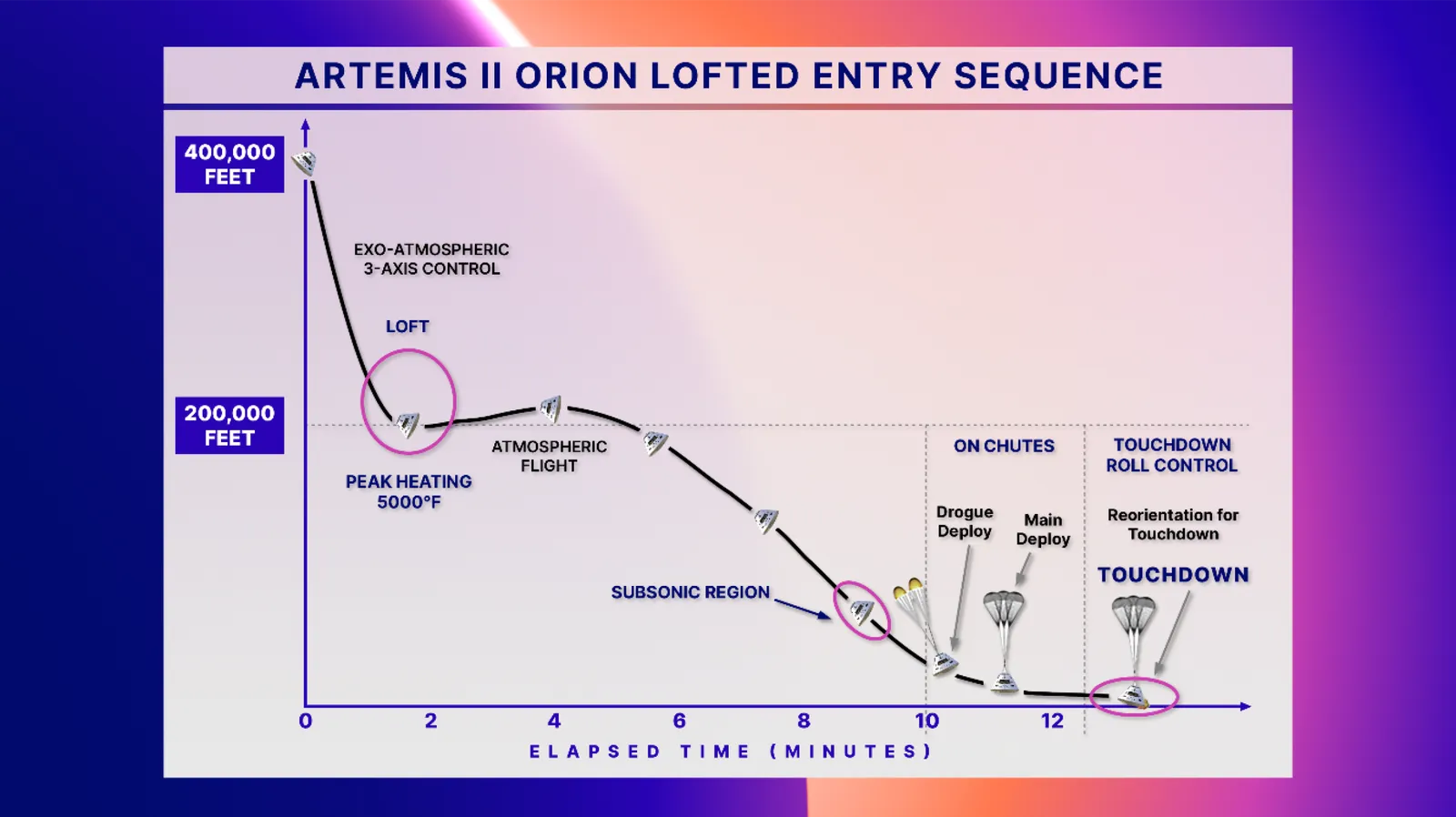
Esquema de cómo amerizar la cpsula Orion.

Orion capsule entry sequence.

Courtesy of NASA

At some point during descent, the spacecraft will go through a six-minute communications blackout. Extreme heat will generate a plasma blanket around the capsule that will temporarily block signals.

In the final phase, Orion will deploy its parachute system for a controlled descent. After landing in the ocean, the astronauts will board a ship for an initial medical evaluation and then travel to Houston to complete more detailed reports and tests.

What’s Next for the Artemis Program?

The purpose of Artemis II was to prove that NASA can once again circle the moon with a crew. The long-awaited lunar landing will have to wait for Artemis IV. In the meantime, the program's third mission will focus on perfecting the technologies that made Artemis II possible and resolving any setbacks, while NASA's partners finish key systems such as SpaceX's lunar descent module. In any case, the agency maintains its goal: to achieve a “return to the moon” by 2030.

This story originally appeared in WIRED en Español and has been translated from Spanish.