







Weirdly, spaceships have no direct way to gauge their own speed. Luckily, we can use some physics tricks to figure it out.
Photograph: Getty Images
Here on Earth, it’s easy to know how fast you’re driving. You get a good sense of it just by seeing trees and cows pass by. And of course you also have a speedometer that counts how many times your tires rotate per second and computes a speed based on their circumference. (Fun fact: Put bigger tires on your car and your speedometer will be wrong.)
If you’re flying over an ocean, of course, there’s no visual reference, so from inside it looks like you’re motionless. But airplanes can get their airspeed by using sensors to measure the rate at which air is passing over the wings. If there’s any wind, this won’t be the same as your speed relative to the ground, but you can get that by using GPS location data from orbiting satellites.
Now imagine you are flying to Mars. Locking in a precise velocity is critical so you don’t miss your rendezvous with the planet in its solar orbit. But there’s no trees or cows, no air, not even a GPS signal to help you out. So how do you know your rate of travel? Well, you need to use some physics. The good news is that there’s more than one way to go about it.
Speed vs. Velocity
First, a word about words: Speed is how far you go in how much time—like 50 miles an hour. For an airplane using GPS coordinates, it’s easy to calculate: Just take the distance between two locations and divide by the time it took to get from point A to point B.
But that only works if you’re going in a straight line. It doesn’t work at all for a bumblebee, whose path more resembles that of a drunken sailor. In the picture below, you can see that it travels much farther than necessary to get from one place to another.
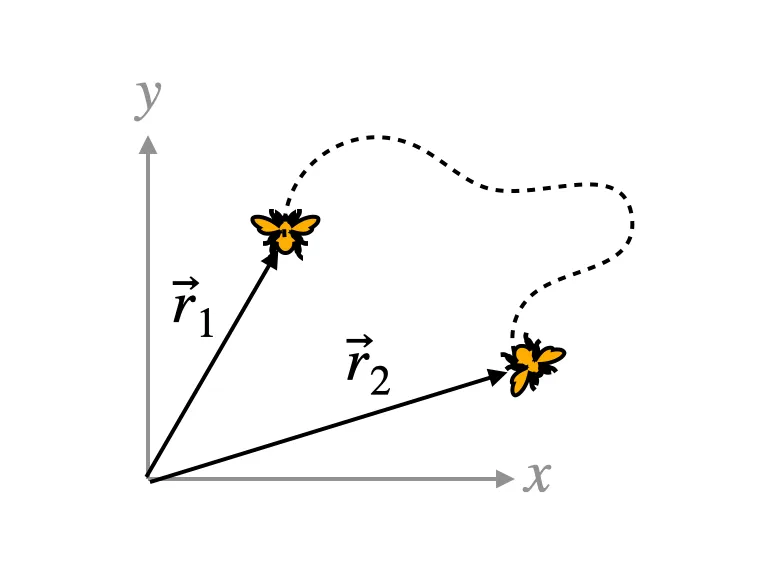
So instead of speed, in physics we use the concept of velocity, which means speed in a given direction. Even if the bee flies at a constant speed, its velocity is always changing.
To map the bee’s path, I drew an xy coordinate plane on the scene above. (For simplicity, I’m keeping it two-dimensional.) Someone looks at their watch and records a time of 1:00:05 (five seconds after 1 o’clock); at that moment the bee is at a position defined by vector r1. At 1:00:15, it’s position vector is r2.
We can still take the change in vector position (Δr), or displacement, and divide by the change in time (Δt = 10 seconds). But what that gives us is average velocity, which might not match the bee’s actual motion anywhere in its journey.
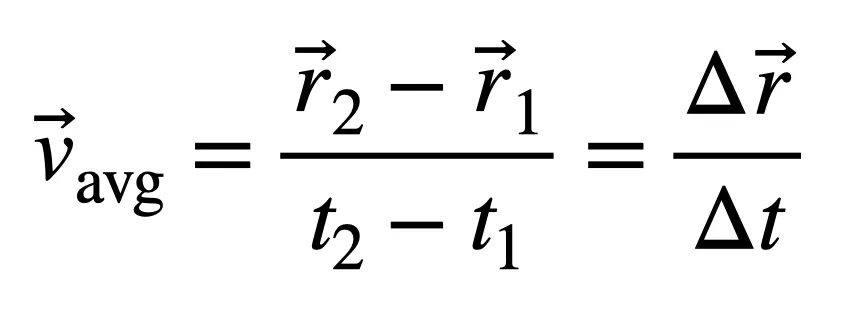
To get closer to the actual velocities, we’d have to use much smaller time intervals. In fact, if we make Δt small enough, that curved path can be approximated by a series of tiny line segments, giving us a pretty accurate velocity at any instant.
Velocity Is Relative
There’s one more thing we need to think about. Imagine you’re pedaling a bicycle with a little speedometer attached to the wheel, and it says you’re going 4 miles per hour. But you aren't riding on the road; you’re on the deck of a cruise ship, which is moving at 10 mph. So how fast are you going?
Well, there’s no single right answer; it depends on your frame of reference. With respect to the ship, you’re going 4 mph. But with respect to the water, your speed depends on your direction. If both ship and bike are heading west, you’d be going 14 mph. If you turned the bike around and headed east, you’d be going 6 mph. What’s more, as an observer on the shore would see, in the latter case you’d be pedaling forward and moving backward at that speed.
Often the reference frame is obvious, like the surface of the Earth. But in space, it's not always so clear. For spacecraft like the Orion on its recent trip around the moon, there are two obvious reference frames. The first is the Earth. We can measure the speed as it moves toward or away from us. This usually makes sense because that's where the flight started and where mission control sits.
But for NASA’S Artemis IV mission, which is scheduled to touch down on the lunar surface in 2028, it would be silly to use Earth as a reference frame. You could have a positive Earth-speed but be stationary with respect to the moon—not very helpful in landing maneuvers. Instead, the lander will use the moon as a reference frame. Or if you wanted to travel around the solar system, it would make sense to use the sun as your reference .
The fact is, there is no stationary reference point anywhere in the universe. All motion is relative to other motion. So now, if your brain is sufficiently scrambled, let's get into some of the ways we can measure speed in space.
Doppler Speed
Perhaps the most common method uses the Doppler effect. You already know about this. If you stand by some train tracks, you hear a high-pitched sound as a train approaches, and it shifts to a low-pitched sound as it passes, right? NNEEEEEEEEE—rrrrrraaaaaa …
What’s happening is that the sound waves are getting bunched up as the train moves toward you. That means more wave peaks hit your ear per second, and your brain interprets that higher frequency as a higher pitch. It’s the opposite as it moves away—the waves get spread out and the frequency drops. Here’s a picture. The yellow ball is you and the blue ball is the sound source:
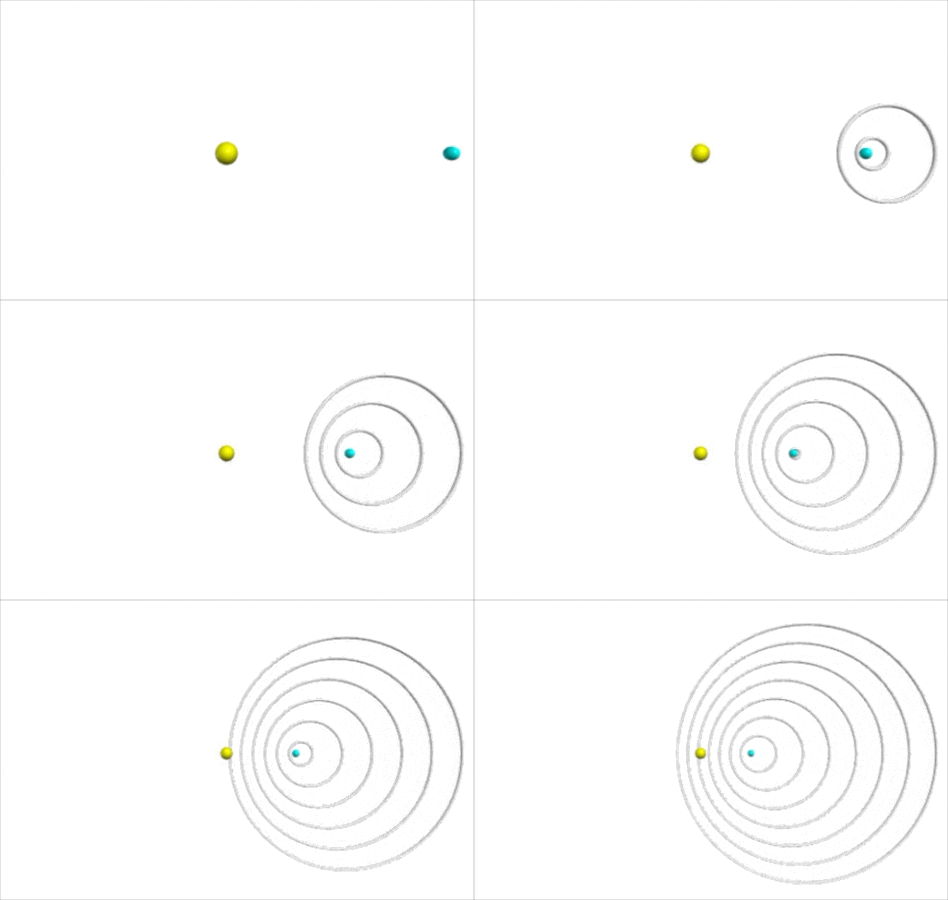
The Doppler effect also happens with electromagnetic waves, like visible light. If a luminous object in space is moving toward us, the wave fronts are compressed, and this change in frequency alters the color of the light we perceive, shifting it toward the blue end of the spectrum. That’s called a blue shift. If the object is moving away, you get a red shift.
Radio waves are another type of electromagnetic wave, and they have a certain advantage: They’re not affected by passing through an atmosphere. So then, say we send a radio beam out into space and it reflects off a moving spaceship; then we can measure the frequency of the signal that bounces back to us and compare it to the original.
For example, say our transmission has a frequency of 100 MHz (1 x 10⁸ hertz). When the reflected wave returns to Earth, it might have a frequency of 1.00001 x 10⁸ Hz. Yes, that’s a tiny difference, but we can measure it quite accurately using some tricks about wave interference. That small Doppler shift would indicate an object moving toward us at a speed of 1,000 meters per second.
Now, this method has two limitations: First, it can only give the velocity of objects moving toward or away from us. If the spacecraft were moving left to right, perpendicular to our line of sight, there would be no Doppler shift. But that’s not a big problem—we can always use more than one radio source to track a spacecraft. It can't move perpendicular to all observers at the same time.
The other limitation is that it requires line-of-sight visibility. So when the Orion spacecraft passed behind the moon on April 6, it was invisible to ground control and on its own. The need for an outside observer would also be a deal-killer for galactic smugglers like Han Solo in Star Wars.
Inertial Measurements
Luckily, there are ways that a spacecraft can derive its own velocity. One method is inertial measurement. Basically it works by measuring acceleration, which is a change in velocity. As long as you know the velocity you started at, you can add up all the changes to track current velocity.
To get a feel for this, imagine you’re sitting in a car with a blindfold on (so you can’t see the cows). When the car takes off, you get pushed back into your seat. The greater the acceleration, the more pressure you feel—that’s your measurement system. Once the car reaches a steady speed, you can use the magnitude and duration of the acceleration to determine the change in velocity—and since you started at 0 mph, the change in velocity is your velocity after one acceleration.
Of course, this seat-of-the-pants method is pretty rough—the best you could probably infer is that you’re going slow, medium, or fast. But why not just measure velocity directly? Because you can’t feel velocity. If you don’t see the cows whizzing by, the sensation of riding at a constant speed of 100 mph is the same as riding at 25 mph. (Lesson: Never drive blindfolded.)
The same thing is true if you’re using real instruments. Spacecraft have gyroscopes and accelerometers that properly measure orientation and acceleration. But they can’t measure velocity, because when velocity is constant, there’s no net force for the instruments to “feel.” That’s straight out of Newton’s second law.
How about a simple example? Remember, acceleration is the rate of change of velocity, so a = Δv/Δt. Rearranging, we get:
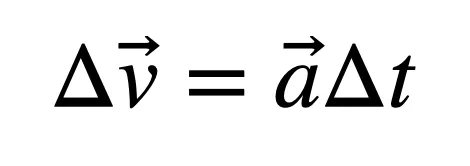
Let’s use our car again, but this time we’ll get real numbers from the accelerometer in our smartphone. Say we start at a red light and then accelerate at 2 m/s2 (meters per second squared) for five seconds. From the equation above, Δv1 would be 2 x 5 = 10 m/s, so that’s our velocity. Now, after cruising for a while, we accelerate again at 1 m/s2 for five more seconds. Δv2 is then 1 x 5 = 5 m/s. Adding these two changes, our velocity is now 15 m/s. And so on.
The only problem is that inertial measurement isn’t as accurate as the Doppler method over long periods because small errors will keep accumulating. That means you need to recalibrate your system periodically using some other method.
Optical Navigation
On Earth, people have long navigated by the stars. In the northern hemisphere, just find Polaris. It’s called the North Star because Earth’s axis of rotation points right at it. That’s why it appears stationary, while the other stars seem to revolve around it. If you point a finger at Polaris you’ll be pointing north, and you can use that orientation to go in whatever direction you want.
Now, if you can measure the angle of Polaris above the horizon, you’ll also know your latitude. If the angle is 30 degrees, you’re at latitude 30 degrees. See, it’s easy. And once you can measure position, you just need to do it twice and record the time interval to find your velocity.
But celestial navigation works because we know how the Earth rotates, and that doesn’t help in a spacecraft. Oh well, can we just use the stars like you would use the cows on the side of the road? Nope. The stars are so far away, astronauts would need to travel for many, many generations to detect any shift in their position. Like the airplane flying over the sea, you’d seem to be stationary, even while traveling 25,000 mph.
But we can still use the basic idea. For optical navigation in space, a spacecraft can locate other objects in the solar system. By knowing the precise location of these objects (which change over time) and where they appear relative to the viewer, it's possible to triangulate a position. And again, by taking multiple position measurements over time, you can calculate a velocity.
In the end, even though spaceships lack speedometers, it’s possible to track their speed indirectly with a little physics. But it’s just another example of how flying in space is really, totally different—and way more complicated—than driving or flying on Earth.
