







Ube Boobey’s bedroom is slightly messy after a trip to Morocco, but her cyberdeck glistens among the clutter. The homemade computer is located inside a clamshell purse, covered in swirly gold accents and filled with pearls, with some makeup and fake moss tucked beneath the keyboard. The 22-year-old, who’s based in London and has worked as a model, designed it to look like a fantastical mermaid’s laptop that just washed ashore.
The TikTok creator, whose real name is Annike Tan, unveiled her very first build in March with a video partially captioned “fuck it. cunty cyberdeck.” In that TikTok, she puts the hardware together and shows off the frilly details, like a custom mouse covered in gold jump rings. Since that post, over 32 million viewers have watched her videos about DIY tech projects; it’s one data point among many that highlights a renewed interest in cyberdecks, especially among women eager to share their creations online.
Annike Tan started documenting her DIY builds on TikTok earlier this year. COURTESY OF ANNIKE TAN
These cyberdecks are more than just a trendy craft project going viral on social media. The DIY gadget is, in part, a rejection of our current moment, dominated by the predictable flatness of generative AI and minimalist, mass-produced devices. “What we should do with cyberdecks is gatekeep them from AI and megacorp,” Tan says in a TikTok video with nearly 4 million views.
The concept of a cyberdeck is decades old, but the idea has always had an antiestablishment bent. In William Gibson’s Neuromancer, an influential sci-fi novel released in 1984, the protagonist is a data thief who uses his deck, which jacks into his brain, to hack big corporations: “He'd operated on an almost permanent adrenaline high, a byproduct of youth and proficiency, jacked into a custom cyberspace deck that projected his disembodied consciousness into the consensual hallucination that was the matrix.”

Author William Gibson was a major influence on the cyberpunk genre.
In the years following the book's release, a bro-y community of hobbyists has dabbled with their own wires and screens to create homebrew devices, frequently for hacking purposes or on-the-go coding. Historically, decks have resembled a heavy-duty laptop, featuring a screen and small keyboard, often sleek, utilitarian, and housed in a Pelican briefcase to survive imagined, apocalyptic scenarios. One niche ham radio YouTuber, over a year ago, titled his tutorial video “DIY Doomsday Cyberdeck EMAIL/TEXT without INTERNET” and, of course, included the “prepper” hashtag.
What sets Tan’s cyberdeck apart is its aesthetic. Inside her refurbished clamshell purse, hardware-wise, is a Raspberry Pi single-board computer with a small keyboard and screen. All fairly standard stuff—the cyberdeck’s feminine shell and crafty details are what subverts expectations. “I've not seen anyone do a hyper-femme one before,” she says. Tan felt an appreciation for the tactical aesthetic previously established by the cyberdeck community, but she wanted to craft a version that felt more authentic to her style. “I've always been very anti-minimalist,” she says. “In my life, I want color, and I want everything that I own to convey that it's me."
To make her mermaid cyberdeck less reliant on internet access, she has transferred heaps of files from her PC, uploading songs, books, maps, Wikipedia articles, and even some photos of her cats directly onto the device. When the custom mouse is connected, she can even run Doom on it.
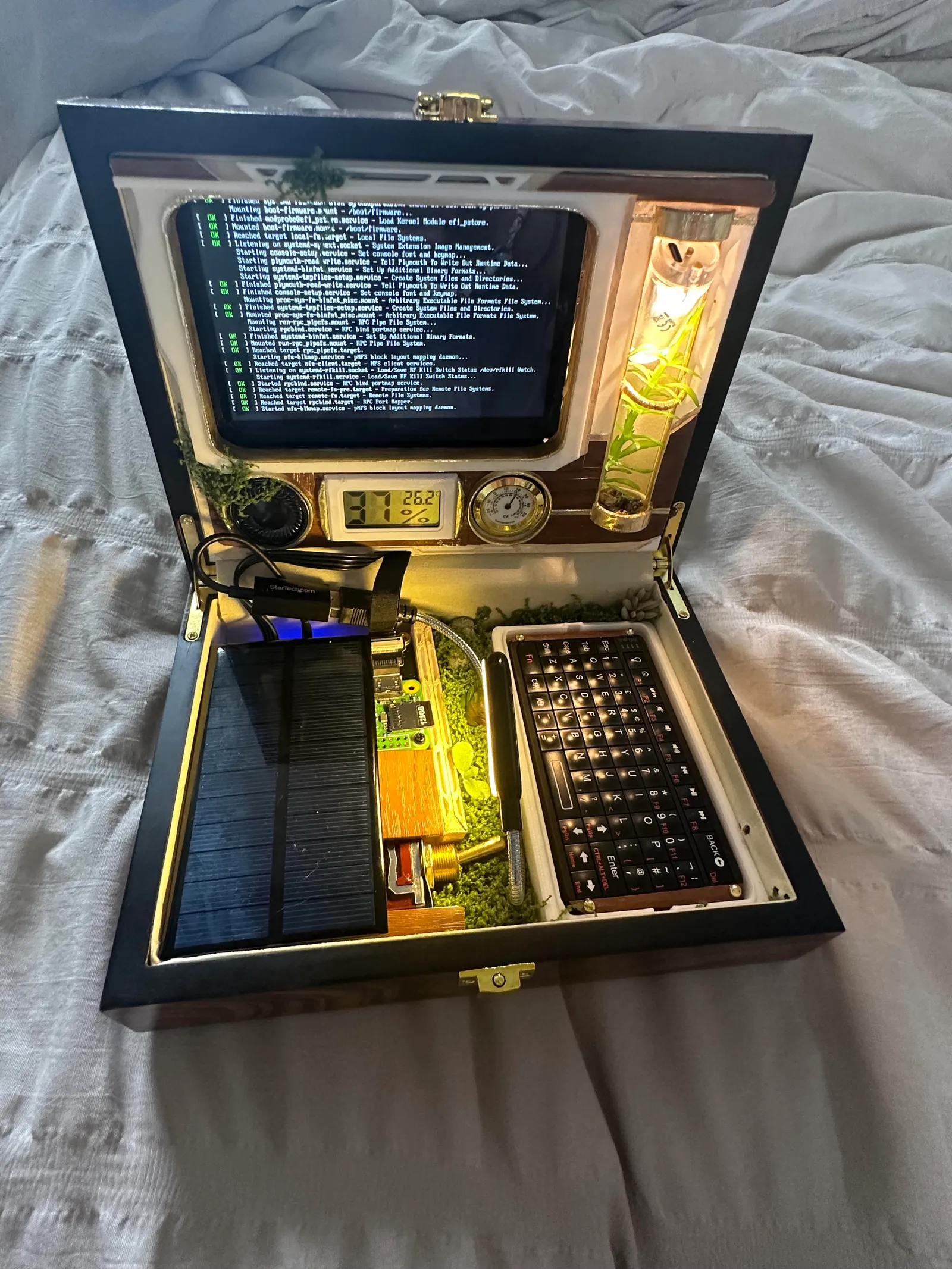
In addition to her mermaid-inspired cyberdeck, Tan also shared the construction of a deck featuring solar panels on TikTok.
Tan says the audience for her widely viewed TikToks are around three-fourths women. “A lot of people had the response, ‘Oh, I didn't know you could make a computer like this. I thought it had to be a gray box, like every other Mac or Dell or whatever,’” says Ling Lu, a 28-year-old product designer and illustrator who lives in New York City. She was inspired by Tan's videos to try to make her own whimsical gadget, the “cyberduck” audio journal, an avian-shaped recording device for personal use.
Another TikTok creator, CocoasAesthetic, who asked to be identified by her first name, Brianna, was also drawn to the vibe of these more ephemeral cyberdecks and wanted to make her own. The 25-year-old, who's based in NYC, had a random box that she thought would be perfect for this project: a small, pink container her mom got from Dunkin’s recent promotional campaign, designed to house a single Wedding Cake Munchkin.
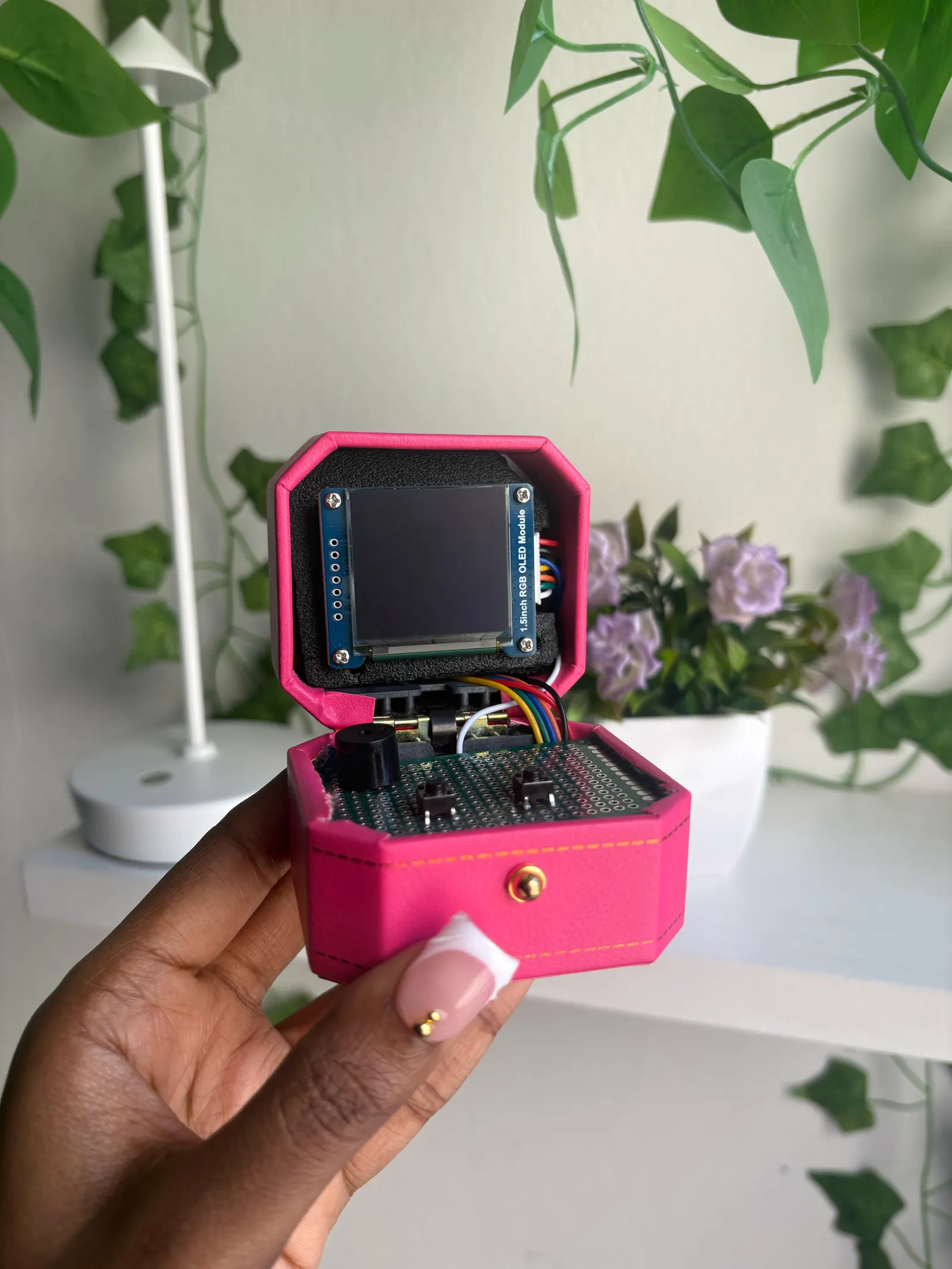
Brianna made a cyberdeck in a Wedding Cake Munchkin box.
She decided to gut the box’s orange interior to install some cheap hardware. As a software engineer who loves doing DIY projects in her off-hours, Brianna programmed a video game inside the revamped Dunkin’ box where you play as a barista and complete mini games to serve up lattes.
These makers aren’t motivated to design a device that survives nuclear war, or even one that replaces your smartphone or laptop. “I am a hypocrite, because I use my phone every day. I wouldn't reach for my cyberdeck over my phone,” says Tan. She does have customized seashell headphones that match the deck, for when she wants to vibe out and listen to music.
Regardless of whether their builds actually displace their smartphones or laptops—no one video-called me from their deck—the hobbyist devices are a joyful, welcome escape into an alternate universe of homemade tech, even if for just a couple of hours a week.
It’s already clear, only fourish years into the generative AI era, that the technology is bound to alienate us even further from the hard work of actually making stuff. Why write that wedding speech when a bot can whip up a draft and then adjust the output to make it a real tearjerker? These bots, when widely used as everyday tools, can also have a broad homogenizing impact. With her cyberdeck, Tan says she’s rejecting the AI-ification of culture by emphasizing personal expression and elbow grease.
“Everything that we use and interact with on a daily basis, we're so disconnected from the process of how it's made, where did it come from, and what are the inner workings,” says Tan. “Cyberdecks are a very good, entry-level point into becoming a bit more tech literate.”
此内容由惯性聚合(RSS阅读器)自动聚合整理,仅供阅读参考。 原文来自 — 版权归原作者所有。