





Everybody seems to want to stick AI into some oddly shaped box or another. Sometimes it's a note transcriber or a wearable pin that doesn’t quite work, or an always-listening Friend necklace that ultimately ends up being a vessel for shitposting.
Now there is a button. Chris Nolet and Ryan Burgoyne are former Apple employees who worked on developing the Apple Vision Pro. They're associated with startup accelerator Y Combinator, and the duo’s new device, available for preorder for $179 and set to ship in December, is an AI hardware puck simply called Button.

Courtesy of Button
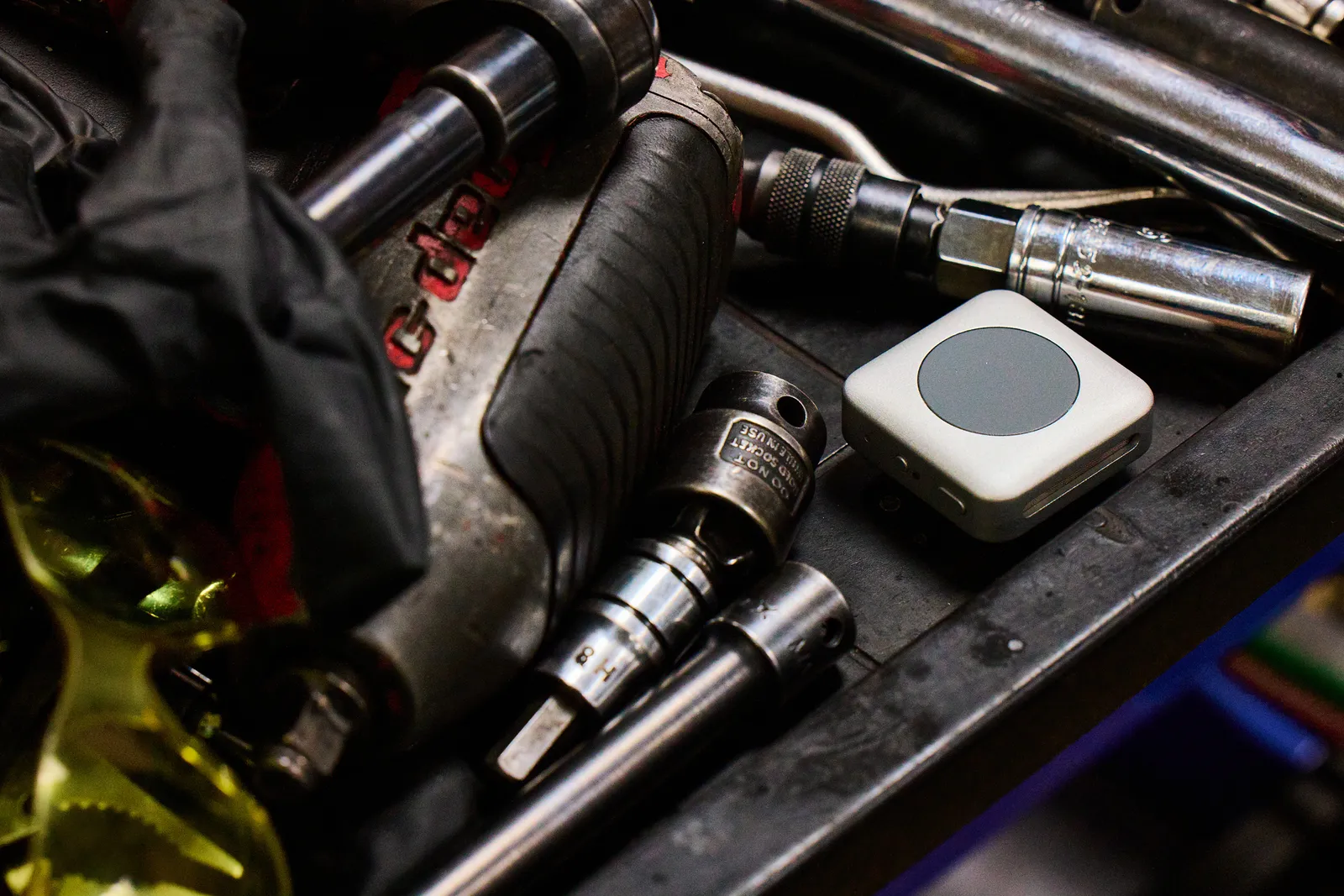
The Button does what it says on the brushed aluminum tin. It is a button, inside a case that looks (deliberately) like an iPod Shuffle. Inside is a generative AI chatbot. Press the button to enable the chatbot to listen, answer questions, and take demands. It will answer out loud or can connect to earbuds or smart glasses via Bluetooth.
It’s a simpler use case than the obvious comparison that is the Humane Ai Pin, a wearable device released in 2024 that was billed as a veritable smartphone replacement but failed to deliver on its promises and was shut down a year later.
The Button boys want there to be a couple of differentiators for their gadget, namely privacy and immediacy. The device only works when you push the button, so it does not listen passively to absolutely everything around it. Nolet says the focus on privacy comes from his experience meeting and talking with someone he later found out had been recording their entire conversation with a wearable device.
“It really freaked me out,” Nolet says. “It's one thing if I make a conscious decision to share something, but that’s totally a different thing. If people are just wearing around these pendants, or they're recording all of our conversations, I think it feels a little icky to me.”
Courtesy of Button
The other goal of the Button is rapid response time. Unlike the Humane Ai pin, which got lots of criticism for taking a painfully long time to reply to queries, the Button is designed to be nearly instantaneous. In a demo via Zoom call, I watched Nolet ask the Button for a recommendation for the best sandwich shops in my neighborhood. While the Button didn't choose my idea of the best sandwich place around, it did at least answer all the questions within a second. It can also be immediately interrupted by pressing the button, which is a great feature for people like me who cannot tell a chatbot to shut up fast enough.
Nolet is unapologetic about the very clear Apple ethos you might be able to suss out in the design.
“The Humane pin felt a little geeky to wear, right?” Nolet says. “But the iPod shuffle? Really cool. That's where the idea started, and then we just put all of our Apple-esque expertise into it and tried to refine it into something that we thought would actually be useful.”
Nearly all their product images and videos show the Button being used as a wearable, but Nolet insists the device can also be kept in a pocket, bag, or car glove box as well.
“My cofounder says we can't tell people it looks cool; they have to decide,” Nolet says. “Our intention is to build something that is kind of fashionable, but it's up to you guys to tell us if it's cool.”
Though Apple has long been a leader in technological coolness, it has struggled in the virtual reality space, specifically with its too expensive, too heavy Vision Pro and that devices complicated rollout. Apple is not alone on that front. Meta is actively rejiggering support for its VR efforts. Nolet posits that part of the reason for that instability is that VR has required building hardware and the software ecosystems to support it at the same time.
“There was no software innovation that we were anchored to as an industry, so I think it’s quite a hard pitch," Nolet says. "It’s much, much easier to stand on the shoulders of giants.”

Courtesy of Button
The dominant devices these days—smartphones, laptops, watches, even smart glasses and VR—are born of designs that precede the AI era. Nolet points to the ideas of Ben Thompson, who has written about the cyclical nature of hardware and software development. Like the way Apple captured the internet on the hardware of the smartphone, Nolet wants the Button to be the hardware answer to generative AI.
“You can use the internet on your PC, but it's better on the phone,” Nolet says. “The new innovation is AI. You can use AI on your PC, you can use it on your phone, but our pitch is that it's better on the Button.”
This is how lots of pitches for AI hardware can feel. The Button will also be competing in a space where AI giants like OpenAI are building their own AI hardware aimed to meet the moment. Some of these efforts are bound to pan out better than others. Nolet says it feels inevitable that somebody will always be building to find the perfect form for this AI foundation.
“I don't think that iPhones are going anywhere,” Nolet says. “We are not trying to replace the phone. It's a complementary device. But I think for all these reasons, the iPhone has one or two feet squarely in the past. It is built for an age before voice AI. And now as we're going into this new era, maybe computers just look different.”
此内容由惯性聚合(RSS阅读器)自动聚合整理,仅供阅读参考。 原文来自 — 版权归原作者所有。