


War had already darkened Tehran’s skies by March 8. When rain began to fall, residents said it was thick, foul-smelling and dark in color. Some described it as black rain, coating streets, rooftops, and cars in sootlike residue.
That night, Israel had struck more than 30 oil facilities in Iran. The scale of the attacks and the fires that followed were so significant that US officials later questioned their strategic rationale.
But the damage has not stopped there. From smoke over Fujairah and oil risks in Gulf waters to burned farmland and contamination fears in southern Lebanon, the environmental toll of conflict is spreading across the wider region.
A growing body of open-source evidence, satellite imagery, social media footage, and official statements points to an unfolding ecological crisis across Iran, the Gulf, and Lebanon. The picture emerging is a multifront assault on the environment: on land, at sea, and in the air.
Some impacts are visible in smoke, spills, and rubble. Others are harder to see. The first two weeks of the war alone unleashed more than 5 million tons of carbon dioxide equivalent.
Researchers estimate that each missile strike releases roughly 0.14 tons of CO2 equivalent, about the same as driving a car for 350 miles. That includes emissions from the strike itself and the embodied carbon tied to the missile’s production and supply chain.
Those emissions do not come only from weapons. They also come from aircraft sorties, naval operations, fires, fuel consumption, and reconstruction. Some damage can be counted in emissions. Much of it is physical, local, and harder to fully measure while the war is still unfolding.
It’s often said that the environment is war’s silent victim. Seven weeks after hostilities against Iran began, and as the world marks Earth Day, it is once again paying a devastating price.
According to Lebanon’s National Council for Scientific Research (CNRS), more than 50,000 housing units were destroyed or damaged within about 45 days of war, including 17,756 destroyed and 32,668 damaged units, AFP reported.
Across Iran, 7,645 buildings have been destroyed in the war, according to satellite damage assessments by Conflict Ecology, a geospatial research lab at the University of Oregon. In Tehran alone, more than 1,200 buildings were destroyed, including military facilities.
But destroyed structures are only the visible part of the toll. Contamination in soil, water, and debris is often slower to detect and harder to quantify.
Antoine Kallab, a policy adviser and academic who has studied environmental damage in Lebanon, says conflict reshapes ecosystems. “Any active war that leads to displacement, where people are forced to leave their communities and agricultural lands, definitely has an impact on the environment,” he says.
Damage to urban infrastructure can drive longer-term pollution, while rubble and debris persist long after smoke clears. “Once a bomb goes off, it creates smoke which dissipates, but something like the debris that contains toxic material stays, and it can be very, very dangerous as it can mix into the soil, changing its quality, or mix with the water."
The scale is severe. Kallab says Lebanon generated between 15 and 20 million tons of rubble in just three months during the previous war with Israel in 2024—what the country would produce in around 20 years in peacetime.
Rubble is not inert. When buildings are bombed or bulldozed, debris can release plastics, solvents, insulation fibers, heavy metals, asbestos, and other pollutants into surrounding soil and water. The environmental toll deepens when homes, roads, water networks, and sanitation systems collapse alongside them.
Pollution from burning fuel and explosives does not disappear. Toxic particles settle back onto land and water, where they can damage soil, forests, and crops, disrupt nutrient cycles, and contaminate water. Wim Zwijnenburg, program leader for humanitarian disarmament at the Dutch NGO PAX, says military and industrial sites are especially dangerous. “Rocket fuel production sites, any sites involved in the process of making missiles, these are facilities that are processing and storing toxic substances,” he says.
According to Patrick Bigger of the Climate and Community Institute, pollutants released by burning fuel and explosives can create longer-term risks beyond the immediate blast zone. “There’s also the really scary potential for the bioaccumulation of heavy metals and persistent organic pollutants in the food chain,” he adds. “The stuff gets into the soil and it gets picked up by plants, it gets eaten by animals, those go up the food chain.”
According to Lebanon’s Ministry of Agriculture, at least 68 percent of agricultural areas had been affected directly or indirectly as of September 2024.
At sea, separate attacks, spills, and leaks risk merging into a wider ecological crisis. The Gulf’s marine environment was already under pressure from warming waters, industrial activity, and habitat loss. War adds another layer of stress.
The danger is not limited to spills. As vessels return to the Strait of Hormuz, mines, sonar, military activity, and renewed shipping congestion can create additional stress beneath the surface for species already living in one of the world’s most extreme marine environments.
The region is home to around 7,000 dugongs and fewer than 100 Arabian humpback whales, a rare nonmigratory population that cannot simply relocate when conflict intensifies.
The Gulf’s waters are shallow, warm, and semi-enclosed, with limited circulation—conditions that can allow contaminants to persist longer than in more open waters. That means spills and chemical pollution may travel beyond the original incident site and linger in fragile ecosystems.
In March, the US and Israel attacked the Shahid Bagheri, a container ship converted into a military drone carrier by Iran’s Islamic Revolutionary Guard Corps (IRGC). Satellite analysis cited by experts indicated the grounded vessel later leaked heavy fuel oil, with slicks drifting west towards the mangroves of the Hara Biosphere Reserve, a Unesco-recognized biodiversity site home to turtles, pelicans, sea snakes, and other wildlife.
Further south, attacks on refineries on Lavan Island created concern for nearby Shidvar Island, an uninhabited area with coral reefs, nesting sea turtles, and migratory birds. Other smaller spills have also been reported off Basra, Kuwait and north of the UAE, underscoring how dispersed maritime incidents can combine into wider ecological stress.
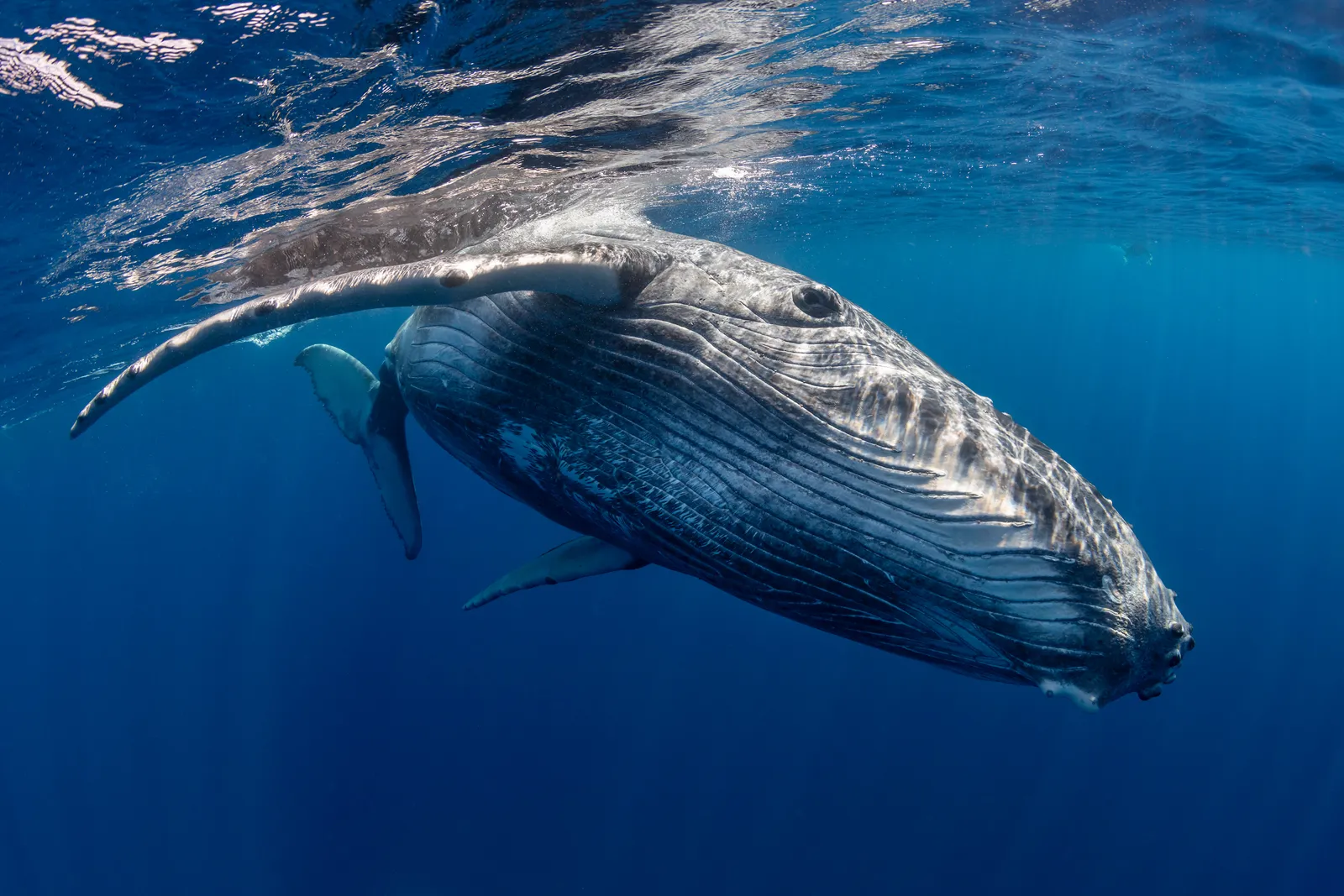
The Arabian Humpback Whale via Getty Images.
The risks extend beyond wildlife. Contaminated coastal waters can damage fisheries, threaten aquaculture, affect seafood safety, and create additional pressure on Gulf states that rely on desalination for much of their freshwater supply.
The Conflict and Environment Observatory (CEOBS), a UK-based monitor of war’s environmental impacts, analyzed footage from Tehran that appeared to show burning oil leaking from a damaged petrochemical facility into a nearby sewer system. Doug Weir, the organization’s director, said many local contamination events may never be fully documented, even as their consequences persist. “There is a huge amount of devastation that we haven’t seen,” he says.
Some of the war’s most visible environmental damage has been in the sky. Strikes on oil facilities in Tehran were followed by days of thick black smoke covering the skies above a city of millions. Iranians described “apocalyptic” scenes as dark clouds of noxious gases from burning oil fires engulfed the capital.
Among the pollutants released during those fires was black carbon, which is associated with acute respiratory problems. Burning oil and high explosives can also emit volatile organic compounds, sulphur oxides, nitrogen oxides, and fine particulate matter that pose broader environmental and public health risks.
Attacks on military facilities can release fuels, oils, heavy metals, energetic compounds, and PFAS—so-called “forever chemicals” that persist in the environment.
In Lebanon, reported use of white phosphorus has raised additional concerns. It can ignite fires, damage crops, alter soil chemistry, and release toxic particles into surrounding areas.
Meanwhile, researchers estimate that a fighter jet can emit around 15 tons of carbon dioxide for every hour of flight. The thousands of sorties carried out in the first weeks of the war are estimated to have generated the equivalent of more than half a million tons of CO2.
The bombs may stop first. The environmental consequences often do not.
“Aside from volatile organic compounds, sulphur and nitrous oxide that we saw falling on people in the black rain, there are also long-term problems to consider,” Bigger says. “The vast majority of the climate damages that come from modern warfare are from the destruction and the necessary rebuilding of concrete buildings.”
Beyond the physical harms of conflict, another environmental risk emerges when the fighting stops: weakened governance and an inability to recover.
“What we always see in conflicts is environmental governance is weakened because states recovering from conflict are distracted,” Weir says. “They have a load of priorities. The environment often isn’t one of them.”
International support may prove crucial. In other conflicts, such as Ukraine, funding and cooperation for environmental recovery were more accessible and reactive, Weir says. Asked whether the world was likely to mobilize in the same way, his answer is blunt: “Not so much.”
In Lebanon, that challenge is compounded by continued instability and displacement. Kallab says many communities are still unable to return to their land, while others face severe humanitarian pressures even after de-escalation. “So before we give people the ability to restore their natural environment, they need to restore their immediate livelihood, home, and houses,” he says.
The lasting environmental impact might not feel immediately obvious because there is not one giant event to point to and to assess the damage from. The impact comes from a series of events which add up. “It’s not about a single instance,” Weir says. “It’s about the kind of death by a thousand cuts.”
This story originally appeared on WIRED Middle East.
此内容由惯性聚合(RSS阅读器)自动聚合整理,仅供阅读参考。 原文来自 — 版权归原作者所有。