


If you could travel back in time, what year would you choose? What would you change about history? For a surprising number of Chinese people, their answer turns out to be the same: Use what they know today to save China from its unglorious past.
In a new book titled Make China Great Again: Online Alt-History Fiction and Popular Authoritarianism, Rongbin Han, a Chinese politics professor at the University of Georgia, examines a popular science fiction genre where people travel back in time to rewrite Chinese history. Han looked at the 2,100 most popular titles on a top web novel review platform and found 238 such stories where the main characters bring technological knowledge, advanced political theories, and economic reform ideas back to ancient China or more recent historical eras. Who says 10th-century China is unequipped for a parliamentary political system? Someone’s gotta try to see how it would have worked.
Han says he has personally read over 70 of these alt-history fiction books, plus dozens of other web novels with other themes for comparison. The alt-history fictions have an average word count of 2.88 million characters, about the length of the entire Harry Potter series in Chinese. It was a lot of work, he tells me, but he really enjoyed the process—when he was in college, online novels were some of the earliest internet content he consumed, and writing this book took him back to his roots.
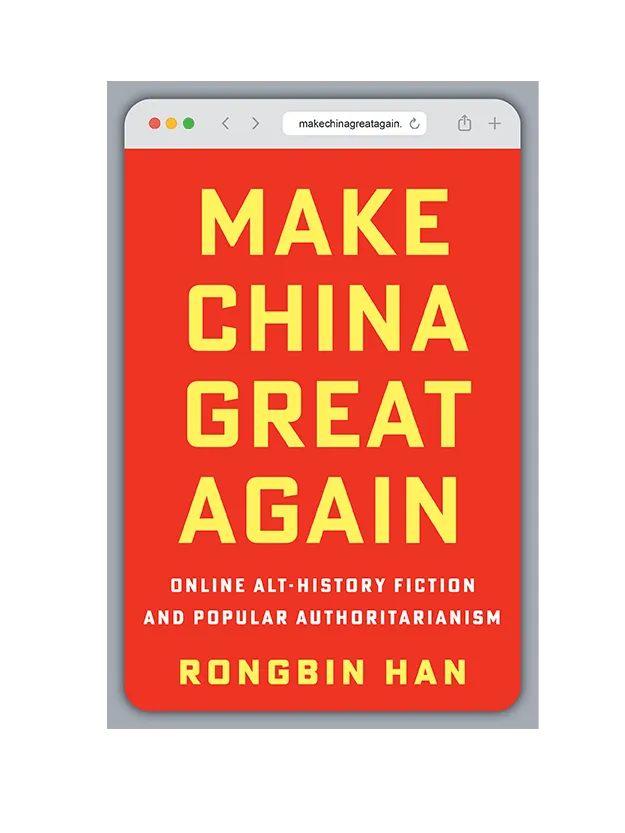
Courtesy of Columbia University Press
Like Han, my early internet life was shaped by a fixation on online novels. Call them fanfic, slashfic, popcorn novels, or web novels (which seems to be the English translation most widely accepted by the industry itself), these are extremely long, winding tales that are published in daily installments, giving readers a quick regular dopamine hit. The most popular authors have legions of highly engaged fans, who are willing to pay to unlock a chapter every day. Web novels have become a massive and highly profitable industry in China, and many titles have been adapted into blockbuster movies and TV series in recent years.
I’ve read at least a handful of novels in the alt-history genre that became the subject of Han’s book, but his work also looks at the political and social context around them. Han analyzed the online comments made on each novel and studied how the government has censored, co-opted, and promoted them.
While most science fiction tries to imagine the future, these novels are hyper-fixated on China’s past mistakes and humiliations. “The dominant narrative structure they come up with is essentially ‘Make China Great Again.’ Literally, they're going back into history and glorifying China,” Han says. In the end, he came to the conclusion that these novels also function as a way for ordinary people to legitimize the Chinese Communist Party and its power by echoing the same themes as nationalist propaganda and adapting to censorship pressures.
Soon into his research, Han noticed an interesting gendered aspect of the novels: “There are a lot of women who travel back in history, but I mostly excluded [those stories] in this study because they don't try to save China from all sorts of crises,” Han says. It is only fiction written by male writers for majority-male readers that tend to embark on the quest of remaking Chinese history.
Han also studied which time period the writers chose to travel to—China’s Ming dynasty emerged as a favorite, appearing in about a quarter of the titles he looked at. There’s a popular understanding in China that the Manchurian Qing dynasty, which toppled the Han-controlled Ming, was to blame for China lagging behind in the industrial revolution; so these people want to save Ming. Other dynasties, as well as modern China before and after the establishment of the current Chinese government, also received their fair share of time travelers.
In January, WIRED covered The Morning Star of Lingao, a classic example of such alt-history novels where 500 people traveled back to the Ming dynasty to attempt to bring industrial revolution to China hundreds of years earlier than actually happened in reality. It is also one of the novels from the study that Han finds particularly interesting.
But his all-time favorite is one called Red Dawn (赤色黎明), a story where the main character goes back to 1905 to start a Communist revolution earlier than the actual one in Chinese history. The novel is a great example of how the genre usually doesn’t challenge China’s current political system, as the protagonist basically copied everything the Chinese Community Party did in history and passed down power peacefully (through a democratic election, however) to two characters that appear to roughly correspond to Mao Zedong and Zhou Enlai, the party’s actual historical leaders.
Government censorship always looms large over the web novel industry, from the moment a writer discusses a book idea with their editor to when readers comment on the novels online. Even Red Dawn, which might be seen as a work of propaganda, ended up being removed from web novel platforms because discussion of political ideologies is often deemed sensitive. But that didn’t stop it from being shared on pirated websites, and it remains one of the most widely-read novels in the genre.
“There's this joke among those writers, who say the censorship machine is essentially a ‘Time and Space Administration.’ The idea is that you can't travel to a certain time, especially the first 30 years under the PRC rule,” Han says.
By calling these novels “Make China Great Again fiction,” Han is intentionally comparing them to populist political movements in the West. What connects them is that they are both nationalist narratives promoted by the government. Ever since Xi Jinping came to power, he has centered his political ideology around what he calls the “Great rejuvenation of the Chinese nation.”
These alt-history novels, Han observes, always echo the dominant political narrative and are “inherently not subversive.” There’s a whole subgenre of stories where main characters travel back in history with the distinct goal of helping the Communist Party in its early years. Even though some of the stories try to bring democratic parliamentary systems and elections to ancient China, they present these scenarios as hypothetical experiments and not insinuations of contemporary politics. By adhering to government messaging about the nation’s history, Han argues that both the writers and readers are actively upholding the state-mandated values.
However, there’s also a core difference between MCGA and MAGA. For MAGA and other populist political narratives in Europe, their adherents are looking backward in history because they are not happy with the current state of things, especially the consequences of globalization, so they fantasize about their countries harkening back to an earlier, more glorious time.
MCGA believers, on the other hand, think China is great now and will remain great in the future. The country has emerged from globalization as a clear winner, so they want to take all the right lessons in politics, trade, and science back in time to make China greater in the past, too. “There are very few people who think ancient China was great and we want to make today's China more like that. Rare, if not nonexistent,” Han says. “I haven’t encountered any.”
This is an edition of Zeyi Yang and Louise Matsakis’ Made in China newsletter. Read previous newsletters here.
此内容由惯性聚合(RSS阅读器)自动聚合整理,仅供阅读参考。 原文来自 — 版权归原作者所有。