

惯性聚合 高效追踪和阅读你感兴趣的博客、新闻、科技资讯
阅读原文 在惯性聚合中打开

推荐订阅源

V
Vulnerabilities – Threatpost
Google DeepMind News
Scott Helme
Scott Helme
NISL@THU
NISL@THU
T
Tor Project blog
T
Tenable Blog
D
Darknet – Hacking Tools, Hacker News & Cyber Security
P
Privacy International News Feed
Cyberwarzone
Cyberwarzone
Project Zero
Project Zero
S
Schneier on Security
C
Cybersecurity and Infrastructure Security Agency CISA
P
Proofpoint News Feed
Exploit-DB.com RSS Feed
O
OpenAI News
freeCodeCamp Programming Tutorials: Python, JavaScript, Git & More
OSCHINA 社区最新新闻
OSCHINA 社区最新新闻
美团技术团队
Hugging Face - Blog
Hugging Face - Blog
V2EX - 技术
V2EX - 技术
H
Help Net Security
C
Check Point Blog
T
The Exploit Database - CXSecurity.com
Forbes - Security
Forbes - Security
人人都是产品经理
人人都是产品经理
U
Unit 42
cs.CL updates on arXiv.org
Microsoft Azure Blog
D
Docker
I
InfoQ
Schneier on Security
K
Kaspersky official blog
罗磊的独立博客
Cisco Talos Blog
Cisco Talos Blog
Cyber Security Advisories - MS-ISAC
S
Security Affairs
Microsoft Security Blog
GbyAI
GbyAI
雷峰网
雷峰网
G
GRAHAM CLULEY
Cloudbric
Cloudbric
IT之家
IT之家
Stack Overflow Blog
Stack Overflow Blog
AI
AI
L
LINUX DO - 热门话题
云风的 BLOG
云风的 BLOG
博客园_首页
T
Threat Research - Cisco Blogs
S
Secure Thoughts
有赞技术团队
有赞技术团队

Hacker News - Newest: "OpenClaw"

OpenClaw just launched an official app for iPhone, details here - 9to5Mac OpenClaw Launch — Deploy AI Chatbots in Seconds Self-Host OpenClaw AI Agent on VPS: Full Setup Guide GitHub - xltvy/openclaw-memgpt: OpenClaw plugin that gives agents MemGPT-style memory: tiered core/archival/recall storage, self-directed memory operations via tool calls, memory-pressure warnings, and recursive summarisation. Integrates the reference MemGPT implementation via a local sidecar service, preserving the original architecture without reimplementation. Malicious AI 23 ClawHub Plugins Squat Official Org Scopes - Manifold Security what shipping OpenClaw in production taught us — AutoClaw AgentLine — AI Phone API | Phone Numbers, Voice & SMS for AI Agents Make Your OpenClaw Agent Cheaper, and Measure It Yourself GitHub - sammysltd/OpenEmployee: Make your OpenClaw agent employable: deny-by-default governance, budgets, allowlists, approval gates, and a signed audit trail via MakerChecker. Migrate from OpenClaw | Hermes Agent StackOverflow closed my OpenClaw and paperclipAI integration q. as "irrelevant" GitHub - sausin/outpost: Removing AI agents' quiet security problem Potassium — ClawHub Plugins Pi Building Pi, Openclaw's Minimalist Coding Agent | Mario Zechner, Creator of Pi I Spent 4 Hours So You Don’t Have To: Hetzner Metal + NixOS in ~15 Minutes − Irakli's blog GitHub - snuri00/osint-mcp: Self-hosted OSINT toolkit — MCP server, AI REPL, CLI, web app & chat apps (WhatsApp/Telegram/Discord via OpenClaw). Entity, event/news & social/community intelligence. Keyless-first. What a Regex Can't Do GitHub - ai-sns/openclaw-hermes-agent-network: OpenClaw Hermes AI Agent Social Network🦞💬🦞Built on Google 3D Maps and A2A protocol, connects OpenClaw and Hermes agents worldwide in a 3D environment. Phishing for Lobsters: How We Tricked OpenClaw into Spilling Secrets GitHub - CODEANDTRUST/clawcall: Give your OpenClaw / self-hosted AI agent inbound phone calls - a Twilio-to-gateway voice bridge with working agent tools mid-call (MIT). Build a ZeroCost Web Automation Pipeline with OpenRouter, OpenClaw, and MediaUse Let OpenClaw Run Wild in Simulation, Not on Your Customers | Veris AI GitHub - gpdir16/tabyAgent: A lighter, easier alternative to OpenClaw/Hermes. Runs autonomously inside Docker and chats with you through Telegram. Ask HN: What are the biggest problems you find in OpenClaw/Hermes? Microsoft launches Scout, an OpenClaw-inspired personal assistant GitHub - openclaw/openclaw-windows-node: Windows companion suite for OpenClaw - System Tray app, Shared library, Node, and PowerToys Command Palette extension Microsoft unveils Scout, an autonomous AI agent built on OpenClaw Gavriel Cohen found his own code inside OpenClaw, so he walked away GitHub - hunvreus/heypi: Chat agents for your team, with approvals and sandboxed tools. Slack, Discord, Telegram, webhooks. HolaClaw: run OpenClaw securely in Mac Multi-Agent Orchestration System: Hermes (Windows) ↔ OpenClaw (WSL) We were building infra for OpenClaw, and today I just tried Hermes and holy shit GitHub - openclaw/openclaw: Your own personal AI assistant. Any OS. Any Platform. The lobster way. 🦞 OpenClaw as the Universal Operating System for Agents ARC Prize - Community Leaderboard Setup OpenClaw with Slack: from install to first message twitter.com I Gave My OpenClaw Agent a Physical Body Use Grok in OpenClaw The creator of OpenClaw used $1,300,000+ of OpenAI tokens in 30 days, which is a hell of a perk GitHub - oswarld/openshears: 🔪 THE OPENCLAW TERMINATOR 🦞 Are we human? Show HN: OpenClaw is just not dangerous enough. I needed something else OpenClaw creator burned through $1.3 million in OpenAI API tokens in a single month — bill covered 603 billion tokens across 7.6 million requests and 100 coding agents Reducing OpenClaw token usage OpenClaw/Hermes Hosting Comparison GitHub - ExTV/rikkahub-agent: RikkaHub Agent -- is RikkaHub fork that have Full agent mode . For $1.3 million a month, OpenClaw founder Peter Steinberger runs 100 AI agents that code, review PRs, and find bugs Where OpenClaw Security Is Heading OpenAI Models in OpenClaw, Done Right GitHub - thesysdev/openclaw-os: The default workspace for OpenClaw Token, Harness, OpenClaw, RAG, MCP, Agent – What's the Difference? We need a safe alternative to Telegram for agents like OpenClaw or Hermes Two OpenClaw agents negotiate a YC SAFE with Agentic Power of Attorney OpenClaw Had a Rough Week GitHub - LobsterTrap/tank-os GitHub - haishmg/Clawback How OpenClaw Got Safer in Public openclaw ggsql — ClawHub Show HN: iClaw is part OpenClaw, part Siri, powered by Apple Intelligence GitHub - lotsoftick/openclaw_client: OpenClaw web client Show HN: OpenClaw but Efficient and with an SDK GitHub - TheGuyWithoutH/mac-computer-use GitHub - microsoft/openclaw: Your own personal AI assistant. Any OS. Any Platform. The lobster way. 🦞 OpenClaw: opioids for Chinese AI companies GitHub - supersuit-tech/permission-slip [AINews] The Two Sides of OpenClaw OpenClaw stats don't add up GitHub - brexhq/CrabTrap: An LLM-as-a-judge HTTP proxy to secure agents in production Anthropic - OpenClaw Hustlers are cashing in on China’s OpenClaw AI craze Engineering Managers are going to hate OpenClaw GitHub - opentalon/opentalon: OpenTalon is an open-source platform built from the ground up in Go as a robust alternative to OpenClaw Ask HN: Who is using OpenClaw? Why Meta’s AI Alignment Director Couldn't Stop Her Own Agent—and How to Fix It GitHub - epsilla-cloud/clawtrace: Make your OpenClaw agents better, cheaper, and faster. Ask HN: What are you using OpenClaw or agents for? GitHub - epsilla-cloud/clawtrace: Make your OpenClaw agents better, cheaper, and faster. GitHub - theprint/nfh-self-improvement-loop: Minimal adversarial framework for AI agent self-modification. Inspired by karpathy/autoresearch. GitHub - ibrahimmukherjee-boop/ClearFrame: OpenClaw Alternative with better governance, security Show HN: Agent-Notifications – Real-Time Alerts for OpenClaw and Hermes Agents OpenClaw + Claude are better than therapy GitHub - zeulewan/glueclaw: Use Claude Max subscription with OpenClaw again Anthropic temporarily banned OpenClaw’s creator from accessing Claude OpenClaw’s memory is unreliable, and you don’t know when it will break Give Your OpenClaw Agent a Real Memory You need a Windows Remote Desktop, not an OpenClaw GitHub - cruxdigital-llc/CongaLine: Deploy and manage a fleet of OpenClaw AI assistants anywhere. Supporting hobbyist, team, and enterprise use cases. GitHub - cezarpena/vsm-cell: VSM-Cell is an OpenClaw agent P2P mesh orchestration standalone app. GitHub - joshchoi4881/dropspace-agents GitHub - askalf/dario: Universal LLM router. One local endpoint, every provider — OpenAI, Groq, OpenRouter, Ollama, Claude Max/Pro subscriptions, the Claude Agent SDK, any OpenAI-compat URL. Your tools stop caring which vendor is upstream. Tutorial: Secure OpenClaw with CloudConnexa OpenClaw and the Dream of Free Labour GitHub - RageDotNet/openclaw-webdav GitHub - kevinslin/openai-apps: Support openai apps in openclaw GitHub - aelaguiz/doctrine: Code-like DSL and compiler for agent workflows that compile to portable AGENTS.md instructions. Unlocking cloud inference compute for OpenClaw OpenClaw for Sales: How AI Agents are Revolutionizing Revenue Teams | Kickscale OpenClaw Architecture - Part 1: Control Plane, Sessions, and the Event Loop
The OpenClaw turkey problem
yakkomajuri · 2026-04-24 · via Hacker News - Newest: "OpenClaw"

Thoughts are mine and mine only. I don't ever use LLMs for writing.


On lobsters

The other day I was listening to an episode of Lenny's Podcast where the guest, Claire Vo, was brought in to talk about OpenClaw. Claire was introduced as someone who started off as a vocal skeptic of OpenClaw and now is running multiple lobster friends across three (!) Mac Minis.

Claire shared her screen and did a whole walkthrough of setting up OpenClaw and I thought the episode did a good job at bringing people up to speed with what's happening in this space (I've recently found out none of my friends outside of tech even know about OpenClaw).

However, when asked about safety, Claire said something that really struck me. The advice given to people who are uneasy about safety with OpenClaw was basically to try it out while giving it limited permissions, then giving it more access as you get comfortable. This was called a "progressive trust process" and Claire said she feels "pretty comfortable about it now that I've used it more and more".

After a bit of back-and-forth, Lenny summarized the points she made: "So what I'm hearing is just, there are risks, start with not giving it access to things that you'd be afraid of it doing, and then as you experience it, you'll be like ok I can try this thing try that thing" [1].

Wait, what? That is not at all how security works.

Hearing this made me connect some dots about reflections I've had about our use of AI, and I think I came to the conclusion that be it with OpenClaw, another "claw", or just the industry in general, I think we might be living a bit of a turkey moment.

On turkeys

The concept of a turkey in the way I'm using here comes from Nassim Taleb, who talks about how learnings we derive from past experience can sometimes have no value in helping us predict what might happen next, and sometimes even negative value by blinding us to the possibility that certain events of large impact can happen.

Much like a Thanksgiving turkey will receive daily reinforcement that humans are friends as it's being fed, only to be very surprised (to say the least) a few days before Thanksgiving.

Taleb explains it best:

“Consider a turkey that is fed every day. Every single feeding will firm up the bird’s belief that it is the general rule of life to be fed every day by friendly members of the human race “looking out for its best interests,” as a politician would say. On the afternoon of the Wednesday before Thanksgiving, something unexpected will happen to the turkey. It will incur a revision of belief.”

Nassim Taleb (Black Swan)

So when I was hearing Claire's advice, all I could think about were turkeys.

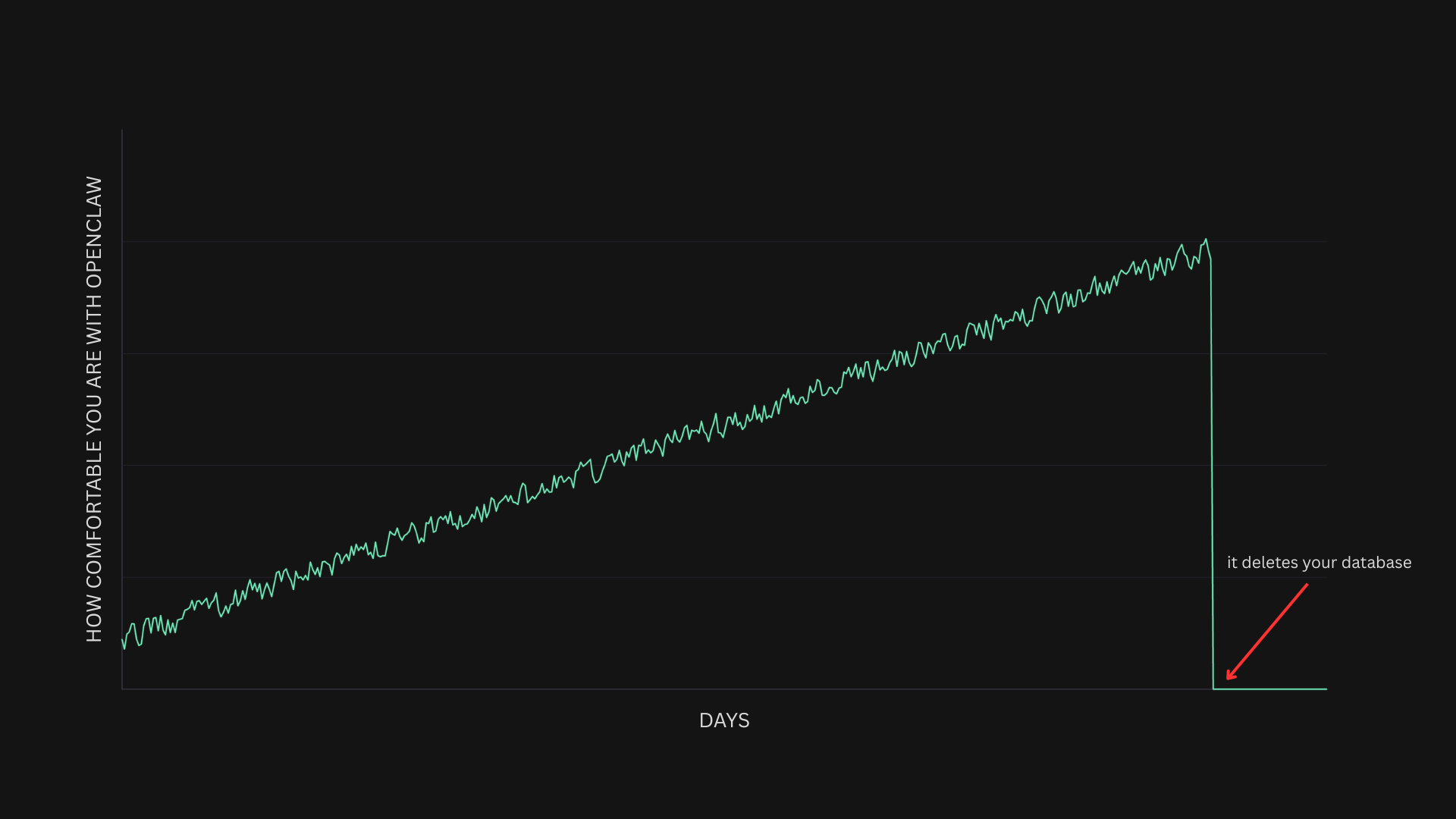
Because if you follow the exact advice, not only are you opening yourself up to be surprised (like a turkey would) but if you give OpenClaw more access the more comfortable you get, you're not only increasing the surprise factor but also increasing the potential negative impact for when something goes wrong.

Let me give you an example.

Say you start using OpenClaw and just give it access to one calendar for it to manage. Each day you believe more and more that nothing can go wrong, but you don't give it any more access. Thus, when it deletes your calendar, your surprise is proportional to how much you'd let your guard down, but the impact is controlled, since it only had access to one calendar.

On the other hand, let's say that as you got more comfortable with OpenClaw you let it manage your personal email, then your drive, and then you gave it access to the production database. Now not only will you be really surprised when it drops a table or deletes the database, but suddenly the impact of the event was much larger than it would have been at the start. The surprise factor and the impact are both proportional to the pre-catastrophe trust/comfort level.
openclaw-turkey.png

A really weird zoo

We've talked about lobsters, we've talked about turkeys, and now I want to add a brief note about swans.

If you've read Taleb's books, you'll be familiar with the concept of a black swan, which in really simple terms is an unpredictable event of extreme impact.

Taleb argues that we we humans are terrible at estimating the likelihood of a black swan event and thus they're a big shock (in terms of surprise and impact) when they do happen.

However, what I'm talking about here is not even a black swan event.

There are many areas in life where our discomfort comes from a lack of understanding, and where increasing your exposure as comfort increases is valid practical advice.

You climb more ambitious routes as you become more comfortable that the climbing equipment will catch you, but you're still subject to a black swan event (unpredictable, high impact) with the equipment. You could e.g. break a leg due to the failure of a carabiner that had an invisible issue from manufacturing [2].

In this case though, the risks are not just unpredictable. A lot of them are very predictable. We know for a fact that hallucinations are a thing, and we know for a fact that prompt injection is a thing.

That means that giving more access to OpenClaw just because you're more comfortable is like continuing to drink expired milk just because you haven't gotten sick yet. The failure modes are known, so what we're really doing is gambling.

Why are you such a hater?

I think some people might read this post and assume I'm just dunking on Claire, or being anti-OpenClaw, but I'd like to make it clear that neither of these is true.

In the podcast, Claire was clear about the prompt injection risks, and she also offered a good mental model for dealing with "claws" that I agree with, which is to treat it like you would treat an assistant. That means giving it its own email and its own calendar, and limited access to your own systems. Claire did not come across as oblivious to the risks.

As for OpenClaw, I'm far from a hater! I actually do think that it is a fascinating project that highlighted a lot of interesting use cases for LLMs. I like seeing people play around with it and build on top of it.

And when it comes to me, I'm no AI-skeptic. I use AI daily (never for writing though) and have been playing around with claws too.

But the reason for writing this post is that it became clear to me that the advice given was a fallacy, and it actually got me thinking that I'm falling for the very same fallacy myself at times. I'm certainly getting more comfortable with AI and taking more risks as a result. So what I'm talking about here is not a Claire thing. It's a me thing. It's an industry thing.

We're still early and there's a lot to learn. We're all still figuring this out and I think it's important to have open discussions about the good, the bad, and the ugly parts of the technology, which is all I'm trying to do here.

I think claws and autonomous agents are really powerful and useful, but I think they get more powerful once we have solid security primitives in place. That's where trust should come from in my opinion.

There will always be things we can't predict. There's no big company out there that hasn't gone through outages and data breaches. But there are ways to reduce risk.

On my end, as I've mentioned, I'm subject to everything I wrote about here, but I'm trying more and more to internalize the principles I described, and building tooling with that in mind.

Conductor is all the rave these days and it's really cool software, but it runs on your machine with no sandboxing, so I built my own orchestrator that was designed to run on a VPS (I might open source it soon).

I've also been building AgentPort, a self-hostable gateway for connecting to third-party services with granular permissioning. Basically a layer that sits between your agent and all your integrations and controls what the agent can do without approval, what it can't ever do, and what it can do provided you approve it each time e.g. it can look up customers and bills on Stripe but issuing a refund requires approval from you.

If any of this is interesting to you, let me know and let's connect. I'm really keen to hear about people's perspectives and what you're building in this space.


[1] If you want to listen this discussion yourself, it happens at around minute 22 of the episode "From skeptic to true believer: how OpenClaw changed my life" of Lenny's Podcast.

[2] There are still ways to prepare against the unpredictable, which is part of the point Taleb makes in his books. Also note that I focused my analogy around climbing equipment specifically because most climbing accidents happen due to human error which is predictable and addressable.

subscribe to get notified of new posts