
惯性聚合 高效追踪和阅读你感兴趣的博客、新闻、科技资讯
阅读原文 在惯性聚合中打开

推荐订阅源

G
GRAHAM CLULEY
V
V2EX
WordPress大学
WordPress大学
博客园 - Franky
Last Week in AI
Last Week in AI
博客园 - 司徒正美
有赞技术团队
有赞技术团队
freeCodeCamp Programming Tutorials: Python, JavaScript, Git & More
博客园 - 【当耐特】
V
Visual Studio Blog
C
CERT Recently Published Vulnerability Notes
OSCHINA 社区最新新闻
OSCHINA 社区最新新闻
cs.CL updates on arXiv.org
Jina AI
Jina AI
Attack and Defense Labs
腾讯CDC
The Hacker News
The Hacker News
Hugging Face - Blog
Hugging Face - Blog
K
KPMG report finds enterprise disconnect between AI and its ROI | CIO
J
Java Code Geeks
人人都是产品经理
人人都是产品经理
阮一峰的网络日志
阮一峰的网络日志
T
Tailwind CSS Blog
S
SegmentFault 最新的问题
大猫的无限游戏
大猫的无限游戏
小众软件
小众软件
A
Arctic Wolf
量子位
博客园 - 聂微东
奇客Solidot–传递最新科技情报
奇客Solidot–传递最新科技情报
N
News and Events Feed by Topic
雷峰网
雷峰网
博客园_首页
Google Online Security Blog
Spread Privacy
Spread Privacy
罗磊的独立博客
H
Hacker News: Front Page
让小产品的独立变现更简单 - ezindie.com
月光博客
月光博客
TaoSecurity Blog
TaoSecurity Blog
Exploit-DB.com RSS Feed
博客园 - 三生石上(FineUI控件)
宝玉的分享
宝玉的分享
IT之家
IT之家
The Cloudflare Blog
爱范儿
爱范儿
博客园 - 叶小钗
Threat Intelligence Blog | Flashpoint
Apple Machine Learning Research
酷 壳 – CoolShell
酷 壳 – CoolShell

Hacker News: Show HN

PurrrrrFocus: Pomodoro Timer App - App Store Workflow Engine — Multi-Step Orchestration for Bun RapidPhoto: Pro Photo Editor App - App Store GitHub - DheerG/swarms: Achieve extraordinary results with claude code across a variety of tasks SPICE simulation → oscilloscope → verification with Claude Code — Lucas Gerads Show HN: VCoding – A 5 MB native Windows IDE with no dynamic dependencies Show HN: LLMs don't hallucinate because they're bad at math, it's the format GitHub - Agent-FM/agentfm-core: AgentFM is a peer-to-peer network that turns everyday computers into a decentralized AI supercomputer. AgentFM lets you run massive AI workloads directly across a global mesh of idle CPUs and GPUs. Show HN: Tracking Top US Science Olympiad Alumni over Last 25 Years GitHub - Potarix/agent-hub: One place to talk to all your agents Show HN: Runtime security for AI agents(injection,tool abuse, data exfiltration) GitHub - dubeyKartikay/lazyspotify: Terminal Spotify client for macOS and Linux GitHub - the-banana-tool/king-louie: Easy to use GUI Personal AI Assistant. Win/Linux/Mac. Show HN I made my vacation rental bookable by AI agents–no Airbnb, 0% commission GitHub - basteez/jsf-autoreload: maven plugin to enable hot reload on jsf projects uvm32/hosts/host-gdbstub at main · ringtailsoftware/uvm32 GitHub - labsai/EDDI: Config-driven engine that turns JSON into production-grade AI agents. Multi-agent orchestration, 12+ LLM providers, MCP/A2A protocols, RAG, persistent memory, and enterprise compliance (EU AI Act, GDPR, HIPAA). Built on Quarkus. GitHub - glitchnsec/fortyone-oss: AI Executive Assistant Platform Quickstart | Alien GitHub - muxshed/shed: One stream in, or many. Every destination, simultaneously. No cloud middleman, no per-channel fees, no limits. GitHub - ocrbase-hq/ocrbase: 📄 PDF/IMG ->.MD/JSON Document OCR API for PaddleOCR and GLMOCR. Self-hostable. GitHub - impactjo/home-memory: MCP server that lets your AI assistant remember everything about your home. GitHub - Sets88/dbcls: DbCls is a powerful terminal database client that supports various databases GitHub - neptun2000/heor-agent-mcp GitHub - SeanFDZ/macmind: Single-layer transformer in HyperTalk for the classic Macintosh RollQuation: Math Puzzles - Apps on Google Play GitHub - dropbox/witchcraft Show HN: Agent-cache – Multi-tier LLM/tool/session caching for Valkey and Redis GitHub - opentalon/opentalon: OpenTalon is an open-source platform built from the ground up in Go as a robust alternative to OpenClaw LinkedIn™ 职位抓取工具 - Chrome 应用商店 GitHub - EdoardoBambini/Agent-Armor-Iaga: AI agents are getting tool access — shell, file system, databases, APIs, secrets. But **nobody is governing what they actually do with it**. Frameworks like LangChain, CrewAI, AutoGen, and Claude Code give agents the power to execute. Agent Armor gives you the power to control, audit, and approve every single action before it happens. HN Vibes — Week 15, Apr 7–13 2026 GitHub - chojs23/ec: Easy terminal-native 3-way git mergetool vim-like workflow GitHub - SethPyle376/hiraeth: Local AWS emulator focused on fast integration testing, with SQS support, SQLite-backed state, and a debug-friendly web UI. GitHub - JakOb-dotcom/cloud-sandbox-security-analysis: Technical analysis and Proof of Concept (PoC) regarding environment variable exfiltration in containerized cloud sandboxes via side-channel data leaks. Springboards - Flint Alpha Show HN: A simpler coding agent harness GitHub - audiodude/sudomake-friends GitHub - 256thFission/mini-mythos: OSS clone of Anthropic’s Mythos harness to locate C/C++ memory vulnerabilities Show HN: OpenParallax: OS-level privilege separation for AI agent execution Hacker News Sorted - Chrome 应用商店 Show HN: How to Install Docker on Ubuntu 24.04 LTS: Complete 2026 Guide GitHub - himanshudongre/smriti GitHub - sverrirsig/claude-control: macOS desktop dashboard for monitoring and managing multiple Claude Code sessions GitHub - ory/dockertest: Write better integration tests! Dockertest helps you boot up ephermal docker images for your Go tests with minimal work. Chiral - Chrome 应用商店 Show HN: Two Claudes collaborating through shared memory on a $100 mini-PC GitHub - pmichaillat/latex-cv: Minimalist LaTeX template for academic CVs GitHub - oguzbilgic/posse: A web UI for Anthropic Managed Agents. GitHub - sshiraz/depsly: Dependency risk analysis tool for npm packages ABI Add safari/agent-harness — Safari browser automation via safari-mcp by achiya-automation · Pull Request #212 · HKUDS/CLI-Anything GitHub - Halfblood-Prince/trustcheck: Verify PyPI package attestations and improve Python supply-chain security GitHub - oguzbilgic/kern-ai: Agents that do the work and show it. GitHub - bruits/satteri: High-performance Markdown and MDX processing for the JavaScript ecosystem GitHub - tylergibbs1/feedstock: High-performance web crawler and scraper for TypeScript, powered by Bun and Playwright GitHub - Grimm67123/grimmbot: The self-improving sandboxed and open-source AI agent. With persistent memory and scheduling. GitHub - whitevanillaskies/whitebloom: Local whiteboard that blooms. GitHub - hwdsl2/docker-whisper: Docker image for a self-hosted Whisper speech-to-text server with speaker diarization and OpenAI-compatible transcription and translation APIs. Powered by faster-whisper. Supports all Whisper models, NVIDIA GPU (CUDA) acceleration, JSON/SRT/VTT output, SSE streaming, offline mode, and multi-arch (amd64, arm64). GitHub - yisding/reviewwiggum GitHub - MarwanAlsoltany/serrors: Structured errors for Go: sentinel hierarchies, typed data, custom formatting, and slog integration. GitHub - soatok/age-php GitHub - Luthiraa/markitme GitHub - stagas/rtdiff: realtime git diff gui and AI-assisted commits GitHub - tombedor/excalicharts GitHub - wh1le/excalidraw-edit: Open and edit .excalidraw files from the terminal. Offline, auto-saves to disk. MalExt Sentry - Malicious Extension Scanner - Chrome 应用商店 GitHub - syi0808/asciianimesvg: Generate animated ASCII art SVGs from text. CLI, Rust library, WASM, and web editor. GitHub - zaina-ml/ml_forge: A visual-based graph node editor for training computer vision models. GitHub - anakin87/llm-rl-environments-lil-course: 🌱 A little course on Reinforcement Learning Environments for evaluating and training Language Models GitHub - takaakit/superpowers-uml: Superpowers-UML modifies Superpowers to ensure a software development workflow in which AI agents design through UML modeling. AdriByte Studio - Sviluppo Web e Soluzioni Digitali GitHub - chouligi/angel-copilot: Your personalized Angel Investment Advisor Show HN: MoodSense AI (ML and FastAPI and Gradio, Deployed on Hugging Face) Moodsense Ai - a Hugging Face Space by aman179102 GitHub - agenteractai/lodmem: Level Of Detail Context Management for Agents GitHub - ostefani/subnetlens: A fast, concurrent network scanner with a TUI and plain-text CLI, built in Go. It discovers live hosts on your network, scans their open ports, resolves hostnames, and fingerprints operating systems—delivered. Cyber Pulse: Agentic Intel - Apps on Google Play Whisper API: Self-Hostable Speech to Text Transcription The Agent-Web Protocol Stack: A Research Thesis GitHub - msmarkgu/RelayFreeLLM: A restful API designed to route user prompts to various AI model providers. Show HN: Provepy – A Python decorator that proves your code using Lean and LLMs Show HN: Pardonned.com – A searchable database of US Pardons GitHub - patrickdappollonio/dux: Dux is a terminal UI that lets you run multiple AI coding agents side by side, each in its own git worktree, with full companion terminals, macros, commit generation, and a command palette that knows more tricks than you do. kMC Crystal Simulator Show HN: HyperFlow – A self-improving agent framework built on LangGraph GitHub - stef41/vibescore: 🎵 Grade your vibe-coded project. One command, instant letter grade across security, quality, dependencies, and testing. GitHub - stef41/lmscan: 🔍 Detect AI-generated text and fingerprint which LLM wrote it. Open-source GPTZero alternative. Zero dependencies, works offline. imgur.com GitHub - visionscaper/collabmem: Enabling long-term collaboration with Agentic AI - building up episodic and world model memory over time with in-context awareness 在 Steam 上购买 FriedrichAI: Offline AI 立省 10% GitHub - atripati/ark: AI Runtime Kernel — a context operating system for AI agents. Eliminates tool bloat, loads only what’s needed, and gives LLMs their reasoning space back. GitHub - nowork-studio/toprank: Open-source Claude Code skills for SEO, SEM, Google Ads GitHub - tacomanator/sash: Lightweight macOS menu bar app for reliably cycling through windows of the current application. Appents | Social Media Management for Product-First Teams GitHub - pnhoang/youtube-spam-blocker: Automatically detects and hides spam messages in YouTube Live chat. Set rate limits, keyword filters, and block repeat offenders. GitHub - decisionnode/DecisionNode: CLI + Local MCP - A shared structured memory store across Claude Code, Cursor, Windsurf, Antigravity, and every MCP client. Semantically queryable. GitHub - AvaCodeSolutions/django-email-learning: An open source Django app for creating email-based learning platforms with IMAP integration and React frontend components. The $100K Gap in Kubernetes Security Tooling Function Calling Harness: From 6.75% to 100%
What is headless cloud security? [A complete guide] | Sysdig
dariobalinzo · 2026-05-13 · via Hacker News: Show HN

What created the need for headless cloud security?

Cloud security has been built around dashboards for over a decade. The model assumes a human is always available to triage alerts, correlate signals, and decide what to do next.

That assumption no longer holds.

Here's why:

Cloud attacks used to unfold over days or weeks. Now they don't. With AI in the hands of attackers, the path from initial access to full control can compress into minutes. By the time an alert reaches a human, the attack is often already over.

  • In 2018, attackers took nearly a year to weaponize vulnerabilities. By 2023, it was only eight days. At the end of 2025, React2Shell was being actively exploited only hours after it was disclosed.
  • The Sysdig TRT has found a malware script that was up to 95% AI-generated and an AI-assisted account takeover in less than 10 minutes.

Which means a model that requires human review at every step can't keep up. The mismatch isn't about better dashboards or faster alerting. It's about who, or what, is operating the security platform.

Then there's where work is happening.

Engineers increasingly operate through AI coding agents. Logging into a separate tool for every task is no longer how the work gets done. Security tooling, by and large, hasn't followed.

The result: Security still lives in dedicated dashboards. But the work it's meant to protect has moved somewhere else. That gap creates friction. It also creates blind spots.

The bottleneck isn't the quality of the dashboard. It's the assumption that a human has to be the one reading it.
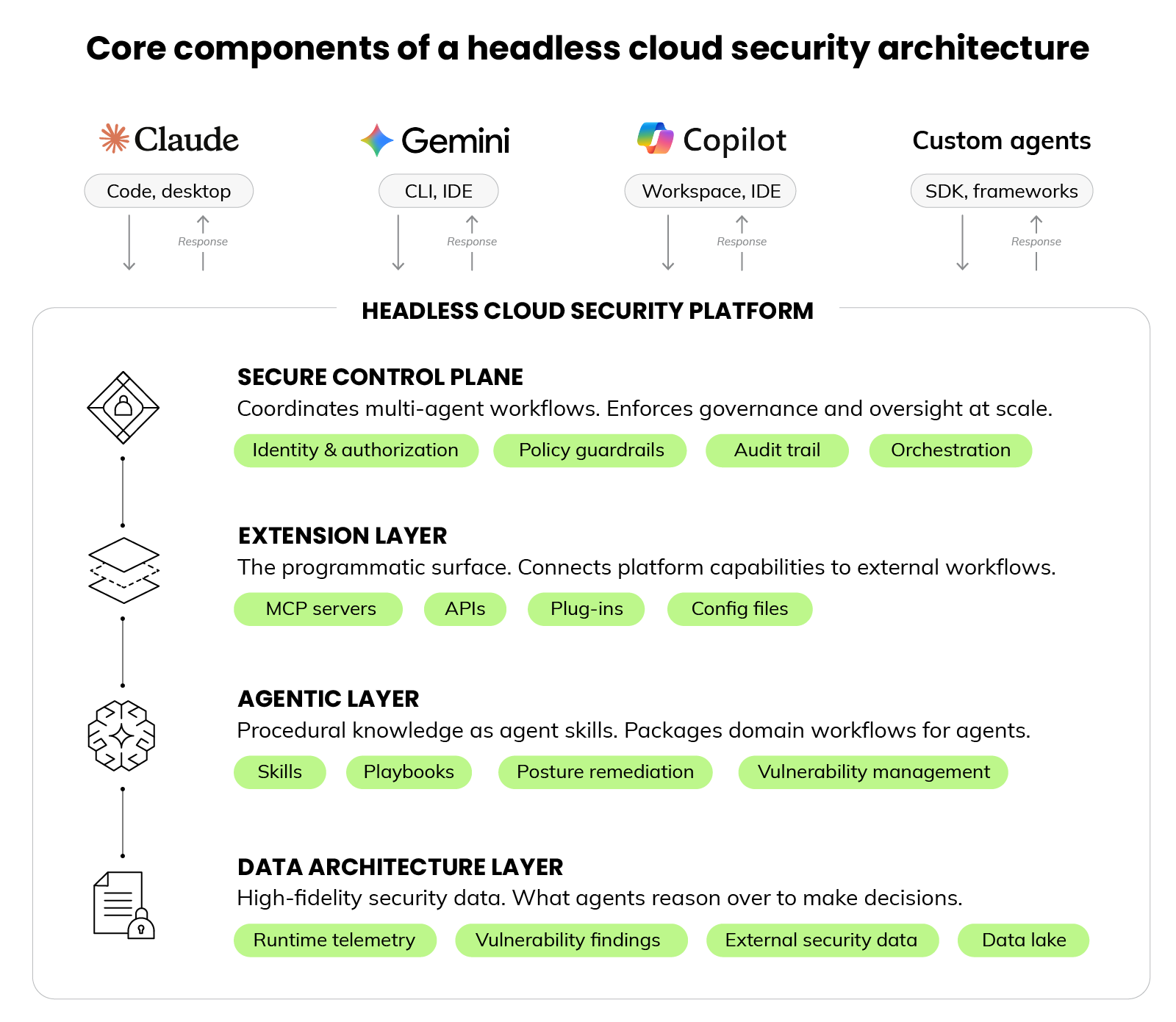
What are the core components of a headless cloud security architecture?

Architecture diagram titled 'Core components of a headless cloud security architecture' showing four AI coding agents — Claude, Gemini, Copilot, and custom age…Architecture diagram titled 'Core components of a headless cloud security architecture' showing four AI coding agents — Claude, Gemini, Copilot, and custom agents — at the top, each connected by request and response arrows to a 'Headless cloud security platform' box below containing four stacked layers: secure control plane, extension layer, agentic layer, and data architecture layer, with each layer labeled by function and tagged with example components.

A headless cloud security architecture isn't defined by a single technology. 

It's defined by how a few specific components work together to expose security capabilities for programmatic, agent-driven consumption, including:

  • Extension layer. The surface that makes the platform reachable. Typically MCP servers, APIs, and configuration files that connect platform capabilities to external workflows and ecosystems. Without it, the platform stays locked behind whatever interface the vendor designed.
  • Data architecture layer. Where security data is ingested and stored. This can be the security platform itself, or the organization's own data lake. The data this layer holds is what agents reason over, which is why its fidelity directly shapes the quality of decisions agents can make.
  • Agentic layer. Where procedural knowledge lives. In practice, this takes the form of agent skills, which are structured packages that tell coding agents how to interact with the platform for specific workflows like vulnerability management, posture remediation, or cloud detection and response.
  • Secure control plane. The coordination layer. It serves as a centralized point for coordinating multiple coding agents working cooperatively on larger or more complex tasks, and supports the oversight needed to operate them at scale.
FYI: An MCP server alone doesn't make a platform headless. A platform can add an MCP server on top of a dashboard-first design and expose some capabilities to agents. That's a partial fix. A headless architecture is built differently from the start, with all four layers designed so agents can run the platform directly.
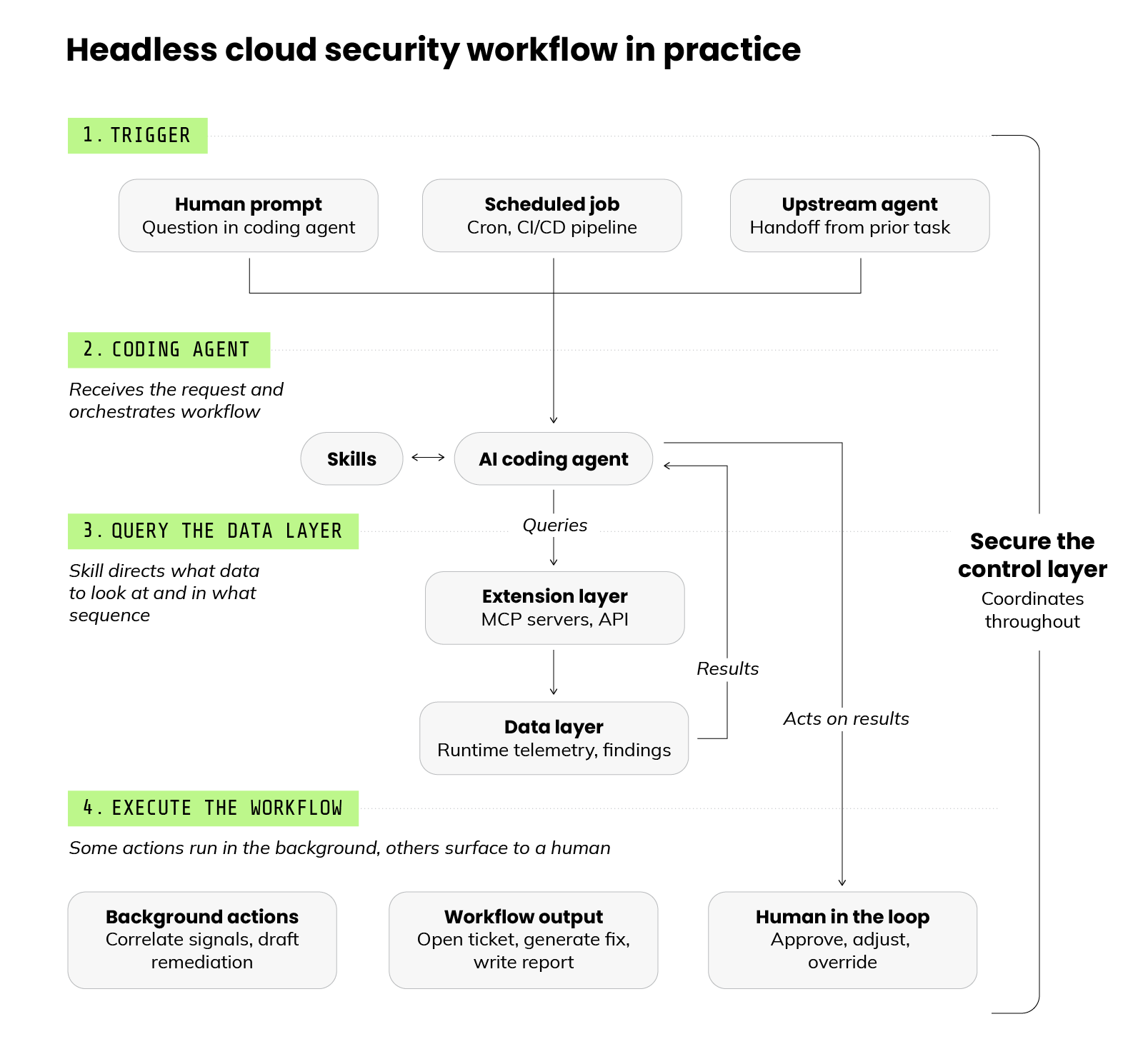
How does headless cloud security work in practice?

Workflow diagram titled 'Headless cloud security workflow in practice' showing four numbered stages, including trigger, coding agent, query the data layer, and execute the workflow, flowing top to bottom, with a secure control layer running vertically along the right side coordinating throughout.

Essentially, headless cloud security works by giving agents the work they handle best and humans the work they handle best. The architecture is built so each side can do its part.

Here's what an actual cloud security workflow looks like in a headless model:

  • A request starts the workflow.
    It can come from a human asking a question in their AI coding agent, a scheduled job, or another agent passing work down the line. The trigger doesn't depend on someone logging into a dashboard.
  • The agent consults a skill.
    The skill tells it how to approach the workflow: what data to look at, what sequence to follow, what counts as a successful outcome. A skill for vulnerability management looks different from a skill for posture remediation.
  • The agent reaches into the data layer.
    It queries what it needs through the extension interface and reasons over the same data the platform was already collecting. The difference is that the agent reaches it directly, on its own terms, without a human translating between dashboard and decision.
  • The agent executes the workflow.
    That can mean correlating signals, drafting a remediation, opening a ticket, or generating a fix. Some actions run in the background. Others surface to the human, who can approve, adjust, or override what the agent proposes.
  • Throughout the workflow, the control plane coordinates.
    It tracks state across longer workflows, supports multiple agents working on parts of the same task, and preserves the record of what happened.

Continue learning:

Where headless cloud security outperforms the traditional model

Most cloud security platforms produce similar lists of capabilities: Posture management. Threat detection. Vulnerability scanning. Cloud infrastructure entitlement management (CIEM).

What changes with a headless cloud security architecture isn't the capability list. It's what teams can do with those capabilities once the platform is built for programmatic, agent-driven consumption.

Here's what becomes possible:

  • Workflows shaped by the organization, not the vendor. 
    A traditional cloud security platform organizes work around the screens its designers built. A headless platform exposes the underlying capabilities directly. Teams can compose workflows around their own cloud environment, risk model, and processes. The platform adapts to the team. Not the other way around.
  • Cloud security operating where work already happens. 
    Engineers and security teams increasingly work through AI coding agents, chat tools, and IDEs. A headless platform can be reached from inside those environments through APIs and skills. Security findings and actions show up where the cloud work is, rather than waiting for someone to switch contexts to a separate tool.
  • Triage and correlation done in parallel. 
    Traditional cloud security relies on a human reading findings serially: open the alert, investigate, decide what to do, move to the next one. A headless architecture lets agents work on multiple findings at once. They correlate signals across runtime, posture, identity, and vulnerability data without the bottleneck of a single set of human eyes.
  • Procedural knowledge that scales beyond team size. 
    When cloud security workflows live as skills, the expertise to run them stops being trapped in the heads of senior engineers. A skill for vulnerability triage encodes what an experienced engineer would do. Anyone on the team can invoke it. New environments, new tools, and new team members can all draw on the same procedural knowledge.
  • A faster path from detection to remediation. 
    The agent investigates the finding, drafts a remediation, and surfaces it for approval. No human has to coordinate the steps. The time from finding to fix shrinks.

The common thread: each of these depends on an architecture designed for agent consumption from the ground up. Headless cloud security removes the assumption that a human has to be in every loop.
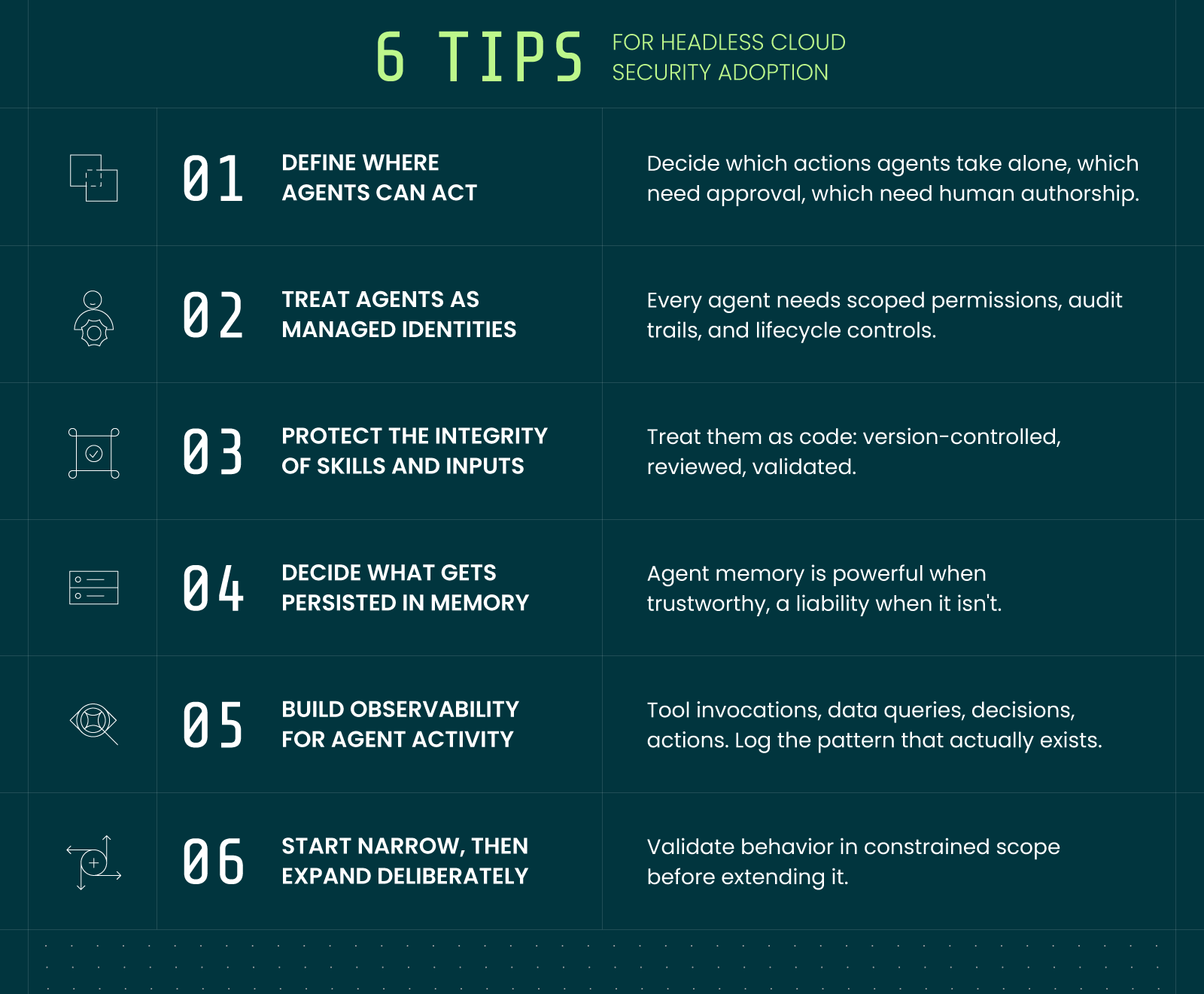
6 considerations for adopting headless cloud security

Sysdig infographic titled '6 Tips for Headless Cloud Security Adoption' on a dark teal background. The six tips are: define where agents can act by deciding which actions agents take alone, which need approval, and which need human authorship; treat agents as managed identities with scoped permissions, audit trails, and lifecycle controls; protect the integrity of skills and inputs by treating them as code that is version-controlled, reviewed, and validated; decide what gets persisted in memory because agent memory is powerful when trustworthy and a liability when it isn't; build observability for agent activity by logging tool invocations, data queries, decisions, and actions; and start narrow then expand deliberately by validating behavior in constrained scope before extending it.

Adopting headless cloud security is an architectural shift. It  works best when teams plan for it deliberately. 

The considerations below cover the decisions worth making early:

  1. Define where agents can act, and where they can't.

    Agents can investigate findings, draft remediations, generate fixes, etc. The decision worth making early is which actions agents can take on their own, which require human approval, and which require human authorship.

  2. Treat agents as managed identities.

    Every agent that operates against the platform needs an identity, scoped permissions, audit trails, and lifecycle controls. If your team can't answer what an agent can do, on whose behalf, and who approved it — the same way you can for a human user — the agent isn't ready to be running in production.

  3. Protect the integrity of skills and inputs.

    Skills tell agents how to behave. Inputs tell agents what to act on. Both are surfaces an attacker can target.

    A skill modified outside change control can shift agent behavior in ways nobody notices. Treat skills and inputs as code: version-controlled, reviewed, and validated before they reach the agent.

    Pro tip: Don't stop at version-controlling skills. Set a runtime baseline for what each skill does when it executes, and alert on agent behavior that deviates from it. That's how you catch a tampered skill that passed code review.
  4. Decide what gets persisted in memory.

    Agents that retain context across sessions are more useful than agents that start fresh every time. But they're also a longer-lived attack surface.

    Anything stored in agent memory can shape future behavior, which is powerful when the memory is trustworthy and a problem when it isn't. Decide early what gets persisted, who can write to it, and how it gets reviewed.

  5. Build observability for agent activity.

    Traditional security telemetry was built to log human actions. Agent activity creates a different kind of trail: tool invocations, data queries, decisions made, actions taken.

    Without observability designed for that pattern, agent behavior becomes difficult to audit and harder to debug when something goes wrong.

    Pro tip: Tag agent-driven system calls at the kernel layer and analyze them alongside human-driven activity. Don't stand up a separate agent observability stack. Extend the runtime telemetry you already have.
  6. Start narrow, then expand deliberately.

    Agents that begin with broad access tend to accumulate more of it over time. Agents that begin narrow expand only when there's evidence the expansion is safe. Validate behavior in a constrained scope before extending it.

In short:

Headless cloud security is most successful when the architecture and the operational discipline develop together. The architecture makes new things possible. The discipline is what makes the new things sustainable.

Comparing headless cloud security to agentic security

It's worth making a distinction between agentic security and headless cloud security. They’re connected, but not the same thing.

Headless cloud security is architectural. It describes a cloud security platform with data and capabilities exposed through programmable interfaces rather than a dashboard.

Agentic security is operational. It describes AI agents reasoning over data, executing workflows, and taking action.

In other words: Headless describes the platform. Agentic describes the operator.

How the shift to headless changes security work

Headless cloud security changes what people spend their time on. 

For security analysts, the shift is from operator to orchestrator.

Agents handle the first pass on alerts. The analyst defines what good investigation looks like. They review what agents produce. They step in on cases that require judgment.

For engineering and platform teams, the shift is from working around security to working with it.

Security findings reach the team in the environments they already use. Through the same coding agents they're already operating against. No more context-switching into a separate tool.

For CISOs, the shift is from managing alert volume to managing decisions.

The question changes from "did the team triage everything?" to "are agents acting within the policies we set, and are humans approving the right things?"

The key takeaway: less time operating tools. More time directing them.