

惯性聚合 高效追踪和阅读你感兴趣的博客、新闻、科技资讯
阅读原文 在惯性聚合中打开

推荐订阅源

OSCHINA 社区最新新闻
OSCHINA 社区最新新闻
S
Security Archives - TechRepublic
宝玉的分享
宝玉的分享
freeCodeCamp Programming Tutorials: Python, JavaScript, Git & More
Engineering at Meta
Engineering at Meta
V
V2EX
Microsoft Azure Blog
Vercel News
Vercel News
MongoDB | Blog
MongoDB | Blog
奇客Solidot–传递最新科技情报
奇客Solidot–传递最新科技情报
P
Proofpoint News Feed
H
Hackread – Cybersecurity News, Data Breaches, AI and More
J
Java Code Geeks
U
Unit 42
让小产品的独立变现更简单 - ezindie.com
I
InfoQ
小众软件
小众软件
博客园_首页
博客园 - 叶小钗
N
Netflix TechBlog - Medium
The Cloudflare Blog
L
LangChain Blog
C
Check Point Blog
雷峰网
雷峰网
A
About on SuperTechFans
Stack Overflow Blog
Stack Overflow Blog
T
The Blog of Author Tim Ferriss
Recent Announcements
人人都是产品经理
人人都是产品经理
S
Security @ Cisco Blogs
IT之家
IT之家
H
Hacker News: Front Page
O
OpenAI News
K
KPMG report finds enterprise disconnect between AI and its ROI | CIO
Schneier on Security
Webroot Blog
Webroot Blog
M
MIT News - Artificial intelligence
D
DataBreaches.Net
V
Vulnerabilities – Threatpost
cs.AI updates on arXiv.org
C
CXSECURITY Database RSS Feed - CXSecurity.com
S
Securelist
Spread Privacy
Spread Privacy
G
Google Developers Blog
cs.CV updates on arXiv.org
P
Privacy International News Feed
I
Intezer
Cloudbric
Cloudbric
Apple Machine Learning Research
Microsoft Security Blog

Hacker News: Show HN

PurrrrrFocus: Pomodoro Timer App - App Store Workflow Engine — Multi-Step Orchestration for Bun RapidPhoto: Pro Photo Editor App - App Store GitHub - f0rr0/pglite-oxide: rust bindings for pglite Show HN: Another experiment with an Erdos problem and LLMs Show HN: Free On-Brand AI Ad Maker MemTensor/MemOperator-4B · Hugging Face Twitter Bulk Delete - 批量删除X帖子 - Chrome 应用商店 Show HN: Intent Bus – SQLite job bus for coordinating scripts across devices GitHub - drio/unixmagic: Capturing all the details of the classic Usenix Unix poster. GitHub - CelestoAI/SmolVM: Open-source AI sandbox infrastructure for code execution, browser use, and AI agents. GitHub - matzapata/nitrum: Rust toolkit for building and deploying secure apps inside AWS Nitro Enclaves, with built-in CLI, attestation, TLS, and AWS integrations. GitHub - light-cloud-com/out-loud: Free, open-source, 100% offline AI text-to-speech for macOS, Windows & Linux. Friend.AI Private Chat App - App Store Release 0.0.3 · wizardofzos/xmi-generator GitHub - pawelb0/matrirc: Local IRC server backed by Matrix (E2EE) GitHub - sachitrafa/YourMemory: Agentic AI memory with Ebbinghaus forgetting curve decay. +16pp better recall than Mem0 on LoCoMo. GitHub - Dreeseaw/mdlens: Token-efficient Markdown CLI for AI agents to navigate, search, and pack docs into bounded context windows GitHub - Audazia/solar-system-agents: Cyberpunk Mission Control dashboard for AI agent fleets. Zero dependencies. Open source. Your bad habits are destroying your charging cables Time Pin 🕹️ Play on CrazyGames arktur App - App Store Show HN: I replaced a memory app with two Markdown files and a Git repo Flocking Game Simulator – Boids, Swarm AI & Predator-Prey Gameplay GitHub - ramongougis/WaveletLM: WaveletLM GitHub - timschmidt/realistic_blas: Linear algebra primitives with infinite precision, exact equality, useful errors, and an f64 fast path GitHub - viggy28/pg_savior: A postgres extension to avoid accidental mistakes GitHub - basegraphhq/relay-plugin: Your Claude Code becomes Relay — a staff engineer thinking partner that listens before proposing and captures decisions in your repo. Show HN: SlothDB is a super fast embedded SQL database GitHub - typomonster/parlor-jarvis: On-device, real-time multimodal AI. Multilingual voice + vision (en/ko/es/pt/fr) with camera, screen, PDF, and video — runs entirely locally. GitHub - ValeriaVG/jigs: Functional request -> response processing framework GitHub - lace-ai/gai: 🤖 GAI is a flexible Go library for building agent-style applications on top of LLMs Kino | Appwared GitHub - lambdadevelopment/lambda-erp: Open-source AI-native ERP. Accounting, inventory, analytics — all through chat. RiverRider/srt-adapter-v8a · Hugging Face GitHub - MinishLab/semble: Fast and Accurate Code Search for Agents GitHub - Jannchie/text-trace: Create Keynote-style SVG text trace animations GitHub - ohmstone/context-artist: A tool for experimenting with context (aka prompts) for LLMs. Provides context template editor, websocket streaming API, drafting, testing, and analytics. Show HN: UseMoney AI: AI Copilot for Retail Investors of India Hyper-Frame: The Power of a Full Browser, Inside an Iframe GitHub - artem-mangilev/ctxbrew: 📦 Ship & Use AI-friendly package context. Hyper-Frame - an iframe that can frame any website GitHub - odest/tntstack: The solid stack for building cross-platform apps. Write your code once and build for Web, Desktop, and Mobile. GitHub - owenrumney/lazypprof: A keyboard-driven TUI for exploring Go pprof profiles. Faster than go tool pprof -http, no browser needed — works in any terminal, including over SSH. GitHub - VincenzoManto/DSSGo: A Go implementation of a CMD-only spreadsheets visualizer based on the new DSS format. Show HN: OpenClaw but Efficient and with an SDK Phonetic Formatter: English App - App Store GitHub - jsdelivr/globalping: A global network of probes to run network tests like ping, traceroute and DNS resolve GitHub - build-neurall/implit: Validate imports and catch fake AI-generated dependencies GitHub - agzam/remoto.el: Browse GitHub repos without cloning GitHub - Giovan321/Reward-Guard: Plug-and-play reward monitoring for RL training loops. Catch reward hacking, component imbalance, and starvation before they tank your run. Drop in one .step() call — get balance reports, auto weight correction, alignment scores, and WandB/TensorBoard/SB3 integrations out of the box. → rewardguard.dev BigTech AI News - Chrome 应用商店 GitHub - jal-co/shieldcn: Beautiful README badges, inspired by shields.io and styled like shadcn/ui. GitHub - Rightbracket/peeroxide: Rust implementation of the Hyperswarm P2P networking stack — wire-compatible with the existing Node.js network. Includes Kademlia DHT, Noise handshakes, UDP hole-punching, and BBR congestion control. Pure Rust, no C dependencies. GitHub - Water-Run/get: get -- get anything from your computer GitHub - mytech-today-now/OO: Automate O&O ShutUp10++ privacy on Windows 10/11 How Lorikeet Security Stopped a Live DDoS Attack Mid-Training, Without Dropping a Single Student GitHub - mytech-today-now/mTTCleaner GitHub - moogacs/tabby: Chrome extension dedupe tabs, export links, and organize by smart category batches. Show HN: Ruosh,full-text search library in Python backed by Tantivy GitHub - ivankuznetsov/llm-wiki GitHub - lu-zhengda/claude-mem-viz: Browse and edit what Claude Code remembers GitHub - klexas/DialUploader: DialUp themed React Loader Component Quantum Temporal Cryptography: Draft Specification v2.0 GitHub - labiium/routiium: A self-hosted LLM reverse proxy that adds managed auth, multi-provider routing, rate limiting, llm as judge, historyand cost tracking to any OpenAI-compatible GitHub - btahir/agent-order: The Order of the Agents is a council of AI agents (Codex, Claude) that deliberate to produce final plans, PRDs, and decisions. GitHub - useknockout/api GitHub - WorkSmartAI-alt/ai-visibility-monitor: Open-source toolkit for tracking AI search citations, Google Search Console, GA4 with AI-referrer cut, and bot-access prerequisites. No SaaS, no dashboard subscription. Built by Work-Smart.ai. Show HN: Auto lock your Mac via phone proximity (No Apple Watch) Hyper-DERP: C++/io_uring DERP relay - Same throughput as Tailscale's derper, half the cores Perfect Fit - Apps on Google Play GitHub - reviseio/errata-bench: A proofreading benchmark for LLMs Show HN: Read and Echo – Turn any text into structured language practice MockHop — Capture web pages and annotate them Show HN:I built a deterministic 10k-node VRP solver on a $100 phone Readox – Read Aloud Text to Speech for Web Pages & PDFs - Chrome Web Store How we taught Chrome to export video GitHub - dogmaticdev/SIMD-Tokenizer: A Hyper Optimzed Tokenizer written in handwritten assembly. Made for SSE2 cpu architectures. GitHub - erickalfaro/multitable I Deleted My Clever Code and the Database Got Better Show HN: WhiskeySour – A 10x faster drop-in replacement for BeautifulSoup GitHub - tryhardfifi/pocket-ingest App Dinner: where to eat – App Store GitHub - gerritsxd/chatforge: Drag two conversations together. Local LLM chat with merge, persistent memory, and LoRA compilation. Introducing Limen: composable authentication for Go | Limen GitHub - sachinsharma9780/memweave: memweave is a zero-infrastructure, async-first Python library that gives AI agents persistent, searchable memory — stored as plain Markdown files GitHub - remyyx/workledger: XRPL-native settlement protocol — escrow-protected contracts, MCC credentials, multi-currency wallet Show HN: Enlist AI: Sub-second interview coaching with persistence GitHub - FuzzAnything/PromptFuzz: PromtFuzz is an automated tool that generates high-quality fuzz drivers for libraries via a fuzz loop constructed on mutating LLMs' prompts. GitHub - tdi/lazytilt: Terminal UI for Tilt.dev, inspired by lazygit GitHub - pando85/kaniop: Kubernetes operator for managing Kanidm public-apis/README.md at master · public-apis/public-apis GitHub - nex-crm/wuphf: Slack for AI employees with a shared brain. Get Claudes, Codexes and OpenClaws to collaborate and do your work autonomously while never losing context. Werner App - App Store Releases · heyallencao/NoonFlow Show HN: Playing music over movies causes them to sync GitHub - Jintin/aliasme: A shell script to memorize your command in command line. GitHub - DO-SAY-GO/aromatic: Aromatic durable low-bandwidth transport demonstrator GitHub - ShadowLLM/shadow-peft: ShadowPEFT: Shadow Network for Parameter-Efficient Fine-Tuning GitHub - buda-ai/bunny-agent: Build coding agent SaaS via native AI SDK UI
Magma
mgunlogson · 2026-06-09 · via Hacker News: Show HN

Magma

Vertical reinforcement infill for FDM 3D printing. A fork of OrcaSlicer that injects molten plastic into sealed lattice channels during printing — for continuous solid Z-axis reinforcement, with no hardware modifications.

⚠️ Experimental. The slicer pipeline works end-to-end. Mechanical print results are still being characterized. Do not report bugs to the official OrcaSlicer repo. This is a research release; help is welcome.


What it does

FDM-printed parts are notoriously weak in the Z-axis because layers only bond at their thin interfaces. Magma changes the infill geometry so that the print contains sealed vertical channels, then it injects molten plastic into those channels during the print itself. The injection comes from the printer’s existing extruder — no new hardware required.

The result, when it works: continuous interlocking solid columns running vertically through the part, mechanically locked into the layer-printed walls.

One paired cell pair, vertical cross-section:

   Before injection:        After injection:

     ┌───┬───┐                ┌───┬───┐
     │   │   │                │███│███│
     │   │   │                │███│███│
     │   │   │      →         │███│███│
     │   │   │                │███│███│
     │   │   │                │███│███│
     │       │                │███████│   ← continuous through window
     └───────┘                └───────┘

  Two adjacent triangle      Injection fills both
  cells sharing a wall,      cells in a continuous
  with a "window" gap at     U-shape, mechanically
  the bottom.                interlocking with the
                             surrounding lattice.
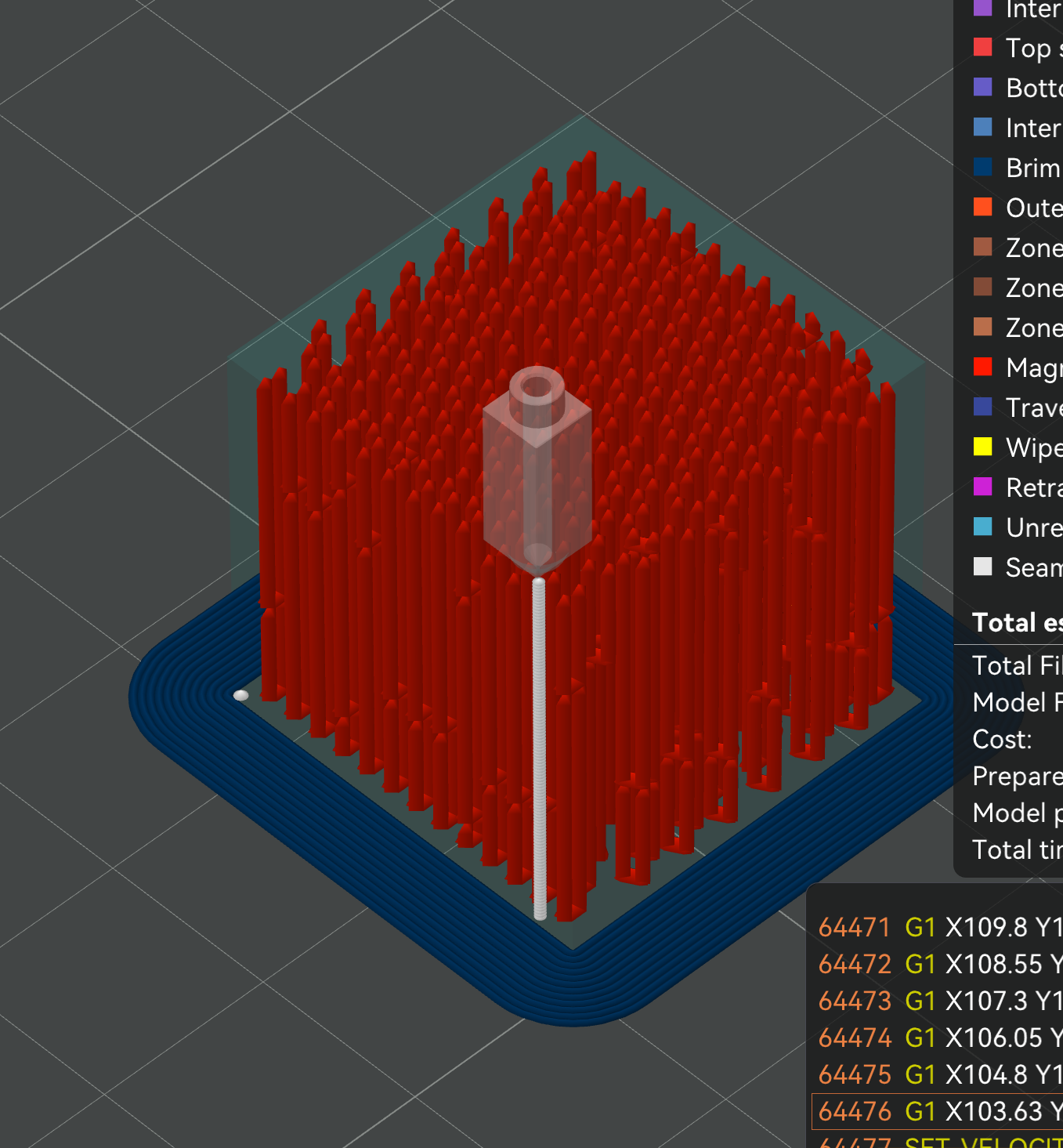
Injection in progress

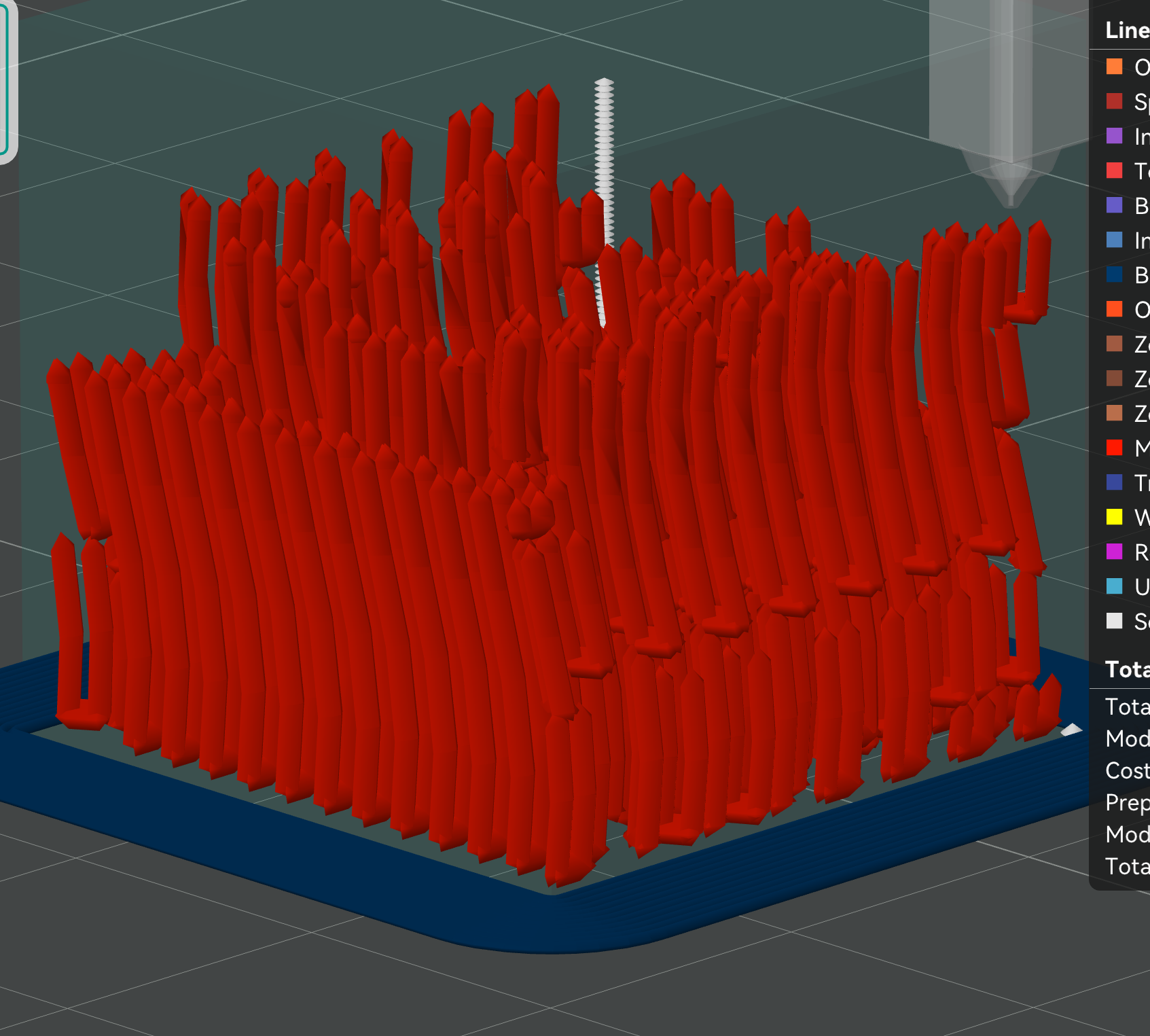
Mid-print injection in GCode preview: the nozzle (white marker) drops into a vertical channel, extrudes a column of molten plastic, lifts, and moves to the next one. Every red column is one of these injection events. They’re what turn an otherwise hollow lattice into solid vertical reinforcement.
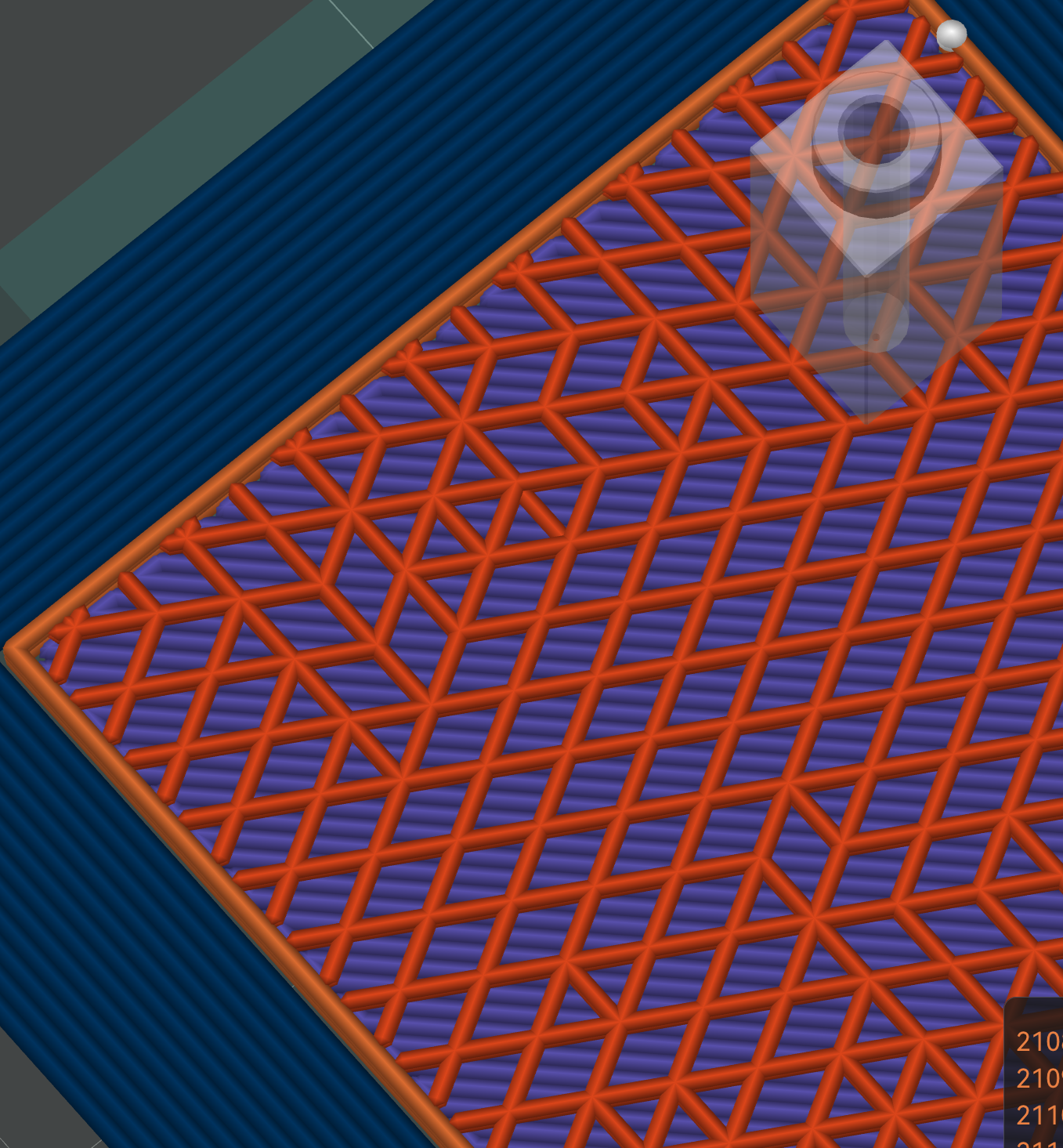
Triangle infill with windows

The lattice the injections fill: top-down view of a single printed layer. The orange triangular grid is the outer Magma zone — hollow channels at this stage. The hexagonal gaps in the lattice are windows, where pairs of channels are connected so plastic can flow from one tube into its partner during injection.


Status: works in software, not yet in physical print

I want to be upfront about this. The slicer pipeline is fully functional:

  • Triangle lattice generation with optional spiral interlock
  • Dual-zone infill (Magma outer + configurable inner)
  • Two-stage tube assignment solver (greedy + CP-SAT)
  • Injection G-code with Z-slam sealing, multi-material support
  • Full GCode preview with tube and injection visualization
  • 40+ configurable settings exposed in the UI

What’s NOT yet working: the physical print. On my Ender, same-material plastic injected into freshly-printed cells melts the cell walls before they can seal. The math says this should work; the materials science is the open question.

I’m publishing the software now so people with better setups can experiment.


What you can try (please)

I’ve done the first three. They didn’t work for me, but might for you with better hardware:

  • Lower-melt injection material — PCL (60°C melt), TPU, sugar/wax for lost-wax style applications
  • Dual extruder — print cells in PETG/ABS, inject with PLA
  • Higher injection temperatures — way above print temp, fast injection before damage propagates

Things I haven’t tried that might work:

  • CHT or Volcano nozzles — much higher flow before pressure drop, faster injection before the cell walls heat-soak
  • Redesigned injection nozzles — triangle-shaped with flat sealing faces (a lathe project for someone)
  • Silicone gaskets on the nozzle tip for sealing
  • PTFE or other non-stick coatings to prevent injected plastic from sticking to the nozzle
  • Thermal breaks around the injection nozzle so it doesn’t conduct heat to cell tops
  • Slow injection with long dwell — let the heat soak rather than melt-and-go
  • Larger nozzle bore — more volume per second at lower pressure
  • Post-print annealing — fuse the interfaces after cooling
  • Different injection volumetric flow ratios — current default is 0.5; testing across 0.3-0.9 needed
  • Different z-slam depths — currently default 0.05mm, testing up to 3.5mm might help sealing
  • Variable cell sizes — current default ~5x nozzle diameter; smaller cells would print faster but require finer nozzles

If you find a combination that works, please open an issue or contact me. The community can solve this faster than I can alone.


Multi-material / multi-extruder

I attempted to wire Magma through OrcaSlicer’s multi-material and multi-extruder infrastructure:

  • magma_injection_filament — pick a dedicated filament/extruder for tube injection (so you can print walls in PETG and inject with PLA, for example)
  • dual_infill_outer_filament — pick a different filament for the outer Magma zone
  • Tool-ordering, temperature management, and filament switching are all wired through

I have not been able to test any of this — I only have a single-extruder Ender. The code path exists and slices without errors in my testing, but real multi-material printing might surface bugs I can’t see. If you have a dual-extruder or IDEX setup, please try this and report what breaks.


Get the beta

Source: MGunlogson/OrcaSlicer (magma-infill branch)

Pre-built binaries: Releases page

These are my current best guesses. None have produced a successful print yet — they’re a starting point for experimentation.

Setting Value
Sparse infill pattern Magma Triangle
dual_infill_enabled on
dual_infill_outer_width 5.0 mm
Inner zone infill (sparse_infill_pattern for the inner region) Lightning — strength isn’t the goal here; the inner zone just needs to support the top of the part. Lightning uses the least material.
magma_tube_height 6 mm (max ~6mm seems to work in preview)
magma_nozzle_outer_diameter 3.5 mm (or 2.5 mm for finer cells)
magma_injection_z_slam 0.5–1.0 mm
magma_injection_speed 8 mm³/s
magma_tube_fill_factor 0.5–0.9 (start higher)
magma_tube_solver_mode Basic — the CP-SAT (Refined) solver is much slower and only really helps on complex geometry
magma_spiral_interlock off — see notes below

Full configuration reference: RELEASE.md

How it works (high level)

  1. Slice with Magma Triangle infill. The slicer generates a triangular lattice. Adjacent cells are paired and connected by “windows” (gaps in the shared wall) at the bottom of each tube pair.
  2. Print normally. The printer prints each layer’s walls, perimeters, and infill — including the cell walls that form sealed tubes.
  3. Inject during print. At configured points in the print, the printer pauses motion, drops the nozzle to the top of a tube, extrudes molten plastic to fill the tube + its U-tube partner, lifts, and continues.
  4. Result. As the print finishes, every tube pair is a continuous solid column of injected plastic, mechanically interlocking with the surrounding lattice.

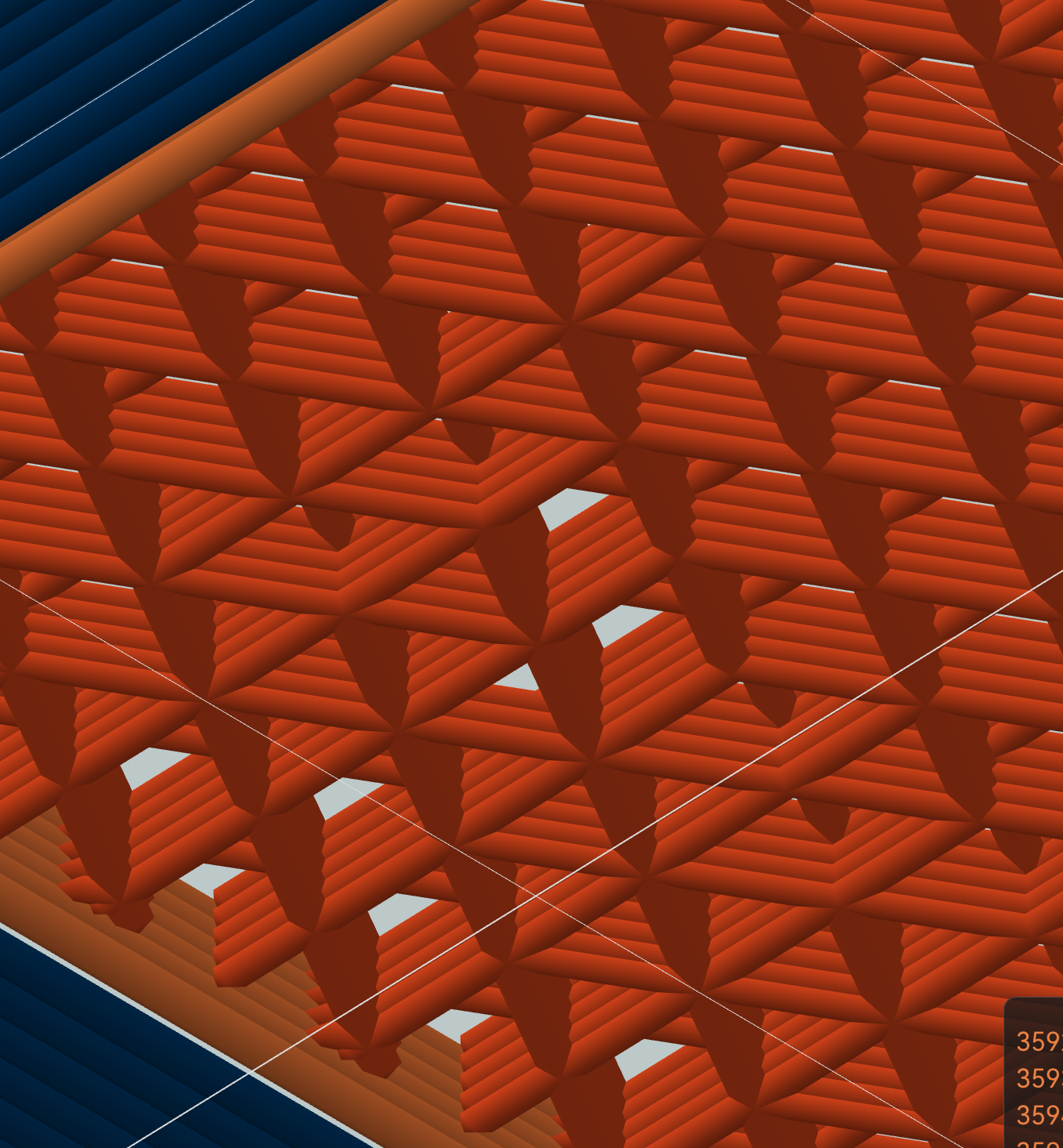
Tube structure with windows

Close-up of the lattice from inside the part, showing the windows — every paired cell has a gap in its shared wall so plastic injected into one tube flows through and fills its U-tube partner.
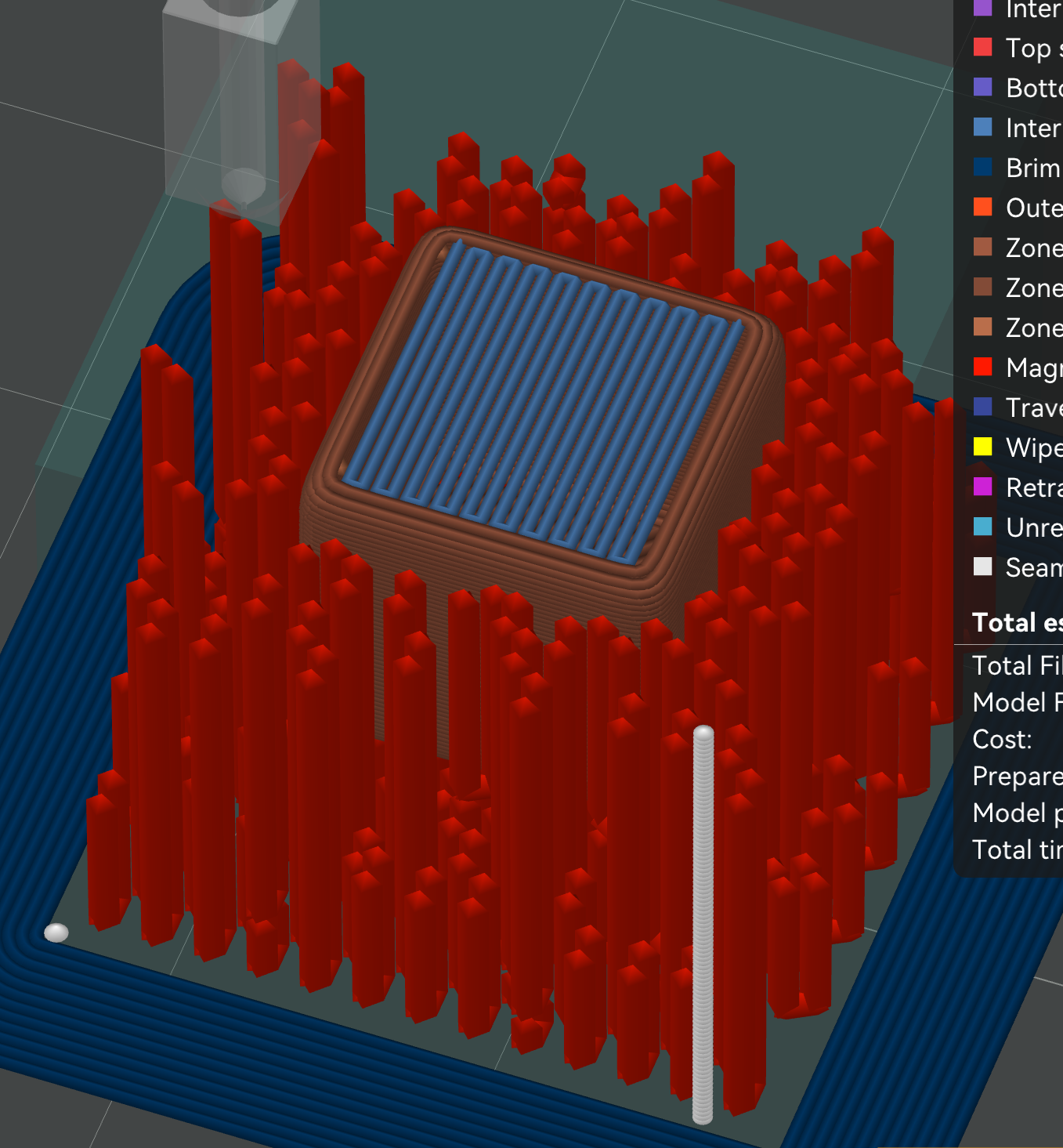
Dual zone fill

Cutaway preview after slicing: the red Magma triangle tubes form the outer reinforcement zone, surrounding the solid blue inner zone (yolk). The brown band visible above the inner solid is the zone-boundary shell — perimeter walls between the two zones.
Spiral interlock

With magma_spiral_interlock on, the entire lattice rotates slightly per layer — the result is helical tube paths rather than straight vertical columns. The intent is mechanical interlock with the surrounding lattice walls (potentially better pullout resistance), but this hasn’t been measured — the actual benefit vs. straight tubes is unknown. There’s a real cost: the spiral arc effectively widens each tube footprint, so fewer full tubes fit, especially in thin sections. Default is off; turn on only if you’re specifically testing this trade-off.
Zone boundary overlay

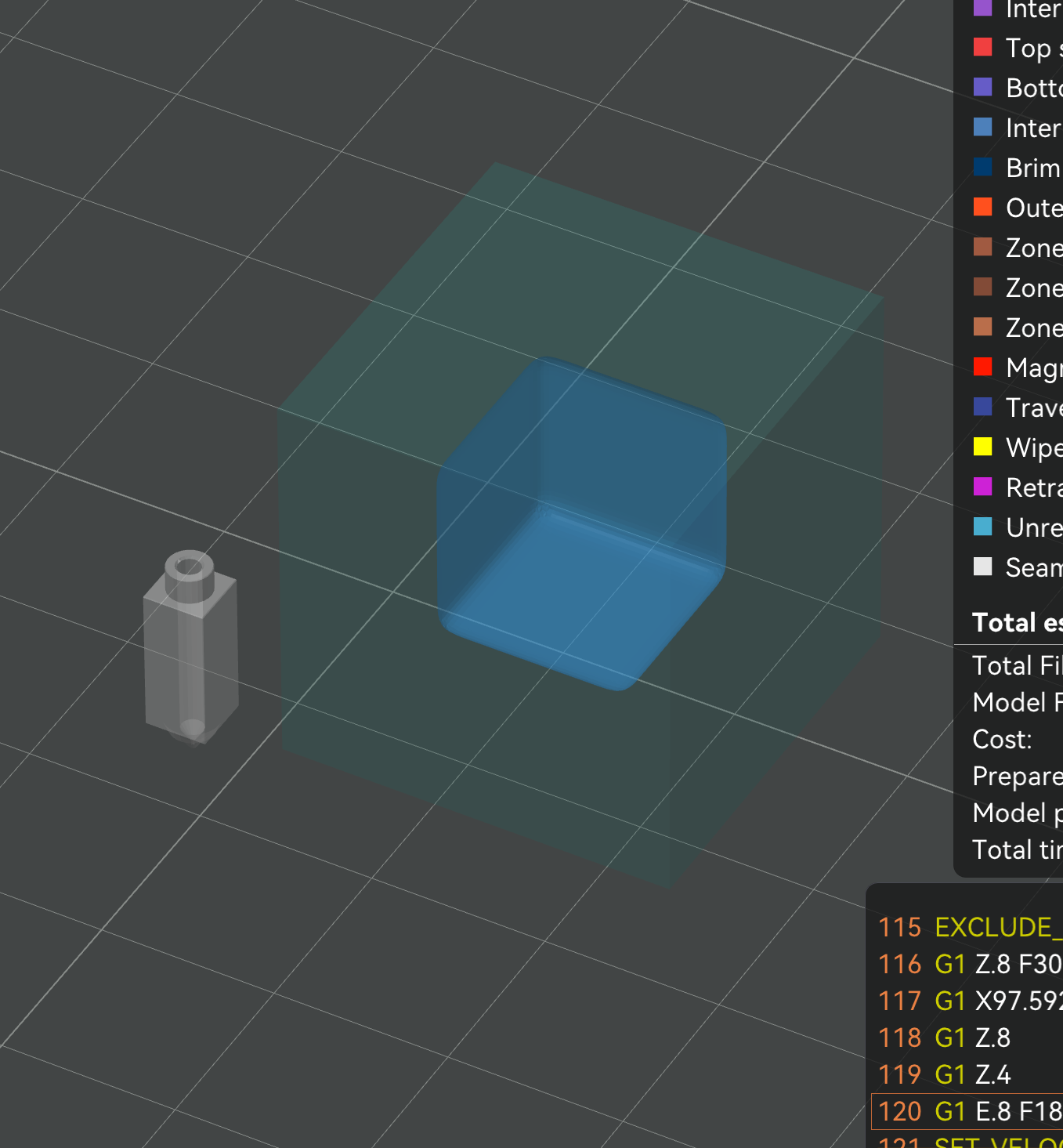
Press J in the preview to toggle the zone-boundary shell overlay — the transparent volumes show the computed inner-zone region (raw vs. smoothed). Useful for diagnosing zone splitting on complex models.

The clever bits are in the solver (figuring out which cells to pair into U-tubes for maximum coverage with weak-plane avoidance), the spiral offset (so tube boundaries don’t form weak Z-planes), and the injection G-code (parking, sealing, multi-material support).

Full design documentation:


Defensive publication

The algorithms, data structures, and techniques in Magma are dedicated to the public domain via a CC0 1.0 Universal defensive publication, dated before public release.

Read it: DEFENSIVE_PUBLICATION.md

This means anyone is free to use, modify, build on, or commercialize any of the techniques. The intent is to prevent third parties from patenting these ideas later.


Why I’m releasing this in this state

I’ve been working on this for months. The software is solid. I don’t have the printer setups, materials, or shop time to characterize all the materials variables, and continuing alone would take another year of trial and error.

The community is much better at materials science than I am. The slicer is the bottleneck — once it exists, anyone with a dual-extruder Voron, a lathe and some brass, or a stash of exotic filaments can experiment in hours.

If this turns into something useful, it should belong to the community. Hence the CC0 dedication.


License

  • OrcaSlicer fork: AGPL-3.0 (inherited from upstream)
  • Magma algorithms and design (this repo): CC0 1.0 Universal — public domain dedication

  • Issues: GitHub issues — for the design/docs
  • Bug reports for the slicer: Fork issuesnot the upstream OrcaSlicer repo
  • Mark Gunlogson — GitHub