








ProductDaily ETF HoldingsETF Holdings APIN-PORT
One daily ETF holdings API across six issuer file formats (csv, xlsx, xls, json, html, pdf), covering 2,200+ funds, far fresher than quarterly N-PORT.
Published June 23, 202611 min readStockFit Engineering
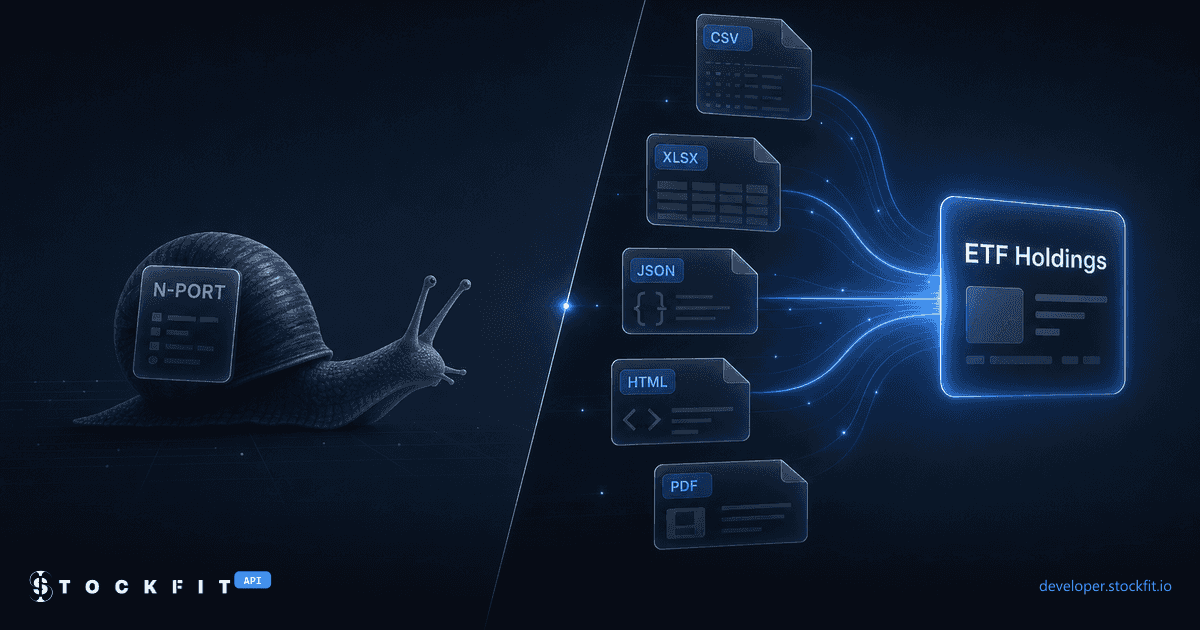
If you want to know what an ETF holds today, there are two very different answers. One is the fund's quarterly SEC filing, structured and authoritative but as much as a few months stale. The other is the full holdings file the issuer posts on its own website every single morning, current to the prior close but published in whatever format that issuer happened to pick. This post is about the second answer: how we turned a zoo of csv, xlsx, xls, json, html, and pdf files from dozens of issuers into a single daily ETF holdings API, what it covers so far, and why the count keeps climbing.
Funds covered
2,242
and growing as we onboard issuers
Source formats
6
csv, xlsx, xls, json, html, pdf
Issuer sites
52
distinct holdings hosts
Freshness
Next day
vs 1 to 4 months for N-PORT
Every number in this post is from the live StockFit production API on 2026-06-23. Coverage is a moving target by design, so treat the figures as a floor: the authoritative current list is always the supported-funds endpoint.
Why daily ETF holdings beat quarterly N-PORT
Registered funds report their portfolios to the SEC on Form N-PORT. They file it monthly, but the SEC only makes the quarter-end month public, and that disclosure lands roughly 60 days after the quarter closes. The practical effect is that the public N-PORT picture of a fund is between one and four months old depending on when you look. For a slow index fund that barely matters. For an active ETF that rotates its book, a four-month-old holdings list is a different portfolio. N-PORT is the right tool for point-in-time history and for funds that do not publish anything else, and it backs our quarterly fund holdings endpoint. It is the wrong tool for "what does this ETF own right now."
There is a fresher source, and it exists because of a rule. When the SEC adopted the ETF Rule (Rule 6c-11) in 2019, transparent exchange-traded funds were required to post their full portfolio holdings on a public website every business day. That daily file is the same composition data market makers use to assemble the creation and redemption basket, so it is complete: every position, the share or par quantity, the market value, and the weight. The issuers comply by dropping a file on their own site each morning. The data is excellent. The delivery is chaos.
For background on where N-PORT sits in the broader filing taxonomy, and why a fund's 10-K equivalent is its N-CSR rather than its holdings report, see our field guide to SEC forms. And because matching a daily file back to the right fund means resolving a ticker to a series in the first place, the CIK-to-fund-ticker problem is a prerequisite we had to solve before any of this worked. The full text of the ETF Rule is on sec.gov.
Every issuer publishes holdings differently
There is no standard for the daily holdings file. The ETF Rule says publish the holdings; it does not say how. So each issuer made its own choice, and over years of building this we have had to read all of them. ARK posts a clean csv. SSGA and the SPDR lineup post xlsx workbooks with a preamble and a header buried on row five. Vanguard serves a json document behind its product page that needs a referer header. Schwab and several others server-render an html table, sometimes paginated a hundred securities at a time. A handful of issuers still publish a legacy binary xls (the old BIFF format that most spreadsheet libraries silently load as zero worksheets). And a stubborn few only ever expose a pdf.
We deliberately did not write a bespoke scraper per fund. A new fund is onboarded by writing a small configuration (the source URL, the format, and a mapping from our standard fields to that file's column headers or json keys), not by shipping code. That keeps roughly two thousand funds maintainable by one person. The hard parts are rarely the parsing: they are the access tricks. Some issuers serve a different file to a browser user-agent than to a default client. Some embed a monthly-rotating token in the URL with no stable alias, so the real file has to be discovered through a documents API first. Several 403 a curl request on a TLS fingerprint but return 200 to a normal fetch, which means a "bot wall" is often a false alarm worth checking before giving up. None of that leaks into the response. What comes out the other side is one shape.
Coverage so far, and why it grows daily
As of 2026-06-23, the daily holdings endpoint covers 2,242 funds drawn from 52 distinct issuer sites. The chart below is the distribution of those funds by the format their issuer publishes. Csv leads, but no single format is close to a majority: a real daily holdings feed has to handle all six, which is the whole engineering point.
How ETF issuers publish their daily holdings
Source publish format of 2,240 supported funds. One feed normalizes all six. Verified 2026-06-23.
The coverage is lumpy by issuer, and that lumpiness is good news. Because onboarding is config-driven and issuers reuse one format across their entire shelf, adding a single issuer's format usually unlocks dozens of its funds at once. iShares, First Trust, Invesco, and Innovator alone account for nearly a thousand of the covered funds.
Coverage by issuer (top 12 of 52)
Onboarding one issuer's holdings format usually unlocks its whole lineup. Verified 2026-06-23.
"Grows daily" means two different things here, and both are true. First, the holdings data itself refreshes every day: a self-scheduling job re-fetches each supported fund's file, so the value you read is the issuer's most recent posting, not a weekly snapshot. Second, the breadth of coverage widens continuously as we onboard more issuers and more of their funds. That is why the figures in this post are a floor and the supported-funds list is the source of truth. If a fund you need is not covered yet, it is usually a config away rather than a capability away.
The unified response: holdings as JSON
Whatever the source format, the output is the same JSON. One call, a ticker, optional pagination. Here is the top of ARK Innovation ETF, an active fund that publishes a csv, returned by /api/fund/holdings/daily:
The reportDate is the as-of date the issuer stamped on the file, not the date we fetched it, so you always know exactly how fresh the data is. Holdings come sorted by portfolio weight (pctVal) descending. Each row carries only the fields the source actually provides, so a field with no value is omitted rather than sent as null. For an equity fund that is name, ticker, cusip, share balance (with units: "NS" for number of shares), valueUsd, and the weight.
The same endpoint adapts when the fund holds bonds. Here are the top rows of a senior-loan fund, SRLN, where the schema fills in the fixed-income fields the equity example left empty:
Now units is PA (par amount, not shares), and each row carries couponRate and a normalized maturityDate. Whatever date format the issuer published (a serial number, "Feb 15 2035", or "15-Feb-2035"), it comes back as YYYY-MM-DD. The daily shape mirrors the quarterly /api/fund/holdings response and is a superset of it: in addition to the common fields it surfaces sedol, currency, sector, and the bond economics above. The one trade-off is that daily rows are taken straight from the issuer file, so unlike the N-PORT endpoint they are not mapped to a CIK or mappedSymbol and carry no fair-value level.
What is and is not covered
Honesty about scope is part of the point. The daily feed covers transparent, US-listed exchange-traded funds, the ones the ETF Rule obliges to publish full holdings every day. It does not cover three categories, and no amount of engineering changes that, because the data simply is not published daily:
Semi-transparent active ETFs
A growing class of active ETFs operates under a semi-transparent (or non-transparent) structure that lets the manager withhold precise daily holdings, disclosing a proxy basket daily and the full book only quarterly. For those funds the daily file does not exist, so the quarterly N-PORT endpoint is the real source.
Mutual funds and closed-end funds
These are not subject to the daily-disclosure rule at all. A mutual fund or a closed-end fund discloses its full portfolio quarterly through N-PORT, and many post only a top-ten list on their website between filings. Where an issuer does publish a fuller file (some closed-end fund families post a monthly holdings workbook), we onboard it, but the cadence is monthly at best, never daily.
Non-US funds
Coverage today is US-listed funds. That is a deliberate scope line, not a permanent one.
For the questions daily holdings cannot answer on its own, the rest of the fund family fills in: quarterly fund flows and portfolio overlap are NPORT-derived and SEC-sourced, which we cover in the SEC EDGAR alternative data signals walkthrough, and fund-to-fund crowding sits on /api/fund/overlap. The SEC's own description of the fund reporting regime, including N-PORT, is on sec.gov.
FAQ
What are daily ETF holdings?
Daily ETF holdings are the full list of securities an exchange-traded fund owns, published by the issuer on its own website every business day under the SEC's ETF Rule (Rule 6c-11). Each entry includes the security name, identifier, quantity, market value, and portfolio weight. It is the same composition data used to build the fund's daily creation and redemption basket, so it is complete rather than a top-ten summary.
How current are daily ETF holdings compared to quarterly N-PORT?
Daily holdings are typically one day old: the file carries the prior close. Public N-PORT holdings, by contrast, are disclosed only for the quarter-end month and arrive about 60 days after the quarter closes, so a position can be one to four months stale depending on when you look. For a fast-rotating active ETF that difference is material. StockFit serves daily holdings from the issuer file and quarterly holdings from N-PORT through two separate endpoints.
How do I get ETF holdings as JSON?
Call /api/fund/holdings/daily with a fund ticker and a bearer token. The response is JSON, paginated, sorted by portfolio weight descending, with the issuer's as-of date in the reportDate field. Whatever format the issuer originally published (csv, xlsx, xls, json, html, or pdf), the response shape is identical, so you never parse a spreadsheet or scrape a table yourself.
How many ETFs have daily holdings, and which ones?
As of 2026-06-23 the daily endpoint covered 2,242 US-listed funds across 52 issuer sites, and the list grows as more issuers are onboarded. The authoritative, current roster is the /api/fund/holdings/daily/supported-funds endpoint, which returns the flat list of covered ticker symbols. Coverage skews toward the large issuers (iShares, First Trust, Invesco, Innovator, SPDR, Vanguard) because onboarding one issuer's format unlocks its whole lineup.
What file formats do ETF issuers publish holdings in?
Six, in practice: csv, xlsx (modern OOXML workbooks), xls (the legacy binary BIFF format), json (often behind the product page), server-rendered html tables (sometimes paginated), and pdf. There is no industry standard, so issuers split across all six. Across the 2,240 classified funds, csv is the most common at about 36 percent, followed by json and html, with pdf the rarest.
Do daily holdings include bond funds with coupon and maturity?
Yes. The response is a superset of the equity shape. For fixed-income funds each row reports units: "PA" (par amount instead of share count) and adds couponRate and a normalized maturityDate in YYYY-MM-DD form. Each holding carries only the fields its source file provides, so equity rows omit the bond fields and vice versa.
Are mutual fund and closed-end fund holdings available daily?
Generally no. Mutual funds and closed-end funds are not subject to the daily ETF disclosure rule. They report full holdings quarterly via N-PORT, and many publish only a top-ten list on their website between filings. Some closed-end fund families post a monthly holdings workbook, which we onboard where it exists, but the cadence is monthly at best. For these funds, use the quarterly /api/fund/holdings endpoint.
Which StockFit endpoints return daily ETF holdings?
/api/fund/holdings/daily returns a fund's most recent daily holdings, and /api/fund/holdings/daily/supported-funds returns the list of covered tickers. The quarterly, N-PORT-sourced counterpart is /api/fund/holdings, which also supports historical date ranges. Related fund analytics (flows, overlap, composition) live under the rest of the /api/fund/* family.
Ready to build?
Free API key, no credit card. Every endpoint mentioned in this post is available on the free tier.