
惯性聚合 高效追踪和阅读你感兴趣的博客、新闻、科技资讯
阅读原文 在惯性聚合中打开

推荐订阅源

Threat Intelligence Blog | Flashpoint
爱范儿
爱范儿
H
Help Net Security
Last Week in AI
Last Week in AI
The Cloudflare Blog
博客园 - 三生石上(FineUI控件)
小众软件
小众软件
IT之家
IT之家
aimingoo的专栏
aimingoo的专栏
大猫的无限游戏
大猫的无限游戏
Jina AI
Jina AI
Google DeepMind News
B
Blog
C
Check Point Blog
T
Tailwind CSS Blog
云风的 BLOG
云风的 BLOG
D
Docker
Recent Announcements
Vercel News
Vercel News
博客园 - 聂微东
阮一峰的网络日志
阮一峰的网络日志
MyScale Blog
MyScale Blog
The GitHub Blog
The GitHub Blog
Stack Overflow Blog
Stack Overflow Blog
雷峰网
雷峰网
人人都是产品经理
人人都是产品经理
月光博客
月光博客
F
Fortinet All Blogs
Blog — PlanetScale
Blog — PlanetScale
B
Blog RSS Feed
The Register - Security
V
Visual Studio Blog
F
Full Disclosure
Hugging Face - Blog
Hugging Face - Blog
T
Threat Research - Cisco Blogs
Latest news
Latest news
PCI Perspectives
PCI Perspectives
Cisco Talos Blog
Cisco Talos Blog
博客园 - Franky
D
DataBreaches.Net
A
Arctic Wolf
OSCHINA 社区最新新闻
OSCHINA 社区最新新闻
奇客Solidot–传递最新科技情报
奇客Solidot–传递最新科技情报
G
Google Developers Blog
P
Palo Alto Networks Blog
Engineering at Meta
Engineering at Meta
Microsoft Azure Blog
T
Tenable Blog
L
LINUX DO - 热门话题
Spread Privacy
Spread Privacy

Hacker News: Show HN

PurrrrrFocus: Pomodoro Timer App - App Store Workflow Engine — Multi-Step Orchestration for Bun RapidPhoto: Pro Photo Editor App - App Store GitHub - DheerG/swarms: Achieve extraordinary results with claude code across a variety of tasks SPICE simulation → oscilloscope → verification with Claude Code — Lucas Gerads Show HN: VCoding – A 5 MB native Windows IDE with no dynamic dependencies Show HN: LLMs don't hallucinate because they're bad at math, it's the format GitHub - Agent-FM/agentfm-core: AgentFM is a peer-to-peer network that turns everyday computers into a decentralized AI supercomputer. AgentFM lets you run massive AI workloads directly across a global mesh of idle CPUs and GPUs. Show HN: Tracking Top US Science Olympiad Alumni over Last 25 Years GitHub - Potarix/agent-hub: One place to talk to all your agents Show HN: Runtime security for AI agents(injection,tool abuse, data exfiltration) GitHub - dubeyKartikay/lazyspotify: Terminal Spotify client for macOS and Linux GitHub - the-banana-tool/king-louie: Easy to use GUI Personal AI Assistant. Win/Linux/Mac. Show HN I made my vacation rental bookable by AI agents–no Airbnb, 0% commission GitHub - basteez/jsf-autoreload: maven plugin to enable hot reload on jsf projects uvm32/hosts/host-gdbstub at main · ringtailsoftware/uvm32 GitHub - labsai/EDDI: Config-driven engine that turns JSON into production-grade AI agents. Multi-agent orchestration, 12+ LLM providers, MCP/A2A protocols, RAG, persistent memory, and enterprise compliance (EU AI Act, GDPR, HIPAA). Built on Quarkus. GitHub - glitchnsec/fortyone-oss: AI Executive Assistant Platform Quickstart | Alien GitHub - muxshed/shed: One stream in, or many. Every destination, simultaneously. No cloud middleman, no per-channel fees, no limits. GitHub - ocrbase-hq/ocrbase: 📄 PDF/IMG ->.MD/JSON Document OCR API for PaddleOCR and GLMOCR. Self-hostable. GitHub - impactjo/home-memory: MCP server that lets your AI assistant remember everything about your home. GitHub - Sets88/dbcls: DbCls is a powerful terminal database client that supports various databases GitHub - neptun2000/heor-agent-mcp GitHub - SeanFDZ/macmind: Single-layer transformer in HyperTalk for the classic Macintosh RollQuation: Math Puzzles - Apps on Google Play GitHub - dropbox/witchcraft Show HN: Agent-cache – Multi-tier LLM/tool/session caching for Valkey and Redis GitHub - opentalon/opentalon: OpenTalon is an open-source platform built from the ground up in Go as a robust alternative to OpenClaw LinkedIn™ 职位抓取工具 - Chrome 应用商店 GitHub - EdoardoBambini/Agent-Armor-Iaga: AI agents are getting tool access — shell, file system, databases, APIs, secrets. But **nobody is governing what they actually do with it**. Frameworks like LangChain, CrewAI, AutoGen, and Claude Code give agents the power to execute. Agent Armor gives you the power to control, audit, and approve every single action before it happens. HN Vibes — Week 15, Apr 7–13 2026 GitHub - chojs23/ec: Easy terminal-native 3-way git mergetool vim-like workflow GitHub - SethPyle376/hiraeth: Local AWS emulator focused on fast integration testing, with SQS support, SQLite-backed state, and a debug-friendly web UI. GitHub - JakOb-dotcom/cloud-sandbox-security-analysis: Technical analysis and Proof of Concept (PoC) regarding environment variable exfiltration in containerized cloud sandboxes via side-channel data leaks. Springboards - Flint Alpha Show HN: A simpler coding agent harness GitHub - audiodude/sudomake-friends GitHub - 256thFission/mini-mythos: OSS clone of Anthropic’s Mythos harness to locate C/C++ memory vulnerabilities Show HN: OpenParallax: OS-level privilege separation for AI agent execution Hacker News Sorted - Chrome 应用商店 Show HN: How to Install Docker on Ubuntu 24.04 LTS: Complete 2026 Guide GitHub - himanshudongre/smriti GitHub - sverrirsig/claude-control: macOS desktop dashboard for monitoring and managing multiple Claude Code sessions GitHub - ory/dockertest: Write better integration tests! Dockertest helps you boot up ephermal docker images for your Go tests with minimal work. Chiral - Chrome 应用商店 Show HN: Two Claudes collaborating through shared memory on a $100 mini-PC GitHub - pmichaillat/latex-cv: Minimalist LaTeX template for academic CVs GitHub - oguzbilgic/posse: A web UI for Anthropic Managed Agents. GitHub - sshiraz/depsly: Dependency risk analysis tool for npm packages ABI Add safari/agent-harness — Safari browser automation via safari-mcp by achiya-automation · Pull Request #212 · HKUDS/CLI-Anything GitHub - Halfblood-Prince/trustcheck: Verify PyPI package attestations and improve Python supply-chain security GitHub - oguzbilgic/kern-ai: Agents that do the work and show it. GitHub - bruits/satteri: High-performance Markdown and MDX processing for the JavaScript ecosystem GitHub - tylergibbs1/feedstock: High-performance web crawler and scraper for TypeScript, powered by Bun and Playwright GitHub - Grimm67123/grimmbot: The self-improving sandboxed and open-source AI agent. With persistent memory and scheduling. GitHub - whitevanillaskies/whitebloom: Local whiteboard that blooms. GitHub - hwdsl2/docker-whisper: Docker image for a self-hosted Whisper speech-to-text server with speaker diarization and OpenAI-compatible transcription and translation APIs. Powered by faster-whisper. Supports all Whisper models, NVIDIA GPU (CUDA) acceleration, JSON/SRT/VTT output, SSE streaming, offline mode, and multi-arch (amd64, arm64). GitHub - yisding/reviewwiggum GitHub - MarwanAlsoltany/serrors: Structured errors for Go: sentinel hierarchies, typed data, custom formatting, and slog integration. GitHub - soatok/age-php GitHub - Luthiraa/markitme GitHub - stagas/rtdiff: realtime git diff gui and AI-assisted commits GitHub - tombedor/excalicharts GitHub - wh1le/excalidraw-edit: Open and edit .excalidraw files from the terminal. Offline, auto-saves to disk. MalExt Sentry - Malicious Extension Scanner - Chrome 应用商店 GitHub - syi0808/asciianimesvg: Generate animated ASCII art SVGs from text. CLI, Rust library, WASM, and web editor. GitHub - zaina-ml/ml_forge: A visual-based graph node editor for training computer vision models. GitHub - anakin87/llm-rl-environments-lil-course: 🌱 A little course on Reinforcement Learning Environments for evaluating and training Language Models GitHub - takaakit/superpowers-uml: Superpowers-UML modifies Superpowers to ensure a software development workflow in which AI agents design through UML modeling. AdriByte Studio - Sviluppo Web e Soluzioni Digitali GitHub - chouligi/angel-copilot: Your personalized Angel Investment Advisor Show HN: MoodSense AI (ML and FastAPI and Gradio, Deployed on Hugging Face) Moodsense Ai - a Hugging Face Space by aman179102 GitHub - agenteractai/lodmem: Level Of Detail Context Management for Agents GitHub - ostefani/subnetlens: A fast, concurrent network scanner with a TUI and plain-text CLI, built in Go. It discovers live hosts on your network, scans their open ports, resolves hostnames, and fingerprints operating systems—delivered. Cyber Pulse: Agentic Intel - Apps on Google Play Whisper API: Self-Hostable Speech to Text Transcription The Agent-Web Protocol Stack: A Research Thesis GitHub - msmarkgu/RelayFreeLLM: A restful API designed to route user prompts to various AI model providers. Show HN: Provepy – A Python decorator that proves your code using Lean and LLMs Show HN: Pardonned.com – A searchable database of US Pardons GitHub - patrickdappollonio/dux: Dux is a terminal UI that lets you run multiple AI coding agents side by side, each in its own git worktree, with full companion terminals, macros, commit generation, and a command palette that knows more tricks than you do. kMC Crystal Simulator Show HN: HyperFlow – A self-improving agent framework built on LangGraph GitHub - stef41/vibescore: 🎵 Grade your vibe-coded project. One command, instant letter grade across security, quality, dependencies, and testing. GitHub - stef41/lmscan: 🔍 Detect AI-generated text and fingerprint which LLM wrote it. Open-source GPTZero alternative. Zero dependencies, works offline. imgur.com GitHub - visionscaper/collabmem: Enabling long-term collaboration with Agentic AI - building up episodic and world model memory over time with in-context awareness 在 Steam 上购买 FriedrichAI: Offline AI 立省 10% GitHub - atripati/ark: AI Runtime Kernel — a context operating system for AI agents. Eliminates tool bloat, loads only what’s needed, and gives LLMs their reasoning space back. GitHub - nowork-studio/toprank: Open-source Claude Code skills for SEO, SEM, Google Ads GitHub - tacomanator/sash: Lightweight macOS menu bar app for reliably cycling through windows of the current application. Appents | Social Media Management for Product-First Teams GitHub - pnhoang/youtube-spam-blocker: Automatically detects and hides spam messages in YouTube Live chat. Set rate limits, keyword filters, and block repeat offenders. GitHub - decisionnode/DecisionNode: CLI + Local MCP - A shared structured memory store across Claude Code, Cursor, Windsurf, Antigravity, and every MCP client. Semantically queryable. GitHub - AvaCodeSolutions/django-email-learning: An open source Django app for creating email-based learning platforms with IMAP integration and React frontend components. The $100K Gap in Kubernetes Security Tooling Function Calling Harness: From 6.75% to 100%
The Visibility Problem Behind AI Tool Adoption in Engineering Teams
Carina de Gouveia · 2026-06-18 · via Hacker News: Show HN

Executives are asking engineering teams to accelerate AI adoption. Most engineering leaders, though, cannot answer a basic question: which AI coding assistants are actually in use across our repositories right now?

The gap is the lack of a reliable inventory. This article covers why visibility is the first governance challenge, what repository-level scanning reveals about real adoption patterns, and how to operationalize AI tool tracking without blocking the tools developers rely on.

In this article:

  • Why visibility into AI tools is the first governance challenge
  • What shadow AI looks like in engineering workflows
  • How widespread is AI tool usage across development teams
  • What repository-level scanning reveals about AI adoption
  • Why existing governance approaches miss AI tool usage
  • How AI tool sprawl affects code quality and security
  • What an AI inventory captures across repositories
  • How to operationalize AI visibility for engineering teams
  • What metrics help leaders report on AI adoption
  • Common mistakes when tracking AI tool usage

Why visibility into AI tools is the first governance challenge

To gain visibility into AI tools used by engineering teams, you can combine quantitative tracking of AI-assisted coding with qualitative developer feedback. Unmonitored AI usage is common, so specialized analytics help track tool usage, security posture, and productivity impact. The challenge, though, is that most engineering leaders cannot answer a straightforward question: which AI coding assistants are active across our repositories right now?

The contradiction is that boards and executives are pushing teams to adopt AI to improve delivery speed. At the same time, leadership often lacks a reliable inventory of which tools developers actually use. The reporting gap widens as AI adoption accelerates.

The visibility problem is not about whether AI is being used, but rather about whether leadership has an auditable view of AI usage across the engineering organization.

What shadow AI looks like in engineering workflows

Shadow AI in software development goes beyond employees using random chatbots. In engineering contexts, shadow AI includes a range of tools and artifacts that often bypass centralized IT or security visibility.

Here are common forms of shadow AI in development workflows:

  • AI coding assistants in IDEs: Extensions like GitHub Copilot, Cursor, or Claude Code installed locally in developer environments
  • CLI-based agents: Command-line tools that generate or modify code outside of managed SaaS platforms
  • AI review tools: Third-party services that analyze pull requests or suggest changes
  • Prompt files and generated config: Workflow artifacts, prompt templates, or AI-generated configuration files committed to repositories
  • Personal account access: Developers using personal subscriptions to tools that are not visible to IT or security teams

How widespread is AI tool usage across development teams

AI coding tools have moved well beyond pilot programs. A significant share of developers now use AI assistants daily, and AI-assisted code represents a growing portion of code creation across organizations.

Several patterns are worth noting. Many developers access AI tools through personal accounts, including personal ChatGPT or Claude subscriptions. The average development team uses multiple AI tools simultaneously, often without centralized tracking. GitHub Copilot, ChatGPT, and Claude are common across development workflows, though adoption varies by team and project.

Exact figures depend on survey methodology, company size, and how "AI-assisted" is defined. The direction, however, is clear: AI use has moved beyond experimentation into everyday development practice.

What repository-level scanning reveals about AI adoption

Surveys and procurement data tell part of the story. Repository-level scanning tells another. When you analyze what is actually committed to codebases, a different picture emerges.

Recently, we scanned over 6,700 repositories across more than 800 organizations and detected 27 different coding assistants. Claude Code appeared most frequently by a wide margin, followed by Cursor and Microsoft Copilot. The long tail included Codex, Windsurf, Augment Code, JetBrains Junie, and more than 20 other tools. 

On the surface, 27 assistants suggests tool sprawl. At the organization level, though, the average org showed traces of only two coding assistants. Most companies do not have chaos everywhere. They have limited but often unmeasured AI adoption.

The visibility problem is not only "too many tools." It is that leaders do not know which tools are present, where they appear, or how usage differs by repository.

Why existing governance approaches miss AI tool usage

Governance policies often live in places that do not observe actual developer behavior. Security questionnaires, procurement approvals, acceptable-use policies, SSO tool lists, and manual team self-reporting all capture intent. They rarely capture reality.

Here is where governance controls miss common engineering paths:

  • Personal accounts: Developers using personal subscriptions that bypass enterprise SSO
  • IDE extensions: Locally installed extensions that do not appear in SaaS management tools
  • CLI agents: Command-line tools used outside centrally managed platforms
  • Repository artifacts: Generated files, prompts, workflows, or tool traces committed into codebases

Even organizations with governance and security validation policies may still have developers using Cursor, Claude, and other tools in parallel. Developer adoption pressure is real: engineers choose tools that help them move faster.

Policies define intent. Inventories reveal reality.

How AI tool sprawl affects code quality and security

AI-generated or AI-assisted code changes the scale and review model for engineering teams. More code can be produced faster. Review depth may decrease when reviewers assume generated code is correct. Similar patterns may be replicated across repositories quickly.

Security and quality risks include:

  • Vulnerable code patterns: Generated suggestions that introduce known vulnerability patterns. Veracode’s 2025 research found that only 55% of AI-generated code samples were free of the security flaws evaluated in its benchmark, meaning 45% contained at least one tested vulnerability.
  • Insecure dependency recommendations: AI tools suggesting outdated or vulnerable libraries
  • Secrets exposure: Sensitive context pasted into unmanaged tools or committed to repositories
  • Generated tests with incorrect assertions: Tests that pass but assert the wrong behavior
  • Compliance gaps: AI usage that cannot be evidenced or explained during audits

Inventory is not a substitute for SAST, SCA, secrets detection, or policy checks. It is the visibility layer that tells leaders where AI code governance applies.

There is also a procurement angle. If most developers already use a particular tool, it may be worth upgrading to an enterprise plan and managing it centrally rather than allowing fragmented personal usage.

What AI Inventory captures across repositories

Codacy's AI Inventory is a repository-level view of AI assets, tools, workflows, and signals found across codebases. It turns scattered repository evidence into a view engineering leaders can act on.

A useful inventory typically captures:

Dimension What it reveals
AI tools detected Which coding assistants appear across repositories    Copilot, Claude Code, Cursor, Windsurf)

AI models called

Which AI models and providers are referenced across repositories (GPT-4o, Claude Sonnet, Gemini, OpenAI SDK, Anthropic SDK, etc.)

Repository distribution Where each tool appears and how usage varies
Configuration and workflow files AI-related config, prompt templates, or agent definitions
Policy compliance status Whether detected tools align with approved lists

AI-related issues

Security or quality findings in repositories with AI usage
Risk assessment summary Aggregated view of exposure by repository or team

The goal is to provide enough visibility that leaders can compare detected usage against policy and decide where enforcement applies.

How to operationalize AI visibility for engineering teams

Visibility without action is just reporting. The practical value of AI Inventory comes from connecting it to enforcement and decision-making.

A reasonable approach follows this sequence:

  1. Scan repositories to establish a baseline of AI tool and workflow traces
  2. Compare detected usage against approved tools and policies
  3. Segment repositories by risk: production-critical, regulated, customer-facing, internal, experimental
  4. Align enforcement with repository risk level, applying AI guardrails for high-risk repositories
  5. Add or tighten checks for SAST, SCA, secrets detection, and license compliance where AI usage is present
  6. Track changes over time to see whether adoption is expanding or concentrating
  7. Report trends to leadership in operational language: tools detected, repos affected, policy gaps, remediation progress

AI tool usage changes quickly. Inventory is not a one-time audit. It works best when continuous or regularly refreshed.

What metrics help leaders report on AI adoption

When executives or board members ask about AI adoption, vague answers erode confidence. Specific metrics convert adoption claims into evidence.

Useful leadership metrics include:

  • Number of AI coding assistants detected across the organization
  • Number and percentage of repositories with AI tool traces
  • Top AI tools by repository presence
  • Repositories with unapproved AI tools or workflows
  • AI-related policy compliance status
  • Security findings in repositories with detected AI usage
  • Trend over time: new tools, new repositories, resolved policy gaps

Metrics like these help leaders report adoption without relying only on surveys or procurement data. They create a bridge between AI enablement and risk management.
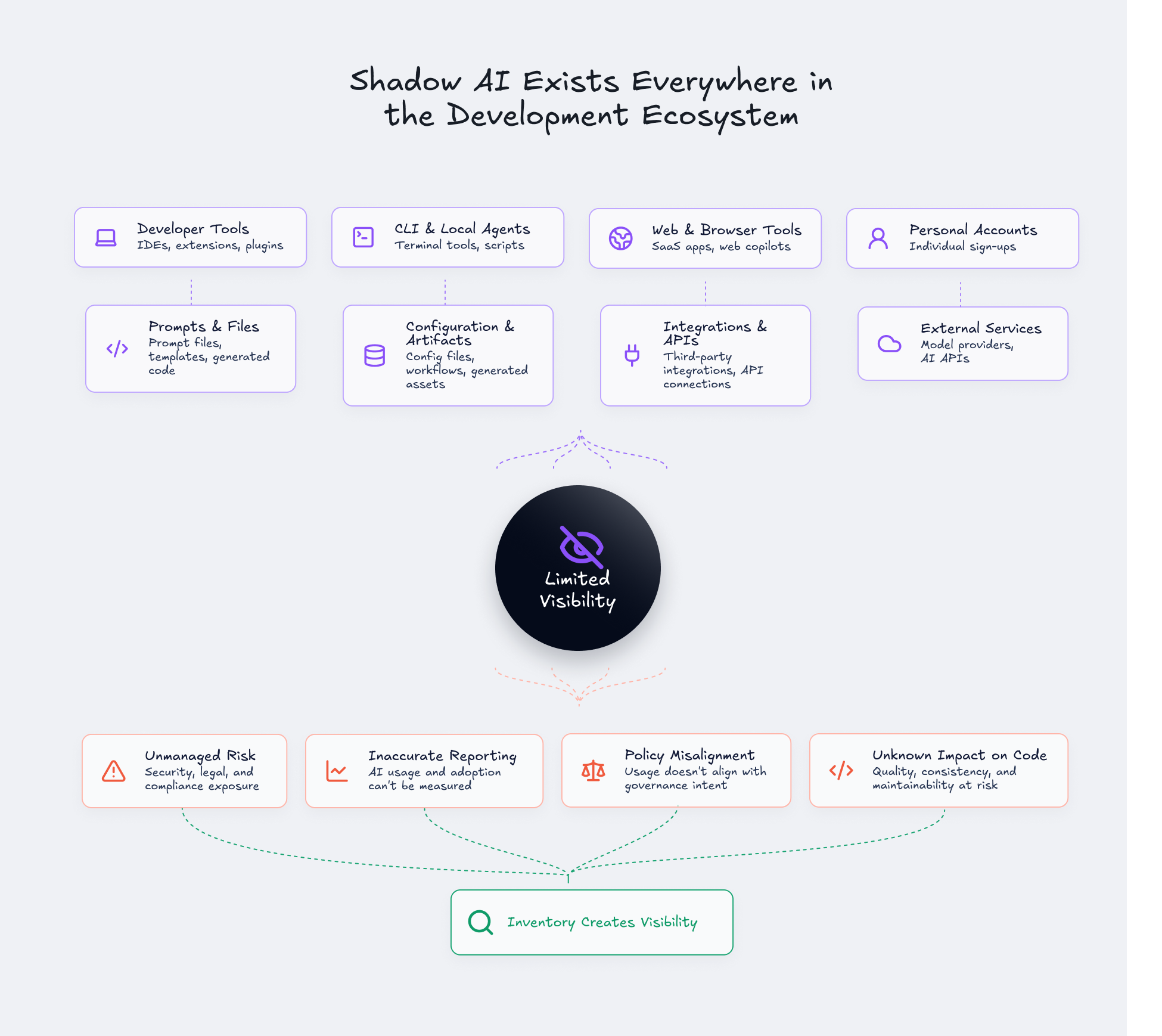
Shadow AI Exists everywhere in the development ecosystem

Common mistakes when tracking AI tool usage

Several patterns undermine AI visibility efforts. Recognizing them early helps avoid wasted effort.

  • Relying only on sanctioned-tool lists: Developers may use personal accounts, local extensions, or CLI tools that never appear in approved lists
  • Treating AI governance as only a legal or procurement issue: In engineering, governance connects to repositories and pull requests
  • Blocking tools without offering approved alternatives: Developers will route around controls if controls slow delivery without reducing risk
  • Measuring adoption only by license count: Licenses show what was bought, not necessarily what influenced code
  • Assuming low incident volume means low risk: Lack of findings may reflect lack of visibility, not absence of exposure

The goal is to create a managed adoption model where leaders know which tools are in use, understand where they appear, define acceptable use by risk level, enforce security and quality checks consistently, and produce evidence for leadership and compliance.

AI adoption has already reached everyday development workflows. The immediate leadership gap is visibility. Leaders cannot credibly report AI adoption or manage AI risk without knowing what is actually being used.

The practical path forward starts with AI inventory across repositories. Use it to align policy, enforcement, and reporting. Then connect it to existing code quality and security controls that already protect the delivery pipeline.

Turn AI adoption into something you can measure

Codacy's AI Inventory provides a repository-level view of AI tools, workflows, and related artifacts, helping engineering leaders track usage, identify policy gaps, and improve visibility across development teams.

Scan your repository for free →