
惯性聚合 高效追踪和阅读你感兴趣的博客、新闻、科技资讯
阅读原文 在惯性聚合中打开

推荐订阅源

TaoSecurity Blog
TaoSecurity Blog
T
Troy Hunt's Blog
cs.AI updates on arXiv.org
Vercel News
Vercel News
T
Threatpost
G
Google Developers Blog
T
Threat Research - Cisco Blogs
Threat Intelligence Blog | Flashpoint
T
The Exploit Database - CXSecurity.com
H
Heimdal Security Blog
Google DeepMind News
Cyberwarzone
Cyberwarzone
T
The Blog of Author Tim Ferriss
Know Your Adversary
Know Your Adversary
Hacker News: Ask HN
Hacker News: Ask HN
www.infosecurity-magazine.com
S
Schneier on Security
B
Blog
V2EX - 技术
V2EX - 技术
NISL@THU
NISL@THU
C
CERT Recently Published Vulnerability Notes
W
WeLiveSecurity
C
Cybersecurity and Infrastructure Security Agency CISA
cs.CV updates on arXiv.org
Y
Y Combinator Blog
K
KPMG report finds enterprise disconnect between AI and its ROI | CIO
Spread Privacy
Spread Privacy
The Last Watchdog
The Last Watchdog
V
Vulnerabilities – Threatpost
N
Netflix TechBlog - Medium
Schneier on Security
F
Fortinet All Blogs
N
News | PayPal Newsroom
Attack and Defense Labs
Blog — PlanetScale
Blog — PlanetScale
OSCHINA 社区最新新闻
OSCHINA 社区最新新闻
Microsoft Security Blog
S
Security @ Cisco Blogs
人人都是产品经理
人人都是产品经理
爱范儿
爱范儿
P
Privacy & Cybersecurity Law Blog
P
Proofpoint News Feed
Project Zero
Project Zero
I
Intezer
罗磊的独立博客
H
Hackread – Cybersecurity News, Data Breaches, AI and More
酷 壳 – CoolShell
酷 壳 – CoolShell
博客园 - Franky
SecWiki News
SecWiki News
Martin Fowler
Martin Fowler

Hacker News: Show HN

PurrrrrFocus: Pomodoro Timer App - App Store Workflow Engine — Multi-Step Orchestration for Bun RapidPhoto: Pro Photo Editor App - App Store GitHub - DheerG/swarms: Achieve extraordinary results with claude code across a variety of tasks SPICE simulation → oscilloscope → verification with Claude Code — Lucas Gerads Show HN: VCoding – A 5 MB native Windows IDE with no dynamic dependencies Show HN: LLMs don't hallucinate because they're bad at math, it's the format GitHub - Agent-FM/agentfm-core: AgentFM is a peer-to-peer network that turns everyday computers into a decentralized AI supercomputer. AgentFM lets you run massive AI workloads directly across a global mesh of idle CPUs and GPUs. Show HN: Tracking Top US Science Olympiad Alumni over Last 25 Years GitHub - Potarix/agent-hub: One place to talk to all your agents Show HN: Runtime security for AI agents(injection,tool abuse, data exfiltration) GitHub - dubeyKartikay/lazyspotify: Terminal Spotify client for macOS and Linux GitHub - the-banana-tool/king-louie: Easy to use GUI Personal AI Assistant. Win/Linux/Mac. Show HN I made my vacation rental bookable by AI agents–no Airbnb, 0% commission GitHub - basteez/jsf-autoreload: maven plugin to enable hot reload on jsf projects uvm32/hosts/host-gdbstub at main · ringtailsoftware/uvm32 GitHub - labsai/EDDI: Config-driven engine that turns JSON into production-grade AI agents. Multi-agent orchestration, 12+ LLM providers, MCP/A2A protocols, RAG, persistent memory, and enterprise compliance (EU AI Act, GDPR, HIPAA). Built on Quarkus. GitHub - glitchnsec/fortyone-oss: AI Executive Assistant Platform Quickstart | Alien GitHub - muxshed/shed: One stream in, or many. Every destination, simultaneously. No cloud middleman, no per-channel fees, no limits. GitHub - ocrbase-hq/ocrbase: 📄 PDF/IMG ->.MD/JSON Document OCR API for PaddleOCR and GLMOCR. Self-hostable. GitHub - impactjo/home-memory: MCP server that lets your AI assistant remember everything about your home. GitHub - Sets88/dbcls: DbCls is a powerful terminal database client that supports various databases GitHub - neptun2000/heor-agent-mcp GitHub - SeanFDZ/macmind: Single-layer transformer in HyperTalk for the classic Macintosh RollQuation: Math Puzzles - Apps on Google Play GitHub - dropbox/witchcraft Show HN: Agent-cache – Multi-tier LLM/tool/session caching for Valkey and Redis GitHub - opentalon/opentalon: OpenTalon is an open-source platform built from the ground up in Go as a robust alternative to OpenClaw LinkedIn™ 职位抓取工具 - Chrome 应用商店 GitHub - EdoardoBambini/Agent-Armor-Iaga: AI agents are getting tool access — shell, file system, databases, APIs, secrets. But **nobody is governing what they actually do with it**. Frameworks like LangChain, CrewAI, AutoGen, and Claude Code give agents the power to execute. Agent Armor gives you the power to control, audit, and approve every single action before it happens. HN Vibes — Week 15, Apr 7–13 2026 GitHub - chojs23/ec: Easy terminal-native 3-way git mergetool vim-like workflow GitHub - SethPyle376/hiraeth: Local AWS emulator focused on fast integration testing, with SQS support, SQLite-backed state, and a debug-friendly web UI. GitHub - JakOb-dotcom/cloud-sandbox-security-analysis: Technical analysis and Proof of Concept (PoC) regarding environment variable exfiltration in containerized cloud sandboxes via side-channel data leaks. Springboards - Flint Alpha Show HN: A simpler coding agent harness GitHub - audiodude/sudomake-friends GitHub - 256thFission/mini-mythos: OSS clone of Anthropic’s Mythos harness to locate C/C++ memory vulnerabilities Show HN: OpenParallax: OS-level privilege separation for AI agent execution Hacker News Sorted - Chrome 应用商店 Show HN: How to Install Docker on Ubuntu 24.04 LTS: Complete 2026 Guide GitHub - himanshudongre/smriti GitHub - sverrirsig/claude-control: macOS desktop dashboard for monitoring and managing multiple Claude Code sessions GitHub - ory/dockertest: Write better integration tests! Dockertest helps you boot up ephermal docker images for your Go tests with minimal work. Chiral - Chrome 应用商店 Show HN: Two Claudes collaborating through shared memory on a $100 mini-PC GitHub - pmichaillat/latex-cv: Minimalist LaTeX template for academic CVs GitHub - oguzbilgic/posse: A web UI for Anthropic Managed Agents. GitHub - sshiraz/depsly: Dependency risk analysis tool for npm packages ABI Add safari/agent-harness — Safari browser automation via safari-mcp by achiya-automation · Pull Request #212 · HKUDS/CLI-Anything GitHub - Halfblood-Prince/trustcheck: Verify PyPI package attestations and improve Python supply-chain security GitHub - oguzbilgic/kern-ai: Agents that do the work and show it. GitHub - bruits/satteri: High-performance Markdown and MDX processing for the JavaScript ecosystem GitHub - tylergibbs1/feedstock: High-performance web crawler and scraper for TypeScript, powered by Bun and Playwright GitHub - Grimm67123/grimmbot: The self-improving sandboxed and open-source AI agent. With persistent memory and scheduling. GitHub - whitevanillaskies/whitebloom: Local whiteboard that blooms. GitHub - hwdsl2/docker-whisper: Docker image for a self-hosted Whisper speech-to-text server with speaker diarization and OpenAI-compatible transcription and translation APIs. Powered by faster-whisper. Supports all Whisper models, NVIDIA GPU (CUDA) acceleration, JSON/SRT/VTT output, SSE streaming, offline mode, and multi-arch (amd64, arm64). GitHub - yisding/reviewwiggum GitHub - MarwanAlsoltany/serrors: Structured errors for Go: sentinel hierarchies, typed data, custom formatting, and slog integration. GitHub - soatok/age-php GitHub - Luthiraa/markitme GitHub - stagas/rtdiff: realtime git diff gui and AI-assisted commits GitHub - tombedor/excalicharts GitHub - wh1le/excalidraw-edit: Open and edit .excalidraw files from the terminal. Offline, auto-saves to disk. MalExt Sentry - Malicious Extension Scanner - Chrome 应用商店 GitHub - syi0808/asciianimesvg: Generate animated ASCII art SVGs from text. CLI, Rust library, WASM, and web editor. GitHub - zaina-ml/ml_forge: A visual-based graph node editor for training computer vision models. GitHub - anakin87/llm-rl-environments-lil-course: 🌱 A little course on Reinforcement Learning Environments for evaluating and training Language Models GitHub - takaakit/superpowers-uml: Superpowers-UML modifies Superpowers to ensure a software development workflow in which AI agents design through UML modeling. AdriByte Studio - Sviluppo Web e Soluzioni Digitali GitHub - chouligi/angel-copilot: Your personalized Angel Investment Advisor Show HN: MoodSense AI (ML and FastAPI and Gradio, Deployed on Hugging Face) Moodsense Ai - a Hugging Face Space by aman179102 GitHub - agenteractai/lodmem: Level Of Detail Context Management for Agents GitHub - ostefani/subnetlens: A fast, concurrent network scanner with a TUI and plain-text CLI, built in Go. It discovers live hosts on your network, scans their open ports, resolves hostnames, and fingerprints operating systems—delivered. Cyber Pulse: Agentic Intel - Apps on Google Play Whisper API: Self-Hostable Speech to Text Transcription The Agent-Web Protocol Stack: A Research Thesis GitHub - msmarkgu/RelayFreeLLM: A restful API designed to route user prompts to various AI model providers. Show HN: Provepy – A Python decorator that proves your code using Lean and LLMs Show HN: Pardonned.com – A searchable database of US Pardons GitHub - patrickdappollonio/dux: Dux is a terminal UI that lets you run multiple AI coding agents side by side, each in its own git worktree, with full companion terminals, macros, commit generation, and a command palette that knows more tricks than you do. kMC Crystal Simulator Show HN: HyperFlow – A self-improving agent framework built on LangGraph GitHub - stef41/vibescore: 🎵 Grade your vibe-coded project. One command, instant letter grade across security, quality, dependencies, and testing. GitHub - stef41/lmscan: 🔍 Detect AI-generated text and fingerprint which LLM wrote it. Open-source GPTZero alternative. Zero dependencies, works offline. imgur.com GitHub - visionscaper/collabmem: Enabling long-term collaboration with Agentic AI - building up episodic and world model memory over time with in-context awareness 在 Steam 上购买 FriedrichAI: Offline AI 立省 10% GitHub - atripati/ark: AI Runtime Kernel — a context operating system for AI agents. Eliminates tool bloat, loads only what’s needed, and gives LLMs their reasoning space back. GitHub - nowork-studio/toprank: Open-source Claude Code skills for SEO, SEM, Google Ads GitHub - tacomanator/sash: Lightweight macOS menu bar app for reliably cycling through windows of the current application. Appents | Social Media Management for Product-First Teams GitHub - pnhoang/youtube-spam-blocker: Automatically detects and hides spam messages in YouTube Live chat. Set rate limits, keyword filters, and block repeat offenders. GitHub - decisionnode/DecisionNode: CLI + Local MCP - A shared structured memory store across Claude Code, Cursor, Windsurf, Antigravity, and every MCP client. Semantically queryable. GitHub - AvaCodeSolutions/django-email-learning: An open source Django app for creating email-based learning platforms with IMAP integration and React frontend components. The $100K Gap in Kubernetes Security Tooling Function Calling Harness: From 6.75% to 100%
Running Is The Hardest Endurance Sport? Not so Fast
kyriakosel · 2026-04-23 · via Hacker News: Show HN

Terra

Chevron pointing leftAll articles

Endurance Training

  • Running really is the hardest sport per minute — highest session average, highest peak, highest sustained intensity ratio. No matter how you cut the data, nothing else comes close minute for minute.
  • Walking's "high" intensity ratio is a statistical illusion — on paper it ranks just behind running. But it comes from flat, low-amplitude sessions with low average and low peak HR. A steady stroll produces the same ratio as a hard effort, without any of the effort.
  • Downhill skiing is all peaks and troughs — peak HR rivals outdoor cycling, but average HR sits near walking. That 47 bpm gap is the signature of a stop-and-go sport: short bursts, long lifts, and a lot of standing around in the cold.

Get the latest Terra Research reports

I've had this debate a thousand times. In changing rooms, on training camps, at race briefings, what is the hardest endurance sport? And the honest answer is that "hard" means different things depending on who's asking.

Psychologically hard, as in hard to motivate yourself to do? For me, that's swimming. Always has been. Staring at a black line for hours requires a kind of mental stubbornness that I find harder than any run. High risk? Maybe skiing, where a moment's lapse can end your season. Hard to master technically? Cycling in a peloton, open water swimming in a pack, cross-country skiing on a frozen track. It’s probably very individual.

But hard physiologically, as in, which sport pushes the cardiovascular system the hardest during a typical session? That's a question I thought I could try to answer with data.

The dataset comprised of thousands of European athletes across nine activity types. Every sport leaves a different cardiovascular fingerprint. And some of what we found contradicts the obvious.

Every sport has a heart rate fingerprint
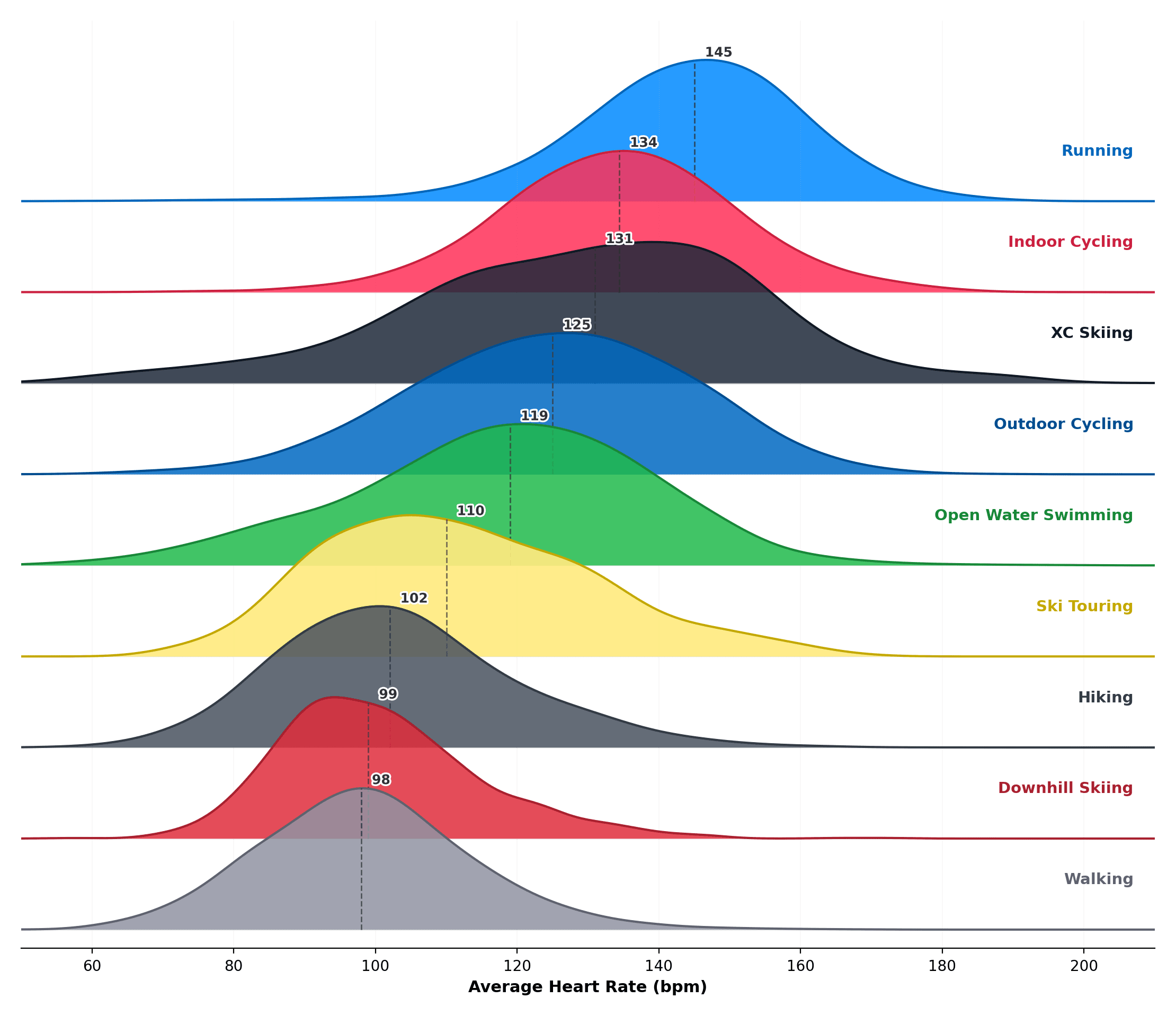
chart1_hr_ridge (1).png
Figure 1:  HR Distribution Ridge Plot. Each distribution is normalized to its own peak to compare shapes across modalities. Dashed lines indicate the median. Running is the most concentrated and furthest to the right; ski touring and hiking are more spread out, highlighting variable session intensity.

When we plot the distribution of session average heart rate for each modality, the shapes are immediately distinct. Running produces a tight, right-shifted bell centered at 145 bpm; people run at a consistently high heart rate with little session-to-session variation. Outdoor cycling is relatively broad and flat, reflecting the reality that a commute, a cafe ride, and a race all count as "cycling." My recent favorite activity, Ski touring, spreads widely of all, probably because there's plenty of down hills in the data. Walking is wide but sits furthest left. Downhill skiing, for most, is not a particularly arduous cardio activity.

The shape of the distribution tells you more about the nature of a sport than any single summary statistic.

Three intensity tiers — and the groupings aren't obvious

Median session average heart rate clusters into three distinct bands:

TierModalitiesMedian Avg HR
HighRunning, Indoor Cycling, XC Skiing131–145 bpm
ModerateOutdoor Cycling, Ski Touring, Open Water Swimming119–129 bpm
LowWalking, Downhill Skiing, Hiking98–102 bpm

The surprise is not that running tops the list. For me, it's the discrepancy between indoor cycling and outdoor cycling drops (a full 9 bpm). The turbo trainer eliminates coasting, traffic lights, descents, and for many people, the joy of riding for fun — the things that suppress average HR outdoors. I explored this indoor-outdoor divergence in detail in our previous post.

Running's high intensity is genuine, not an artefact

A high average on its own doesn’t necessarily tell us very much. Maybe even one who runs has a very high Max HR, it’s a population of fitter people, not a harder exercise? So I calculate the intensity ratio, the session average as a fraction of the session peak. Running’s highest ratio of 87.5% could mean two things: the average is genuinely high, or the peak is suppressed. This matters because the metric alone can't tell you which.

The scatter plot resolves it. Running occupies the top-right quadrant: both the highest average HR (145 bpm) and the highest peak HR (166 bpm) of any modality. There is no ambiguity. Runners hold a high heart rate throughout and push to the highest peaks. The 87.5% ratio reflects genuine sustained output.
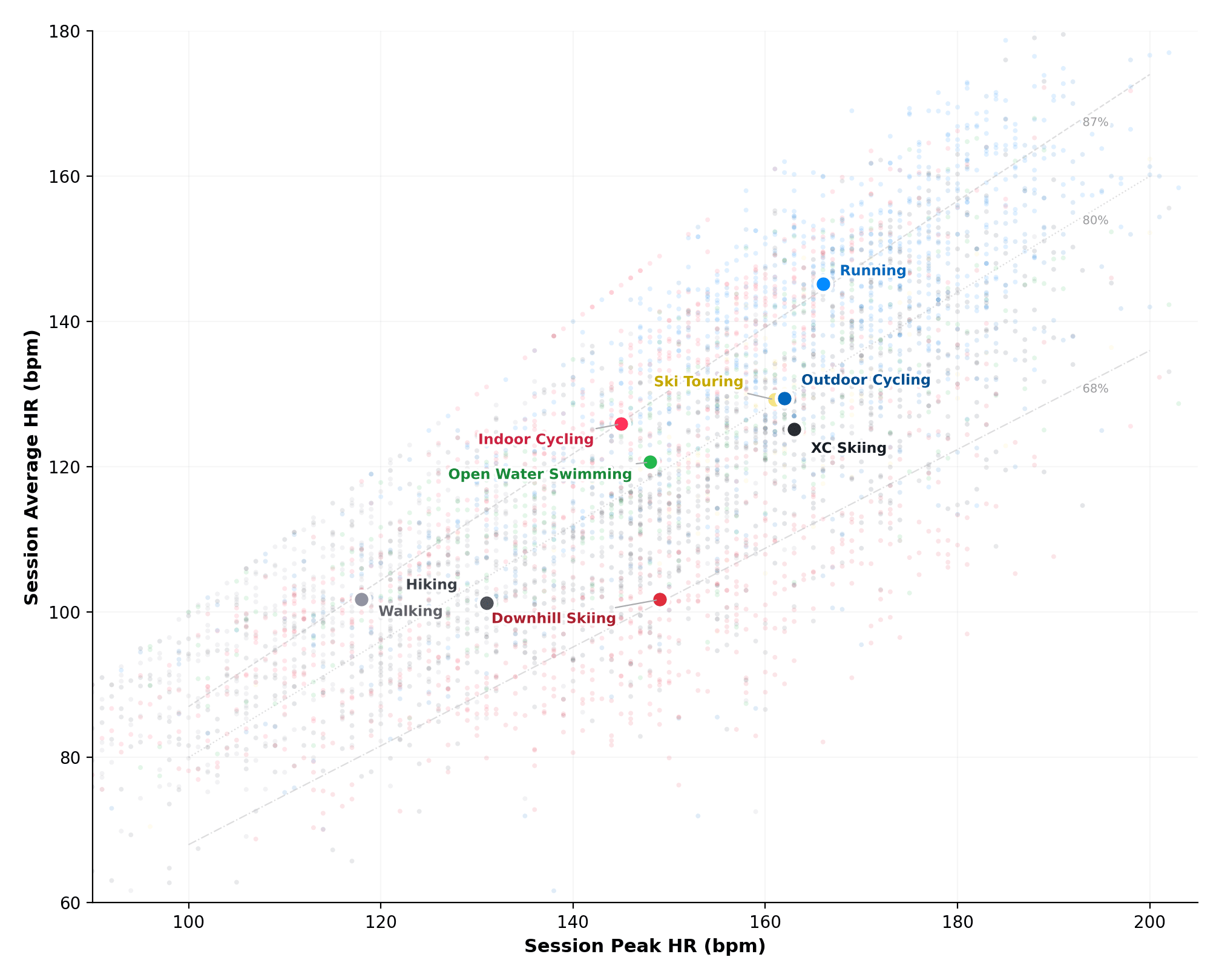
chart2_avg_vs_peak (1).png
Figure 2: Average HR vs Peak HR Scatter. Running occupies the top-right quadrant: both the highest average and highest peak HR, confirming genuine sustained high output. Walking clusters bottom-left — its high ratio (86%) reflects a flat, low-amplitude session rather than true intensity.

Walking's 86% ratio is a statistical illusion

Walking ranks third in sustained intensity at 86.3%, just behind running and indoor cycling. On paper, that looks like genuine sustained effort. But the scatter tells the real story: walking clusters in the bottom-left, with both low average (98 bpm) and low peak (118 bpm). Its "high" ratio is simply the absence of intensity variation. A flat, low-amplitude session where heart rate never really goes anywhere produces a ratio that mimics hard exercise.

Downhill skiing has the biggest within-session swings

At 68.3%, downhill skiing has the lowest sustained intensity ratio by far. The decomposition shows exactly why. Its median peak HR (149 bpm) rivals outdoor cycling, but its median average (102 bpm) is on par with walking and hiking. That 47 bpm gap is the heart rate signature of a stop-and-go sport: explosive effort on the piste, then lifts, queues, and standing in the cold. Or maybe it’s just blind terror, I get some pretty wild heart rates on gnarly descents.
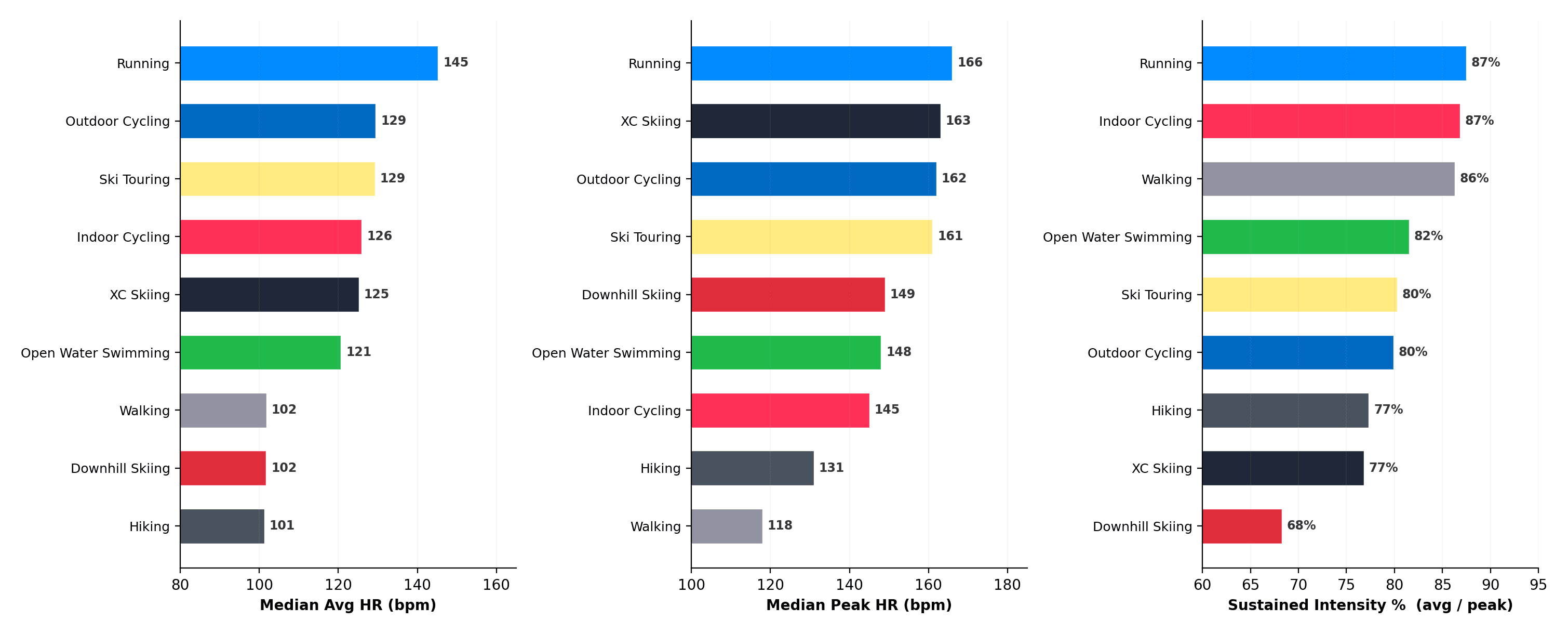
chart3_decomposition.png
Figure 3: Sustained Intensity Decomposition (3-panel bars). The ranking shifts between panels reveal the mechanism. XC skiing and outdoor cycling rank top-3 in peak HR but drop sharply in sustained intensity — high peaks with long low-HR recovery phases. Running leads in both average and ratio.

XC skiing peaks like running but sustains like cycling

Cross-country skiing yields the joint-highest median peak HR in the dataset, 163 bpm, virtually tied with running at 166 bpm. Yet its sustained intensity ratio is only 76.8%, seventh out of nine. The mechanism is clear from the decomposition: XC skiing involves explosive hill efforts that spike heart rate to near-maximum, separated by long gliding recovery phases that pull the average down.

This shows up strikingly in the three-panel decomposition, where the ranking reshuffles completely across metrics. XC Skiing jumps from 5th in average HR to 2nd in peak. Indoor Cycling leaps from 8th in peak to 2nd in sustained ratio. The ranking shifts reveal the underlying mechanism, whether a sport's character comes from high sustained effort, high peaks, or the gap between the two.

Indoor cycling is the purest sustained effort after running

Indoor cycling's sustained intensity ratio (86.8%) sits just 0.7 percentage points behind running. That makes sense: both are continuous, self-paced activities with no coasting and no external interruptions. What separates them is the absolute level, indoor cycling's median average HR (134 bpm) is 11 bpm lower than running's. The cardiovascular demand of weight-bearing locomotion at a running pace simply exceeds that of seated cycling at a typical indoor effort, even when the relative intensity profiles are nearly identical.

Within the same person, running still wins

Everything up to this point could be explained away by population differences; maybe runners are simply fitter, or more motivated, or younger. So I ran the analysis that controls for all of that: within-person comparison.

I identified 2,808 multi-sport users who logged at least five sessions in two or more modalities. For each person, we used their highest-ever recorded heart rate as their personal Max HR, then expressed each session's average HR as a percentage of that ceiling. The result is unambiguous. The same individuals who run at a median 78% of their personal Max HR cycle outdoors at just 63%, and walk at 51%. Among the 1,480 users who both run and cycle outdoors, 93% have a higher relative intensity when running, a median gap of 10 percentage points. It's not that runners are fitter than cyclists, it's that running, as a biomechanics act, demands more of the cardiovascular system than cycling does, even in the same body.

I also tested this using the 95th percentile of each user's peak HR rather than the absolute maximum, to exclude potential sensor artefacts. The ranking and gaps were identical.
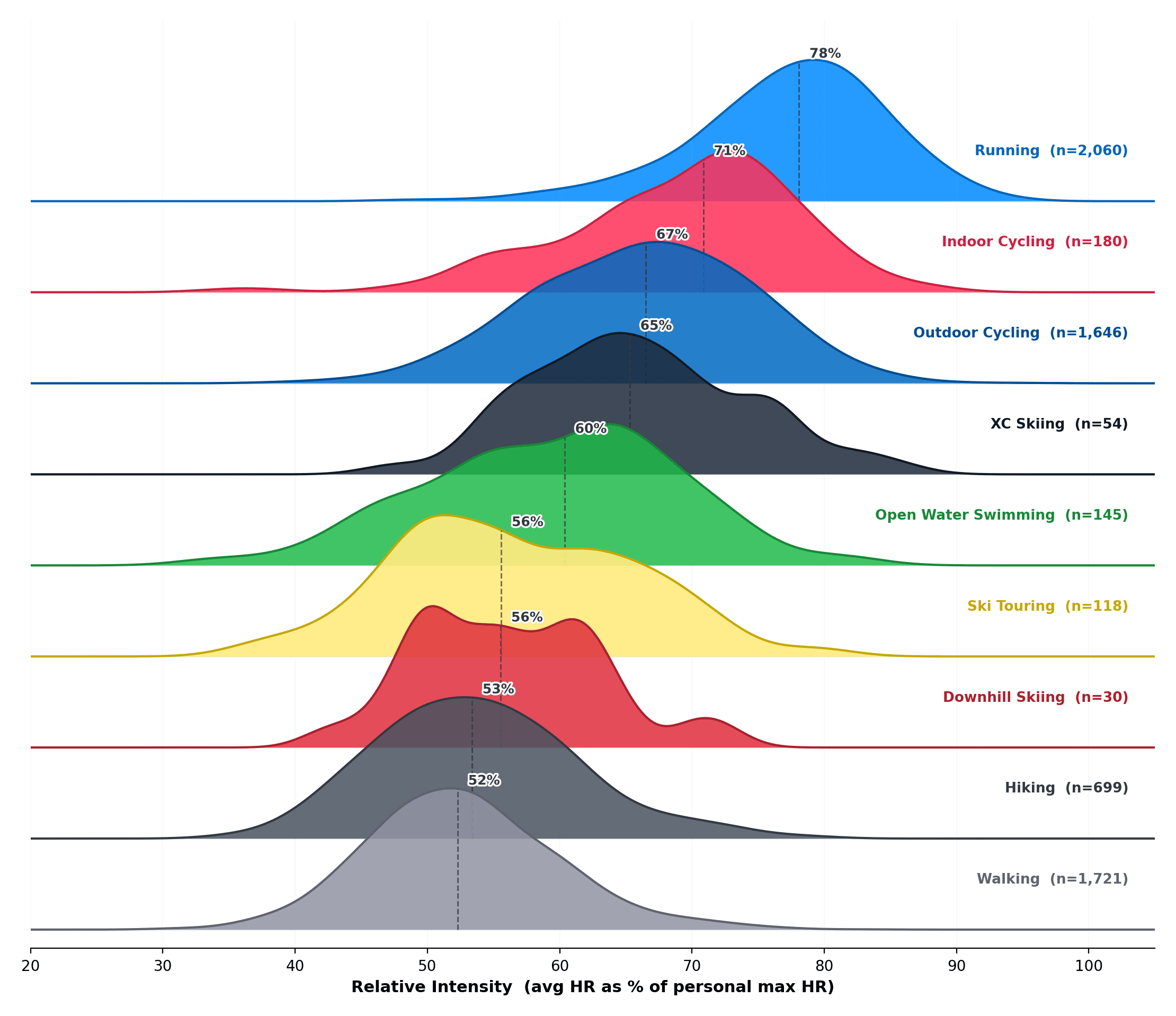
chart6_within_person_ri.png
Figure 4: Within-Person Relative Intensity Ridge. Each user's session average HR is expressed as a percentage of their highest ever recorded heart rate. Even controlling for individual fitness, running sits highest — 93% of runner-cyclists train harder when they run.

But running is mostly shorter — and that changes the picture

I can already hear people screaming: But running sessions are shorter. Fair point. The median run in this dataset lasts 41 minutes. The median outdoor cycle lasts 64. A hike: 115. Downhill skiing: 129. Running may be the most intense sport per minute, but is it the hardest session overall?

To answer that, we multiplied each session's relative intensity by its duration to create "intensity-minutes" — a single metric that captures total cardiovascular load. A 40-minute run at 78% of max yields 31 intensity minutes. A 64-minute cycle at 67% produces 42.

The rankings flip. Downhill skiing — the least intense per minute — tops the chart at 71 intensity-minutes because sessions last over two hours. Hiking (61) and XC skiing (52) also overtake running (31). Among the 1,480 runner-cyclists, only 39% accumulate more intensity minutes when running than when cycling.
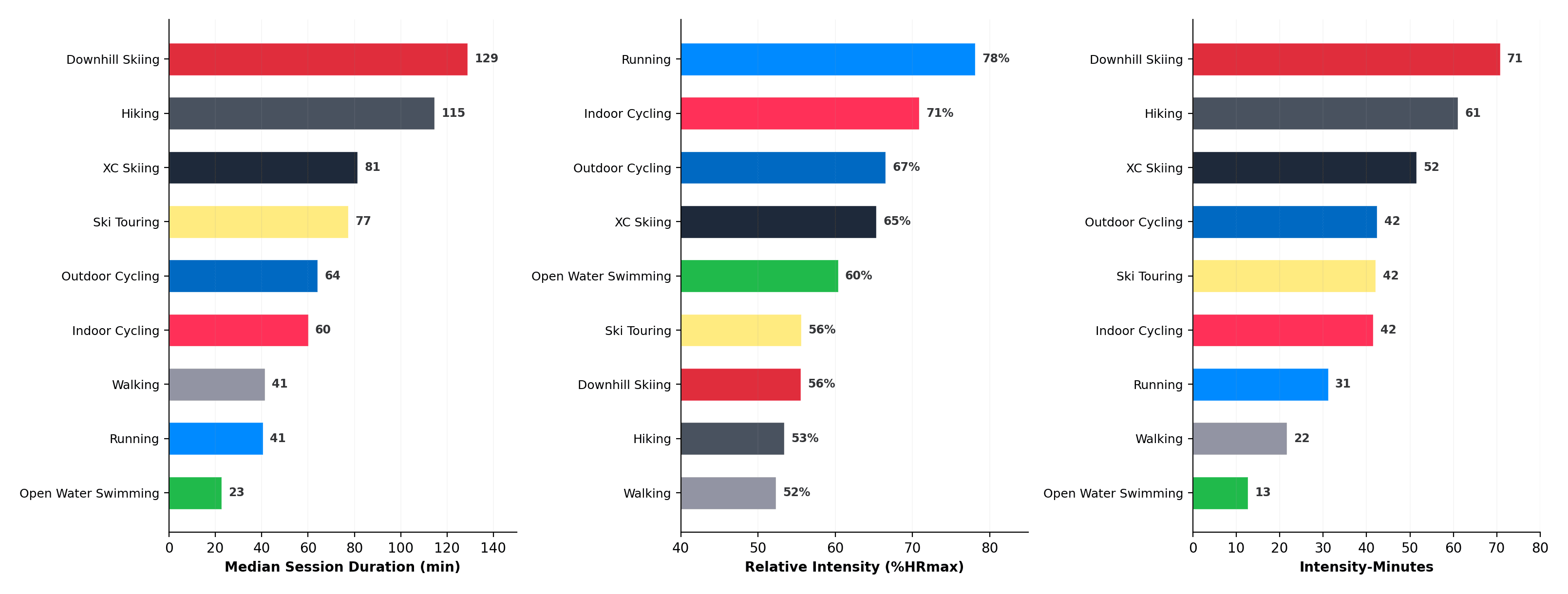
chart7_time_weighted.png
Figure 5: Time-Weighted Intensity (3-panel bars). Running is the most intense sport per minute (B), but shorter sessions mean its total cardiovascular load per session is lower than outdoor cycling, XC skiing, or hiking (C). Intensity-minutes = relative intensity × duration.

So which framing is right? That depends on how you think about intensity, and this is a problem we deal with every day at Terra when building physiological scores.

Intensity isn't linear, and the weighting method changes the answer

Here's the issue with a straight duration × intensity calculation: it treats every beat per minute equally. But going from 110 to 120 bpm is not the same physiological event as going from 160 to 170. Above the lactate threshold, the metabolic cost of exercise rises exponentially, oxygen consumption drifts upward, lactate accumulates faster, and recovery cost per minute increases sharply. A linear model ignores all of this.

So I tested four weighting approaches:

  • Linear — duration × relative intensity. The naive model.
  • Exponential — duration × intensity². Squares the intensity term so high HR contributes disproportionately.
  • TRIMP (Banister, 1991). The academic standard. Uses an exponential function calibrated against blood lactate data: load = duration × HRR × 0.64e^(1.92 × HRR). I estimated resting HR at 60 bpm when individual data weren't available.
  • Zone-weighted - Assigns escalating multipliers by HR zone (1× below 60%, up to 5.5× above 90%). The consumer-platform approach.

The results are dramatic. Under the linear model, running ranks 7th, duration dominates, and cycling, hiking, and skiing all produce more total load. Apply the exponential weighting, and it climbs to the 6th. But under TRIMP, running jumps to 2nd, behind only XC skiing.
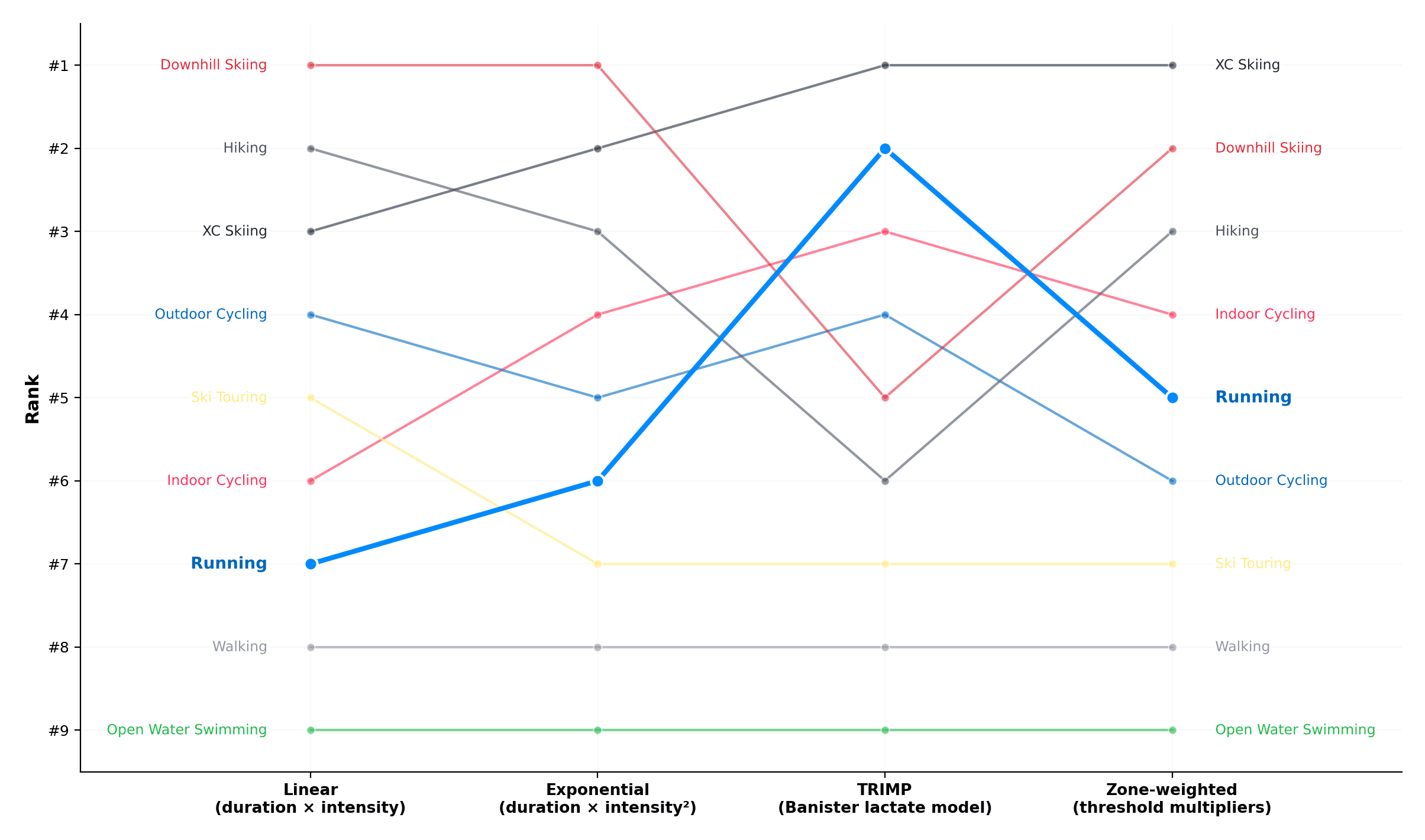
chart8_weighting_bump.png
Figure 6: Weighting Method Bump Chart. How you weight intensity changes the answer. Under a linear model, running ranks 7th — duration dominates. Apply the exponential weighting derived from blood lactate data (TRIMP), and running climbs to 2nd, behind only XC skiing.

In the paired runner-cyclist comparison, TRIMP is the only model where running edges ahead (53% of users, median delta +5). The linear model has cycling winning in 61% of users. The exponential narrows the gap to 56-44. TRIMP tips it. The reason is straightforward: running spends more time at high fractions of heart rate reserve, where the TRIMP exponential term amplifies the load. A runner at 78% of HRmax for 41 minutes generates more TRIMP than a cyclist at 63% for 64 minutes, because the exponential penalizes moderate intensity less than it rewards high intensity.

A caveat: TRIMP is designed to be calculated from the full heart rate time series by summing the exponential weighting at every second, not by applying it to a session average. We don't have second-by-second HR in this dataset, only session summaries. Averaging the heart rate before applying the exponential smooths out the spikes, which means I’m likely understating the load for variable sports like XC skiing and outdoor cycling (where those high-HR bursts would contribute disproportionately) and possibly overstating it for steady-state efforts like running. But in data science, you work with the information you have, and the direction of travel across four different models is consistent enough to draw conclusions.

This is exactly the kind of problem we think about at Terra when building training load scores. The model you choose isn't just a technical detail, it determines what the data tells you.

Where our data falls short

We should be transparent about what this analysis cannot tell you. We have no demographic information — no age, sex, or fitness level — so we can't separate these effects from sport selection. We don't know training intent (easy run vs tempo session), which means our distributions blend structured training with casual activity. And the HR data comes from wrist-worn devices, which are less accurate than chest straps, particularly during activities with significant arm movement like swimming and skiing.

References

1.⁠ ⁠Banister EW, Calvert TW. Planning for future performance: implications for long term training. Can J Appl Sport Sci. 1980;5(3):170–176. https://pubmed.ncbi.nlm.nih.gov/6778623/

2.⁠ ⁠Kreider RB, Cundiff DE, Hammett JB, Cortes CW, Williams KW, Hill DW, et al. Physiological responses of triathletes to maximal swimming, cycling and running. J Sports Sci. 1986;4(2):155–163. https://pubmed.ncbi.nlm.nih.gov/3821455/

3.⁠ ⁠Solli GS, Tønnessen E, Sandbakk Ø. Training load quantification in elite swimmers using a modified version of the training impulse method. Int J Sports Physiol Perform. 2017;12(3):373–381. https://pubmed.ncbi.nlm.nih.gov/24942164/

4.⁠ ⁠Wallace LK, Slattery KM, Impellizzeri FM, Coutts AJ. Establishing the criterion validity and reliability of common methods for quantifying training load. J Strength Cond Res. 2014;28(8):2330–2337. https://pubmed.ncbi.nlm.nih.gov/24662229/

5.⁠ ⁠La Gerche A, Heidbuchel H. Endurance sport and cardiovascular health: can too much exercise damage the heart? Heart. 2014;100(16):1227–1234. https://pmc.ncbi.nlm.nih.gov/articles/PMC4535361/

Cookie Preferences

Essential CookiesAlways On

Advertisement Cookies

Analytics Cookies

Crunch Time: Embrace the Cookie Monster Within!

We use cookies to enhance your browsing experience and analyse our traffic. By clicking “Accept All”, you consent to our use of cookies according to our Cookie Policy. You can change your mind any time by visiting out cookie policy.