








Durable, AI-ready engineering memory for your repository — and a deterministic doctor that
proves it stays healthy.
Persist OS is a local-first CLI that turns a repository into the source of truth for why it is
built the way it is. It creates structured, reviewable memory — product intent, architecture
decisions, module ownership, testing and security expectations, AI agent rules — and then
validates that memory with persist doctor. Architecture-neutral. No network, no telemetry, no
code generation.
Website · Install · Quickstart · Commands · What Doctor Checks · Presets · Why I built this · Contributing

AI can write code fast, but its context is temporary — it forgets decisions, compacts conversations, and drifts from earlier intent. Git records what changed. Persist OS records why, in a form humans and agents can re-read and validate before and after work.
What are we building?   Why did we decide this?
What must not drift?    What evidence proves this work is complete?
When these questions live in the repository instead of a chat window, the repository can answer them.
Not a vector memory engine. Tools like supermemory or mem0 retrieve information with embeddings; Persist OS writes the decisions themselves — reviewable files, not vectors — and checks they stay consistent. They're complementary, not competitors. → Why I built this
Why Persist OS
- Memory that outlives the conversation. Decisions, constraints, and ownership are committed to the repo, not trapped in an agent's context window.
- A gate, not just docs.
persist doctoris deterministic and returns an exit code, so "is this work actually finished and consistent?" becomes a check you can run in a hook or CI. - Decisions change safely. When a decision changes,
persist adr supersederecords it (the old ADR is marked superseded, the new one links back) and Doctor flags any memory still citing the old one — so the trail stays auditable instead of silently contradicted. The generated agent rules even carry the CLI commands inline, so your AI tool uses them itself. - Fights context rot. Doctor warns when the always-loaded memory bloats into a wall of text, or
when it still points at
src/code that changed long after the memory did — so memory stays a lean, current map, not a stale dump. - Reuse over reinvent. Generated
CONVENTIONS.md(your canonical, reusable vocabulary) andLESSONS.md(durable pitfalls) load into every agent session, and the agent is told to keep them current itself — so it reuses your components and patterns instead of reinventing them, and stops repeating mistakes you already solved. It works even on vibe-coded projects, because the agent maintains the memory, not you. - Architecture-neutral by design. Persist OS records and protects your decisions. It never silently picks a framework, database, or pattern for you.
- Local-first and private. No network calls, no telemetry, no AI API calls, no remote templates. It runs entirely on your machine.
- Safe by default. Non-destructive writes, path-traversal and symlink protection, and a refusal to overwrite an existing installation without explicit intent.
Install
Run it without installing — the quickest way to try it:
npx persist-os@latest init
Every command works the same way: npx persist-os <command> (e.g. npx persist-os doctor).
Or install the CLI globally:
npm install -g persist-os
persist --help
(Requires Node.js >= 20. Published at npmjs.com/package/persist-os.)
Quickstart
# 1. Create repository memory (architecture-neutral, or pick an opinion pack)
persist init
persist init --preset kotlin-android   # optional, proposes stack decisions

# 2. Capture intent and decisions as you work
persist feature create checkout
persist adr create payment-provider
persist adr accept payment-provider    # promote a proposal to accepted memory

# 3. Bring an MCP server's context into durable memory (offline)
persist mcp add figma

# 4. Validate the memory is healthy and complete
persist doctor
Every command guides you — it names the file it created, where it is, and what to do next.
Generate files only for the AI tools you use: persist init --ai-tools claude,cursor (default: all
of claude, codex, cursor; AGENTS.md is always written).
persist init also generates tracked pre-commit and pre-push hooks in .persist/hooks/ that
run persist doctor plus any gates you configure. The pre-push hook is the final regression gate
before code leaves your machine (it catches commits made with --no-verify or before the hook was
active). Enable them once per clone — Persist OS proposes the command but never runs it for you:
git config core.hooksPath .persist/hooks
Commands
| Command | Purpose |
|---|---|
persist init |
Create neutral repository memory (and a pre-commit hook). |
persist init --preset <id> |
Add an opinion pack: rich guidance and proposed ADRs. |
persist init --ai-tools <list> |
Generate files only for the AI tools you use (claude, codex, cursor, generic). |
persist adopt |
Inspect an existing repo and propose reviewable memory. |
persist preset list |
List built-in presets. |
persist feature create <name> |
Scaffold feature memory (PRD, acceptance, tests, review). |
persist adr create <title> |
Create a proposed architecture decision record. |
persist adr accept <name> |
Promote a proposed ADR to accepted source-of-truth. |
persist adr supersede <old> <new> |
Record a changed decision: mark the old ADR superseded by a new accepted ADR. |
persist module create <name> |
Scaffold module memory (ownership, boundaries, tests). |
persist skill create <name> |
Generate a portable AI agent skill (Claude + Agent Skills). |
persist skill list |
List the built-in agent skill catalog. |
persist mcp add <server> |
Generate offline, proposed memory for an MCP server. |
persist doctor |
Validate memory health, evidence, and drift. |
persist guard --source <dirs> |
Fail when staged source changed without tests (add to your gates to enforce). |
What Doctor Checks
persist doctor is the part that makes Persist OS more than a template. Every check is
deterministic, local, and read-only.
| Category | Detects | Severity |
|---|---|---|
| Structure | Missing config, required docs, or feature / module / ADR sections | error |
| Completion evidence | A feature marked complete with review pending or no test / result evidence | error |
| ADR quality | An accepted ADR with no meaningful consequences | error / warn |
| Security | A security-sensitive feature with no documented security impact | error / warn |
| Drift | Memory that references a missing, or not-yet-accepted, ADR | error / warn |
| Superseded | Memory still citing a decision that has been superseded by a newer ADR | warning |
| Staleness | Memory citing src/ code that changed long after the memory did (git-based; off-git skips) |
warning |
| Context budget | The always-loaded agent files (CLAUDE.md + AGENTS.md + Cursor rule) grown past a budget | warning |
| Content | A feature PRD, module, or (once work exists) the threat / security model left as a stub | warning |
| Conventions | The canonical-vocabulary doc left as a stub once the repository has real work | warning |
Exit codes: 0 = healthy 1 = warnings only 2 = errors
Because it returns an exit code, Doctor drops straight into the completion loop:
pnpm test:run && pnpm typecheck && persist doctor
Use it locally via the generated pre-commit hook, or add persist doctor as a step in CI.
Presets
Presets are opinion packs. They ship proposed guidance and proposed ADRs for a stack's real
decision forks — and they can never silently accept a choice for you (the schema enforces Proposed
status on every preset decision).
| Preset | Stack | Proposes (always as proposed ADRs) |
|---|---|---|
laravel-react |
Laravel + React | Laravel, Inertia + React, Eloquent, Sanctum, Form Requests + Policies, queues, Pest |
laravel-vue |
Laravel + Vue | Laravel, Inertia + Vue, Eloquent, Sanctum, Form Requests + Policies, queues, Pest |
laravel-api |
Laravel (API) | Laravel, versioned REST + API Resources, Eloquent, Sanctum, queues, Pest |
kotlin-android |
Kotlin / Android | Compose, Coroutines + Flow, Hilt, Room, MVVM |
python-fastapi |
Python / FastAPI | FastAPI, PostgreSQL + SQLAlchemy, Pydantic, pytest, Redis |
ios-swift |
iOS / Swift | SwiftUI, async/await + Observation, SwiftData, MVVM |
nextjs |
Next.js / TS | App Router, typed data layer, Tailwind, Vitest + Playwright |
flutter |
Flutter | Platform and state-management guidance |
generic |
none | Architecture-neutral memory |
Adding a preset is a small contribution — see CONTRIBUTING.md.
How It Works
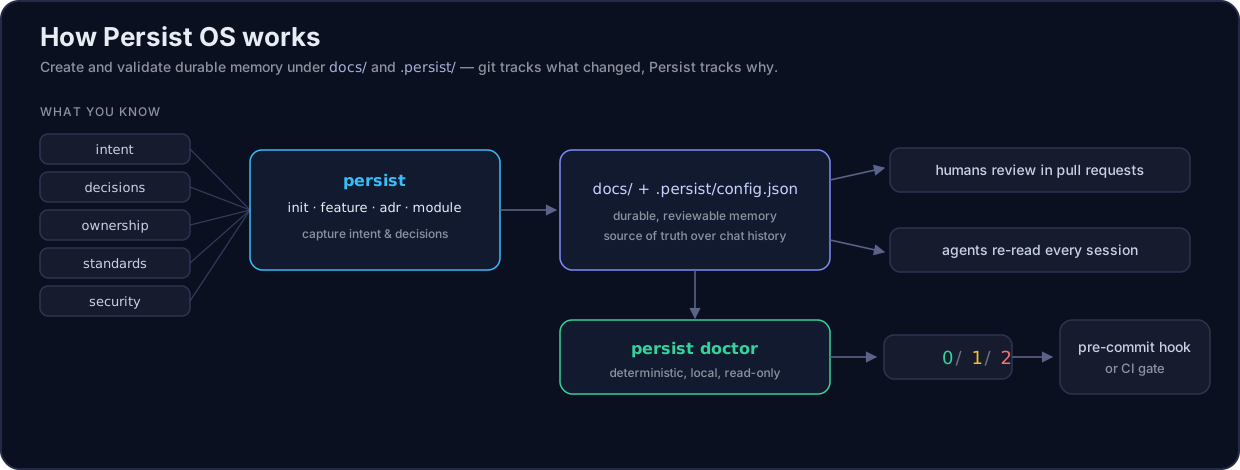
How agents load the memory
Writing memory only helps if the agent reads it, so persist init wires each tool with its own
native mechanism:
| Tool | How memory loads |
|---|---|
| Claude Code | CLAUDE.md (auto) imports AGENTS.md; a SessionStart hook injects a live map of accepted ADRs and modules every session. |
| Cursor | .cursor/rules/persist-memory.mdc is an always-apply rule that loads the memory rules into every request. |
| Codex | AGENTS.md is auto-discovered and loaded. |
The portable guarantee across every tool is AGENTS.md plus the generated Agent Skills
(.agents/skills/). The dynamic per-session ADR/module map is a Claude Code bonus; the Cursor rule
and AGENTS.md carry the same rules everywhere else.
AGENTS.md leads with a short, imperative Rules block (read memory first, reuse the
conventions, record lessons, don't contradict accepted ADRs, run persist doctor before "done") —
and instructs the agent to keep CONVENTIONS.md and LESSONS.md current itself, so that memory
stays useful without anyone hand-writing it. The human just reviews the agent's edits in the pull
request.
Repository Memory
Persist OS creates a memory structure under docs/ and .persist/config.json, with an explicit
source-of-truth order:
1. Accepted ADRs and repository decisions     6. Module docs
2. Architecture docs                          7. Feature plans
3. Engineering standards                      8. Task files
4. Current PRD and accepted changes           9. External context
5. Security and testing docs                 10. Chat history
If external context or chat history conflicts with repository memory, repository memory wins.
Local-First Guarantees
Persist OS does not:
- make network calls at runtime;
- collect telemetry;
- connect to MCP servers or call AI APIs;
- generate production application code;
- install dependencies into your repository;
- overwrite existing files by default.
Examples
Committed sample outputs show the exact memory each preset generates:
examples/generated-generic/         examples/generated-kotlin-android/
examples/generated-nextjs/          examples/generated-python-fastapi/
examples/generated-ios-swift/       examples/generated-flutter/
examples/generated-laravel-react/   examples/generated-laravel-vue/
examples/generated-laravel-api/
Development
pnpm install
pnpm lint
pnpm format:check
pnpm test:run
pnpm typecheck
pnpm build
pnpm pack:check
Run the gates above and persist doctor before claiming work is complete. See
CONTRIBUTING.md for the full workflow and how to add a preset, and
SECURITY.md for the security model.
Acknowledgments
The landing page is deployed with Pagecast — thank you.
License
MIT — see LICENSE.