



LISA is a small semi-modular polyphonic wavetable synthesizer and configurable kinetic MIDI controller for Raspberry PICO with live dynamic wavetable synthesis. The synthesizer and MIDI controller are standalone, but gain extended capabilities and flexibility when paired with Nallely (e.g: LFOs, sequencers, sensors interactions, ...).
LISA is a hard-fork of the VIJA synthesizer v1.0.2 for Raspberry PICO created by [Vadims Maksimovs] (https://github.com/ledlaux). The original version is based on the port of the Mutable Instruments Braids macro oscillator.
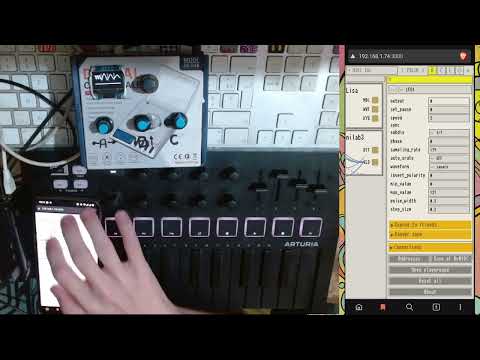
Features
Features inherited from VIJA:
- 40+ Oscillator Engines: Includes VA, FM, Additive, Wavetable, Physical Modeling and Drums.
- 4-Voices Polyphony: Per-sample AR (Attack-Release) envelopes.
- OLED Interface: Real-time feedback with a menu system and a oscilloscope.
- Modulation: 2 pots, CV input and midi cc.
- Internal Filter: Integrated State Variable Filter (SVF) with Low-Pass and Resonance.
- Dual MIDI: Support for both USB MIDI and classic UART MIDI.
Features added in LISA:
- Up to 6 Voices Polyphony at 44100 sampling rate, to 8 voices at 32000 sampling rate (depending on the engine, some will handle only 5 or 7 properly).
- New LIVE engine: Live Dynamic Wavetable stream wavetables directly from Nallely or any environement that can stream pitchwheel data on different channels. This allows you to shape in real-time the wavetables that are played by the LIVE engine (played while streamed), with bilinear (vector synthesis-like) interpolation.
- Envelope Adaptation Envelope attack/release can go from nothing to quite long (up to 5s)
- New internal parameters exposed Gain, FM slew (slew between FM jumps if FM is modulated)
- MIDI Controller Support to send MIDI controls via USB.
- MIDI Controller extended configuration Allows to either repeat the value set by the buttons, or to only send values without interacting with the synth part.
- Advanced configuration Access all synth parameter configuration and more with the physical buttons.
- Multiple MIDI/Physical button interaction Support for 2 different modes of interaction between arriving MIDI messages and manually touching the knobs, configurable by knob:
raw mode: the button and the MIDI CC value fights to make their value prioritary (first arrived first served).catch-up mode: the button stays "innactive" until the moment it reaches the value set by the MIDI CC value.
- Kinetic Controls Support for a "friction" and "elasticity" on buttons to send MIDI values that oscillate and damp themselves when huge movements are operated.
- Attenuator Mode Select the min, center, max of a range with the buttons, restricting the range of values that will be received by MIDI. MIDI CC value targetting a button is then scaled on this new range, allowing for finer grain definition (planned).
- Nallely deep integration Send/receive messages via websocket to a running Nallely session to route the signal to whatever target you want with float precision in the message sent/received (planned).
Menu System & UI
The synthesizer operates in two primary display modes:
- ENGINE SELECT + SETTINGS::
- ENGINE SELECT Rotate the encoder to scroll through engines
- SETTINGS: Click the encoder button to cycle through parameters
- VOLUME: Global gain control
- A/R ENVELOPES: Adjust the "snappiness" (Attack) or "fade" (Release) of notes
- FILTER: Enable/Disable the Filter
- CV: CV modulation mode
- MIDI: Enable MIDI CC and disable CV
- MIDI CH: Set the input channel (1-16)
- OSCILLOSCOPE Toggle: On / Off
- SAVE SETTINGS: Long press button to save menu settings
- EXIT MENU
- OSCILLOSCOPE: Automatically engages after 10 seconds to visualize the current waveform
There is 2 additional displays which are accessible with a double press of the encoder:
- ALL PARAMETERS display (double press from the OSCILLOSCOPE display): that brings you to a page with all the parameter of the synth and a quick access to modify them.
- Rotate the encoder to select a parameter row. Each parameter row is automatically mapped on A, B, C, representing the 3 main pots of LISA.
- Click the encoder to activate the modification on the row *.
- Rotate A, B or C to set the desired parameter level.
- Rotate the encoder again to pass to another row (no need to press again, but you can if you want to).
- Double press the encoder to come back to the OSCILLOSCOPE display.
- [ENGINE SELECT] When on the name of the synth engine
- Press the encoder to pass in engine select mode.
- Rotate the encoder to select your engine.
- Press the encoder again to go back to the row selection.
- GLOBAL SETTINGS display (double press from the ENGINE SELECT or SETTINGS display): that brings you to the general synth settings where you can configure the behavior of some buttons (type of conflict resolution between pots and MIDI messages, etc).
- Rotate the encoder to select a parameter row:
paramis the synth parameter to edit.ALLrepresents modifications that are applied to all parameters. If a single parameter is selected, this parameter will be impacted by the other rows, but not all the parameters.resolis the resolution policy on arriving messages. By defaultcatchupis selected, can be set toraw.modeis the mode for the parameter, it can bekineticornormal(default isnormal).- Press the encoder to modify the selected parameter.
- Double press the encoder to come back to the SETTINGS of the engine.
- [KINETIC MODE] When
kineticmode is activated, 3 new parameters appears in the bottom on the screen. Those parameters are automatically mapped to the 3 potentiometers and represent:
mas: the mass of the potentiometer cursor (going towards 100% means higher amplitude oscillation),dmp: the damping of the damping factor of the sprint (going towards 100% damps the oscillation),stf: the stiffness of the spring (going towards 100% oscillation become like a pendulum, almost LFO),
* At this point, if you are in CATCHUP resolution mode (default mode), the levels will stay put until you move the related pot close from the parameter recorded value.
* At this point, if you are in RAW resolution mode, the levels will adujst with the values of the pots! Use this feature to quickly prepare new values for your row and jump to the values when pressing the encoder.
Filter Mode (Default)
- Timbre & Color (default)
- CV1 & CV2 → Filter cutoff & resonance
CV Modulation Mode1
- Timbre & Color modulation
- POTS → modulation depth
- CV1 & CV2 → Modulation source
CV Modulation Mode2
- CV1 → Engine selection
- CV2 → FM MOD
MIDI Modulation Mode
-
Timbre & Color (Soft takeover mode)
Align coresponding MIDI CC value with Timbre or Color pot value to release or vice versa (screen indicator)
-
CV1 & CV2 → Free for future functions
All Modes OFF
- Timbre & Color (default)
MIDI Implementation (CC Chart)
LISA responds to the following Control Change (CC) messages on the selected MIDI Channel:
| CC # | Parameter |
|---|---|
| 7 | Master Volume |
| 8 | Engine Select |
| 9 | Timbre |
| 10 | Color |
| 11 | Envelope Attack |
| 12 | Envelope Release |
| 15 | FM Modulation |
| 16 | Timbre Modulation Amount |
| 17 | Color Modulation Amount |
| 18 | FM slew |
| 64 | Sustain (Hold notes) |
| 71 | Filter Resonance |
| 74 | Filter Cutoff |
| 75 | Filter Type |
| 100 | b1 (send CC only) |
| 101 | b2 (send CC only) |
| 102 | b3 (send CC only) |
| 103 | b4 (send CC only) |
| 104 | b5 (send CC only) |
| 116 | Activates the double buffering default false (**) |
| 117 | Reset all wavetables to 0 (**) |
| 118 | Reset write index on all wavetables (**) |
| 119 | Freezes wavetable 1 (**) |
| 120 | Freezes wavetable 2 (**) |
| 121 | Freezes wavetable 3 (**) |
| 122 | Freezes wavetable 4 (**) |
| 123 | Freezes all the wavetables (**) |
| 124 | Retrigger (reset phase on strike) (**) |
| 125 | Add an offset to the phase (**) |
| 126 | Reset the watetable phase (**) |
| pitchweel channel 1 | Streams a waveform for wavetetable 1 (**) |
| pitchweel channel 2 | Streams a waveform for wavetetable 2 (**) |
| pitchweel channel 3 | Streams a waveform for wavetetable 3 (**) |
| pitchweel channel 4 | Streams a waveform for wavetetable 4 (**) |
| 127 | Reset USB to upload from IDE (WARNING: for dev mode)* |
CC#100-104 are sent by the button B or C depending on the row you are located in the ALL PARAMETERS mode. They are sent CCs that are here mainly to provide extra actions to LISA used as a MIDI controller in general, and can achieve internal rewiring if used with Nallely.
In Nallely, you can remap each parameter b1 to b5 to any port of Nallely session, and you can reroute them also on other LISA's parameters (you can map b1 on the cutoff for example).
* Note: in dev mode, CC#127 have 2 specific values it can use:
- 127 -> resets the USB stack and sets the device in "receiving" mode to flash another firmware
- 126 -> resets LISA (app reset)
** Note: those CCs are only used by the live wavetable engine (LIVE).
Software Setup
- Arduino IDE: Install the Earle Philhower Pico Core
- Libraries:
- arduinoMI project (ported Mutable Instruments libraries)
- I2S
- Adafruit TinyUSB
- Adafruit SSD1306 or SH110X display
- LittleFS & ArduinoJson for saving settings
- Compilation Settings:
- Enable flash file system for saving menu settings:
Flash size: "2MB (Sketch:1984KB, FS:64KB)" - Enable USB Stack: Adafruit TinyUSB
- RP2040: - Optimize: Fast (-O3)
- CPU Speed: 200-240mhz (Overclock) depending on the sample rate and needed voice count
- Sample rate: 32000 (up to 8 voices depending on the engine) / 44100 (up to 6 voices depending on the engine)
- RP2350: - Optimize: Fast (-Ofast)
- Sample rate: 48000
Quick deployment and testing using Nallely
If you have Nallely installed as a library somewhere on your system (i.e: accessible from Python when doing import nallely) and arduino-cli installed and configured properly (i.e: configuration pointing to the shared folder where all the third-party libraries are located), you can use the Makefile to have a quick update or dev workflow:
make           # builds the firmware in `build`
make upload    # builds the firmware if necessary and uploads it to your LISA synth
make fulltest  # builds the firmware if necessary, uploads it to your LISA synth and runs the tests (interactive audio test)
make test      # runs the all the defined tests
make testX     # runs the test X (e.g: "make test3" runs the test3)
Schematic & Wiring
For this project I use RP2040 Zero model, so adjust GPIO numbers for your board.
1. Audio Output (I2S DAC)
Connect your PCM5102 or similar I2S DAC:
- VCC/VIN -> Pico 3.3V (Pin 36)
- GND -> Pico GND
- LCK (LRCK) -> Pico GP11
- BCK (BCLK) -> Pico GP10
- DIN (DATA) -> Pico GP9
2. Control & Display
- OLED SDA -> Pico GP0
- OLED SCL -> Pico GP1
- Encoder CLK -> Pico GP2
- Encoder DT -> Pico GP3
- Encoder SW -> Pico GP4
3. Potentiometers (ADC)
Connect the outer pins to 3.3V and GND, and the center wiper to:
- Pot 1 (Timbre) -> GP26
- Pot 2 (Color) -> GP27
- Pot 3 (CV1) -> GP28
- Pot 4 (CV2) -> GP29 (Raspberry Pico & Pico W don't have GP29!)
4. MIDI Input (UART)
Connect your MIDI Jack via a 6N138 optocoupler circuit to GP13.
License
This project is licensed under the GNU General Public License v3.0 (GPLv3).
Copyright
- Original work (VIJA synthesizer v1.0.2) Copyright (c) 2025 Vadims Maksimovs
- Modifications and additional features (LISA) Copyright (c) 2026 Dr Schlange
All modifications and newly added features are original work by Dr Schlange and are distributed under the GNU GPLv3 as part of this derivative project.
Third-Party Components
This project depends on the following external components:
- Mutable Instruments Braids / stmlib
Copyright (c) 2020 Emilie Gillet
Licensed under the MIT License - Braids port for Raspberry Pico
Copyright (c) 2025 Mark Washeim
Licensed under the MIT License
These components are not distributed as part of this repository. They are separate projects, each licensed under their respective terms.
Attribution
LISA is a hard fork of the VIJA synthesizer v1.0.2, originally created by Vadims Maksimovs. This project is an independent fork and is not affiliated with or endorsed by the original authors.
Version history
- 2026-05-02 - LISA v0.0.1 first version with LIVE engine
- 2026-03-24 - LISA v0.0.0 hard-fork from VIJA
- 2026-02-26 - VIJA v1.0.2
- 2026-02-03 - VIJA v1.0.1
- 2026-02-02 - VIJA First release v1.0