


惯性聚合 高效追踪和阅读你感兴趣的博客、新闻、科技资讯
阅读原文 在惯性聚合中打开

推荐订阅源

Security Latest
Security Latest
T
The Exploit Database - CXSecurity.com
Threat Intelligence Blog | Flashpoint
T
Tor Project blog
Help Net Security
Help Net Security
PCI Perspectives
PCI Perspectives
T
The Blog of Author Tim Ferriss
H
Heimdal Security Blog
The Register - Security
Schneier on Security
宝玉的分享
宝玉的分享
Google DeepMind News
人人都是产品经理
人人都是产品经理
cs.AI updates on arXiv.org
C
CERT Recently Published Vulnerability Notes
L
LangChain Blog
Security Archives - TechRepublic
MongoDB | Blog
MongoDB | Blog
美团技术团队
S
Security @ Cisco Blogs
Cloudbric
Cloudbric
Cisco Talos Blog
Cisco Talos Blog
C
Cybersecurity and Infrastructure Security Agency CISA
月光博客
月光博客
B
Blog RSS Feed
Cyberwarzone
Cyberwarzone
U
Unit 42
AWS News Blog
AWS News Blog
F
Fortinet All Blogs
L
LINUX DO - 最新话题
GbyAI
GbyAI
T
Threat Research - Cisco Blogs
cs.CV updates on arXiv.org
A
About on SuperTechFans
Hugging Face - Blog
Hugging Face - Blog
Attack and Defense Labs
Engineering at Meta
Engineering at Meta
MyScale Blog
MyScale Blog
Hacker News - Newest:
Hacker News - Newest: "LLM"
V2EX - 技术
V2EX - 技术
Y
Y Combinator Blog
T
Tailwind CSS Blog
酷 壳 – CoolShell
酷 壳 – CoolShell
Recorded Future
Recorded Future
TaoSecurity Blog
TaoSecurity Blog
博客园_首页
C
CXSECURITY Database RSS Feed - CXSecurity.com
M
MIT News - Artificial intelligence
K
KPMG report finds enterprise disconnect between AI and its ROI | CIO
H
Hacker News: Front Page

Hacker News: Show HN

PurrrrrFocus: Pomodoro Timer App - App Store Workflow Engine — Multi-Step Orchestration for Bun RapidPhoto: Pro Photo Editor App - App Store GitHub - DheerG/swarms: Achieve extraordinary results with claude code across a variety of tasks SPICE simulation → oscilloscope → verification with Claude Code — Lucas Gerads Show HN: VCoding – A 5 MB native Windows IDE with no dynamic dependencies Show HN: LLMs don't hallucinate because they're bad at math, it's the format GitHub - Agent-FM/agentfm-core: AgentFM is a peer-to-peer network that turns everyday computers into a decentralized AI supercomputer. AgentFM lets you run massive AI workloads directly across a global mesh of idle CPUs and GPUs. Show HN: Tracking Top US Science Olympiad Alumni over Last 25 Years GitHub - Potarix/agent-hub: One place to talk to all your agents Show HN: Runtime security for AI agents(injection,tool abuse, data exfiltration) GitHub - dubeyKartikay/lazyspotify: Terminal Spotify client for macOS and Linux GitHub - the-banana-tool/king-louie: Easy to use GUI Personal AI Assistant. Win/Linux/Mac. Show HN I made my vacation rental bookable by AI agents–no Airbnb, 0% commission GitHub - basteez/jsf-autoreload: maven plugin to enable hot reload on jsf projects uvm32/hosts/host-gdbstub at main · ringtailsoftware/uvm32 GitHub - labsai/EDDI: Config-driven engine that turns JSON into production-grade AI agents. Multi-agent orchestration, 12+ LLM providers, MCP/A2A protocols, RAG, persistent memory, and enterprise compliance (EU AI Act, GDPR, HIPAA). Built on Quarkus. GitHub - glitchnsec/fortyone-oss: AI Executive Assistant Platform Quickstart | Alien GitHub - muxshed/shed: One stream in, or many. Every destination, simultaneously. No cloud middleman, no per-channel fees, no limits. GitHub - ocrbase-hq/ocrbase: 📄 PDF/IMG ->.MD/JSON Document OCR API for PaddleOCR and GLMOCR. Self-hostable. GitHub - impactjo/home-memory: MCP server that lets your AI assistant remember everything about your home. GitHub - Sets88/dbcls: DbCls is a powerful terminal database client that supports various databases GitHub - neptun2000/heor-agent-mcp GitHub - SeanFDZ/macmind: Single-layer transformer in HyperTalk for the classic Macintosh RollQuation: Math Puzzles - Apps on Google Play GitHub - dropbox/witchcraft Show HN: Agent-cache – Multi-tier LLM/tool/session caching for Valkey and Redis GitHub - opentalon/opentalon: OpenTalon is an open-source platform built from the ground up in Go as a robust alternative to OpenClaw LinkedIn™ 职位抓取工具 - Chrome 应用商店 GitHub - EdoardoBambini/Agent-Armor-Iaga: AI agents are getting tool access — shell, file system, databases, APIs, secrets. But **nobody is governing what they actually do with it**. Frameworks like LangChain, CrewAI, AutoGen, and Claude Code give agents the power to execute. Agent Armor gives you the power to control, audit, and approve every single action before it happens. HN Vibes — Week 15, Apr 7–13 2026 GitHub - chojs23/ec: Easy terminal-native 3-way git mergetool vim-like workflow GitHub - SethPyle376/hiraeth: Local AWS emulator focused on fast integration testing, with SQS support, SQLite-backed state, and a debug-friendly web UI. GitHub - JakOb-dotcom/cloud-sandbox-security-analysis: Technical analysis and Proof of Concept (PoC) regarding environment variable exfiltration in containerized cloud sandboxes via side-channel data leaks. Springboards - Flint Alpha Show HN: A simpler coding agent harness GitHub - audiodude/sudomake-friends GitHub - 256thFission/mini-mythos: OSS clone of Anthropic’s Mythos harness to locate C/C++ memory vulnerabilities Show HN: OpenParallax: OS-level privilege separation for AI agent execution Hacker News Sorted - Chrome 应用商店 Show HN: How to Install Docker on Ubuntu 24.04 LTS: Complete 2026 Guide GitHub - himanshudongre/smriti GitHub - sverrirsig/claude-control: macOS desktop dashboard for monitoring and managing multiple Claude Code sessions GitHub - ory/dockertest: Write better integration tests! Dockertest helps you boot up ephermal docker images for your Go tests with minimal work. Chiral - Chrome 应用商店 Show HN: Two Claudes collaborating through shared memory on a $100 mini-PC GitHub - pmichaillat/latex-cv: Minimalist LaTeX template for academic CVs GitHub - oguzbilgic/posse: A web UI for Anthropic Managed Agents. GitHub - sshiraz/depsly: Dependency risk analysis tool for npm packages ABI Add safari/agent-harness — Safari browser automation via safari-mcp by achiya-automation · Pull Request #212 · HKUDS/CLI-Anything GitHub - Halfblood-Prince/trustcheck: Verify PyPI package attestations and improve Python supply-chain security GitHub - oguzbilgic/kern-ai: Agents that do the work and show it. GitHub - bruits/satteri: High-performance Markdown and MDX processing for the JavaScript ecosystem GitHub - tylergibbs1/feedstock: High-performance web crawler and scraper for TypeScript, powered by Bun and Playwright GitHub - Grimm67123/grimmbot: The self-improving sandboxed and open-source AI agent. With persistent memory and scheduling. GitHub - whitevanillaskies/whitebloom: Local whiteboard that blooms. GitHub - hwdsl2/docker-whisper: Docker image for a self-hosted Whisper speech-to-text server with speaker diarization and OpenAI-compatible transcription and translation APIs. Powered by faster-whisper. Supports all Whisper models, NVIDIA GPU (CUDA) acceleration, JSON/SRT/VTT output, SSE streaming, offline mode, and multi-arch (amd64, arm64). GitHub - yisding/reviewwiggum GitHub - MarwanAlsoltany/serrors: Structured errors for Go: sentinel hierarchies, typed data, custom formatting, and slog integration. GitHub - soatok/age-php GitHub - Luthiraa/markitme GitHub - stagas/rtdiff: realtime git diff gui and AI-assisted commits GitHub - tombedor/excalicharts GitHub - wh1le/excalidraw-edit: Open and edit .excalidraw files from the terminal. Offline, auto-saves to disk. MalExt Sentry - Malicious Extension Scanner - Chrome 应用商店 GitHub - syi0808/asciianimesvg: Generate animated ASCII art SVGs from text. CLI, Rust library, WASM, and web editor. GitHub - zaina-ml/ml_forge: A visual-based graph node editor for training computer vision models. GitHub - anakin87/llm-rl-environments-lil-course: 🌱 A little course on Reinforcement Learning Environments for evaluating and training Language Models GitHub - takaakit/superpowers-uml: Superpowers-UML modifies Superpowers to ensure a software development workflow in which AI agents design through UML modeling. AdriByte Studio - Sviluppo Web e Soluzioni Digitali GitHub - chouligi/angel-copilot: Your personalized Angel Investment Advisor Show HN: MoodSense AI (ML and FastAPI and Gradio, Deployed on Hugging Face) Moodsense Ai - a Hugging Face Space by aman179102 GitHub - agenteractai/lodmem: Level Of Detail Context Management for Agents GitHub - ostefani/subnetlens: A fast, concurrent network scanner with a TUI and plain-text CLI, built in Go. It discovers live hosts on your network, scans their open ports, resolves hostnames, and fingerprints operating systems—delivered. Cyber Pulse: Agentic Intel - Apps on Google Play Whisper API: Self-Hostable Speech to Text Transcription The Agent-Web Protocol Stack: A Research Thesis GitHub - msmarkgu/RelayFreeLLM: A restful API designed to route user prompts to various AI model providers. Show HN: Provepy – A Python decorator that proves your code using Lean and LLMs Show HN: Pardonned.com – A searchable database of US Pardons GitHub - patrickdappollonio/dux: Dux is a terminal UI that lets you run multiple AI coding agents side by side, each in its own git worktree, with full companion terminals, macros, commit generation, and a command palette that knows more tricks than you do. kMC Crystal Simulator Show HN: HyperFlow – A self-improving agent framework built on LangGraph GitHub - stef41/vibescore: 🎵 Grade your vibe-coded project. One command, instant letter grade across security, quality, dependencies, and testing. GitHub - stef41/lmscan: 🔍 Detect AI-generated text and fingerprint which LLM wrote it. Open-source GPTZero alternative. Zero dependencies, works offline. imgur.com GitHub - visionscaper/collabmem: Enabling long-term collaboration with Agentic AI - building up episodic and world model memory over time with in-context awareness 在 Steam 上购买 FriedrichAI: Offline AI 立省 10% GitHub - atripati/ark: AI Runtime Kernel — a context operating system for AI agents. Eliminates tool bloat, loads only what’s needed, and gives LLMs their reasoning space back. GitHub - nowork-studio/toprank: Open-source Claude Code skills for SEO, SEM, Google Ads GitHub - tacomanator/sash: Lightweight macOS menu bar app for reliably cycling through windows of the current application. Appents | Social Media Management for Product-First Teams GitHub - pnhoang/youtube-spam-blocker: Automatically detects and hides spam messages in YouTube Live chat. Set rate limits, keyword filters, and block repeat offenders. GitHub - decisionnode/DecisionNode: CLI + Local MCP - A shared structured memory store across Claude Code, Cursor, Windsurf, Antigravity, and every MCP client. Semantically queryable. GitHub - AvaCodeSolutions/django-email-learning: An open source Django app for creating email-based learning platforms with IMAP integration and React frontend components. The $100K Gap in Kubernetes Security Tooling Function Calling Harness: From 6.75% to 100%
GitHub - davet47/heddle
davet47 · 2026-06-24 · via Hacker News: Show HN

CI

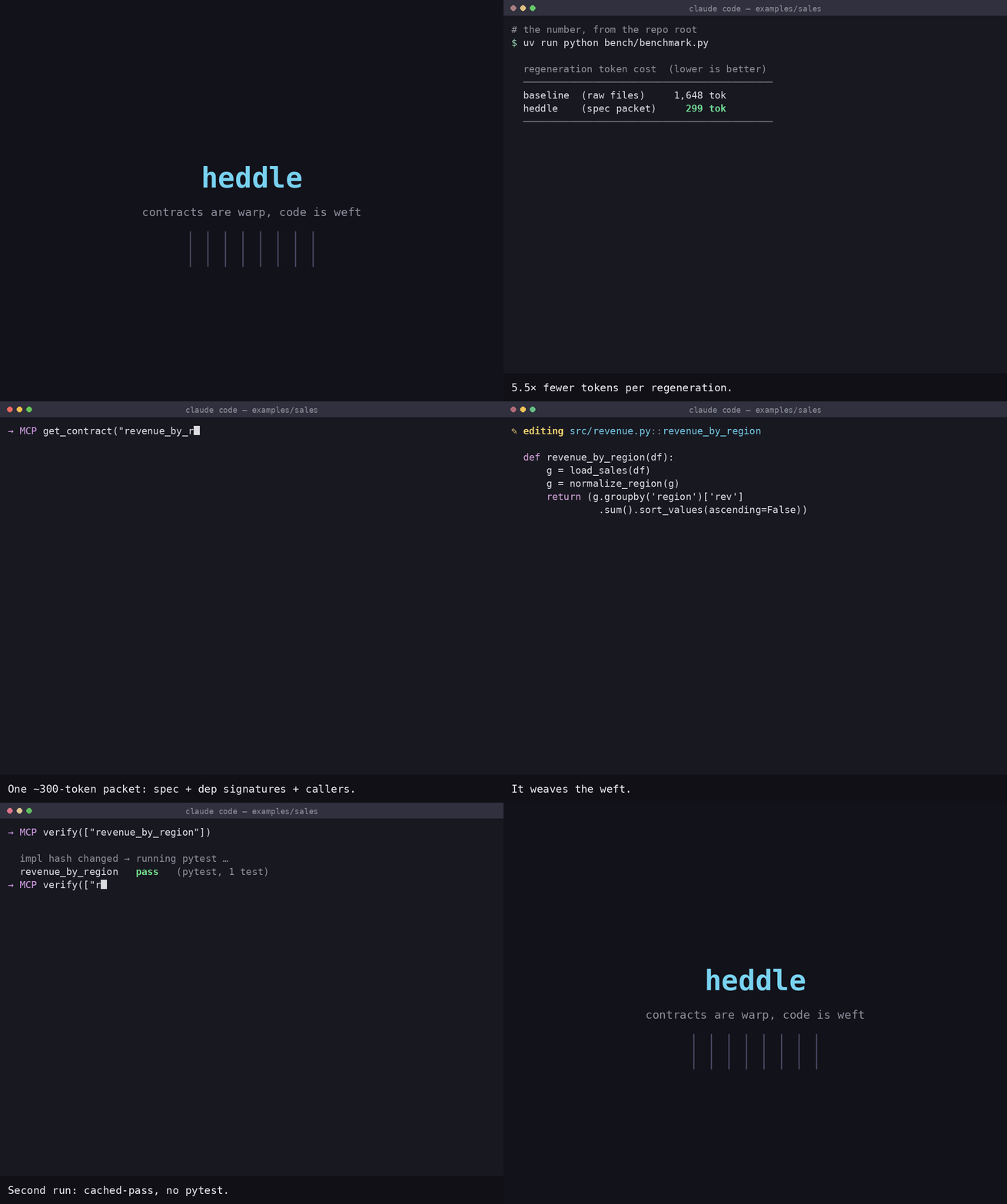
heddle regenerating a unit: one ~300-token context packet plus a cached verification, instead of re-reading whole files

Heddle treats software units as content-addressed contracts rather than files. An MCP server that makes agent regeneration loops cheap.

Because contracts are content-addressed and dependency-aware, agents reuse verification, compute blast radius precisely, and regenerate code from a few hundred tokens of context instead of re-reading whole files. Build systems ask which files changed. Heddle asks which software obligations changed.

The heddle is the part of a loom that holds the warp threads, the fixed, durable strands, while the shuttle weaves disposable weft through them. Contracts are warp. Code is weft.

The problem

Agents repeatedly pay to rediscover software structure. Spec-driven development tools made specs the durable artifact and code regenerable, but they run on plain files, so every regeneration loop re-derives what the project already knows:

  1. Context acquisition is expensive. Regenerating one unit means re-reading whole spec and source files: thousands of tokens to learn what a few hundred convey.
  2. Verification is uncached. Every regeneration re-runs (and re-reads the output of) the full relevant test surface, even for units whose contracts haven't changed.
  3. Blast radius is by convention, not mechanism. When a spec changes, nothing tells the agent precisely which dependents are invalidated.

The model

Heddle treats each software unit as a content-addressed contract with explicit dependencies, not a file. A contract is a small YAML spec (signature, invariants, examples, dependency names); the implementation behind it is regenerable weft. Because every contract is hashed and its dependencies are named, the structure an agent keeps re-deriving from files becomes something heddle computes once and serves.

Outcomes

The model buys three things, all mechanical:

  • Verification caching. A green test result is keyed on the contract, implementation, and dependency hashes, and served from cache until one of them changes. pytest runs only on a real miss.
  • Mechanical blast radius. A contract change reports the exact set of invalidated dependents, transitively and by hash, not by convention.
  • Tiny context packets. An agent regenerating a unit gets the contract, its dependencies' signatures, and its callers as one packet of a few hundred tokens, instead of the whole file closure.

The number

Same three regeneration tasks on a 20-contract sample project, once with raw file reads, once through heddle (tiktoken cl100k, reproduce with uv run python bench/benchmark.py):

task raw files heddle reduction
revenue_by_region 1,925 371 5.2x
top_customers 2,137 334 6.4x
revenue_by_category 1,942 392 5.0x
total 6,004 1,097 5.5x

Raw mode counts what a file-based agent reads per task: the unit's spec file, every transitive dep's spec file, every source module in the dep closure, the unit's test file, and the output of running the suite. It is deliberately generous to the baseline: it assumes the agent already knows the exact dependency closure, which is precisely the thing heddle computes for you.

Quickstart

pip install heddle-mcp
# or from source: pip install "git+https://github.com/davet47/heddle"

cd your-project
heddle init                 # creates .heddle/ and contracts/
heddle index                # builds the store from contracts/

Point Claude Code at it:

claude mcp add heddle -- heddle serve

(Stdio transport; the server resolves the project by walking up from its working directory to the nearest .heddle/.)

Contracts

One YAML file per unit in contracts/. Minimal, hand-writable, hashable:

name: revenue_by_region
signature: "(sales: list[Sale]) -> dict[Region, float]"
deps: [Sale, Region]            # other contract names
invariants:
  - excludes sales where completed is false
  - excludes sales with null amount
examples:
  - in:  "[Sale(region='QLD', amount=10, completed=True)]"
    out: "{'QLD': 10.0}"
tests: [tests/test_revenue.py::test_revenue_by_region]   # pytest node IDs
impl: src/revenue.py::revenue_by_region                  # current woven weft

Subdirectories are namespaces: contracts/billing/invoice.yaml is the contract billing/invoice, so the same short name can live in different folders. A contract's name must match its path under contracts/.

When to write a contract

A contract belongs on a stable seam: an interface other units depend on and that you expect to outlive its current implementation. The implementation behind it is disposable weft, regenerated freely. Dropping a contract where it does not earn that place is correct use, not a failure. The failure mode is the opposite, over-pinning interiors you would happily rewrite, which turns the durable layer into busywork.

Contracts are reviewed artifacts. Authoring one is cheap and getting cheaper, so the real cost is reviewing it, not writing it. A wrong contract is worse than no contract, because the durable artifact now lies: agents will regenerate code to satisfy a spec that is itself incorrect. Review a contract the way you review an interface, not the way you skim generated code.

Hashing semantics

  • Contract hash: sha256 over a canonical form: keys sorted, whitespace normalised, comments stripped, invariant and example order preserved, dep order ignored. impl and tests are excluded, so relocating files never invalidates. Invariants are free text and live inside this hash, so rewording one without changing its meaning still moves the contract hash and re-verifies every dependent. Behaviour-equivalent prose edits are not free yet (see Roadmap).
  • Impl hash: sha256 over the normalised AST of the implementation, so reformatting and comment edits never bust the cache. Docstrings are stripped too.
  • Verification key: (contract hash, impl hash, transitive dep contract hashes). Heddle caches verification results, not correctness: a cached green result is served iff the full key matches, and an edit to any contract in the closure forces a re-run. Failures are never served from cache. Two caveats are worth knowing. A cached pass assumes deterministic tests, so a green result that depended on wall-clock time, network, or randomness can outlive the condition that made it pass. And test source is not yet part of the key, so editing a test body without touching the contract or impl does not by itself force a re-run (see Roadmap).

MCP tools (the entire surface)

tool does
get_contract the ~300-token context packet: contract + hash + one-line dep signatures + caller list
put_contract validate, write contracts/<name>.yaml, return new hash + every invalidated dependent
get_dependents blast-radius query, direct or transitive, names + hashes
verify per-unit cached-pass / pass / fail; runs pytest only on cache misses; failures come back as a ≤40-token assertion summary, never a traceback
status dirty contracts, stale verifications, cache hit-rate, resolved verify interpreter, cumulative token counters

Every tool returns structured errors — {"error": {"code": "unknown_dep", "message": "'Regoin' not found — nearest: 'Region'"}} — never a stack trace.

The verify interpreter

verify runs your tests with the project's own python, resolved in order: heddle serve --python PATH.heddle/config.json ({"python": "..."}) → an auto-detected <project>/.venv → the interpreter running heddle. So a globally-installed heddle can verify a project against its own virtualenv without being installed into it; heddle status shows which interpreter it resolved.

.heddle/config.json also takes verify_timeout (seconds per pytest run, default 300) for suites that need longer than the default, and pycache_trust (default true); set pycache_trust: false — or pass --no-pycache-trust — to clear the project's __pycache__ before each verify run, so a stale .pyc can never shadow the current source.

CLI

heddle init · heddle index · heddle serve · heddle status · heddle verify. The sqlite store under .heddle/ is derived state: delete it any time and heddle index rebuilds it from contracts/.

heddle verify <name>… runs the same cached verification as the MCP tool from the command line and exits nonzero if any unit fails — drop it in CI or a pre-commit hook.

Try the sample project

cd examples/sales
heddle init && heddle index && heddle serve   # then point your agent at it

20 contracts, 25 tests, three dependency layers deep.

Development

uv sync
uv run pytest             # full suite; hash stability is the load-bearing suite
uv run python bench/benchmark.py

Python-only and single-process by design for v0.1. Everything not in this README is an issue.

License

Apache 2.0